The Olympians’ second cosmic war, won only when a mortal joined the gods.
- Gaia
- Giants
- Heracles
- Olympians
- Order and Chaos
- Gaia’s AngerThe treatment of the Titans provokes a new challenge.
- Giants RiseEarth-born warriors attack the Olympian order.
- Mortal Aid RequiredAn oracle declares that gods cannot win alone.
- Heracles JoinsThe mortal hero completes the gods’ attacks.
- Olympian VictoryThe Giants fall and the divine settlement endures.
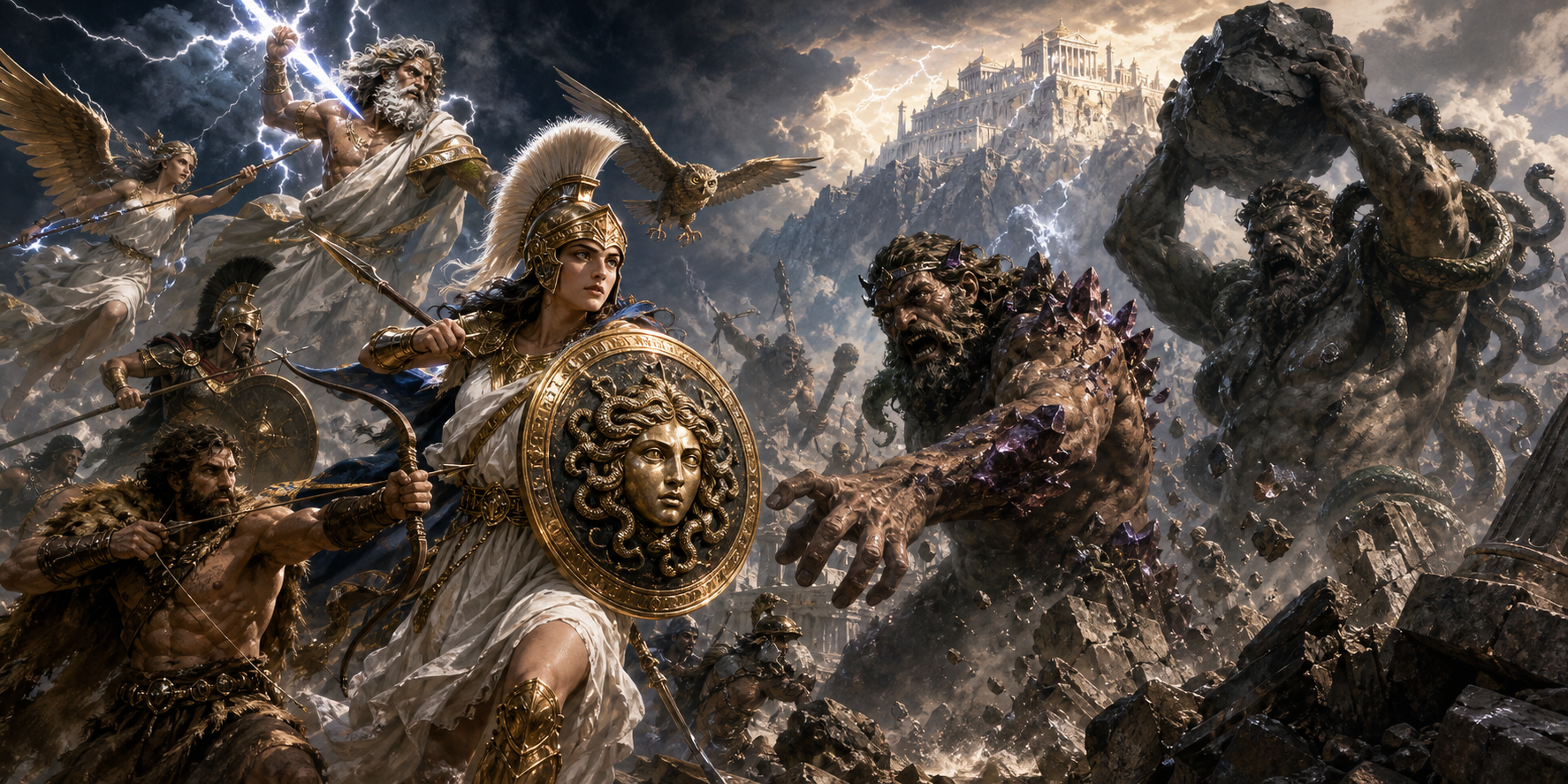
The Gigantomachy was the war between the Olympian gods and the earth-born Giants, distinct from the earlier Titanomachy. Gaia raised the challenge after the Titans’ defeat, while prophecy required mortal aid for victory. Heracles fought beside Zeus and Athena, making cooperation between god and mortal the key to Olympus’s survival.
The Titans had fallen, but the victory of Olympus did not end resistance to Zeus. From the earth itself came another challenge: Giants born for war, gods forced back into battle, and an oracle declaring that immortality alone would not be enough. The new order would survive only if it accepted help from a mortal.
A Different War from the Titanomachy
The Gigantomachy and Titanomachy are often confused because both place Olympian gods in a cosmic struggle. They are not the same event. The Titanomachy is the war between Zeus’s generation and the Titans led by Cronus. The Gigantomachy is a later conflict between the Olympians and the Giants, earth-born opponents associated especially with Gaia.
The distinction changes the story’s meaning. The first war establishes Olympian rule. The second tests whether that rule can endure. Why does conflict return after the cosmos has supposedly been settled? Greek myth answers by showing that victory creates consequences, grievances, and new forms of resistance.
Gaia’s Renewed Defiance
In the mythographic account of Apollodorus, Gaia gives birth to the Giants because she is angered over the treatment of the Titans. They rise as beings of extraordinary size and strength, traditionally connected with the earth from which they come. Ancient art may give them human warrior bodies, while later works increasingly show serpent-like legs.
Gaia’s role should not be simplified into permanent evil. She has aided succession before, including the rise of Zeus, and she also resists the punishment of her children. Her shifting alliances express a deeper loyalty to the generations she bears. The Gigantomachy asks whether Olympian order can answer the pain left by its own victory.
The Oracle of Mortal Aid
The gods learn that no Giant can be destroyed by gods alone. A mortal ally is required. Zeus therefore brings Heracles into the conflict and acts to prevent Gaia from obtaining a plant that would make her children invulnerable to mortal attack.
This prophecy creates the event’s central discovery hook: why can immortals not win without a human being? Heracles does not replace divine power; he completes it. The boundary between god and mortal becomes an advantage when neither side can succeed within a purely divine contest.
Alcyoneus and the Ground of Power
Alcyoneus is among the greatest Giants. Apollodorus says he cannot die while fighting in the land of his birth. Heracles first shoots him, then, on Athena’s advice, drags him beyond that boundary. The victory depends on understanding the condition of the Giant’s strength rather than simply striking harder.
The episode turns geography into fate. Earth-born power is not abstract; it is anchored to place. Follow Alcyoneus and the reader encounters a form of invulnerability that can be defeated only by crossing a line.
Porphyrion, Zeus, and Hera
Porphyrion stands beside Alcyoneus as a leading opponent. During his attack on Heracles and Hera, Zeus turns his desire toward Hera; when Porphyrion tears at her clothing, Zeus strikes him with lightning and Heracles finishes him with an arrow. The account is violent and shaped by ancient assumptions about divine conflict, but its tactical pattern is clear.
Again, god and mortal act together. Zeus’s Thunderbolt is decisive but not sufficient under the oracle’s rule. Heracles supplies the mortal blow that completes the defeat.
Athena and the Aegis
Athena is one of the most prominent divine fighters in literary and artistic Gigantomachies. She advises Heracles, overwhelms Enceladus in one tradition, and defeats Pallas in the mythographic account. On temple sculpture and painted pottery, her controlled advance often stands against the collapsing movement of the Giants.
The Aegis gives that role a visible center. Its Gorgoneion unites protection with terror, turning the dangerous face outward against the attackers. Is the Aegis armor, emblem, or weapon? In this battle it is all three at once: defense for Athena, a sign of Zeus’s authority, and a sight that declares the Olympian line will hold.
How the Giants Fall
Apollodorus lists many pairings: Apollo confronts Ephialtes, Dionysus strikes Eurytus, Hecate attacks Clytius, Hephaestus uses heated metal, and the Fates fight with bronze clubs. Heracles supplies arrows against wounded Giants so the oracle can be fulfilled. Other sources and artworks vary the names and matchups.
A complete fixed roster should therefore be treated cautiously. The stable pattern is collective: Olympian powers act according to their identities, while Heracles repeatedly converts divine victory into a final, mortal conclusion.
Order and Chaos in Ancient Art
The Gigantomachy became one of the great subjects of Greek art. Vase painters, temple sculptors, and later Hellenistic artists used the crowded battle to explore bodies in motion and the restoration of order. The Great Altar at Pergamon made the struggle monumental, surrounding viewers with gods and Giants in violent contact.
Calling the scene order against chaos captures an ancient visual theme, but it should not erase Gaia’s grievance or turn every Giant into meaningless disorder. The myth gains depth when the Olympian victory is seen as both necessary to its own world and born from unresolved family conflict.
What Victory Proves
The gods prevail, but the manner of victory changes the image of Olympus. Divine authority proves strongest when it can recognize a needed ally outside itself. Heracles, not yet an immortal in the usual chronology of these stories, becomes indispensable to the survival of the divine regime.
The event leaves several paths open. Gaia leads back toward the buried costs of the Titanomachy. Athena and the Aegis reveal how protection can become offensive power. Alcyoneus and Porphyrion give individual faces to the earth-born challenge. Mount Olympus shows what was being defended. The war ends, but its network keeps the questions alive.
That network is the event’s final legacy: victory belongs neither to isolated gods nor to a lone hero, but to cooperation across the boundary between immortal and mortal.
Trivia
- Ancient artists did not always give Giants serpent legs; early representations often show them as fully human-shaped warriors.
- Heracles is frequently identified in Gigantomachy art by his lion skin and bow.
- The Pergamon Altar’s Gigantomachy is among the most famous surviving monumental versions of the subject.