The sacred contests where athletic victory carries the memory of a child's funeral and a hero's first labor.
- Heracles
- Nemea
- Opheltes
- Seven against Thebes
- Wild Celery
- Zeus
- Opheltes DiesThe infant is killed by a serpent while Hypsipyle guides the Seven to water.
- Funeral GamesThe Seven honor Archemorus with contests in the foundation tradition.
- Heraclean RenewalA competing tradition connects the festival with the defeated Nemean Lion.
- Historical FestivalOrganized Panhellenic competition is visible from the sixth century BCE.
- Nemea and ArgosPolitical change moves the games between the sanctuary valley and Argos.
The Nemean Games were a major Panhellenic festival associated with Zeus at Nemea. Foundation myths connect them with funeral games for Opheltes and with Heracles after the Nemean Lion, while historical contests began in the sixth century BCE and later moved between Nemea and Argos.
Greek Mythology Timeline
Move through broad mythic ages and open the events that connect one story to the next. The sequence is a reading path, not an exact historical calendar.
The Nemean Games were one of the four great Panhellenic athletic festivals, held in the valley associated with Nemean Zeus, Heracles’s lion, and the death of the infant Opheltes. Myth gives the festival more than one beginning. The Seven against Thebes establish funeral contests for the child renamed Archemorus, while another tradition credits Heracles after the first labor. Historical competition emerges in the sixth century BCE and later moves between Nemea and Argos, binding mythic memory to changing civic control.
A Panhellenic Festival
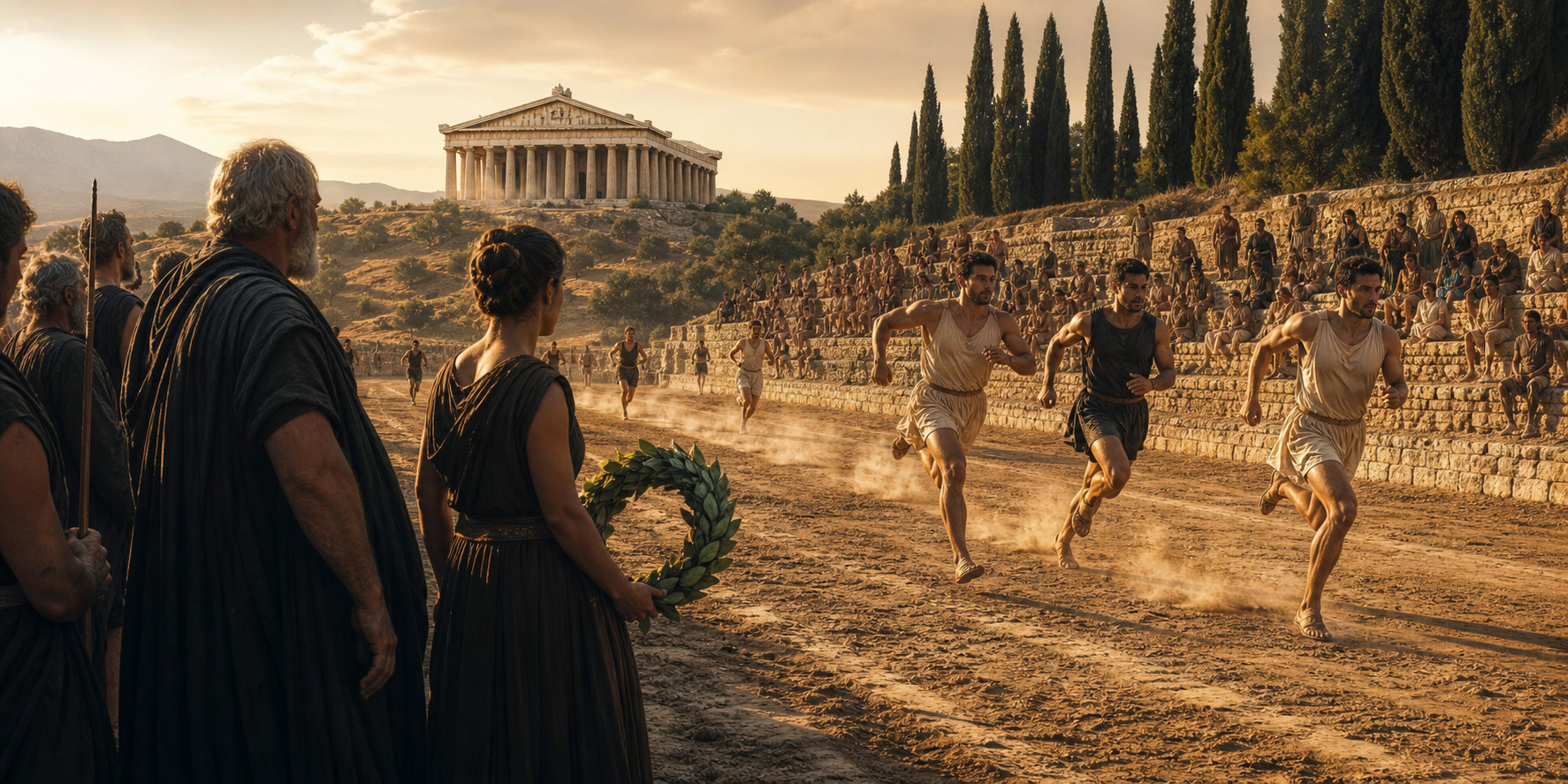
Together with the Olympic, Pythian, and Isthmian Games, the Nemean Games drew competitors and spectators beyond one city. Victory carried prestige across the Greek world. The festival was celebrated on a recurring two-year rhythm in the ancient inclusive system of counting, filling the calendar between the larger four-year contests.
The games honored Zeus in their mature sanctuary setting, but their identity also carried funerary signs. Athletic excellence, divine worship, and remembrance of premature death were not separate themes. They met in the same valley and gave competition a solemn origin beneath its public glory.
Opheltes and Hypsipyle
In the best-known foundation myth, the Seven against Thebes pass through Nemea and ask Hypsipyle to show them water. She is caring for the infant Opheltes under a warning that he must not touch the ground before he can walk. She places him on wild vegetation while guiding the warriors.
A serpent kills the child in her absence. The Seven interpret the death as an omen for their expedition and rename him Archemorus, often understood as Beginning of Doom. They hold funeral games in his honor, turning a failed act of care and a terrible sign into recurring communal memory.
Wild Celery and Dark Robes
Tradition explains the victors’ wreath as wild celery, the plant associated with the child’s resting place and funeral remembrance. Judges wear dark robes in mourning. These customs make the founding story visible whenever a new athlete wins; the prize is living greenery marked by death rather than precious metal.
Origin stories for ritual details often develop over time, and sources do not preserve every practice in the same form. Yet the cluster is coherent: black clothing, cypress, a grave, and a perishable crown distinguish Nemea’s mood from a purely celebratory spectacle.
Heracles as Founder or Renewer
A second tradition connects the games with Heracles after he kills the Nemean Lion. The hero may found the contests, renew an older festival, or redirect it toward Zeus. This version makes the valley’s most famous labor the beginning of organized competition.
The Heraclean and Opheltes traditions need not be forced into a single event. Ancient communities often preserved multiple founders because each explained a different relationship: the Seven link Nemea to Argos and Theban war, while Heracles links it to the first labor and Zeus’s heroic son.
The Historical Beginning
Ancient written evidence places the historical foundation around 573 BCE, and archaeology broadly supports a sixth-century start for major organized competition. An early inscription records victories by Aristis of Cleonae, showing that local athletes and administrators mattered alongside Panhellenic claims.
Mythic beginnings and historical beginnings answer different questions. Opheltes explains ritual memory; Heracles explains heroic identity; inscriptions and buildings show when institutions become visible to archaeology. A careful account allows all three levels to stand without using one to disprove the others.
Competition in the Stadium
Events included foot races, wrestling, boxing, pankration, and the pentathlon, with equestrian contests also belonging to the festival tradition. Athletes competed for a wreath rather than money at the sanctuary, although victory could bring honors and rewards from their home cities.
Training, travel, rules, judges, and spectators made the games a large social system. The sacred truce associated with Panhellenic festivals supported movement, but competition also displayed civic rivalry. An individual body raced in Nemea while carrying the reputation of a wider community.
Nemea, Cleonae, Argos
Control of the sanctuary was not permanently fixed. Cleonae played an important early role, while Argos held increasing authority. After destruction during the Peloponnesian War, the festival continued at Argos. A major building program brought competition back to Nemea in the later fourth century BCE.
The return did not last forever. By the early third century BCE the games had moved again to Argos, and Pausanias later saw the Nemean sanctuary in ruin. These shifts show that a festival can keep its name and prestige while its actual venue changes.
Temple, Stadium, and Sacred Landscape
The later Temple of Zeus, stadium, bath, training spaces, and processional routes made the valley an architectural setting for temporary crowds. The stadium’s entrance tunnel transformed arrival into ritual movement, bringing athletes from preparation into public view.
Nearby memory of Opheltes and the cypress grove kept the foundation story embedded in the land. Nemea was therefore neither only a sports complex nor only a mythic place. Buildings, graves, water, roads, and vegetation joined to make competition sacred and locally rooted.
What the Nemean Games Mean
The festival turns loss into disciplined recurrence. Opheltes cannot be restored, but his name returns whenever athletes gather and wreaths are awarded. Heracles’s victory over the lion similarly becomes something others can reenact through exertion without repeating the monster fight.
Follow the games toward Nemea for the landscape, Zeus for the sanctuary, the Nemean Lion and Heracles for the heroic foundation, and the Seven against Thebes for the funeral tradition. Molorchus remains another local route for a later pack, preserving room for the valley’s quieter household story.
Trivia
- The traditional victor’s crown at Nemea was made from wild celery.
- The games moved between the sanctuary at Nemea and the city of Argos.
- Myth credits both the Seven against Thebes and Heracles with foundation or renewal.