The Argive campaign in which seven champions carry a family claim toward prophecy, Opheltes, and mutual ruin.
- Adrastus
- Amphiaraus
- Eteocles
- Nemean Games
- Opheltes
- Polynices
- Brothers DivideEteocles and Polynices contest the succession after Oedipus.
- Argive AlliancePolynices gains marriage, protection, and champions at Adrastus's court.
- Opheltes DiesThe Nemean stop creates the Beginning of Doom and funeral games.
- Seven GatesAttackers and defenders are paired through the city's architecture.
- Mutual DeathThe brothers kill one another while the expedition fails.
The Seven against Thebes is the Argive expedition assembled to restore Polynices against his brother Eteocles. The army's stop at Nemea produces the Opheltes omen and funeral games; the siege ends with the brothers' mutual death and the destruction of most leaders.
Greek Mythology Timeline
Move through broad mythic ages and open the events that connect one story to the next. The sequence is a reading path, not an exact historical calendar.
The Seven against Thebes is the doomed Argive expedition launched to restore Polynices to the Theban throne held by his brother Eteocles. Seven leaders march against a city of seven gates, stopping at Nemea where the death of Opheltes becomes an omen and the beginning of funeral games. At Thebes, boasting shields meet chosen defenders, the brothers kill one another, and only Adrastus escapes in the dominant tradition. The event is both a war story and a study of inherited claims, reluctant knowledge, and civic survival purchased through family ruin.
The Sons of Oedipus
After Oedipus’s fall, Eteocles and Polynices contend over Thebes. One tradition says they agree to alternate rule, but Eteocles refuses to yield when his term ends. Polynices leaves the city and seeks allies in Argos.
Other sources arrange the inheritance differently, yet the central conflict remains fraternal. A dispute inside one dynasty becomes an international expedition. Private grievance recruits cities, seers, marriages, and armies.
Polynices in Argos
At Argos, Polynices encounters Tydeus, another exile. King Adrastus interprets signs or an oracle and marries his daughters to the two men. The marriages make their restoration his political obligation.
Adrastus gathers champions for campaigns connected with both sons-in-law. Kinship turns hospitality into war planning. The expedition is therefore not a spontaneous band of adventurers but a network of promises created around displaced claimants.
Who Were the Seven?
Lists vary by source. Aeschylus includes Eteoclus, Hippomedon, Parthenopaeus, Capaneus, Tydeus, Amphiaraus, and Polynices as the attackers, with Adrastus commanding the larger expedition. Other accounts count Adrastus among the Seven and substitute another name.
The instability is important because the group is defined as much by the seven-gate structure as by one permanent roster. Ancient poets select leaders whose personalities, shield devices, and deaths serve their particular version of the siege.
Amphiaraus Knows the Outcome
The seer Amphiaraus foresees that the expedition will fail and that most leaders will die. He initially hides or refuses to join. Polynices bribes Eriphyle, Amphiaraus’s wife, with the necklace of Harmonia so that she will compel or judge him to go.
Knowledge does not prevent the war. The seer enters a disaster he understands because social authority and corrupted judgment bind him to it. His reluctance gives the expedition a tragic conscience before it leaves Argos.
Nemea and Opheltes
The army reaches Nemea suffering from thirst and asks Hypsipyle for water. She sets down the infant Opheltes while guiding them to a spring, and a serpent kills him. Amphiaraus names the child Archemorus, Beginning of Doom.
The Seven hold funeral games in his honor, forming one origin of the Nemean Games. The pause turns a local tragedy into a prediction of the siege and gives the campaign a ritual legacy before it achieves any military goal.
Seven Gates
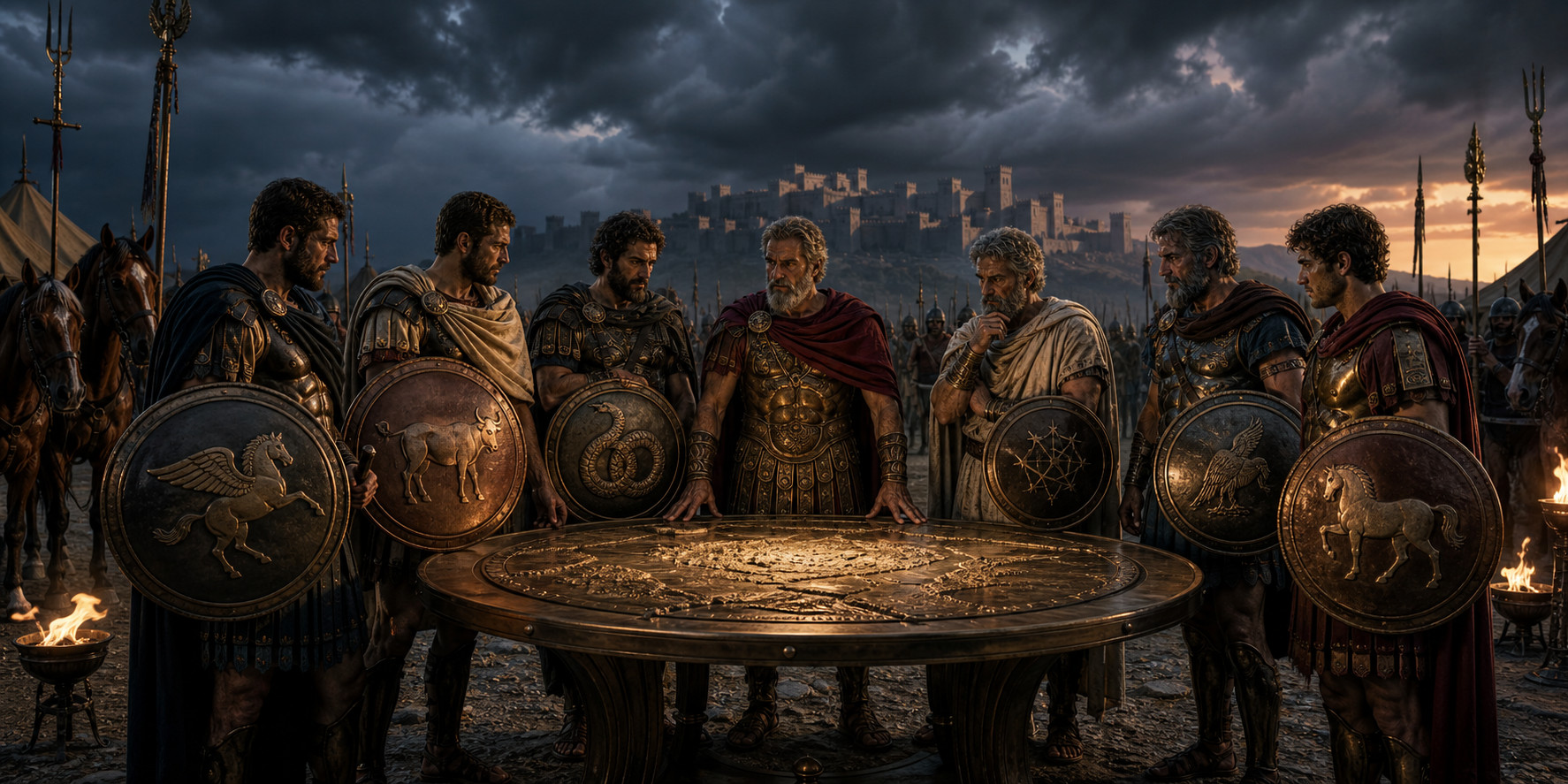
At Thebes, attackers are assigned to gates and matched with defenders. In Aeschylus, a scout describes each enemy and shield emblem while Eteocles chooses the corresponding Theban. The sequence makes interpretation part of defense.
The shields announce identity, ambition, and impiety. Capaneus boasts that even Zeus cannot stop him, while other devices invoke animals, gods, or cosmic claims. The city reads the images approaching its walls and answers symbol with person.
The Brothers at the Seventh Gate
Eteocles ultimately chooses to face Polynices at the seventh gate. The brothers kill one another, fulfilling the curse and ending their contest without resolving the family’s moral claims. The city survives, but its ruling house is broken.
Their paired death is the event’s center because victory and defeat collapse together. Polynices does not regain a living kingship; Eteocles does not keep one. The throne outlasts both claimants while the community inherits the burial dispute.
Deaths and the Escape of Adrastus
Most of the champions die in distinctive ways. Zeus strikes Capaneus for his boast; the earth opens to receive Amphiaraus and his chariot; Tydeus’s violence costs him a promised immortality in one tradition. Adrastus alone escapes on the divine horse Arion in many accounts.
These deaths judge character as well as military failure. Arrogance, rage, prophecy, and divine intervention shape the outcome. The siege becomes a collection of moral endings organized around one unsuccessful campaign.
Burial and the Next Generation
The aftermath leads into disputes over burial, treated differently by Aeschylus, Sophocles, Euripides, and later mythographers. Antigone’s determination to bury Polynices becomes the most famous continuation, but it is not the only surviving arrangement.
The sons of the fallen leaders later return as the Epigoni and capture Thebes. Their success does not erase the first expedition. It proves how inherited obligation can renew war after the original claimants are dead.
What the Seven Mean
The Seven against Thebes turns family conflict into civic geometry: seven leaders, seven gates, matched emblems, and one city forced to absorb a dynasty’s curse. Prophecy is clear, yet institutions and promises continue to move the army forward.
Follow the event toward Thebes and Megara for the city, Opheltes and the Nemean Games for the ominous pause, Ares for the sacred violence beneath Theban foundations, and later routes toward Oedipus, Antigone, and the Epigoni.
Trivia
- Ancient sources do not all use the same roster of seven leaders.
- The expedition’s stop at Nemea creates one foundation story for the Nemean Games.
- In the dominant tradition, Adrastus is the only leader to escape the siege alive.