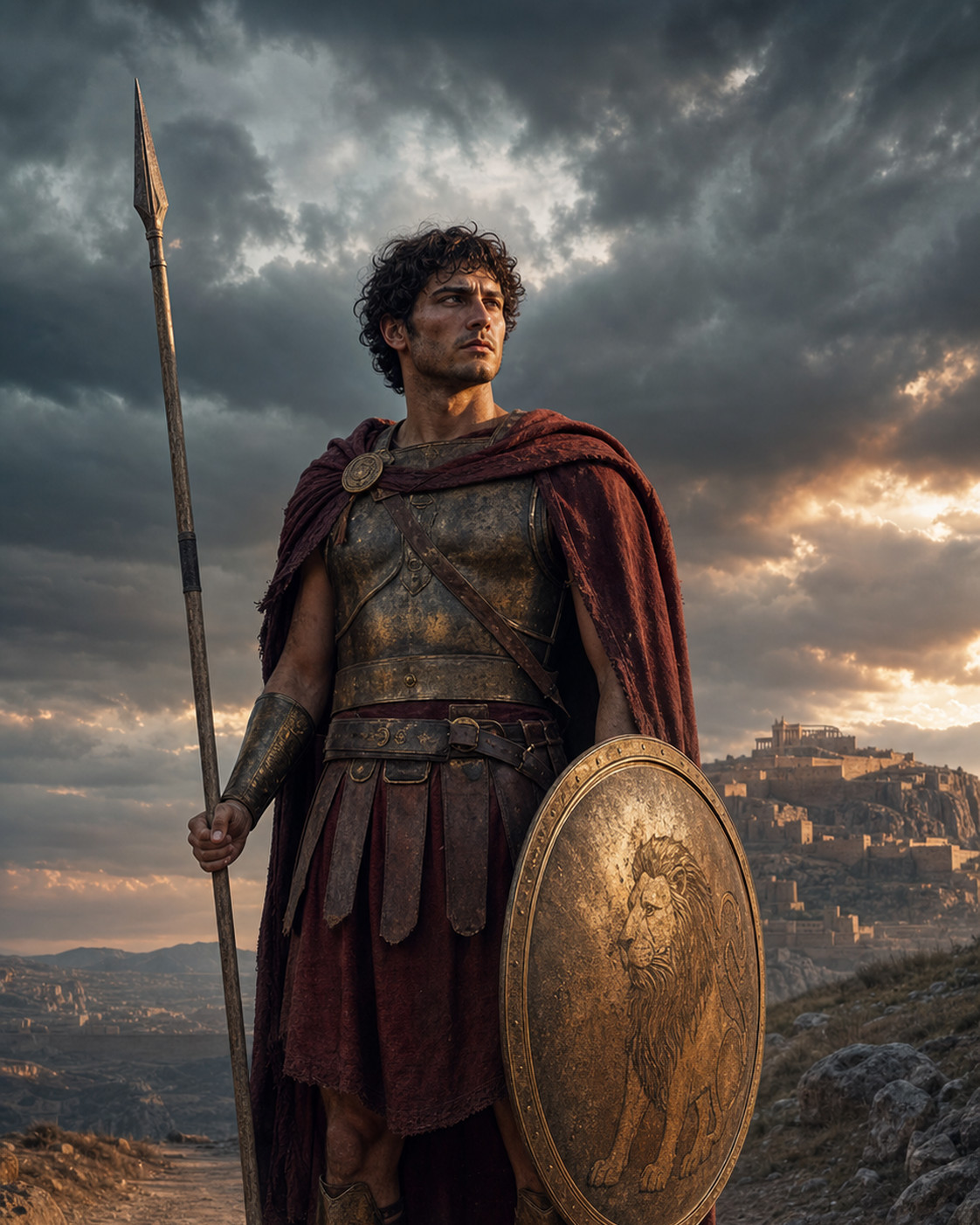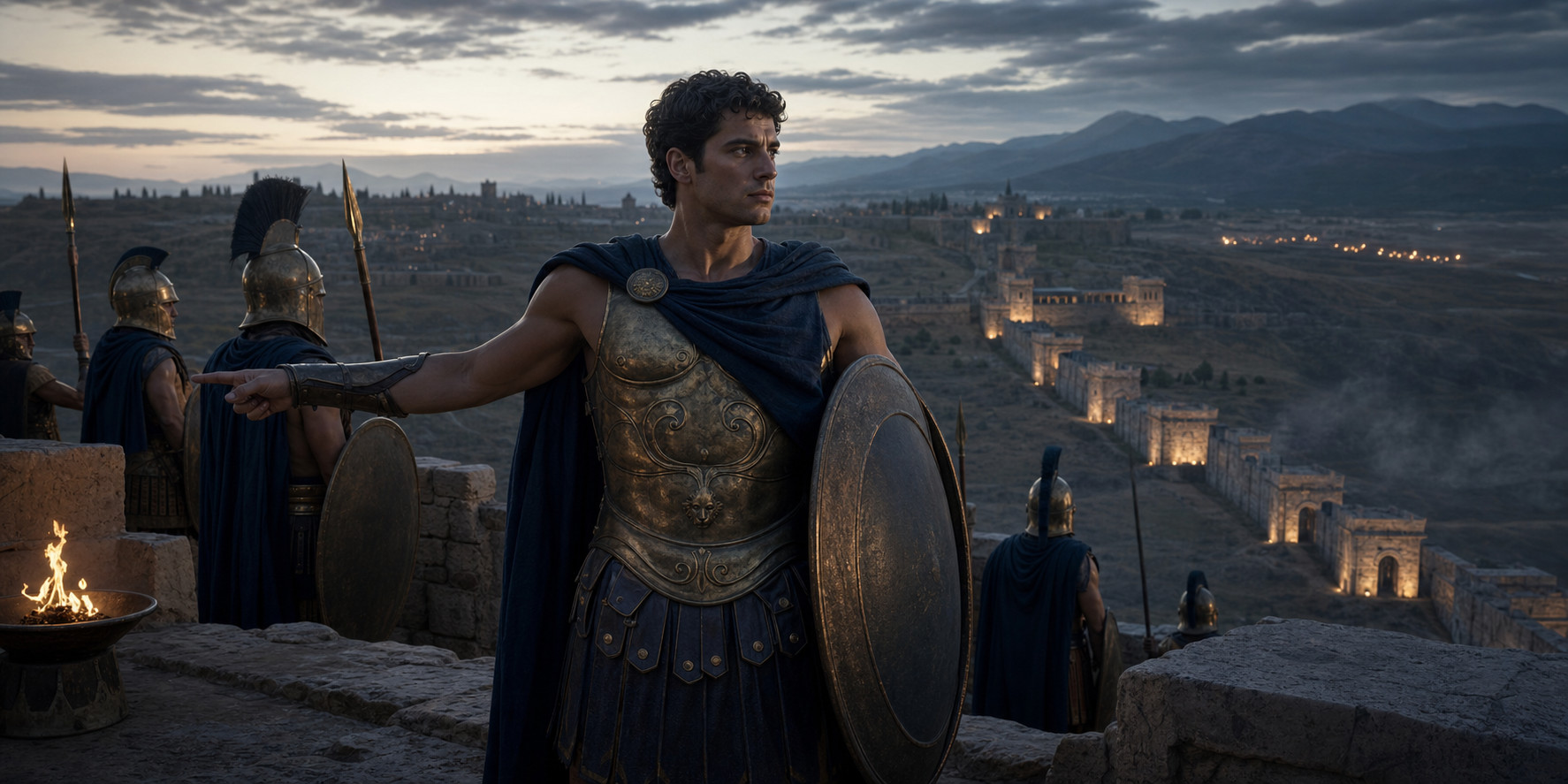
The commander who protects every gate of Thebes yet meets his brother at the final one and dies for the throne.
- Kingship
- Oedipus
- Polynices
- Seven against Thebes
- Seven Gates
- Thebes
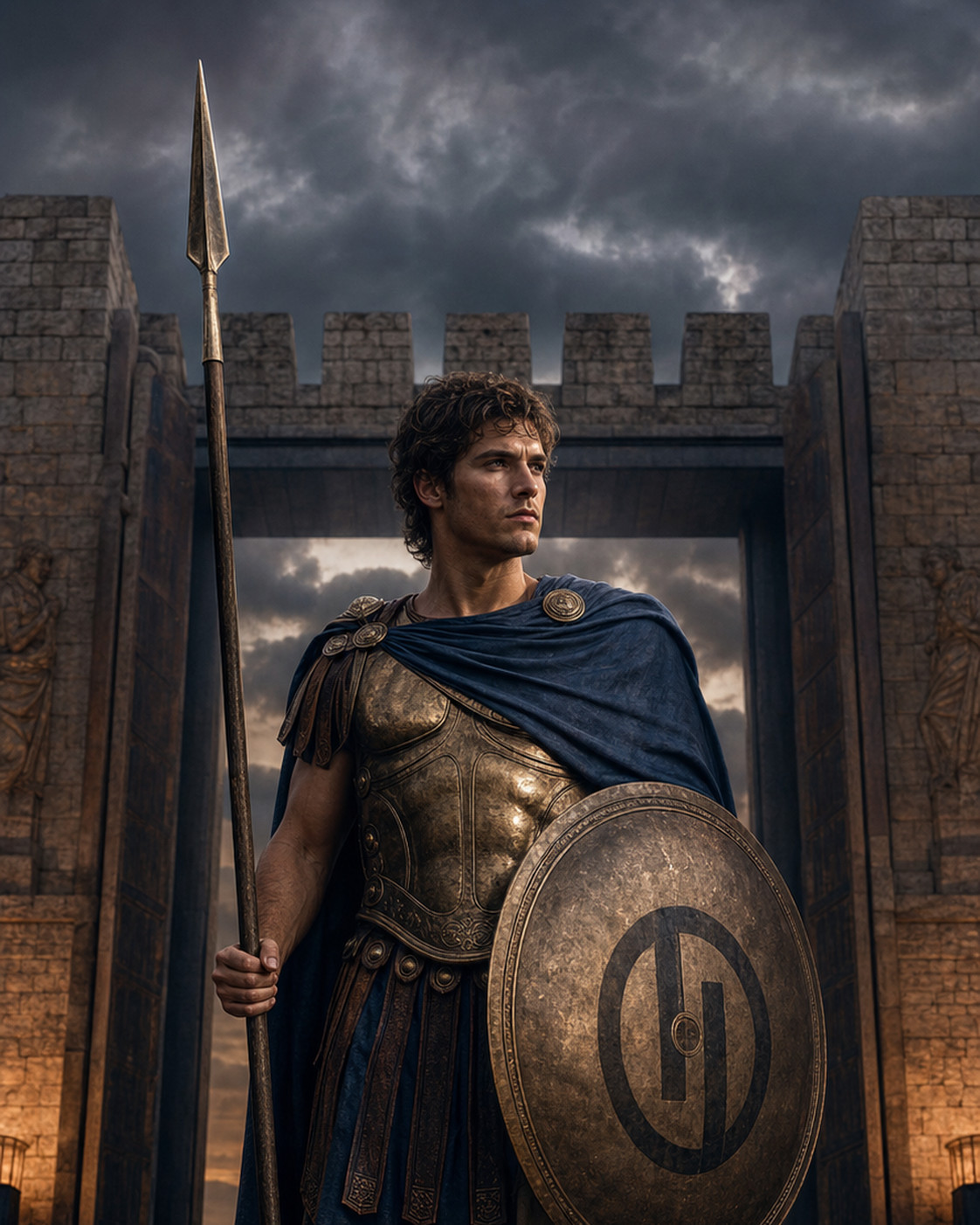
Eteocles is the son of Oedipus who rules and defends Thebes when Polynices returns with the Seven. Sources disagree over which brother ruled first, but their broken compact ends with mutual death in combat for the kingdom.
Greek Mythology Timeline
Move through broad mythic ages and open the events that connect one story to the next. The sequence is a reading path, not an exact historical calendar.
Eteocles is the Theban son of Oedipus who defends the seven-gated city against the army led by his brother Polynices. Depending on the source, the brothers agree to alternate the kingship, divide inheritance in another way, or inherit a curse whose exact cause varies. Eteocles either refuses to surrender rule after his year or receives the first turn from Polynices and keeps it. Aeschylus makes him the vigilant commander who assigns defenders to the gates and accepts the final station opposite his brother, while Euripides gives the family a failed negotiation before battle. He saves Thebes from capture but dies in mutual combat, leaving victory inseparable from dynastic ruin.
A Son of the Oedipus House
Eteocles is usually named with Polynices, Antigone, and Ismene as a child of Oedipus and Jocasta. Apollodorus also records Eurygania as an alternative mother of the siblings. His place in the Labdacid dynasty makes kingship both an inheritance and a burden shaped by Laius’s oracle, Oedipus’s discovery, and competing versions of the father’s curse.
Ancient poetry does not agree on every stage between Oedipus’s fall and the brothers’ conflict. In some accounts Oedipus is dead or gone; in others he remains within Thebes, neglected or dishonored. The disagreement matters because Eteocles can appear as an independent ruler, a son refusing care, or a participant already trapped by a paternal curse.
The Agreement to Share Rule
Apollodorus says the brothers make an agreement to rule in alternate years. One tradition lets Polynices rule first and hand power to Eteocles; another makes Eteocles first and unwilling to yield. Diodorus chooses Eteocles as the elder and first ruler. The common point is a compact whose failure turns succession into exile and war.
Other traditions describe a division of the inheritance in which one brother takes the kingship and city while the other receives Oedipus’s treasure. Details involving the necklace and robe of Harmonia show that royal objects can carry both value and disaster. Project Mythos keeps the alternating-year agreement central while acknowledging that it is not the only ancient arrangement.
Polynices Goes to Argos
When Eteocles keeps Thebes, Polynices leaves for Argos. There he encounters Tydeus, marries Argia, daughter of Adrastus, and gains the king’s promise of restoration. What begins as a dispute between brothers becomes an international expedition of Argive leaders, each attached to a gate and each carrying a different reputation for courage, violence, or impiety.
Eteocles can describe the attackers as foreign invaders, yet Polynices presents himself as an excluded Theban claimant enforcing an oath. Both descriptions contain truth. The conflict is civil war supported by outsiders, making loyalty to the city difficult to separate from loyalty to one interpretation of the royal agreement.
Commander of the Seven Gates
Aeschylus’ Seven against Thebes places Eteocles at the center of defense. He listens to a scout’s report of each Argive champion and assigns a Theban opponent to each gate. The repeated decisions show a ruler matching character, divine favor, and military skill rather than merely waiting for the prophecy to unfold.
His language is disciplined but increasingly drawn toward the family’s curse. He rejects panic among the chorus and insists that citizens protect children, altars, and the earth that raised them. The city depends on his leadership even when the audience recognizes that the final assignment will turn public defense into private fratricide.
The Last Pairing
At the seventh gate Eteocles learns that Polynices stands opposite him. He chooses to face his brother despite attempts to stop him. In Aeschylus, he understands the inherited doom yet also frames the encounter as the unavoidable completion of military responsibility. The defender of every other gate becomes both commander and final combatant.
Other accounts arrange mutual combat by agreement between the armies after the larger battle. The brothers fight for the kingdom and kill one another. The symmetry fulfills Oedipus’s curse in the most literal political form: neither possesses the whole inheritance, and the earth receives both at the same moment.
Victory without Succession
Thebes survives the assault. Capaneus is struck by Zeus, most Argive champions die, and Adrastus escapes. Yet Eteocles cannot enjoy the victory he helped create. His death removes the ruler at the instant his claim is militarily secured, and the city must decide how to remember two brothers who fought on opposite sides.
This is why Eteocles cannot be reduced to either rightful defender or selfish usurper. Aeschylus gives him real civic competence; other traditions emphasize the broken agreement. The two aspects coexist uneasily. He protects the community through a decision that also makes the expedition necessary.
Burial and the Next Conflict
Later Theban tradition sharply separates the brothers after death. Eteocles receives honorable burial as defender, while Polynices is denied rites as an attacker. The decree, associated especially with Creon in Sophocles’ Antigone, creates the next crisis when Antigone insists that kinship and divine burial law cannot be canceled by civic judgment.
Some endings of Aeschylus’ play also move toward disputed burial, though questions about the textual history make the exact original conclusion uncertain. Whatever the dramatic route, Eteocles’s corpse becomes a political symbol. The city uses his defense to define loyalty, while his shared family and shared death resist a clean division.
Follow the Defender
Follow Eteocles toward Polynices for the competing claim, Seven against Thebes for the siege, Oedipus for the curse, and Thebes for the city whose safety authorizes his decisions. Jocasta provides the version in which a mother still attempts mediation, while Antigone shows how the brothers’ conflict survives through burial law.
Eteocles asks a central Project Mythos question: can a ruler be a successful guardian and still be responsible for the war he defeats? His story provides no easy separation between public duty and private ambition. Every gate he secures makes the final gate, where the enemy is his brother, more difficult to interpret.
Trivia
- Sources disagree about which brother ruled first.
- Aeschylus presents Eteocles personally assigning defenders to all seven gates.
- He and Polynices kill one another in combat for the kingship.