The Boeotian city where dragon teeth, divine marriages, riddles, and inherited wars become civic memory.
- Ares
- Cadmus
- Heracles
- Megara
- Oedipus
- Seven against Thebes
- Origin
- Divine Occupation
- Major Myths
- Cult / Tradition
- Legacy
Thebes is the major Boeotian city founded in myth by Cadmus and the Spartoi, walled by Amphion and Zethus, and shaped by the houses of Cadmus and Oedipus. It is also the home of Megara and a central setting for Heracles and the Seven against Thebes.
Greek Mythology Timeline
Move through broad mythic ages and open the events that connect one story to the next. The sequence is a reading path, not an exact historical calendar.
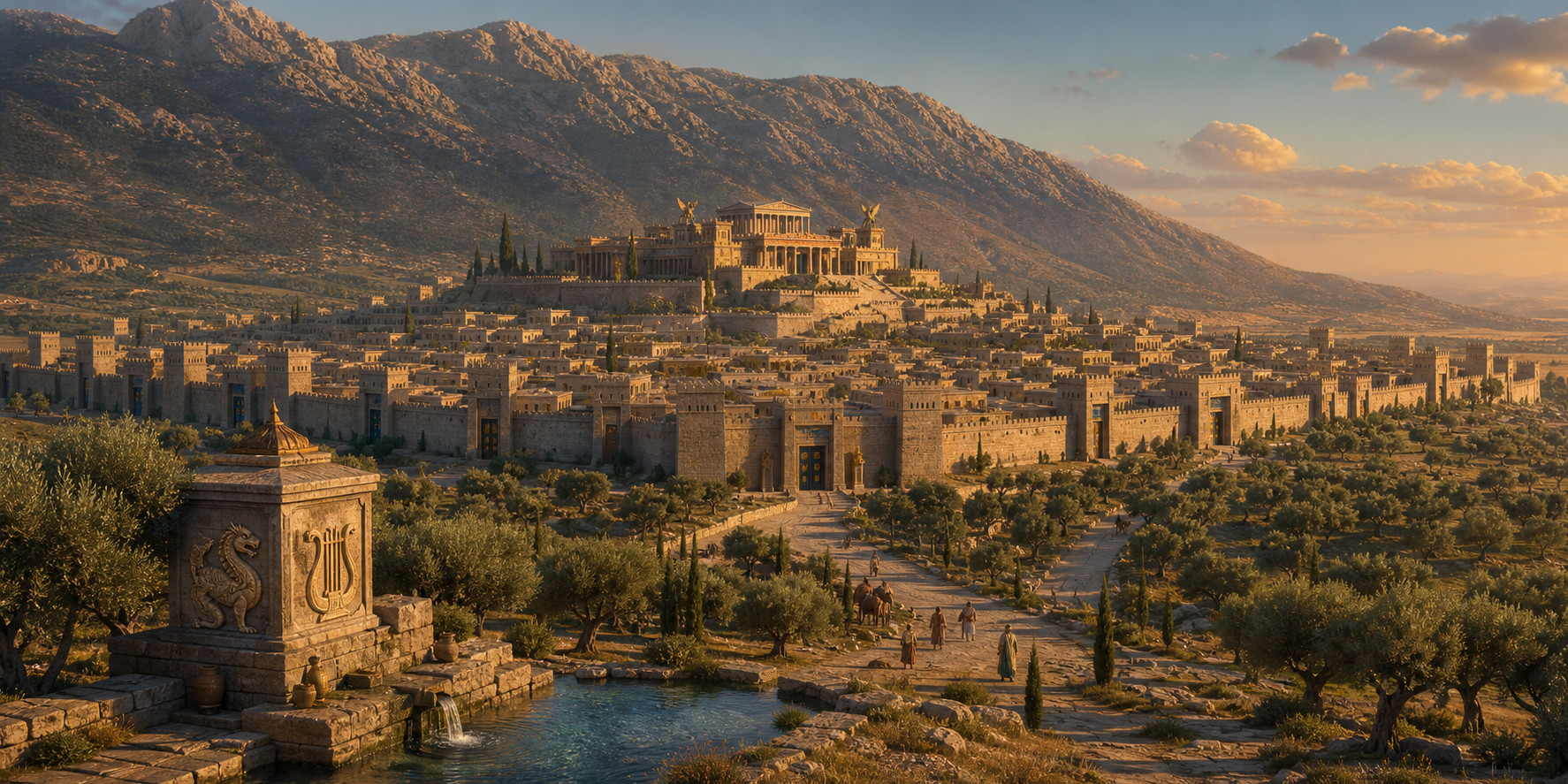
Thebes is the seven-gated city of Boeotia where Greek myth repeatedly turns foundation into family crisis. Cadmus follows an oracle, kills the dragon of Ares, sows its teeth, and builds the Cadmeia with the surviving earth-born warriors. Amphion and Zethus later shape the wider walls, while the houses of Cadmus, Labdacus, Oedipus, and Heracles fill the city with divine births, riddles, exile, civil war, and tragic return. Thebes is not one story’s background; it is a machine for remembering how cities inherit unresolved acts.
A Real City and a Mythic Capital
Ancient Thebes stood in Boeotia north of Attica, and archaeology confirms a major Bronze Age center beneath the later city. Myth magnifies that historical depth. The elevated Cadmeia becomes a royal core from which dynasties, gates, springs, and roads organize generations of narrative.
Project Mythos distinguishes the real site’s long history from mythic chronology. Cadmus, Oedipus, and Heracles do not form a securely datable sequence in modern archaeology. They form a remembered landscape through which ancient communities explained identity, ritual, and ruin.
Cadmus Follows the Cow
Cadmus searches for his abducted sister Europa until an oracle redirects him. He is told to follow a marked cow and found a settlement where it lies down. The animal leads him into Boeotia, replacing a failed family quest with the beginning of a city.
The foundation is therefore born from displacement. Cadmus does not recover the person he sought; he creates a new home. Thebes begins as an answer that changes the question rather than solving it.
The Dragon of Ares
To prepare a sacrifice, Cadmus sends companions to fetch water from a spring guarded by a dragon sacred to Ares. The serpent kills them, and Cadmus kills the serpent. The city’s first access to water is purchased through violence against a divine guardian.
Cadmus must later serve Ares in recompense. Marriage to Harmonia, daughter of Ares and Aphrodite in a prominent tradition, joins the offender to the god’s family. The settlement is legal and marital, but it does not erase the dragon beneath the foundation.
Sowing the Dragon’s Teeth
Athena instructs Cadmus to sow the dead dragon’s teeth. Armed men rise from the earth and fight one another until five remain: the Spartoi or Sown Men. They become ancestral figures within Theban nobility and help establish the Cadmeia.
The image is one of Greek myth’s clearest statements about civic violence. Warriors grow fully armed from local soil, and their first action is internal conflict. The city gains defenders and ancestors through a survival shaped by mutual destruction.
Amphion, Zethus, and the Walls
Another foundation layer credits the twins Amphion and Zethus with building or enlarging Thebes. Zethus contributes physical labor, while Amphion’s lyre moves stones into place. The story pairs strength with music as complementary civic powers.
The famous seven gates belong to this monumental city. Their names vary in ancient lists, but their narrative importance is stable: each gate becomes a station in the assault of the Seven against Thebes, turning architecture into the structure of a tragedy.
House of Cadmus
Cadmus and Harmonia’s descendants include Semele, mother of Dionysus, and figures whose stories cross divine desire, madness, transformation, and loss. Their wedding is celebrated by the gods, yet the family does not receive lasting peace.
The pattern makes Thebes a place where divine closeness is dangerous. Gods enter households, but their presence can produce jealousy, impossible knowledge, and altered bodies. Civic prestige and family catastrophe grow together.
Oedipus and the Labdacids
The city’s best-known dynasty centers on Laius, Oedipus, and the children born from Oedipus and Jocasta. The Sphinx threatens Thebes until Oedipus answers its riddle, earning kingship without knowing the truth of his own birth.
Recognition destroys the apparent rescue. Oedipus’s sons Eteocles and Polynices inherit conflict over rule, producing the expedition of the Seven. The city saved by a solved riddle becomes the object of a family war.
Heracles and Megara
Thebes is also the mortal home of Heracles in major traditions. He defends the city and receives Megara, daughter of Creon, in marriage. Their household ties the city’s political history to the chronology of the Twelve Labors.
Euripides sets Heracles’s family crisis in Thebes under the usurper Lycus. The city becomes both the home he rescues and the place where madness destroys the meaning of return. Megara’s viewpoint keeps the royal landscape connected to domestic vulnerability.
Seven Gates and Two Sieges
Polynices brings six allied champions from Argos against his brother Eteocles. Each attacker is assigned to a gate, and the brothers meet at the seventh. The city survives while the brothers kill one another and most attackers die.
A later expedition of the Epigoni, sons of the first attackers, eventually captures Thebes. The paired wars turn defeat into inherited obligation. Children return to complete what their fathers could not, repeating the city’s pattern of unresolved acts passing forward.
What Thebes Means
Thebes is a city built from interrupted quests, dragon blood, earth-born conflict, music, law, and family memory. Its walls protect a community but also divide brothers and assign enemies to gates. Foundation never becomes a clean beginning.
Follow Thebes toward Ares and Cadmus, Megara and Heracles, Dionysus and Semele, Oedipus and the Sphinx, and the Seven against Thebes. Each route reveals another layer of the same landscape rather than a separate decorative myth.
Trivia
- The fortified citadel of Thebes was called the Cadmeia.
- The Spartoi were warriors born from dragon teeth sown in the earth.
- Ancient lists differ on the exact names of the city’s seven gates.