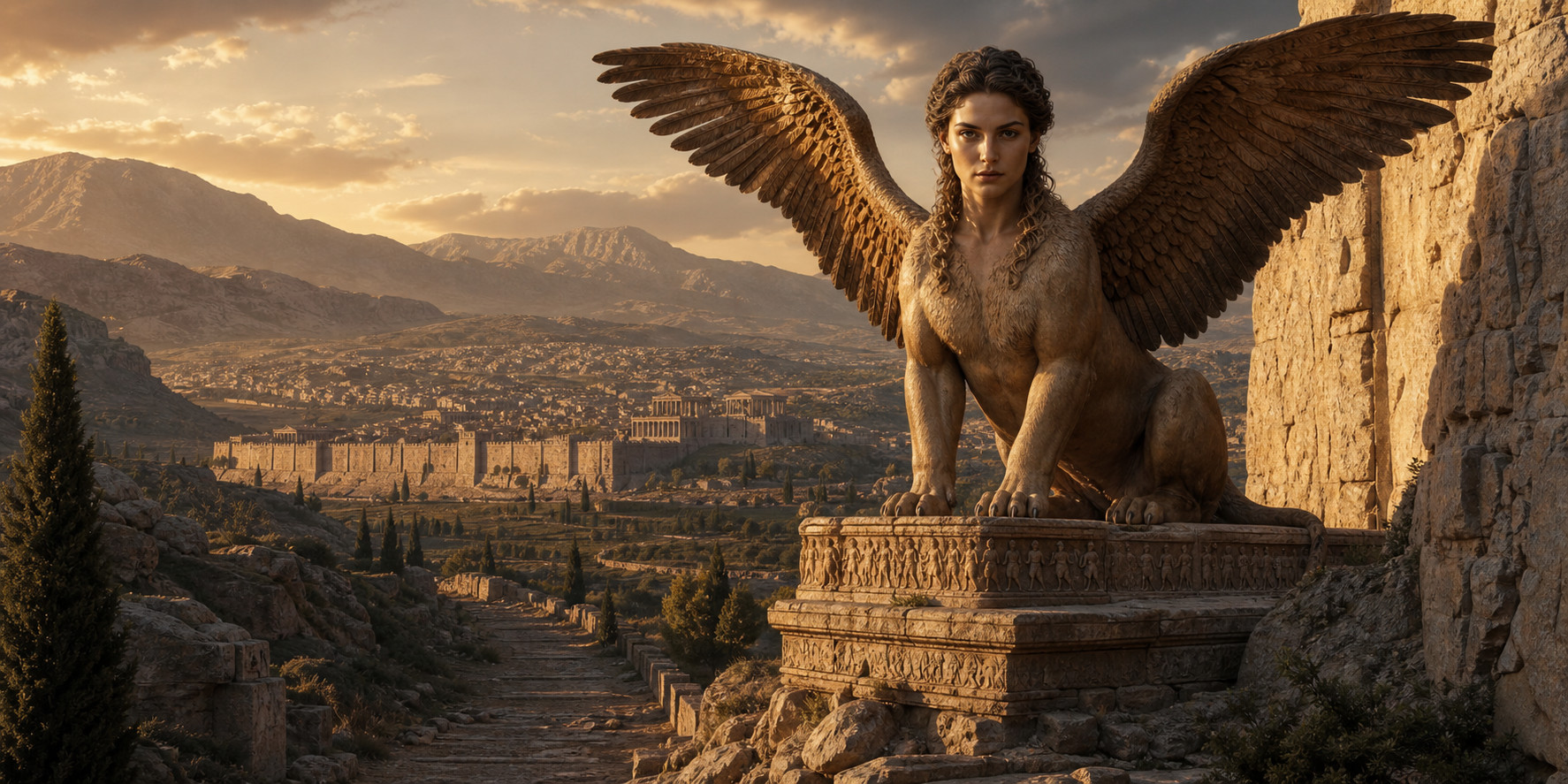
The hybrid guardian whose question saves or destroys, and whose defeat places Oedipus on the Theban throne.
- Cithaeron
- Jocasta
- Laius
- Oedipus
- Riddle
- Thebes
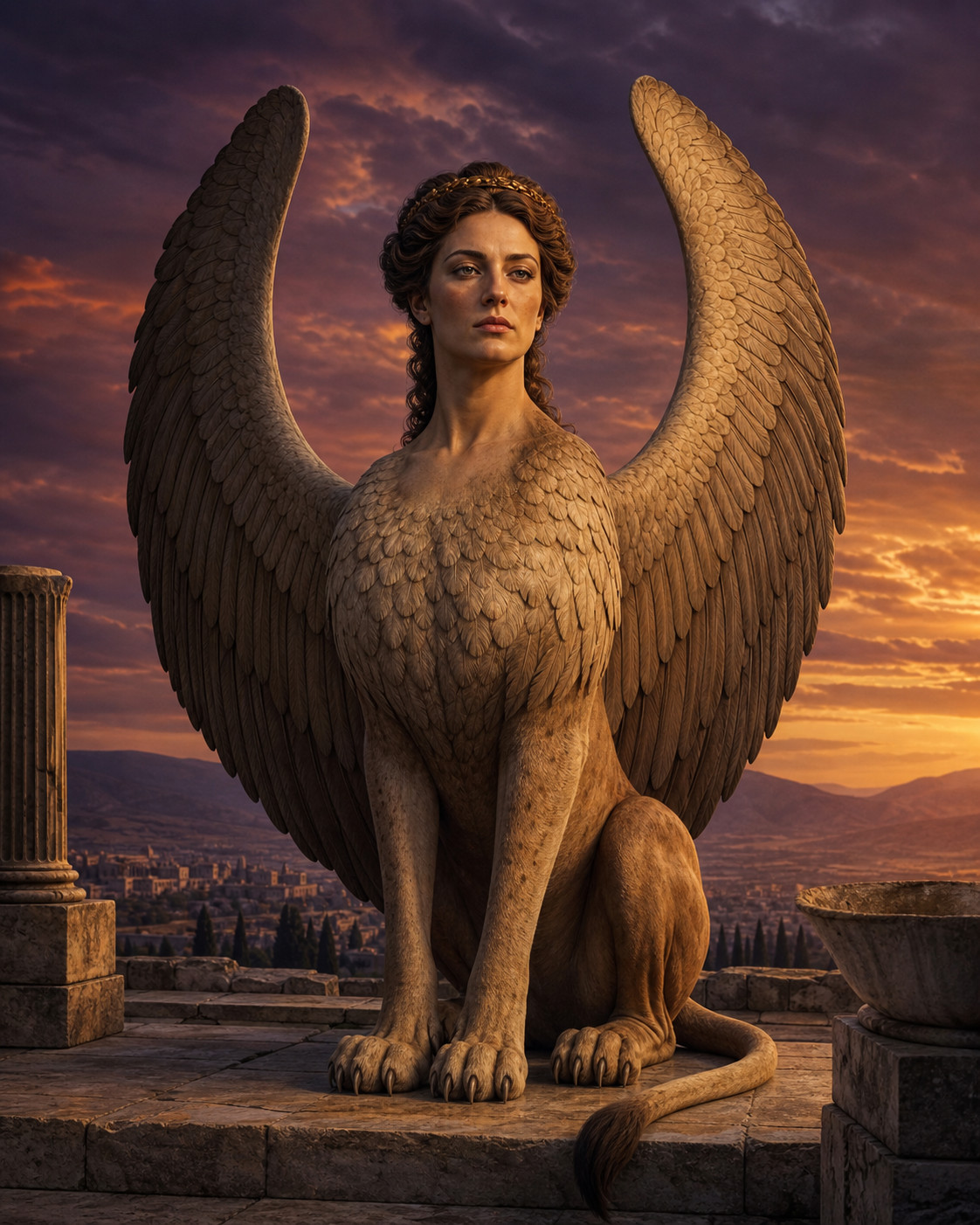
The Theban Sphinx is the winged lion-bodied monster who kills those unable to solve her riddle. Oedipus answers that the four-, two-, and three-footed being is humanity across the stages of life, ending the blockade and winning Thebes and Jocasta.
Greek Mythology Timeline
Move through broad mythic ages and open the events that connect one story to the next. The sequence is a reading path, not an exact historical calendar.
The Sphinx of Thebes is the riddle-giving monster whose blockade turns intelligence into a matter of civic survival. Greek tradition usually gives her a woman’s head, a lion’s body, wings, and a destructive voice, though images and texts vary. Sent against Thebes, she occupies the approaches to the city and kills those who cannot answer her question. Oedipus defeats her without a weapon by identifying the creature that moves on four, two, and three supports as the human being across infancy, adulthood, and old age. Her story is brief, but it changes a dynasty: solving the riddle gives Oedipus the throne and Jocasta, allowing an older prophecy to enter the palace unnoticed.
A Hybrid from a Monstrous Family
Ancient genealogies do not give the Sphinx one uncontested set of parents. Hesiodic tradition places a related destructive creature within the family of Echidna and Orthus, while Apollodorus calls the Theban Sphinx a daughter of Echidna and Typhon. Other accounts attach her to Chimera or local powers. These alternatives identify her with the wider world of hybrid monsters without producing a single stable family tree.
Her composite body carries several kinds of danger at once. The lion supplies physical force, the wings make ordinary barriers unreliable, and the human face makes speech part of the attack. She is not merely a beast that happens to know a question. Her form places human intelligence beside predatory power, so that conversation itself becomes the moment of danger.
Why She Comes to Thebes
Apollodorus says Hera sends the Sphinx against Thebes, connecting the punishment with the unresolved crimes of Laius. Other traditions emphasize Ares, Dionysus, or a more general divine hostility. The exact divine commission changes, but the city receives a threat whose solution depends on confronting knowledge that its ruling house has failed to acknowledge.
The Sphinx learns or receives her riddle from the Muses in a common account. That detail distinguishes her test from random cruelty. Inspired knowledge has been turned into a closed gate: the citizens cannot pass until someone interprets a statement about human life. The monster weaponizes a form of cultural wisdom that should ordinarily educate or delight.
The Riddle and Its Variants
The familiar riddle asks what has four feet in the morning, two at noon, and three in the evening, or what is simultaneously four-footed, two-footed, and three-footed. The wording varies across surviving sources and later retellings. The answer remains the human being, crawling as an infant, walking upright as an adult, and using a staff in old age.
Some traditions preserve a second question about two sisters who give birth to one another, answered by Day and Night. The addition shows that the Sphinx could attract expanding riddle lore. Project Mythos treats the human-life question as the central Theban tradition while marking secondary riddles as later or variant material rather than requirements of every version.
A City Held by Questions
The Sphinx is often imagined on a mountain or high place near Thebes, including Mount Phicium. From there she poses the riddle to Thebans and travelers and destroys those who fail. Creon’s son Haemon is among the victims in one account, giving the royal household a direct reason to offer kingship and Jocasta’s marriage to the successful solver.
The blockade differs from an ordinary siege. Walls and armies cannot remove it because the decisive contest is individual and interpretive. Every failed answer reduces the city’s future leadership. The reward offered to a solver therefore combines desperation with succession: whoever reopens the road will inherit the political place left vulnerable by Laius’s death.
Oedipus Answers
Oedipus reaches Thebes after killing an unknown older traveler at a narrow road. He does not know that the man was Laius or that the city threatened by the Sphinx is his birthplace. When he answers the riddle, his reasoning is correct even though his understanding of himself remains incomplete. His greatest public success rests beside his deepest private ignorance.
The answer is especially charged because Oedipus already carries a staff in later dramatic imagination and bears damaged feet from infancy. His own body contains the riddle’s stages and supports. He can name the universal pattern of human life while failing to recognize the particular infant, adult traveler, and future old exile joined within his own history.
The Death of the Sphinx
After the answer, the Sphinx throws herself from the height in the familiar prose mythographers. Other images and summaries allow Oedipus to kill her or show a more direct confrontation. The dominant literary point is that correct interpretation ends her power. Once the riddle is opened, the monster cannot continue controlling passage through secrecy.
Her death does not free Thebes from the larger problem. It removes the visible danger and installs the person whose hidden identity will bring another crisis. The city interprets victory as proof that Oedipus should rule, but the reward completes the marriage foretold by the oracle. Knowledge solves one emergency and unknowingly prepares the next.
From Archaic Image to Tragic Symbol
Greek artists depicted sphinxes long before every surviving literary detail of the Oedipus story was fixed. They appear as guardians and funerary beings as well as narrative monsters. The Theban Sphinx later became inseparable from the image of Oedipus seated or standing before a winged female creature, a compact scene representing the pressure of an unanswered question.
Drama can treat her as an absent cause rather than an onstage character. In Sophocles, the solved riddle proves Oedipus’s intelligence and explains the city’s trust in him. Her memory makes the later investigation sharper: the man who once penetrated a public mystery must discover that the next riddle is constructed from witnesses, scars, names, and his own life.
The Question She Opens
Follow the Sphinx toward Oedipus for the victory and its hidden cost, toward Thebes for the city held at the edge of extinction, and toward Jocasta and Laius for the dynastic vacancy that makes the reward possible. Chimera and other hybrids show the wider family of forms through which Greek myth joins human, animal, and divine danger.
Her lasting role is not simply to ask a clever puzzle. She tests whether general wisdom can protect people from truths they do not know how to connect. Oedipus gives the right answer, but Thebes draws the wrong conclusion from it. That gap between solving and understanding is what keeps the Sphinx central to the Theban cycle.
Trivia
- The exact wording and even the number of the Sphinx’s riddles vary across traditions.
- Ancient genealogies disagree about her parents.
- Her defeat wins Oedipus both the Theban throne and marriage to Jocasta.