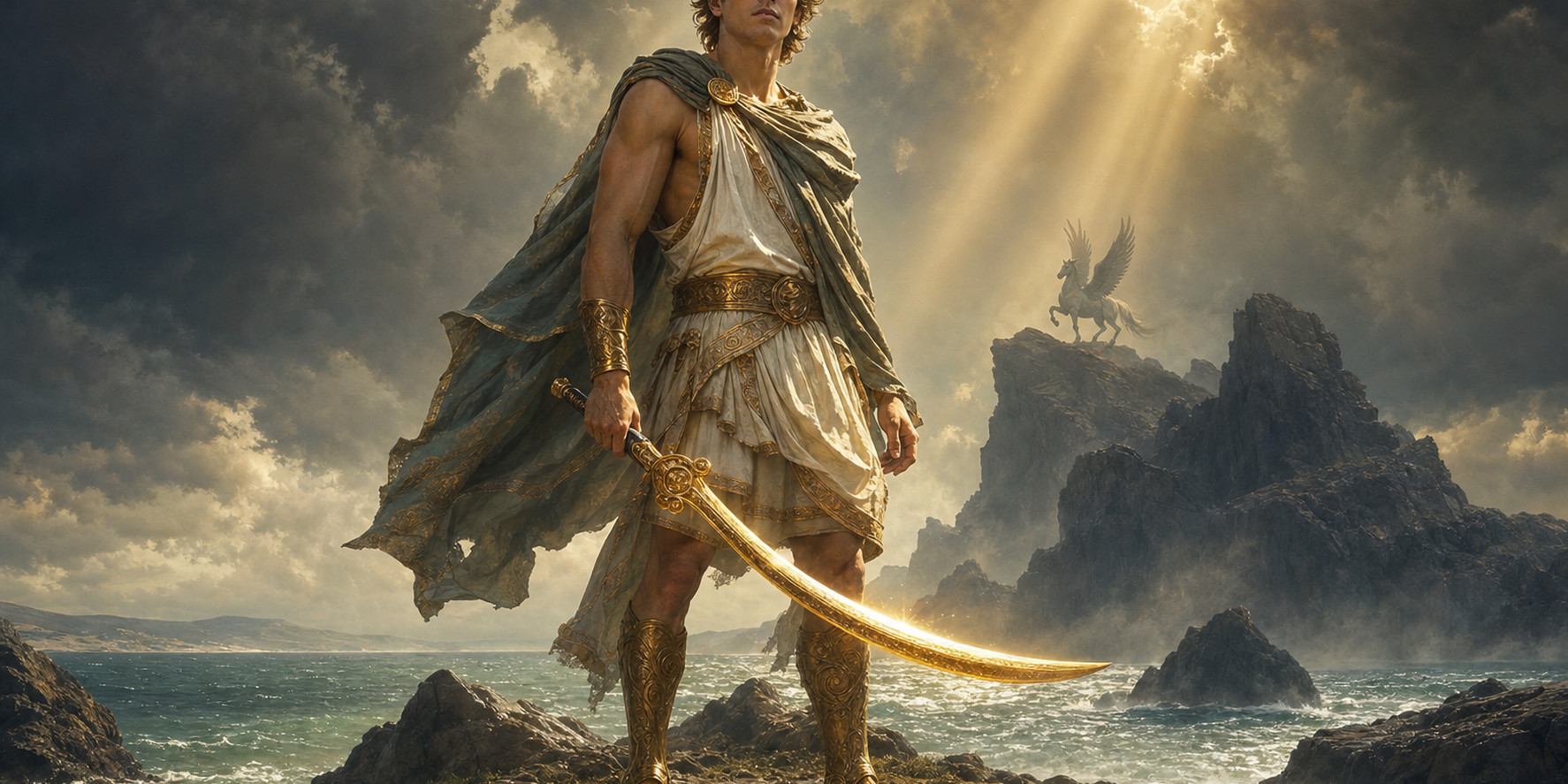
The mysterious brother of Pegasus whose brief genealogy joins Medusa's death to Geryon and the labors of Heracles.
- Callirhoe
- Geryon
- Heracles
- Medusa
- Pegasus
- Poseidon
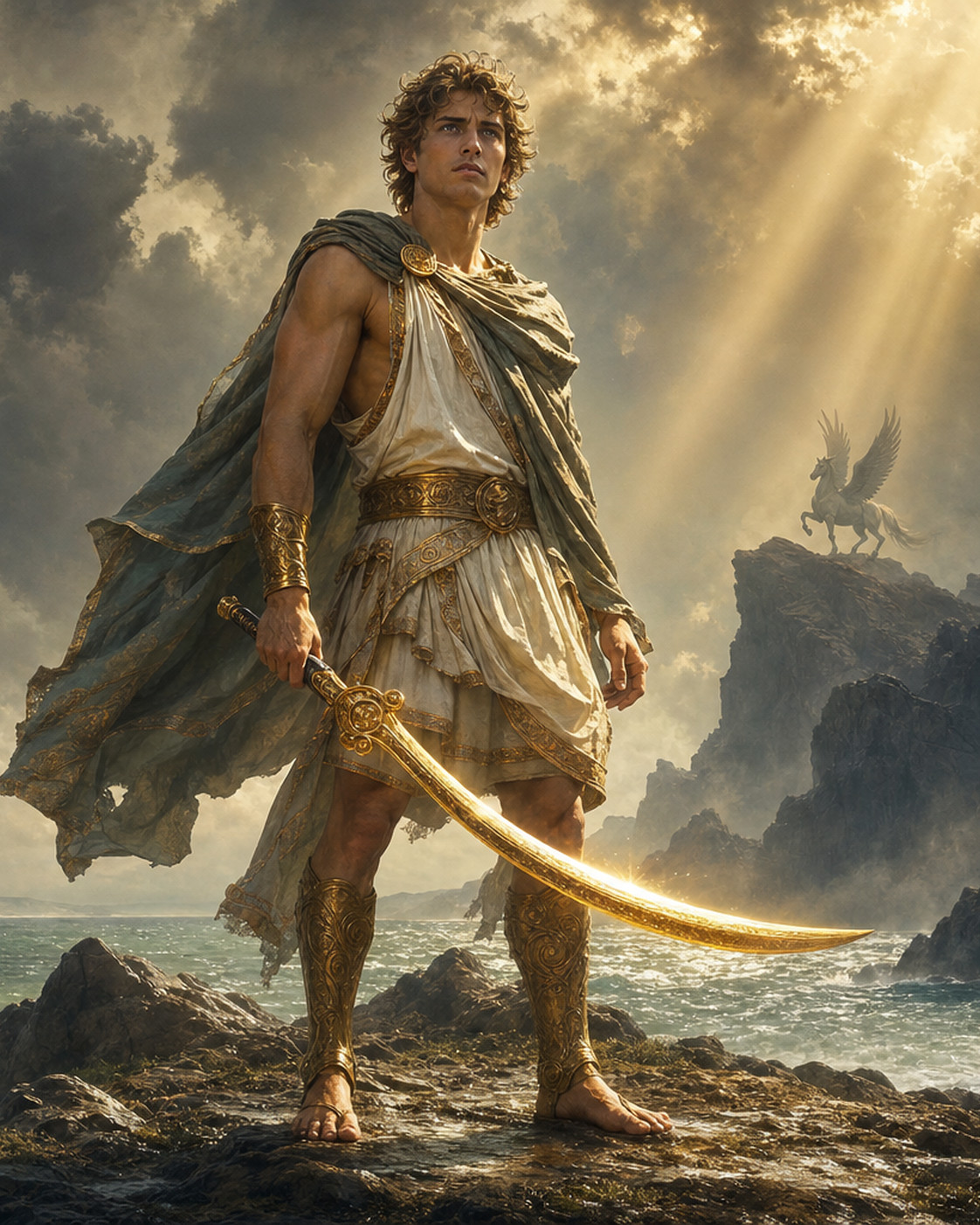
Chrysaor is the golden-sworded son of Poseidon and Medusa, born with Pegasus when Perseus beheads the Gorgon. He later fathers Geryon with Callirhoe, connecting the Gorgon family to Heracles' cattle labor.
Greek Mythology Timeline
Move through broad mythic ages and open the events that connect one story to the next. The sequence is a reading path, not an exact historical calendar.
Chrysaor is the golden-sworded son of Poseidon and Medusa who emerges when Perseus cuts off the Gorgon’s head. He is born alongside Pegasus, then almost disappears from narrative. Hesiod next identifies him as the partner of the Oceanid Callirhoe and father of the three-bodied Geryon. That compressed genealogy makes Chrysaor an important bridge: Medusa’s death produces a lineage that eventually meets Heracles at the western edge of the world.
Born at Medusa’s Death
Hesiod says that when Perseus beheads mortal Medusa, great Chrysaor and the horse Pegasus spring forth. Their father is Poseidon, who had lain with Medusa before the birth was released by violence. The scene combines death and generation in one instant. What Perseus treats as the end of a monster becomes the beginning of two unexpected lives.
Later authors describe emergence from Medusa’s blood or neck and sometimes call Chrysaor a boy or man. These vivid details belong to different receptions of the sparse early statement. The sources do not provide a continuous childhood, explain where he goes, or make Perseus raise or fight him. Narrative silence begins almost immediately after birth.
The Meaning of the Name
Hesiod explains Chrysaor through chrysos, gold, and aor, a sword or blade: he is the one who holds the golden blade. The weapon supplies identity where biography is missing. Ancient and modern images may therefore show a heroic swordsman, but the literary phrase does not establish one standardized costume, age, or physical type.
Alternative visual traditions have occasionally connected the name with a winged boar, partly through difficult iconographic interpretation and the imagery surrounding Geryon. Such reconstructions are debated. The safest presentation keeps the golden blade central while acknowledging that ancient evidence does not describe Chrysaor’s body in detail.
Brother of Pegasus
Pegasus and Chrysaor share parents and a birth event, yet their paths sharply diverge. Pegasus receives a rich narrative afterlife: the winged horse reaches Zeus, carries thunder, and later joins Bellerophon in the Chimera story. Chrysaor appears mainly in genealogy. The contrast shows how myth preserves some figures through action and others through descent.
Calling them twins is convenient but can imply a human birth pattern the sources do not explain. They are simultaneous offspring whose radically different forms belong to the Gorgon’s generative strangeness. One rises into the sky; the other leads toward Ocean and the far-western cattle of Geryon.
Son of Medusa and Poseidon
Chrysaor is also evidence that Medusa’s story extends beyond her encounter with Perseus. Hesiod mentions Poseidon with her in a meadow; Ovid’s much later Roman account turns the encounter into sexual violence in Athena’s temple. These traditions should not be merged without labels. The nature and setting of the union differ, while the parentage of Pegasus and Chrysaor remains influential.
Through Poseidon, Chrysaor belongs to a divine network of sea power and extraordinary offspring. Through Medusa, he inherits connection to Phorcys, Ceto, the Graeae, and the Gorgons. Yet no source says he simply reproduces either parent’s powers. Genealogy gives him position, not a complete personality.
Callirhoe and Geryon
Hesiod joins Chrysaor with Callirhoe, daughter of Oceanus, and names their son Geryon. Geryon is a formidable figure associated with Erytheia beyond Ocean, whose cattle become the object of Heracles’ tenth labor. Chrysaor thus helps place a branch of the Gorgon family at the western limit of heroic geography.
Stesichorus’ fragmentary Geryoneis gives Geryon more pathos and refers to Chrysaor as dear to Ares. Diodorus later rationalizes Chrysaor as a wealthy ruler of Iberia and Geryon as multiple sons or forces. These versions show mythography turning a golden-sworded being into dynasty, king, and geopolitical ancestor.
From Perseus to Heracles
Perseus causes Chrysaor’s birth, while Heracles kills Chrysaor’s son. The two greatest monster-facing heroes are therefore joined through a family they confront in different generations. Medusa’s lineage is not extinguished by decapitation; it expands into Pegasus above and Geryon beyond Ocean.
This structure also complicates the label monster. Chrysaor may be called a giant in later reference traditions, yet Hesiod’s language emphasizes greatness and the golden sword, not a detailed monstrous anatomy. Geryon’s multiple body is clearer. Readers should let each generation retain its own evidence rather than making the whole family visually identical.
A Figure Made of Gaps
Chrysaor demonstrates how ancient myth can assign enormous genealogical importance to a figure with almost no surviving adventures. Filling every gap with invented exploits would make the page seem complete while weakening its accuracy. The absence itself is informative: early poets often use descent to organize cosmic and heroic relationships without narrating every life.
His profile therefore works best as a junction. The golden sword explains the name; the birth returns to Medusa and Poseidon; Pegasus opens the skyward route; Callirhoe opens Ocean; and Geryon leads to Heracles. Chrysaor’s significance lies in holding these paths together.
How to Read Chrysaor
Modern fantasy may present Chrysaor as a fully developed warrior, winged boar, or divine king. Such images can be creative interpretations, but they should be separated from the limited ancient record. Project Mythos uses a golden-sworded human form as a legible visual hypothesis, not as a claim that one canonical portrait survives.
Follow him toward Medusa for the extraordinary birth, Poseidon for paternity, Pegasus for the contrasting brother, and Heracles for Geryon’s death and cattle. This small node closes a surprisingly long circuit from the Gorgon shore to the edge of Ocean and back into the Twelve Labors.
Trivia
- Hesiod directly connects Chrysaor’s name with the golden blade he carries.
- No continuous ancient adventure cycle centered on Chrysaor survives.
- His son Geryon, not Chrysaor himself, is the opponent Heracles meets during the cattle labor.