Arrival in disguise becomes an alliance, bow contest, marriage test, and civic settlement rather than an instant return to kingship.
- Athena
- Bow
- Eumaeus
- Eurycleia
- Ithaca
- Odysseus
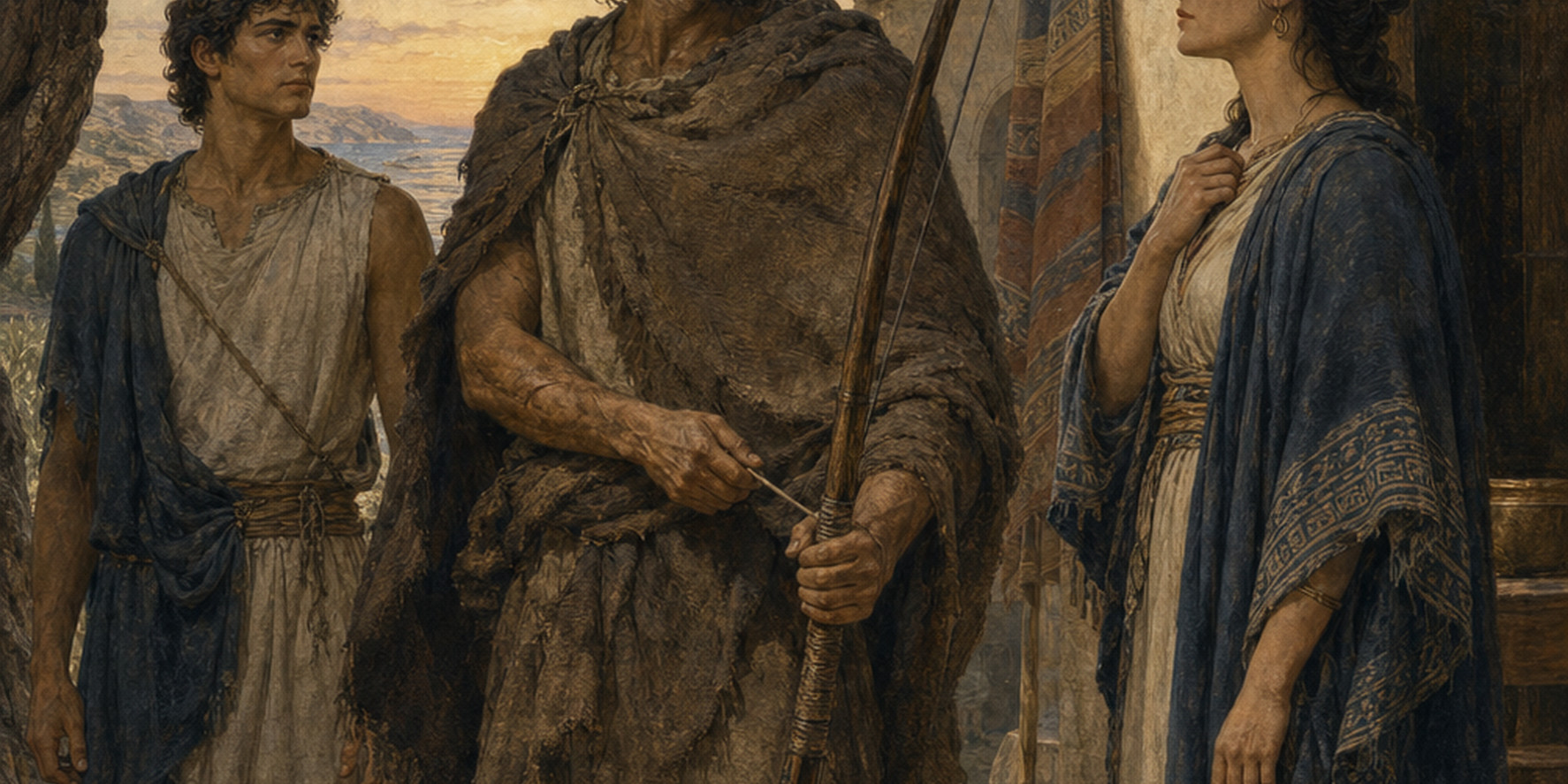
- Arrival AsleepPhaeacians place Odysseus and his gifts on Ithaca before dawn.
- Beggar DisguiseAthena hides the king's identity while he measures the changed household.
- Father and SonRecognition creates an alliance between Odysseus and Telemachus.
- Bow ContestThe one person able to string the bow turns proof into action.
- Bed and PeacePenelope's rooted-bed test confirms identity before Athena settles civic revenge.
The Phaeacians bring Odysseus to Ithaca asleep. Disguised by Athena, he tests the household, reunites with Telemachus, wins the bow contest, destroys the suitors, and is finally recognized by Penelope through the secret of their rooted bed.
Greek Mythology Timeline
Move through broad mythic ages and open the events that connect one story to the next. The sequence is a reading path, not an exact historical calendar.
Odysseus’ Homecoming is the final Ithacan movement of the Odyssey: arrival without public recognition, alliance with loyal household members, reunion with Telemachus, testing by Penelope, the bow contest, destruction of the suitors, and a difficult settlement with their families. The event separates arrival from restoration. Odysseus reaches his island asleep and disguised, but he does not truly regain home until identity has been proven through scars, stories, shared plans, a rooted bed, and negotiated peace.
Arrival in Sleep
The Phaeacians carry Odysseus to Ithaca while he sleeps and place him with gifts beside the shore. He wakes unable to recognize the landscape because Athena has covered it in mist. The long-awaited arrival begins with uncertainty rather than triumph.
Poseidon punishes the Phaeacian ship after its service. Even the final successful transport carries consequences, reminding readers that divine conflicts surrounding the voyage do not end exactly at the island’s boundary.
Athena and the Beggar’s Form
Athena reveals Ithaca, helps hide the treasure, and transforms Odysseus into an aged beggar. Concealment protects him while he measures loyalties and the strength of the suitors occupying his household.
Disguise is not only a clever trick. It reverses status so that a king must experience how servants, strangers, and the vulnerable are treated in his absence. Hospitality becomes evidence for coming judgment.
Eumaeus and the Loyal Household
Odysseus goes first to the swineherd Eumaeus, who welcomes the unknown guest despite limited resources and grief for his missing master. The hut provides the ethical opposite of the palace where wealthy suitors consume another man’s estate.
Other household members later reveal different loyalties: Eurycleia recognizes the scar, Philoetius supports the plan, while Melanthius and Melantho align with the suitors. Home is a network of relationships rather than a building waiting passively for its owner.
Recognition by Telemachus
Telemachus returns from his search for news, and Athena restores Odysseus’ appearance so father and son can recognize one another. The reunion is emotional but immediately strategic. They count opponents, conceal weapons, and coordinate the coming confrontation.
The son who began without memory of his father must decide to trust a transformed stranger. Recognition creates an alliance between two generations, not a simple restoration of childhood dependence.
Penelope Questions the Stranger
Still disguised, Odysseus speaks with Penelope and offers a carefully constructed story. She tests detail and emotion without surrendering control. Their conversation makes verbal intelligence a shared marital language long before open recognition.
Penelope announces the bow contest under conditions that can choose a husband or expose the suitors’ inadequacy. Whether Athena, Penelope, or accumulated necessity most strongly guides the decision remains open to interpretation.
The Bow and the Axes
The suitors fail to string Odysseus’ bow. The beggar strings it, sends an arrow through the aligned axe heads, and transforms proof of identity into immediate tactical advantage.
The bow is personal property, marital memory, and weapon. Mastery verifies embodied knowledge that costume cannot imitate. The contest’s public rule is overturned by the hidden returnee who alone understands its full meaning.
The Suitors and the Cost of Restoration
Odysseus, Telemachus, Eumaeus, and Philoetius kill the suitors with Athena’s support. The poem distinguishes leading offenders, reluctant participants, servants, and protected figures, but the scale of violence remains morally difficult.
Restoration is not presented as consequence-free. Families of the dead later mobilize, and Ithaca risks a new cycle of revenge. A household victory must still become a civic settlement.
The Rooted Marriage Bed
Penelope does not accept Odysseus solely because others recognize him. She orders their bed moved, provoking him to explain that he built it around a living olive tree and that moving it would require cutting the structure apart.
The secret proves identity through shared craftsmanship and intimacy. The bed is rooted yet constructed, natural yet architectural, private yet politically decisive. It represents a marriage preserved by knowledge rather than appearance alone.
Peace and an Unfinished Future
Athena, acting under Zeus’ direction, stops battle between Odysseus and the suitors’ families and establishes peace. Kingship cannot be restored permanently by private revenge; divine intervention closes the immediate civic rupture.
Before that settlement, Odysseus also visits Laertes and tests him with another disguised story before revealing the scar and knowledge of orchard trees. Recognition therefore expands from wife and son to the older generation, reconnecting a household whose memories span before and after Troy.
The poem’s ending remains deliberately compressed. The families’ grief is real, the returned king has used overwhelming force, and peace depends on imposed forgetting or restraint. Homecoming reaches closure as a civic decision, not as proof that every wound has disappeared.
Memory remains, but retaliation is interrupted before it becomes another inherited war.
Tiresias has also foretold a later inland journey to reconcile Odysseus with Poseidon. Follow the homecoming toward Penelope and Telemachus for recognition, Athena for strategy, Polyphemus and Poseidon for the delayed voyage, Ithaca for political restoration, Nostoi for the wider return cycle, and the Trojan War for the absence that began it.
Trivia
- Odysseus reaches Ithaca asleep aboard a Phaeacian ship.
- Eurycleia recognizes him by a scar before Penelope accepts his identity.
- The rooted olive-wood bed is Penelope’s decisive recognition test.