The wandering prince who exchanges a lost sister for a city, then pays for its foundation through service and dynasty.
- Ares
- Athena
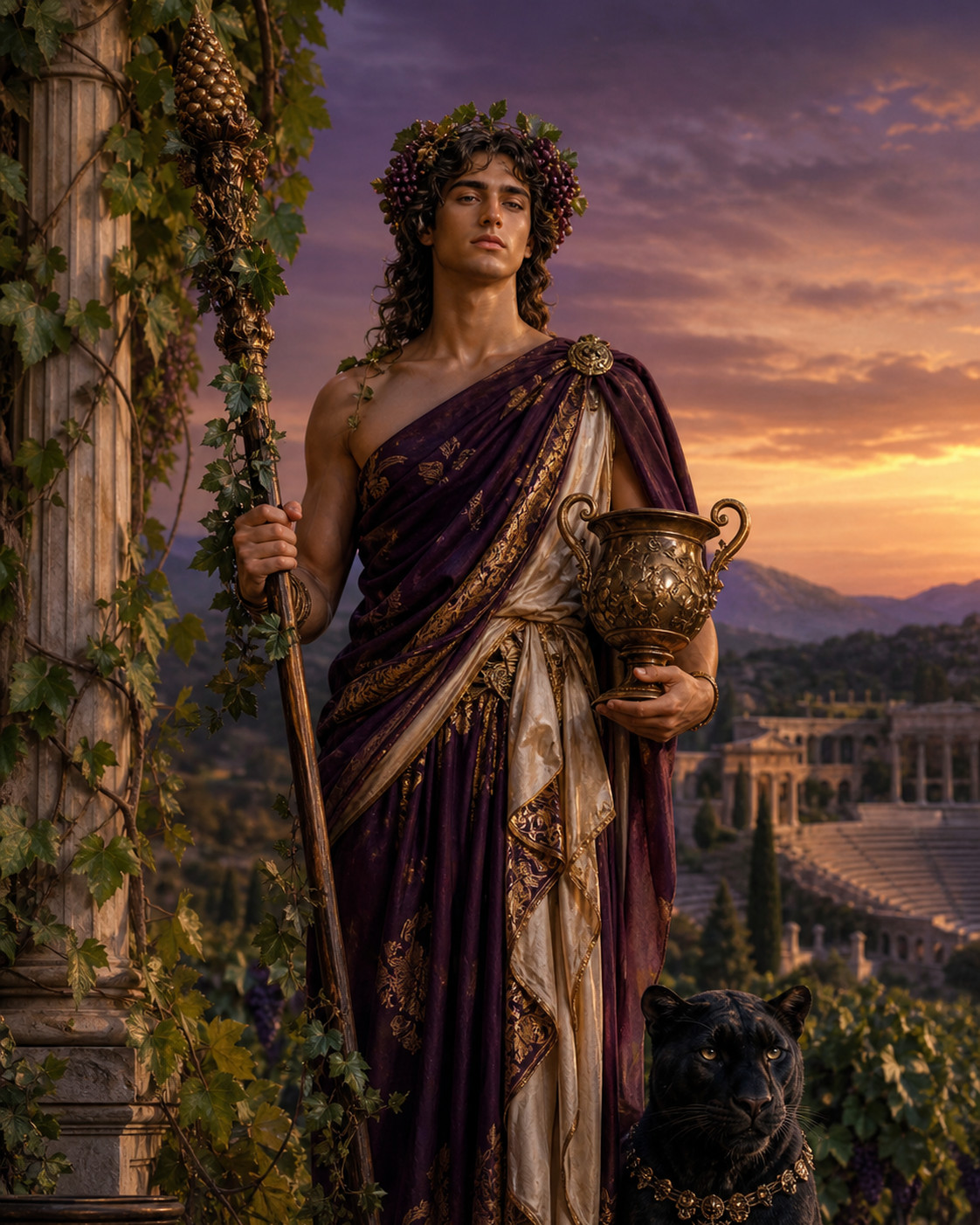
- Dionysus
- Europa
- Harmonia
- Spartoi
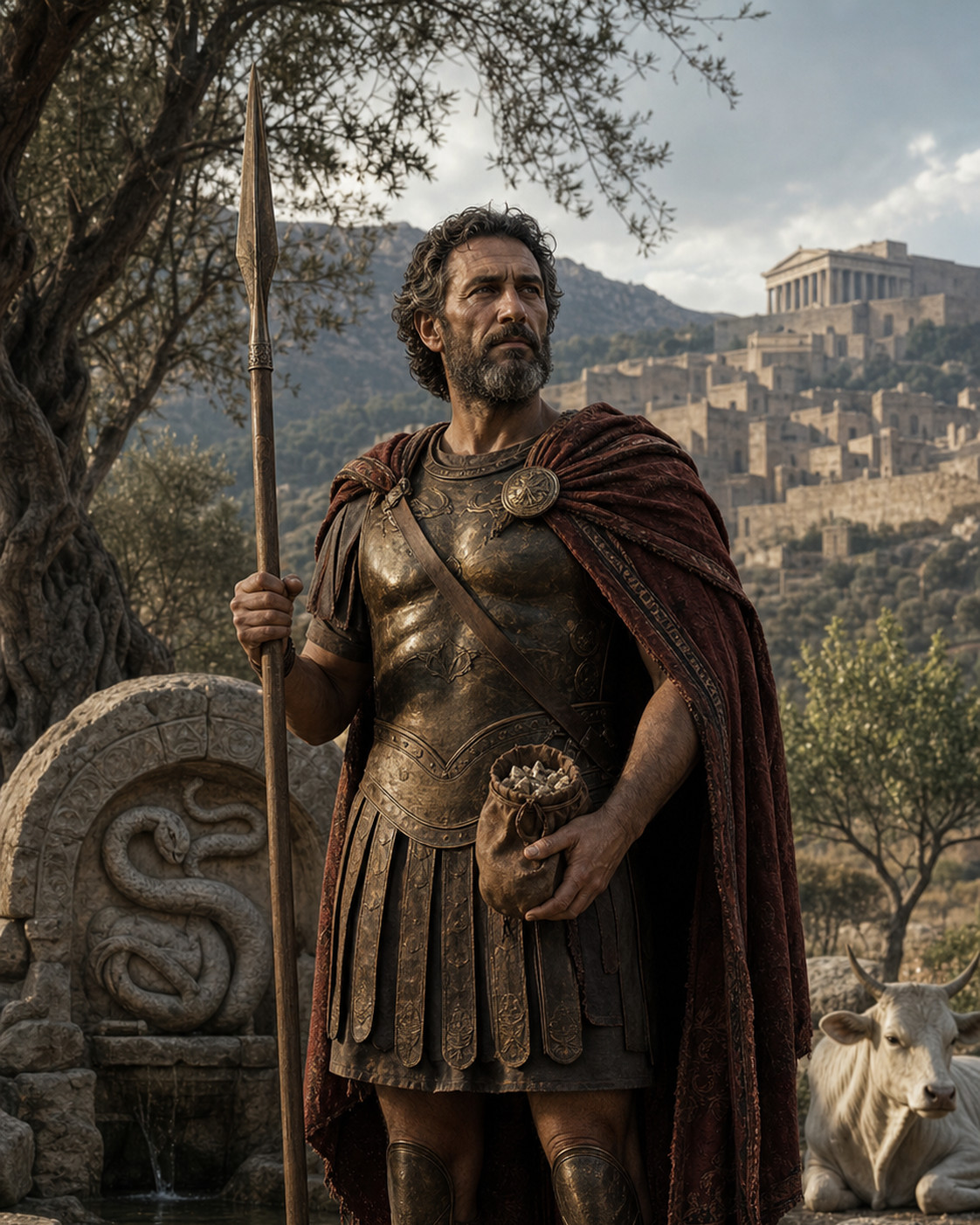
Cadmus is the Phoenician prince guided by Delphi to found Thebes. He kills Ares's dragon, sows its teeth to produce the Spartoi, serves Ares in atonement, and marries Harmonia before eventually becoming a serpent.
Greek Mythology Timeline
Move through broad mythic ages and open the events that connect one story to the next. The sequence is a reading path, not an exact historical calendar.
Cadmus is the wandering Phoenician prince who stops searching for his abducted sister Europa and becomes the founder of Thebes. Guided by Delphi and a marked cow, he reaches Boeotia, kills the dragon guarding Ares’s spring, sows its teeth at Athena’s direction, and watches armed Spartoi rise from the earth. After serving Ares in atonement, he marries Harmonia at a divine wedding and begins a dynasty that produces Semele, Dionysus, Pentheus, Actaeon, and generations of Theban crisis. His achievements never separate cleanly from loss. The city, marriage, and family established through divine favor remain bound to the sacred violence that made foundation possible.
The Search for Europa
Cadmus is a son of Agenor in Phoenicia and brother of Europa in the dominant genealogy. When Zeus carries Europa to Crete, Agenor orders his sons to find her and not return without her. The search scatters the family across the Mediterranean and turns failure to recover one person into the foundation of new peoples and cities.
After his mother Telephassa dies, Cadmus consults Delphi. The oracle tells him to stop searching for Europa, follow a cow, and found a city where it lies down. Obedience requires abandoning the task that defined his journey. Thebes begins when a lost brother accepts a different future.
The Cow and Boeotia
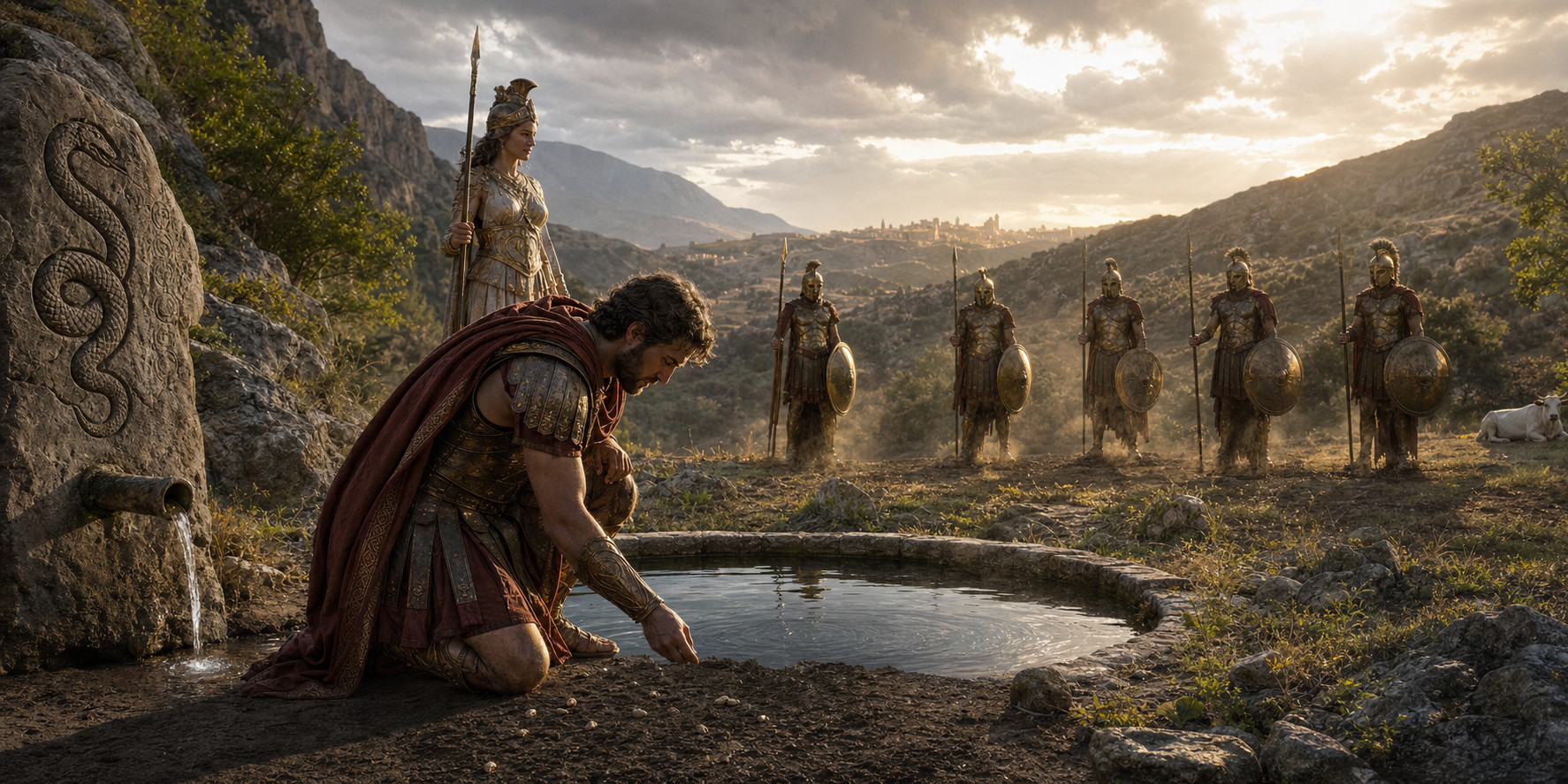
Cadmus follows the marked animal through Phocis into Boeotia. When it rests, he prepares to sacrifice it to Athena and sends companions to fetch water. The chosen place is not empty land: it contains a spring guarded by a dragon sacred to Ares.
Foundation therefore begins as an encounter with existing divine ownership. Cadmus has an oracle and a sacrifice to perform, but those permissions do not erase Ares’s claim. The conflict between commands produces the debt that shapes the city’s first generation.
The Dragon of Ares
The dragon kills Cadmus’s companions at the spring. Cadmus attacks and kills it, using weapons or a stone in different accounts. Heroic victory preserves the founder, yet the creature is not a random monster. It belongs to Ares and makes the killing a sacred offense.
The episode differs from simple monster slaying because success creates obligation. Cadmus gains water and place but loses companions and incurs service. The spring remains part of Theban memory, keeping Ares inside the city’s landscape before walls or royal genealogy exist.
Sowing the Teeth
Athena instructs Cadmus to sow the dragon’s teeth. Armed men called Spartoi rise from the ground and fight one another. One version says Cadmus throws stones among them so each suspects another; five survive and become ancestors of Theban houses.
The city is populated through violence turned into kinship. Earth-born warriors provide strength and local legitimacy, but their first act is mutual killing. The pattern anticipates later Theban stories in which people sharing a city or family destroy one another over uncertain claims.
Service to Ares
To atone for killing the dragon, Cadmus serves Ares for a divine year, interpreted by Apollodorus as eight ordinary years. The conqueror of the serpent becomes a servant of its divine father. Time, not another victory, is required before kingship can be secured.
Atonement prevents the foundation myth from treating sacred force as free material for a hero. Cadmus must acknowledge the god whose landscape he entered. His later marriage into Ares’s family turns repayment into alliance without pretending the original violence never happened.
Marriage to Harmonia
Zeus gives Harmonia, daughter of Ares and Aphrodite, as Cadmus’s wife, and the gods attend their wedding at the Cadmeia. Famous gifts include a robe and a necklace associated with Hephaestus. Later stories make the necklace part of continuing Theban misfortune.
The marriage joins mortal founder, war, desire, and divine craftsmanship. Harmony is not the absence of conflict but a relationship formed after debt and service. The wedding is among myth’s grandest celebrations, yet readers know the family that follows will suffer repeatedly.
The House of Cadmus
Cadmus and Harmonia have daughters Autonoe, Ino, Semele, and Agave, and a son Polydorus. Their descendants include Actaeon, Pentheus, Dionysus, Labdacus, Laius, Oedipus, and the brothers whose dispute brings the Seven against Thebes.
This genealogy makes Cadmus a junction rather than only a founder. Dionysian religion, heroic transformation, riddles, civil war, and tragic drama all grow from the household established at Thebes. Relationships across generations are often more important than direct encounters.
Exile and Serpent Form
After accumulated family disasters, Cadmus and Harmonia leave Thebes and travel among the Encheleans. They lead a successful campaign in Illyria according to Apollodorus. Finally both are transformed into serpents and sent to the blessed afterlife or promised release in variant traditions.
Serpent form recalls the dragon killed at the beginning. Ancient sources interpret the ending in different ways: punishment, completion, prophecy, or eventual divine favor. The founder becomes physically joined to the sacred creature whose death enabled his city.
What Cadmus Founds
Later Greek and Roman writers also connect Cadmus with the introduction of Phoenician letters, although this cultural memory is not identical with the older dragon narrative. His eastern origin allowed communities to think about how skills, names, and lineages cross the sea.
Follow Cadmus toward Thebes for the city, Ares and Athena for dragon and teeth, Dionysus for his divine grandson, and future routes toward Europa, Harmonia, Semele, the Spartoi, and the Necklace of Harmonia. His page opens the deepest roots of the Theban network.
Trivia
- Cadmus is told by Delphi to end his search for Europa and follow a cow.
- Only five Spartoi survive the first battle in the common account.
- Cadmus and Harmonia both become serpents at the end of their wandering.