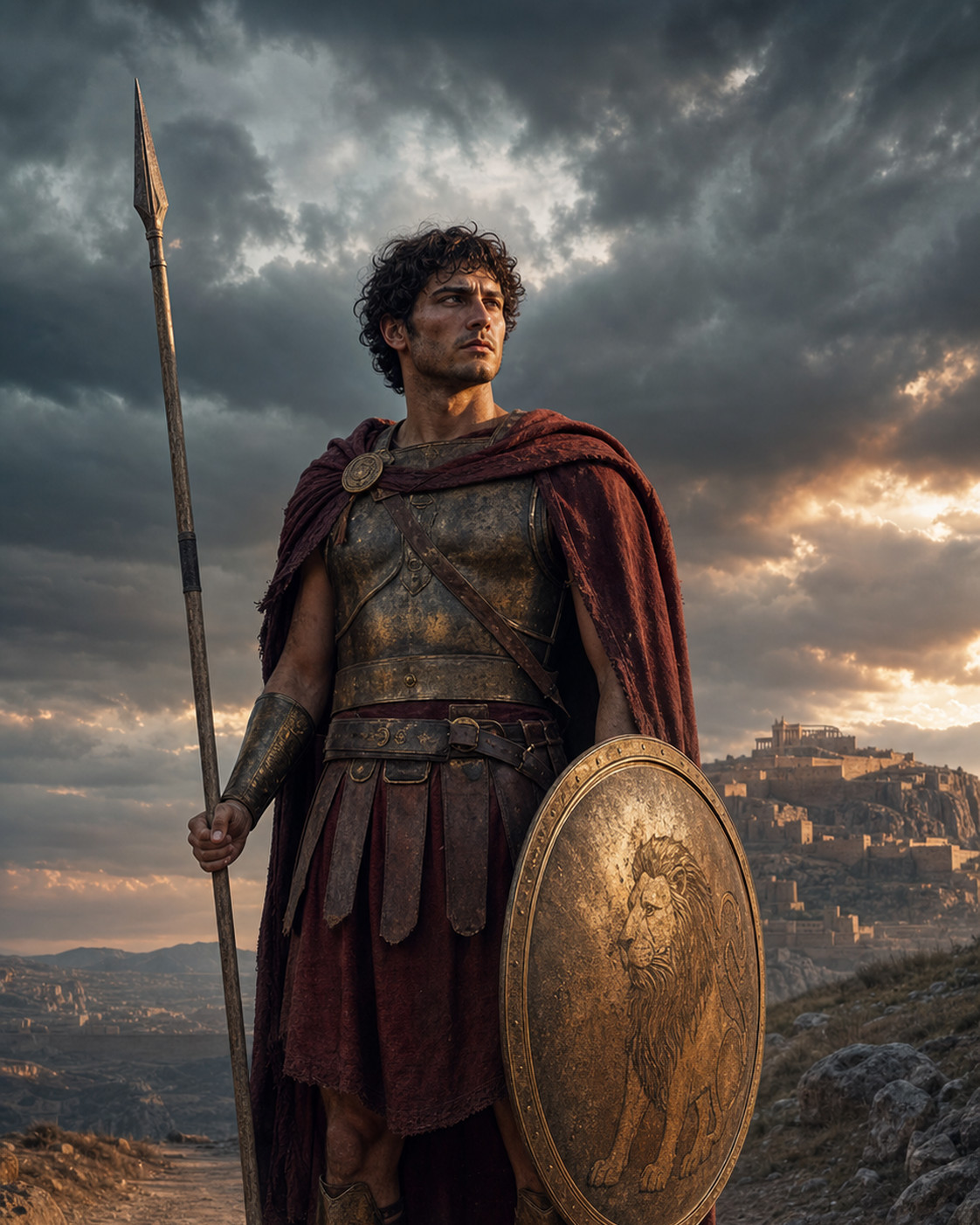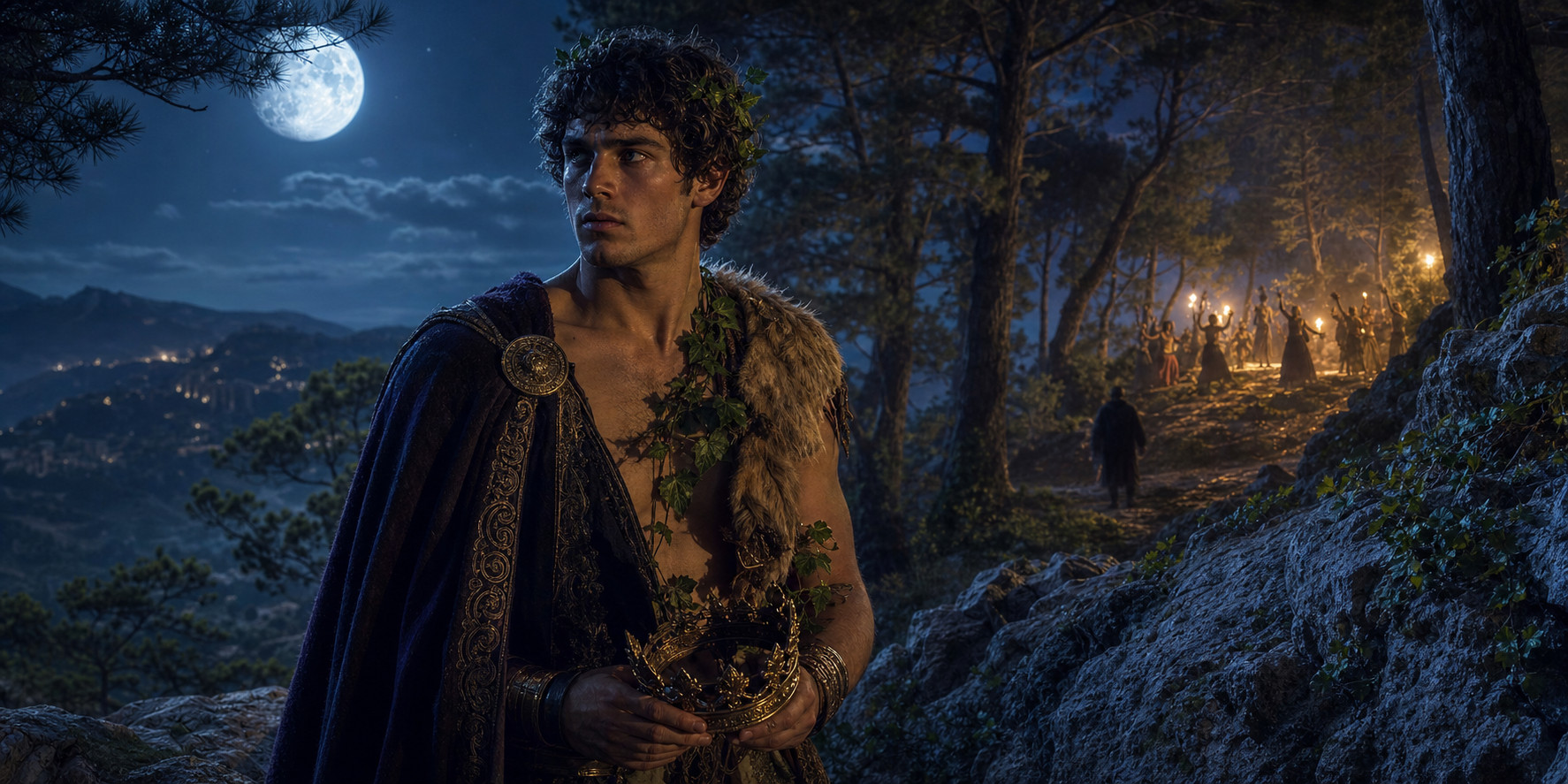
The ruler who tries to imprison divine transformation, then enters its hidden rites as watcher, disguise, and prey.
- Agave
- Bacchae
- Cadmus
- Cithaeron
- Dionysus
- Thebes
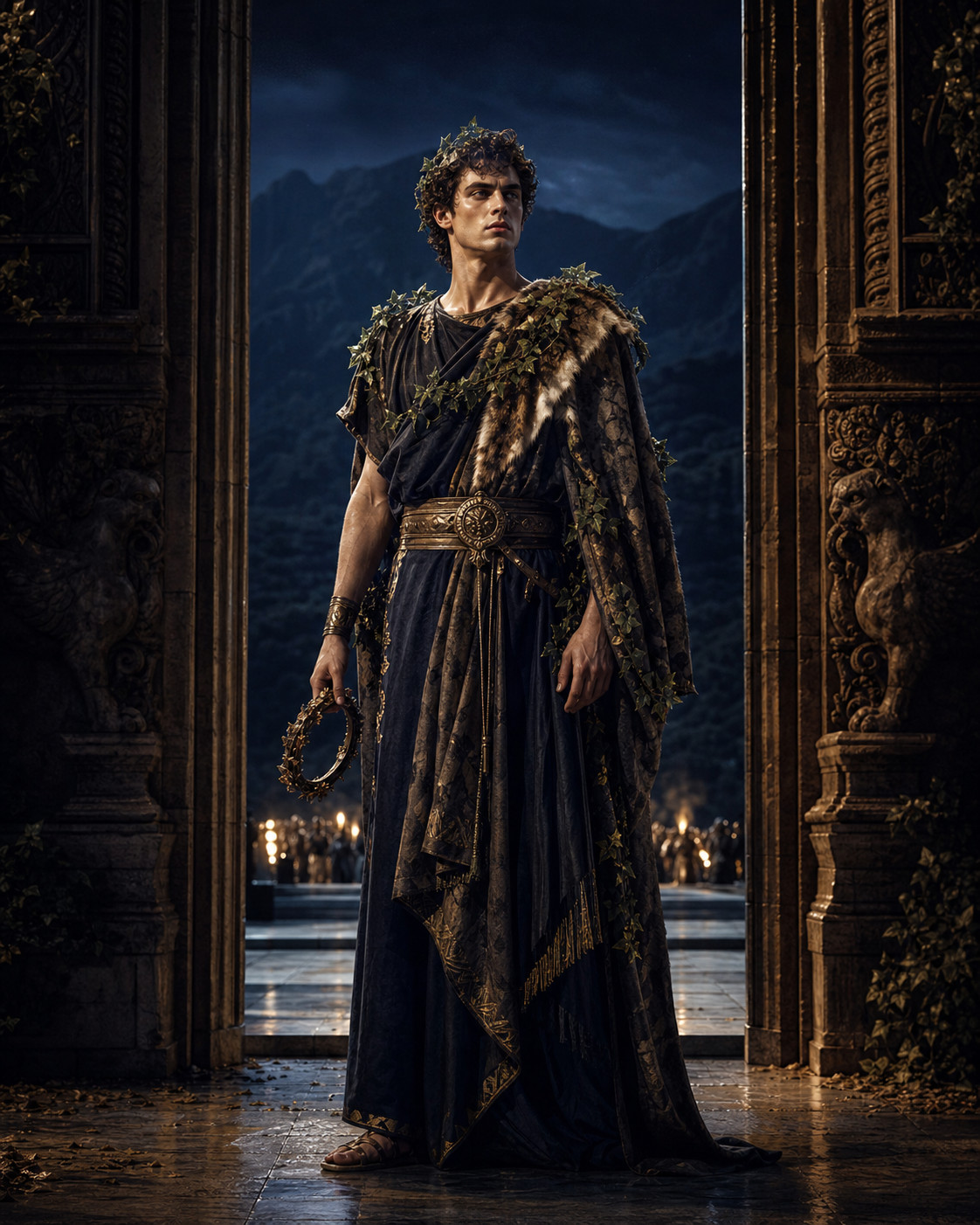
Pentheus is the young Theban king who denies Dionysus, arrests the disguised god, and is persuaded to spy on the Bacchants dressed as one of them. On Cithaeron, Agave and the frenzied women dismember him while seeing him as a beast.
Greek Mythology Timeline
Move through broad mythic ages and open the events that connect one story to the next. The sequence is a reading path, not an exact historical calendar.
Pentheus is the young king of Thebes who refuses to recognize Dionysus and tries to contain the god’s new rites through arrest, surveillance, and force. Son of Agave and the Spartoi warrior Echion, he rules the city founded by Cadmus while Dionysus returns as the son of Semele, another daughter of Cadmus. Euripides’ Bacchae makes the conflict a struggle within one family over divine identity, civic authority, gendered behavior, and the limits of observation. Dionysus escapes confinement, persuades Pentheus to disguise himself as a Bacchant, and leads him to Mount Cithaeron. There the frenzied women, including Agave, tear the king apart while believing him a wild animal.
Grandson of Cadmus
Pentheus is born to Agave, daughter of Cadmus and Harmonia, and Echion, one of the surviving Spartoi grown from the dragon’s teeth. His genealogy therefore joins the city’s divine marriage with the violent earth-born founders. He inherits Theban rule from or after Cadmus while still belonging to the generation that doubts Semele’s claim about Zeus.
Dionysus is Pentheus’s cousin. The conflict is not simply between a foreign god and a rational king, even though Dionysus arrives in disguise with rites associated with Lydia and Asia. The god returns to his mother’s home to establish honor, and the person denying him is a close relative ruling the family city.
The Return of Dionysus
In the Bacchae, Dionysus announces that Semele’s sisters claimed she lied about Zeus and was destroyed for inventing a lover. He drives the women of Thebes to the mountain and enters the city in human form as the leader of a Bacchic group. His purpose is recognition, punishment, and the establishment of worship.
Pentheus returns to find households disrupted and women beyond ordinary civic supervision. Reports of ritual behavior are mixed with male fantasies and accusations. He assumes sexual disorder and imposture before he has seen the rites. His first response is imprisonment, showing a ruler who treats religious change primarily as a policing problem.
Warnings from Cadmus and Tiresias
Cadmus and Tiresias prepare to honor Dionysus despite their age. They urge Pentheus to accept the god and warn that cleverness without reverence can be destructive. Their willingness to wear ritual dress appears ridiculous to Pentheus, who reads transformed clothing as evidence that social hierarchy has been inverted.
The elders are not presented as simple proof of every theological claim. Their speeches include civic prudence, family loyalty, and traditional piety. Together they offer Pentheus several reasons to avoid confrontation. He rejects all of them because acknowledgment would limit his authority and require accepting Semele’s disputed story.
The Stranger in Chains
Pentheus arrests the disguised Dionysus, questions him, cuts his hair, and orders him bound in the palace. The stranger answers calmly and repeatedly indicates that the god is near. Bonds fall away, the building shakes, fire appears, and Dionysus emerges unharmed. Royal confinement cannot hold a deity of altered form and released boundaries.
The prison scene exposes a mismatch of power. Pentheus believes that naming, cutting, chaining, and locking can stabilize the stranger’s identity. Dionysus controls what can be seen and where he appears. The king’s commands continue to sound official, but each one becomes part of a demonstration arranged by the prisoner.
The Herdsman’s Report
A messenger from Cithaeron describes the Bacchants resting modestly before divine energy moves through them. They nurse animals, draw water, wine, or milk from the landscape, and then become terrifying when attacked. They tear cattle apart and overwhelm villages, while weapons fail to wound them in ordinary ways.
The report offers Pentheus a chance to revise his assumptions. The rites are neither the simple sexual misconduct he imagined nor safely controllable civic ceremony. They combine order, abundance, altered perception, and violence under divine power. Instead of withdrawing, he becomes increasingly interested in seeing the women himself.
Desire to See
Dionysus shifts from captive to guide and persuades Pentheus to spy on the Bacchants. To avoid detection, the king must wear a woman’s ritual clothing. The disguise he previously mocked becomes the condition of his secret observation. Dionysus adjusts his dress and hair with an intimacy that also prepares him as a sacrificial victim.
Pentheus’s perception changes before he reaches the mountain. He sees double and imagines Dionysus with bull-like form. His desire is difficult to reduce to one motive: curiosity, control, voyeurism, attraction, and divine delusion overlap. The ruler who demanded public visibility now enters the hidden rites through disguise and manipulated sight.
Death on Cithaeron
Dionysus places Pentheus high in a fir tree so he can watch, then reveals him to the women. They uproot or bend the tree and seize him. Pentheus removes part of the disguise and appeals to Agave as her son, but she sees a lion or beast. She leads the dismemberment and carries his head back to Thebes as a hunting trophy.
The scene reverses nearly every claim of control. The watcher becomes spectacle, the hunter becomes prey, and the mother who should recognize kinship misidentifies her child. Pentheus is punished brutally, yet the play does not make the suffering emotionally simple. Cadmus must restore Agave’s sight and name the head she carries.
Recognition after Ecstasy
Agave’s return to ordinary perception is gradual. Cadmus asks her to look at the sky, the object in her hands, and her memories until she recognizes Pentheus. The god’s victory establishes divine power but leaves the house of Cadmus shattered. Exile and transformation follow in the play’s damaged ending.
Follow Pentheus toward Dionysus for the god’s return, Cadmus for the grandfather who warned him, Agave for the terrible recognition, Thebes for civic authority, and Cithaeron for the mountain outside ordinary rule. His story asks not whether a city needs order, but what happens when a ruler cannot distinguish order from total control over bodies, belief, and sight.
Trivia
- Pentheus and Dionysus are cousins through the daughters of Cadmus.
- His name was associated in antiquity with grief or suffering.
- In the Bacchae, Agave carries his head back to Thebes believing it is a lion’s.