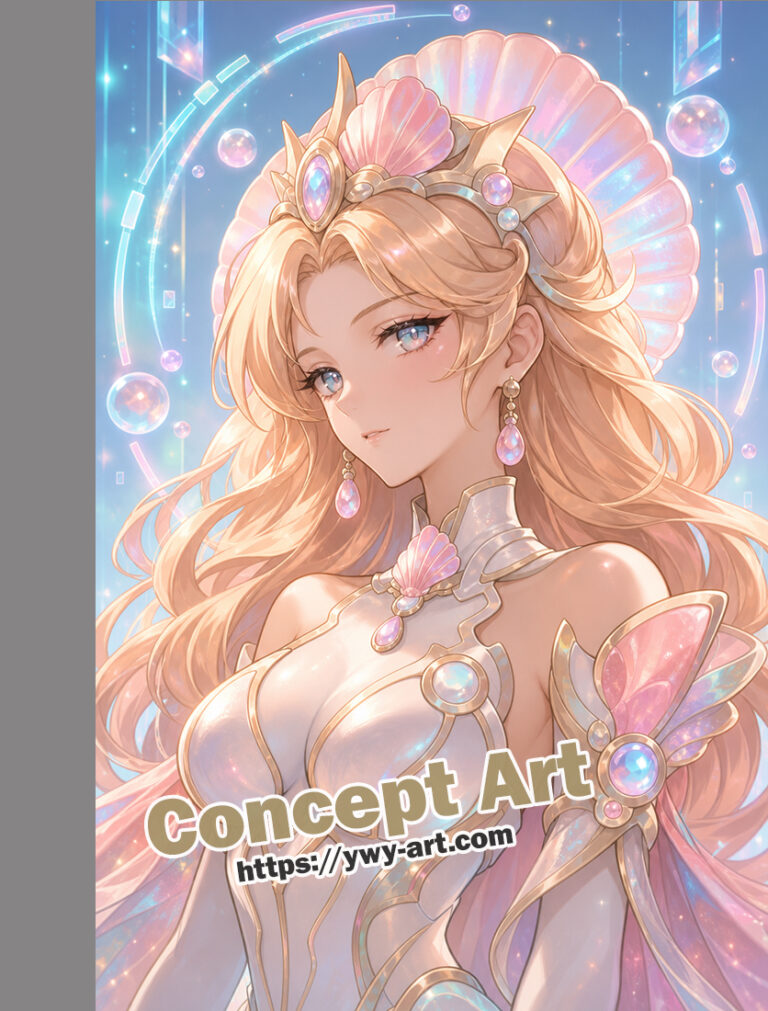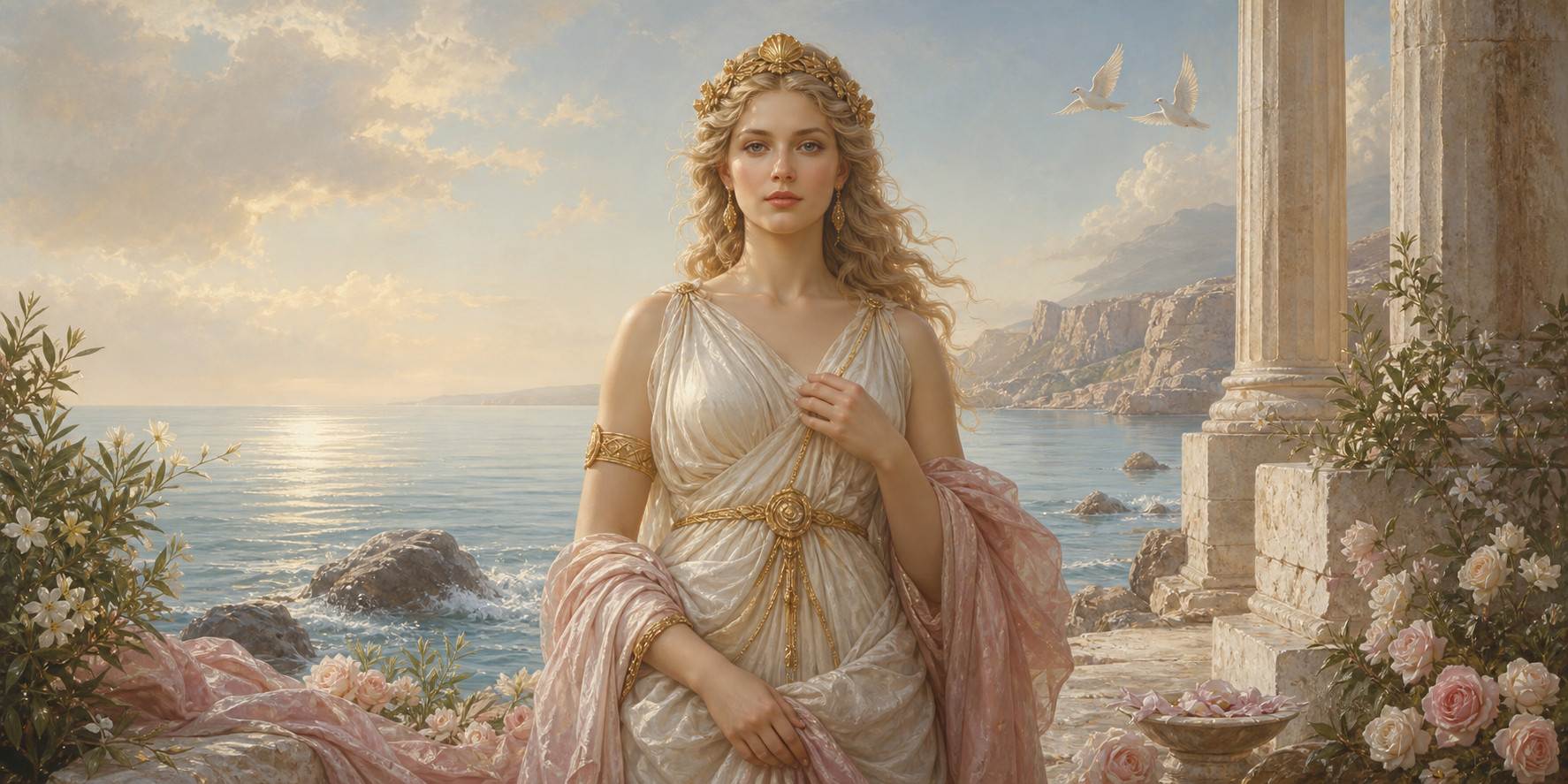
The power that draws gods, mortals, families, and cities together—and exposes conflict inside desire.
- Ares
- Cyprus
- Desire
- Harmonia
- Hephaestus
- Uranus

Aphrodite is the goddess of desire, beauty, sexuality, and generative union. Hesiod brings her from sea foam after Uranus's overthrow, while Homer calls her daughter of Zeus and Dione. Her power creates marriage and life but also rivalry and war.
Greek Mythology Timeline
Move through broad mythic ages and open the events that connect one story to the next. The sequence is a reading path, not an exact historical calendar.
Aphrodite is the Greek goddess who makes attraction a power capable of joining bodies, families, cities, and generations. She governs desire and beauty, but also marriage, fertility, persuasion, rivalry, and the political consequences of wanting. Ancient tradition gives her two major origins: Hesiod brings her from sea foam after the overthrow of Uranus, while Homer calls her a daughter of Zeus and Dione. Her myths show how beauty can create relation without becoming harmless.
Born from Sea and Succession
In Hesiod’s Theogony, Cronus casts the severed generative part of Uranus into the sea. Foam gathers and the goddess grows within it before reaching Cythera and Cyprus. Eros and Desire accompany her as she enters divine society. Beauty therefore emerges from a violent transfer of rule and transforms cosmic separation into renewed generative force.
The poetic connection between her name and aphros, foam, gives Cyprus and Cythera permanent places in her geography. This is not merely a decorative arrival from a shell. It links attraction with the moving sea, the older sky god’s lost fertility, and life’s capacity to arise after injury.
Daughter of Zeus and Dione
The Iliad preserves another family. When Diomedes wounds Aphrodite as she rescues Aeneas, she returns to Olympus and seeks comfort from her mother Dione. Zeus addresses her as his daughter and tells her that battle is not her work. This places her inside the younger Olympian household.
The two origins remained available rather than becoming one settled biography. Later authors could distinguish heavenly and common Aphrodites for philosophical or cultic purposes, but those systems are not a simple reconciliation. Project Mythos keeps the Hesiodic sea birth and Homeric parentage visible as alternatives.
Power over Gods and Mortals
The Homeric Hymn says Aphrodite bends gods, humans, birds, and animals toward union. Athena, Artemis, and Hestia are the great exceptions. Their resistance defines separate divine vocations, while her reach over nearly everything else makes reproduction and attachment part of the world’s continuing order.
Zeus makes Aphrodite desire the Trojan Anchises after she has boasted of causing divine-mortal unions. Disguised as a maiden, she approaches him on Ida and later reveals herself. Their son Aeneas carries her power into heroic genealogy and Roman tradition; the goddess who directs desire learns that she can also be directed by it.
Ares, Hephaestus, and the Net
The Odyssey’s song of Demodocus makes Aphrodite wife of Hephaestus and lover of Ares. The smith discovers them and constructs invisible bonds that trap the pair before assembled gods. Craft defeats speed and martial confidence, turning betrayal into a public dispute over marriage and gifts.
Other traditions emphasize Aphrodite and Ares as parents of Phobos, Deimos, and Harmonia. Their children join attraction with fear, terror, and concord. The pattern does not reduce love to peace; it places desire beside conflict and gives Thebes a bride whose gifts carry divine consequences.
The Trojan War
In the Judgment of Paris, Hera, Athena, and Aphrodite compete for the golden apple. Aphrodite offers Paris the most beautiful woman and receives his choice. Helen’s departure becomes a central cause of the Trojan War, bringing desire into diplomacy, hospitality, marriage, oath, and armed conflict.
During the Iliad Aphrodite protects Paris and Aeneas, rescues bodies, and is herself wounded. Her limited battlefield success contrasts with her enormous power over choices that create the war. The poem separates physical combat from the attachments and promises that armies cannot simply defeat.
Adonis and Mortal Loss
Adonis becomes one of Aphrodite’s famous mortal attachments. Accounts differ over his birth, her care, Persephone’s claim, and the division of his time. His death while hunting joins beauty with seasonal loss and ritual lament; later poetry expands details absent from earlier evidence.
The Athenian Adonia included rapidly withering gardens associated with women’s mourning. Their brief growth evokes desire without durable roots. Aphrodite’s sphere includes not only successful union, but grief produced when divine or human life attaches itself to what cannot be kept.
Cult and Symbols
Aphrodite received worship throughout the Greek world, with strong associations at Cyprus, Cythera, Corinth, and many harbors. Myrtle, roses, doves, sparrows, marine arrival, and adornment gather around her. Local titles could emphasize heaven, the people, armed protection, seafaring, marriage, or civic concord.
These titles warn against treating her as a modern category called romance. Sexuality, legitimate marriage, childbirth, persuasion, naval safety, and public harmony could all require divine negotiation. Beauty is part of her power, but belongs to the larger problem of bodies and communities being drawn together.
The Question She Opens
Follow Aphrodite toward Ares for attraction joined to war, Hephaestus for the crafted net, Uranus for the sea-birth genealogy, and Ariadne for later traditions of marriage and the starry crown. Harmonia, Anchises, and Paris open future Theban and Trojan routes.
Her myths repeatedly ask whether desire creates relation or destroys structures meant to contain it. The answer is commonly both. She produces children, marriages, alliances, and beauty, yet also rivalry, exposure, betrayal, and war. No lasting order can ignore the force by which beings choose one another.
Trivia
- Hesiod and Homer preserve different parentages.
- Athena, Artemis, and Hestia resist her power in the Homeric Hymn.
- Her Roman counterpart is Venus.
YWY Artwork Connection
Explore coloring pages and studio articles connected to this mythology entry.