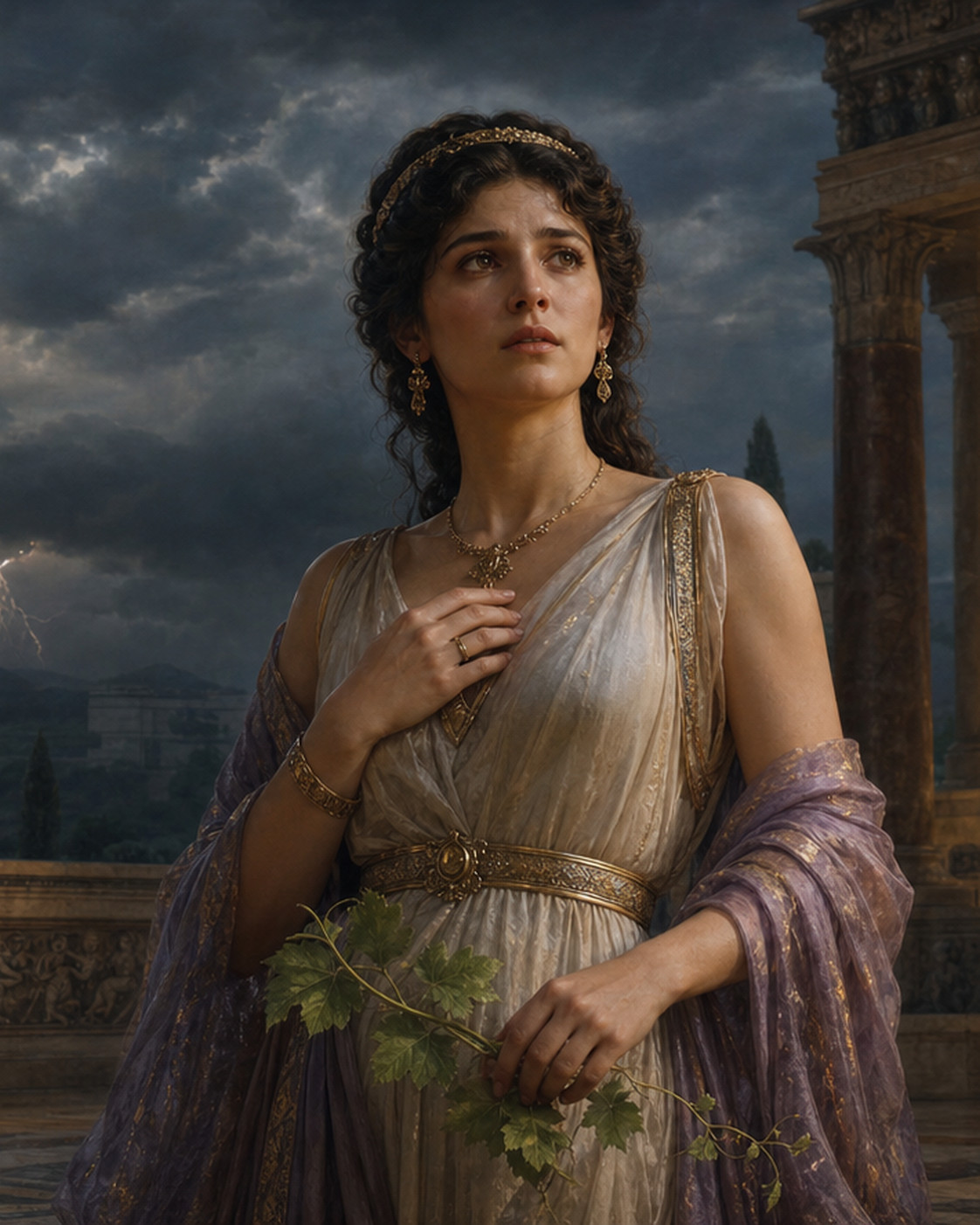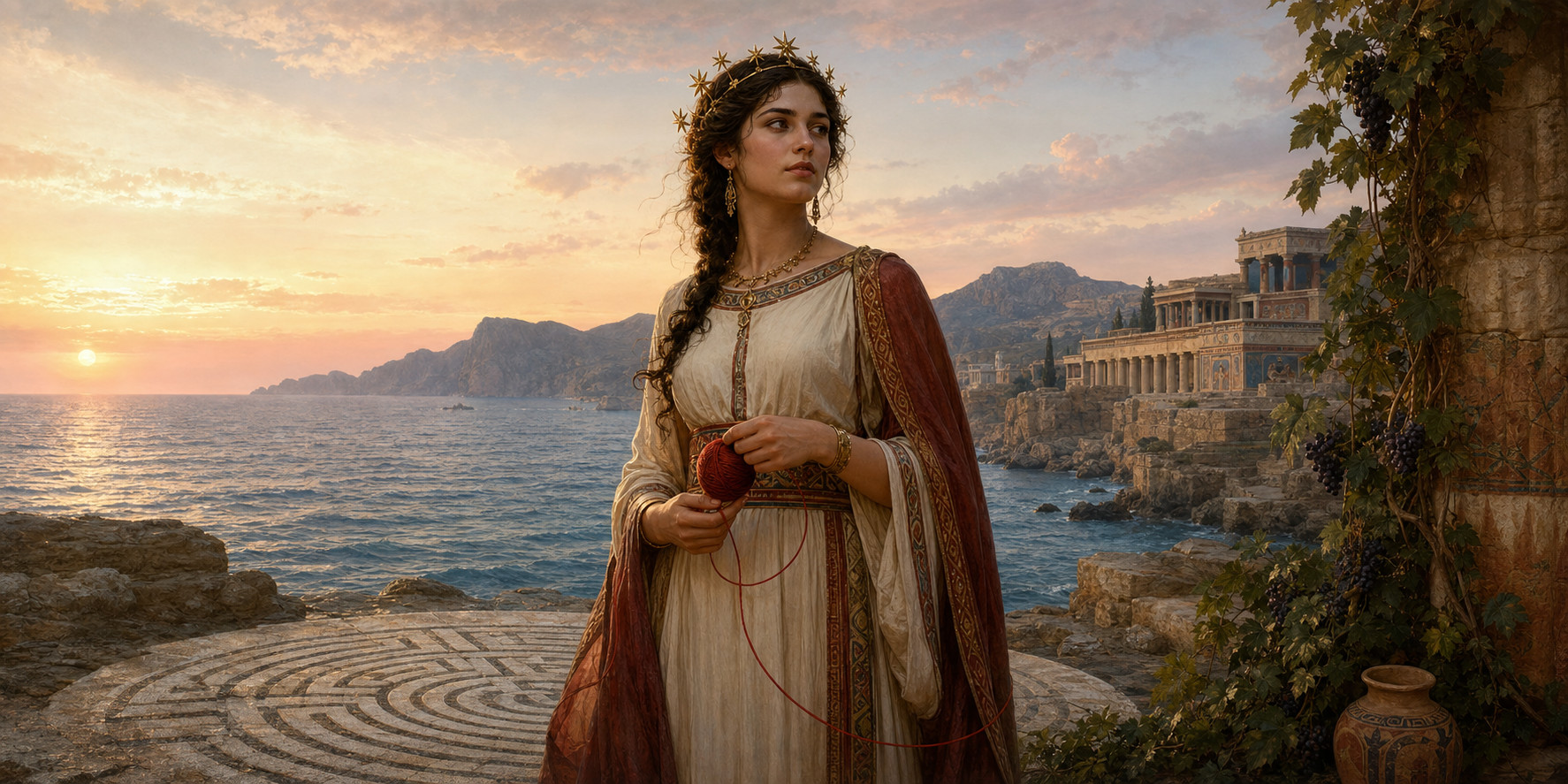
The keeper of the thread whose guidance defeats the Labyrinth while her future divides into competing endings.
- Dionysus
- Labyrinth
- Minos
- Naxos
- Theseus
- Thread
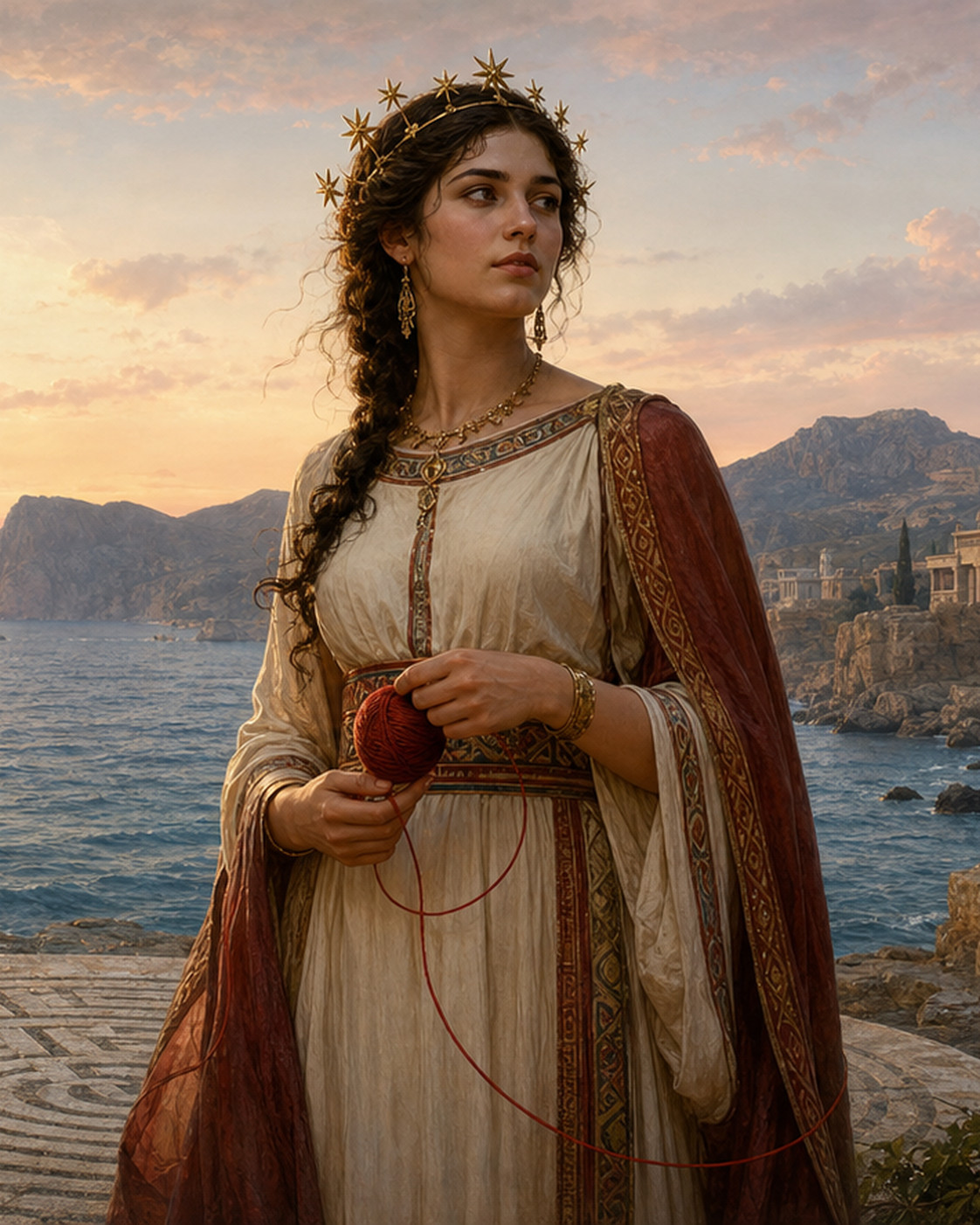
Ariadne gives Theseus the guidance that makes escape from the Labyrinth possible. Sources disagree whether she dies on Dia, is abandoned on Naxos, or becomes immortal wife of Dionysus.
Greek Mythology Timeline
Move through broad mythic ages and open the events that connect one story to the next. The sequence is a reading path, not an exact historical calendar.
Ariadne is the Cretan princess who turns the Labyrinth from an inescapable prison into a path that can be retraced. Daughter of Minos and Pasiphae and half-sister of the Minotaur, she gives Theseus the thread or guidance needed to kill the monster and lead the Athenians out. Yet ancient tradition gives her no agreed fate: Homer links her with death on Dia, many accounts make Theseus abandon her on Naxos, and Hesiod makes Dionysus her husband and Zeus render her deathless.
Inside the Cretan House
Ariadne belongs to the court containing the Labyrinth. Minos rules, Pasiphae bears the Minotaur after Poseidon’s punishment, and Daedalus builds the enclosure. Ariadne is royal insider and relative of the creature fed with Athenian youths; helping Theseus turns her against her own household.
Sources vary over siblings and first encounter. Plutarch preserves athletic, naval, romantic, and negotiated versions. Her assistance is central, but it belongs to a wider Cretan field rather than one universal scene.
Thread and Labyrinth
Ariadne gives Theseus a coil of thread, teaching him to secure one end and unwind it while entering. After killing the Minotaur he follows the line back and leads the youths out. Other versions emphasize a shining crown or Daedalus’s directions.
The thread is simple but decisive. Courage and a weapon cannot preserve orientation. Ariadne supplies memory made physical; each outward step depends on the path recorded during entry. Survival is collaborative rather than an individual feat.
Departure from Crete
Theseus sails with Ariadne and the rescued Athenians. Some traditions add disabled Cretan ships or a defeated commander; others move directly to Dia or Naxos. Ariadne leaves family, rank, and homeland before any promised future becomes secure.
The moral shape changes with the ending. She may be willing lover, promised bride, divinely directed helper, or princess drawn into conflict larger than her knowledge. Different sources should not be forced to prove one motive.
Competing Endings
The best-known later story has Theseus leave Ariadne sleeping on Naxos. Some condemn him; others say a god commands separation or Dionysus claims her. Plutarch lists pregnancy, death, nurses, and even different Ariadnes, showing that antiquity recognized instability.
The Odyssey offers an early difficult notice: Artemis kills Ariadne on Dia at Dionysus’s testimony before she enjoys Theseus. This does not match the later romantic rescue and must remain a distinct ending rather than being silently rewritten.
Bride of Dionysus
Hesiod says golden-haired Dionysus makes Ariadne his wife and Zeus renders her immortal and ageless. Mortal princess becomes divine bride, and her imagery gathers island, dance, wine, procession, and movement from human loss into altered sacred status.
Marriage can appear as rescue, replacement, or destiny independent of Theseus. Later art often shows Dionysus approaching sleeping Ariadne because one scene holds two stories: abandonment remains visible while a new divine life approaches.
The Starry Crown
A bridal crown given by Dionysus, or linked in variants to Aphrodite or Hephaestus, becomes Corona Borealis. The object’s genealogy changes. A starry circle turns a wedding gift into orientation, echoing the thread that once gave direction inside the Labyrinth.
Constellation stories are often later and do not erase early deaths. They show Ariadne’s imagery growing through thread, circle, dance, crown, and stars—patterns that help beings locate themselves in difficult space.
Ritual Memory
Delian tradition linked Theseus and the rescued youths with a winding crane dance imitating the Labyrinth. Ariadne’s enabling role stands behind the performance even when Theseus leads it. Naxian rites developed other sorrowful and joyful memories.
Plutarch reports practices that seem to distinguish forms or moods of Ariadne. The evidence requires care, but confirms she was not only literary. Communities used lament, celebration, dance, and geography to negotiate incompatible endings.
More than a Helper
Reception often reduces Ariadne to the woman with thread or the woman left on an island. Both matter, but neither captures her range. She turns against one household, saves victims, loses a future, dies in some versions, and becomes immortal in another.
Her agency is real but constrained. She controls escape, not every consequence afterward. Like Medea and other helpers, specialized knowledge enables heroic victory and then raises the question of what happens to the person whose intelligence the victory required.
The Question She Opens
Follow Ariadne toward Dionysus for marriage, Aphrodite for desire and crown traditions, and Hephaestus for one possible maker. Theseus, Minotaur, Daedalus, Crete, and Naxos remain future paths.
Her story asks whether a path out is also a path forward. The thread guarantees return from the center but cannot guarantee loyalty, safety, or one ending. She solves the spatial problem while myth leaves the human future unresolved.
Trivia
- The Odyssey preserves an ending unlike the familiar Naxos rescue.
- Hesiod makes her immortal as Dionysus’s wife.
- Her crown became Corona Borealis.
Reading the Traditions
Ariadne’s conflicting endings are a guide to responsible myth reading. An early epic death, local Naxian rites, a betrayed helper, and an immortal Dionysian bride cannot all be arranged into one uncontested sequence. Ancient authors already collected disagreements and sometimes proposed more than one Ariadne. The proper response is not to select the most romantic ending and hide the rest, but to ask what each setting needs from her. Athens remembers escape and dance; Naxos remembers separation and divine arrival; constellation lore turns her crown into permanent orientation. Across them all, Ariadne remains the person whose knowledge creates the route that heroic courage alone could not find.