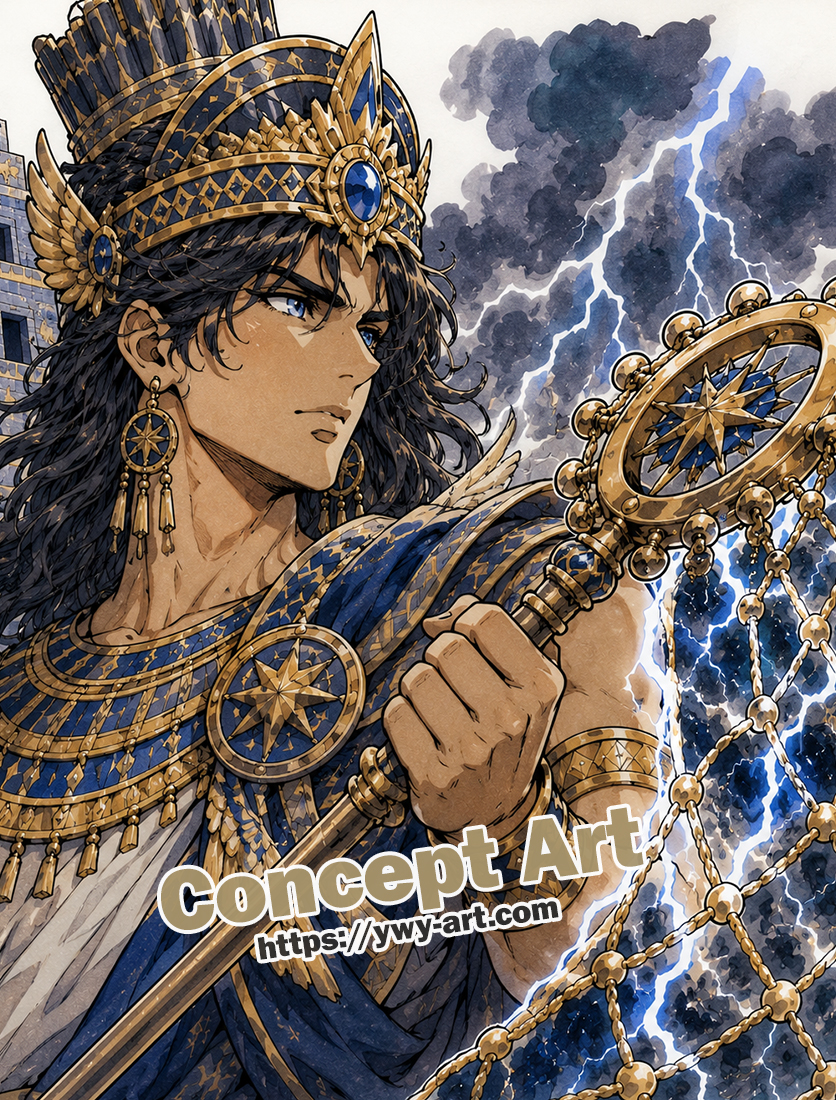
Marduk and the Net of the Four Winds – Storm, Kingship, and a Captured Sky
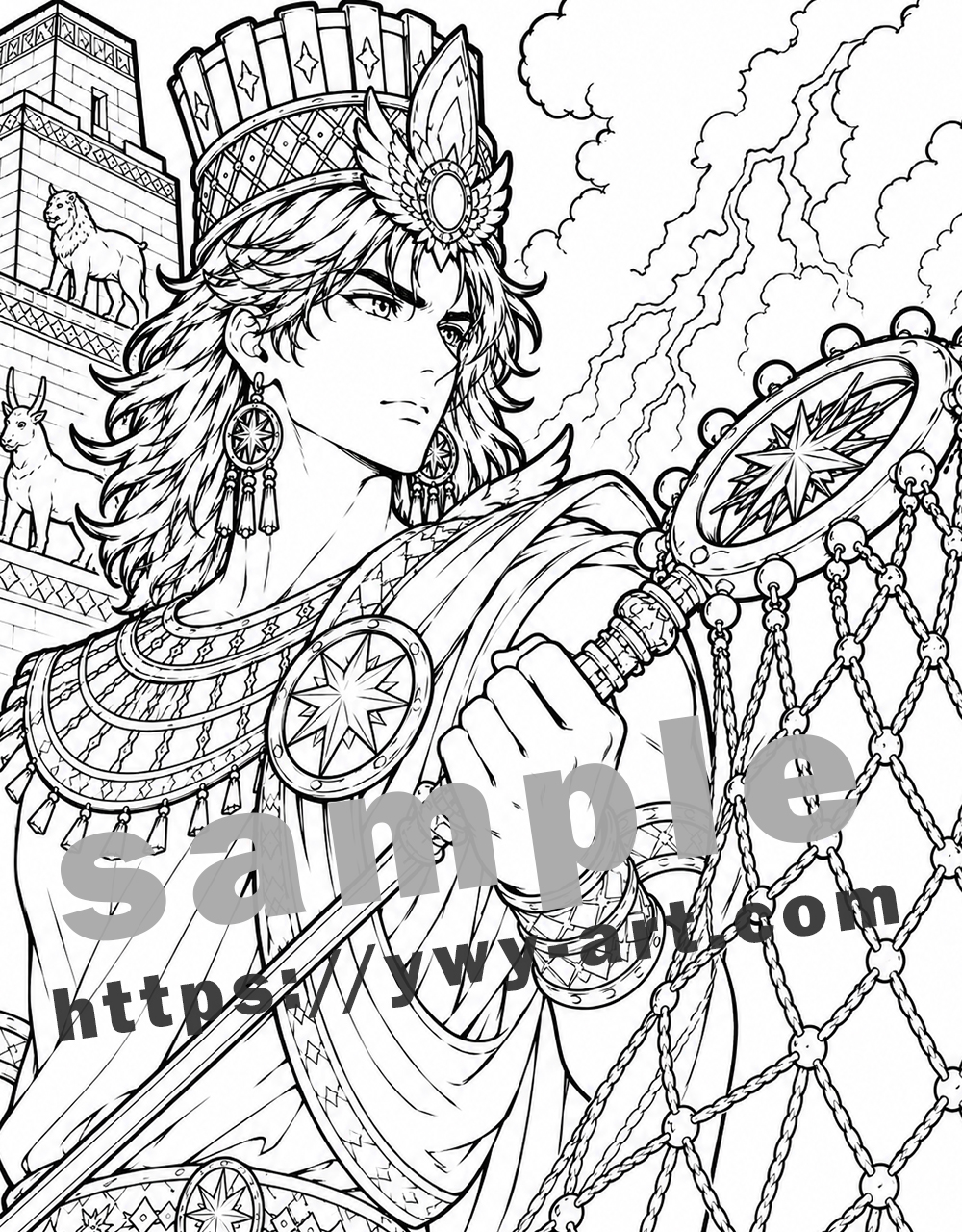
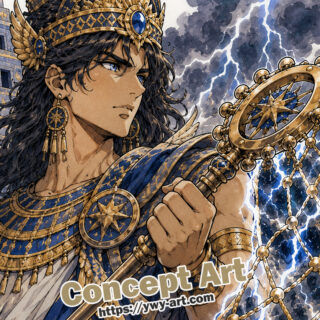
This page has a very different kind of strength from a simple weapon pose. Marduk is not only holding a staff or scepter here; the real drama is in the great net stretching across the right side of the artwork. It feels as if the storm itself has been caught in a golden mesh. Dark clouds gather behind it, lightning breaks through the gaps, and the blue-and-gold architecture in the background gives the whole scene a royal Mesopotamian atmosphere.
What I like most is that Marduk’s expression is controlled rather than furious. The page is full of thunder, metal, and pressure, but his face stays calm. That contrast makes the design more interesting to color. He looks like someone who does not need to shout to command the sky.
Who Is Marduk?
Marduk is one of the great gods of ancient Mesopotamian mythology, especially connected with Babylon. In later Babylonian tradition, he becomes the chief god, associated with kingship, order, storms, magic, and the protection of the city. He is often remembered through the creation epic in which he confronts Tiamat, the chaotic sea-dragon or primordial force.
In that mythic battle, Marduk does not win by brute force alone. He prepares with divine weapons, winds, a net, and a commanding presence that turns chaos into structure. That is why this page fits him so well. The artwork is not just showing a beautiful fantasy king. It is showing a figure who can gather violent forces, bind them, and reshape them into order.
For the Anime Gods and Mythic Relics Coloring Book, Marduk gives us a wonderful mix of ancient-world detail and dramatic fantasy design. The crown, earrings, layered garments, and star motifs all make the page feel ceremonial, while the lightning and net keep it active.
The Net as a Mythic Relic
The net in this illustration is the main relic, and it is a great choice because it is less obvious than a sword or spear. A net can look delicate at first, but in mythology it can be a symbol of control, strategy, and divine authority. Here it becomes almost like a portable piece of the heavens: gold knots, crossing cords, and storm-dark spaces caught between them.
I would think of this as Marduk’s Net of the Four Winds, a divine tool used to trap destructive chaos. The circular top of the staff has a starburst shape inside it, which echoes the stars on his chest ornament and earrings. That repetition helps the page feel intentional. The relic is not separate from Marduk’s identity; it belongs to the same visual language of sky, rulership, and celestial power.
The net also gives colorists a useful challenge. It is large, detailed, and placed close to the viewer, so it can easily dominate the page. If every bead, knot, and chain is colored with the same bright gold, the whole right side may become too heavy. A better approach is to separate the parts into levels: bright gold for the nearest highlights, darker bronze for inner shadows, and a softer ochre or muted yellow for the smaller connecting strands.
Details to Notice Before Coloring
The background architecture is important. The blue wall with gold animal reliefs immediately suggests Babylonian art and the famous glazed-brick feeling of the Ishtar Gate. You do not need to make it historically exact, but the page will feel stronger if the building stays in a blue-and-gold family rather than becoming random stone gray.
There are several repeated motifs worth connecting through color:
- The star medallion on Marduk’s chest
- The star design inside the relic
- The round earrings with star shapes
- The blue jewels in the crown and staff
- The gold animal forms on the tower
Using the same accent colors across these areas will make the finished page feel unified. For example, if you choose deep lapis blue for the crown jewel, repeat that color in the relic center and perhaps in small sections of the clothing. If you use warm gold for the star emblems, let that gold return in the architecture and the net.
A Palette I Would Try
For this fantasy coloring page, I would begin with a strong Babylonian palette: lapis blue, antique gold, storm gray, warm bronze, ivory white, and a few flashes of electric blue. The page already has a lot of line detail, so a limited palette will probably look more powerful than using many unrelated colors.
For Marduk’s clothing, deep blue is the natural anchor. You can shade it with navy, indigo, or even a little black at the folds. The trim and jewelry can move between yellow gold, bronze, and dark brown. His skin can be warmed with tan, sienna, peach, or soft brown shadows, depending on your preferred style.
The lightning should be planned early. I would leave the center of each lightning bolt nearly white, then surround it with pale blue, then a darker blue glow. This makes the storm feel luminous. If the lightning is colored too dark from the beginning, it loses its power. The clouds around it can be gray-violet, blue-gray, charcoal, or smoky purple, but try not to fill every cloud with the same flat shade.
Coloring the Net Without Losing the Design
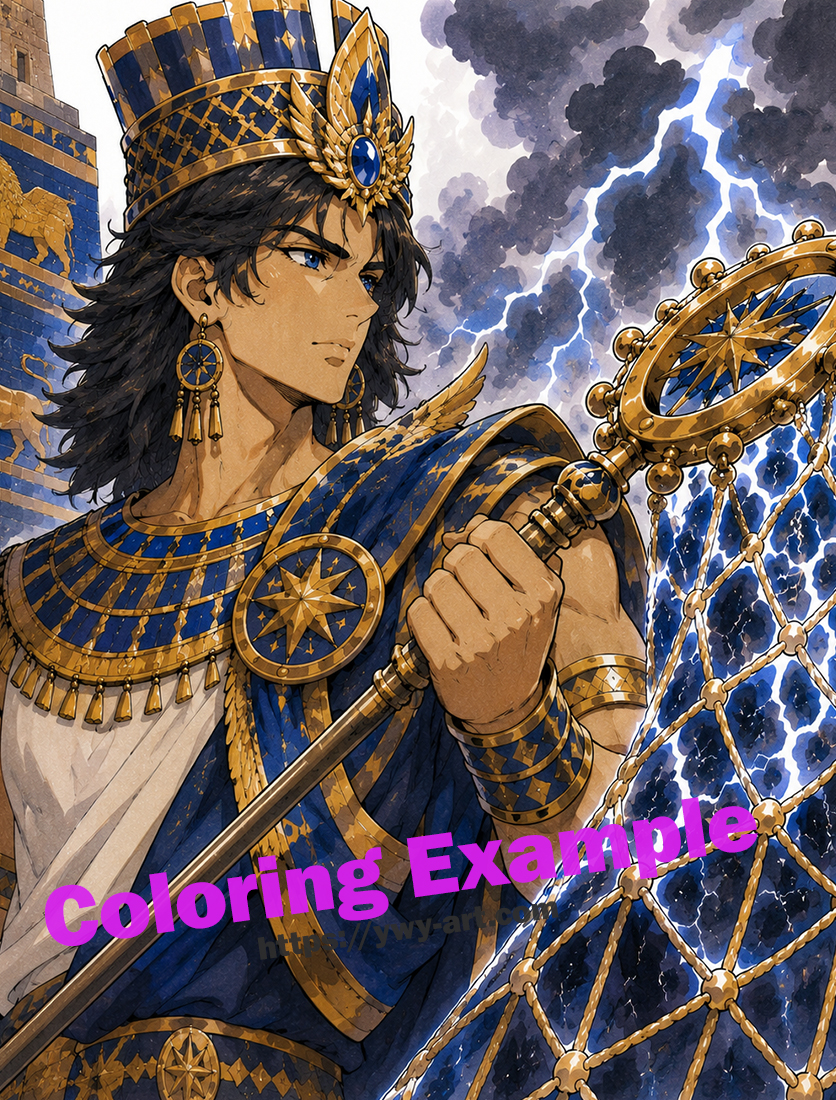
The net is probably the most time-consuming part of the page, and it deserves patience. Because it sits in the foreground, clean contrast will help a lot. I would color the round knots first, then the main diagonal cords, and finally the smaller chains. This order keeps the structure readable.
One practical warning: do not outline every gold strand with the darkest brown you own. It may seem like a good way to add depth, but it can make the net look muddy and overly busy. Instead, use darker shading only where strands overlap or disappear behind the beads. Leave some gold areas clean and bright so the relic still feels sacred and metallic.
If you enjoy metallic effects, this is a perfect page for gel pens or metallic pencils. A small touch on the starburst, bead tops, crown edges, and shoulder ornaments can make the finished artwork shine. Keep those highlights selective. The page has many decorative pieces, and if everything sparkles equally, nothing feels special.
The Mood of the Page
Marduk’s page has a strong feeling of command. The storm is not just weather in the background; it feels like something he has summoned, measured, and bound. The net gives the composition movement, while his upright posture keeps it steady. That balance is what makes the artwork satisfying.
I would avoid making the whole page too dark, even though the subject includes thunderclouds. The best effect will come from contrast: dark storm clouds behind bright lightning, deep blue clothing against warm gold, and pale fabric against the heavier ornaments. The white areas of the robe can stay fairly light, with only soft gray or beige shadows. They give the eye a place to rest.
For a softer version, you could make the storm more watercolor-like, with smoky lavender and pale blue. For a more dramatic version, push the clouds toward charcoal and make the gold very bright. Both approaches can work, as long as Marduk remains the calm center of the composition.
Final Coloring Thought
This is one of those mythic relics pages where the object tells the story as much as the character does. Marduk’s net is not just decoration; it explains his role as a god who confronts chaos and brings shape to it. When coloring, try to let that idea guide your choices. Give the storm movement, give the net structure, and give the figure enough quiet strength to hold everything together.
In the Anime Gods and Mythic Relics Coloring Book, this page is a beautiful chance to work with sacred weapons, divine artifacts, ancient architecture, and storm-light all at once. Take your time with the gold details, protect the brightness of the lightning, and let the blue tones carry that powerful Babylonian atmosphere.
Step into the world of mythology..
Available on Amazon Anime Gods and Mythic Relics Coloring Book Open in a new tab


コメント