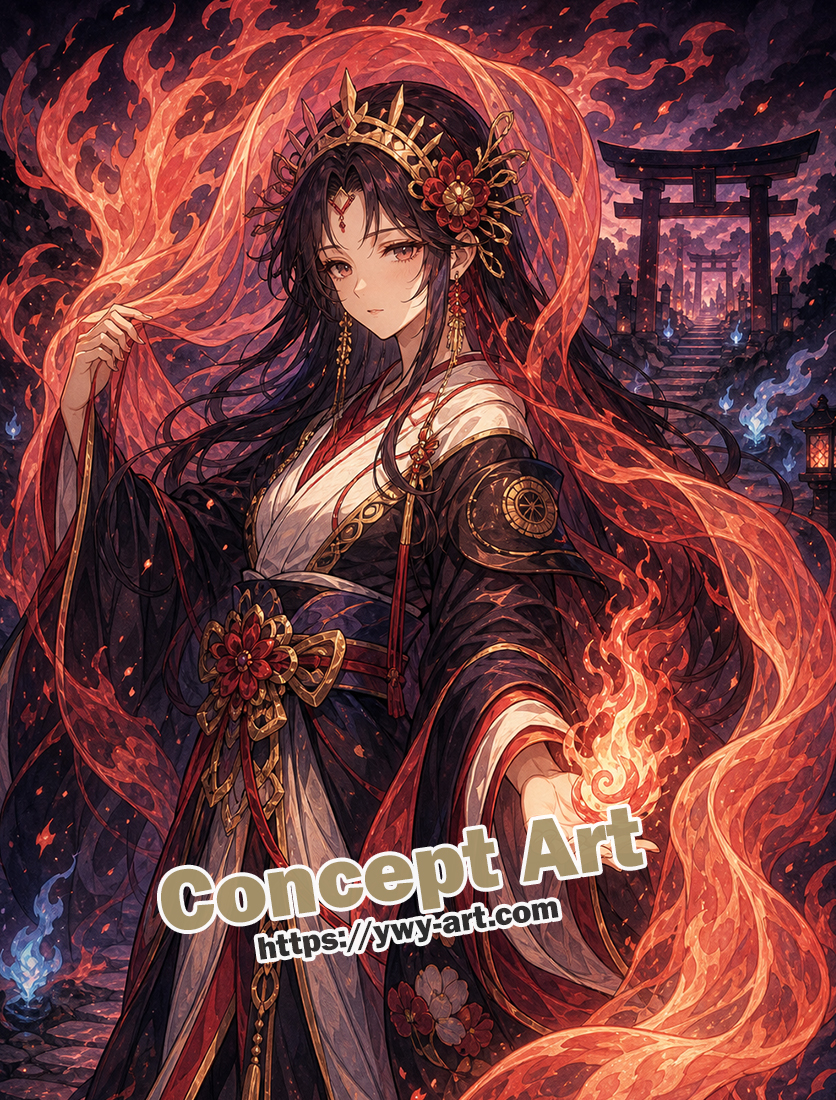
Amaterasu and the Flame Veil – Light Returning to the Sacred Path
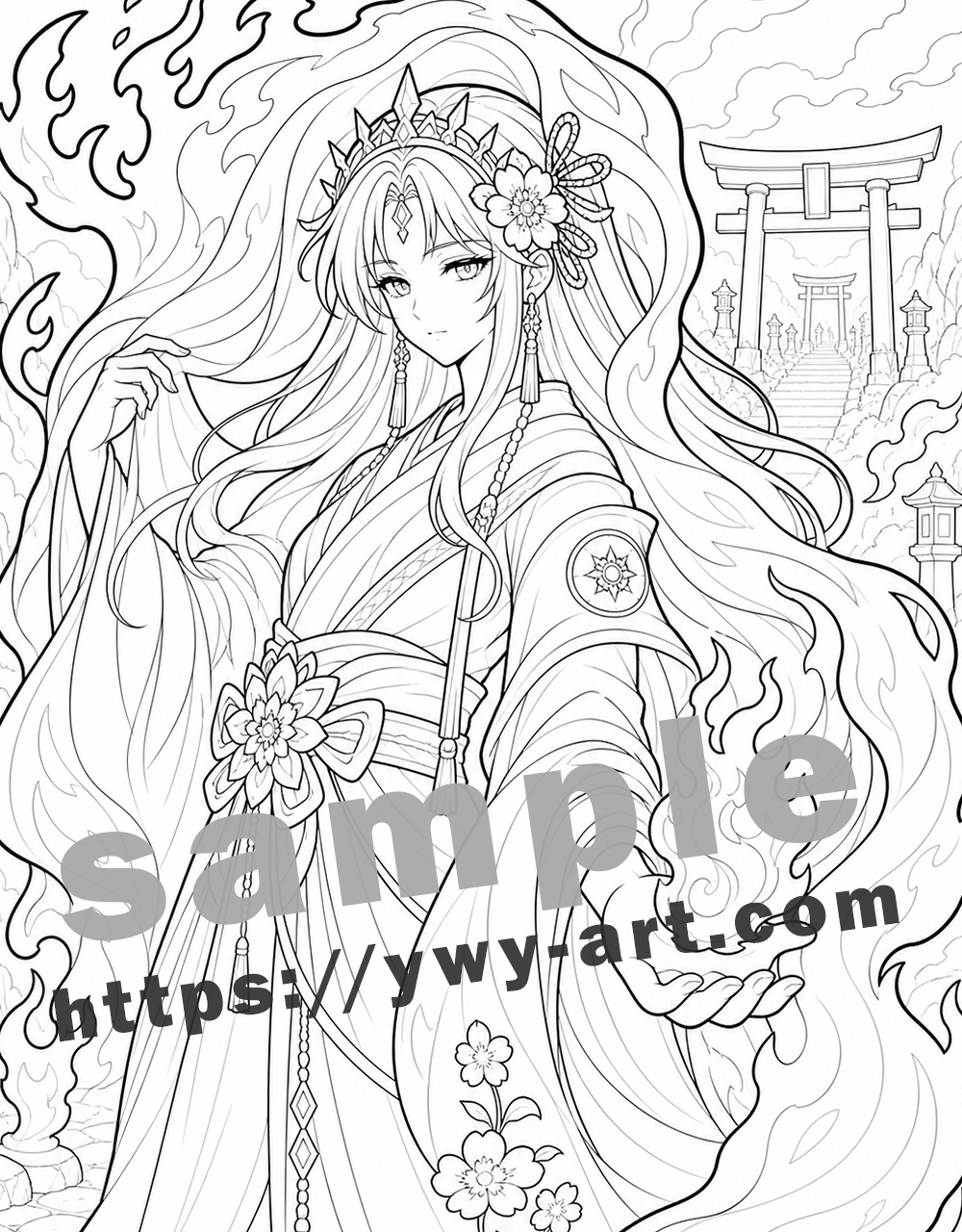
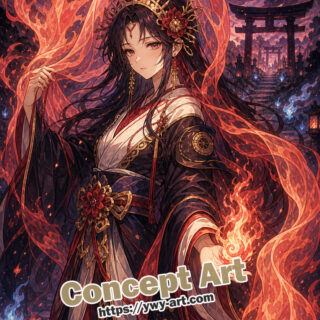
This page has a darker, more mysterious beauty than a simple sun-goddess image. Amaterasu stands in a shrine-like landscape, surrounded by torii gates, stone lanterns, drifting smoke, blue spirit flames, and a great ribbon of fire that curls around her like living fabric. The artwork feels ceremonial rather than explosive. The fire is powerful, but it is also controlled.
What stands out first is the contrast between her calm expression and the enormous movement around her. The flame veil loops behind her head, crosses the page, and rises from her open hand. It could have been drawn like ordinary fire, but here it behaves almost like silk. That mix of flame and fabric gives the page its personality.
Amaterasu in Japanese Mythology
Amaterasu is one of the most important deities in Japanese mythology. She is the goddess of the sun, associated with light, divine order, and the radiance that sustains the world. In one of the most famous myths about her, she hides in a cave and the world is covered in darkness until she is drawn out again, allowing light to return.
This illustration does not retell that story directly, but it carries a similar feeling: darkness around the edges, a sacred path in the distance, and a central figure holding light in her hand. The torii gates behind her make the scene feel like a threshold between worlds. She is not just standing in a landscape; she seems to be guarding or awakening it.
The anime mythology coloring book style gives Amaterasu a graceful, dramatic form. Her kimono, hair ornaments, crown, floral details, and long sleeves all create a refined silhouette, while the surrounding fire gives the page intensity. It is elegant, but not quiet.
The Flame Veil as a Mythic Relic
The relic in this artwork can be read as Amaterasu’s Flame Veil: a divine band of fire that wraps around her like a sacred garment. It is not a sword, shield, or staff. It is closer to a visible form of sunlight, warmth, and spiritual presence.
That makes the page interesting among the mythic relics in the Anime Gods and Mythic Relics Coloring Book. The artifact is not separate from the goddess. It moves with her, frames her body, and becomes part of the composition. The flame in her hand feels like the source, while the larger veil shows that light spreading outward.
When coloring this page, I would treat the Flame Veil as the main path for the viewer’s eye. It begins near her hand, curves across the lower right, rises behind her, and wraps around the top of the page. If you color that shape with strong, layered warmth, the whole artwork will come alive.
Reading the Composition
The composition is built on strong contrast. Amaterasu’s kimono has large dark areas, the background is filled with deep purples and shadow, and the fire cuts through everything with orange and gold. This gives the page a dramatic night-shrine atmosphere.
The main areas to plan first are:
- the Flame Veil, which should be the brightest and warmest element;
- Amaterasu’s face and hand, which need to stay clear and softly lit;
- the dark kimono, where subtle red and gold trim can prevent flatness;
- the torii gates and lanterns, which create the sacred background setting;
- the blue spirit flames, which add cool contrast to the orange fire.
This is a page where color balance matters a lot. If the entire background is colored too dark, the details may disappear. If every flame is equally bright, the page may lose depth. The best version will probably have one strongest flame area near her hand, then slightly softer fire as the veil moves away.
A Palette I Would Use
For this page, I would choose black violet, deep wine red, warm ivory, crimson, gold, orange, flame yellow, smoky purple, and a small amount of electric blue. The reference direction is rich and dramatic, and it suits the shrine setting very well.
For the Flame Veil, avoid using only one orange. Build it in layers: pale yellow at the hottest center, golden orange for the main body, red-orange around the edges, and a little dark red in the inner curves. The flame shapes inside the veil can be slightly different tones, almost like patterns in brocade fabric.
For Amaterasu’s kimono, deep black or charcoal purple works beautifully, but do not make it completely flat. Use dark plum, muted red, or blue-gray shadows in the folds. The white inner fabric can be shaded with pale gray, lavender, or a very soft warm beige so it stays luminous beside the darker robe.
The gold details should feel refined rather than loud. Her crown, earrings, cords, sleeve emblem, belt ornaments, and floral accessories can all use gold, but keep the brightest yellow highlights small. Too much bright gold will compete with the fire.
Coloring the Fire
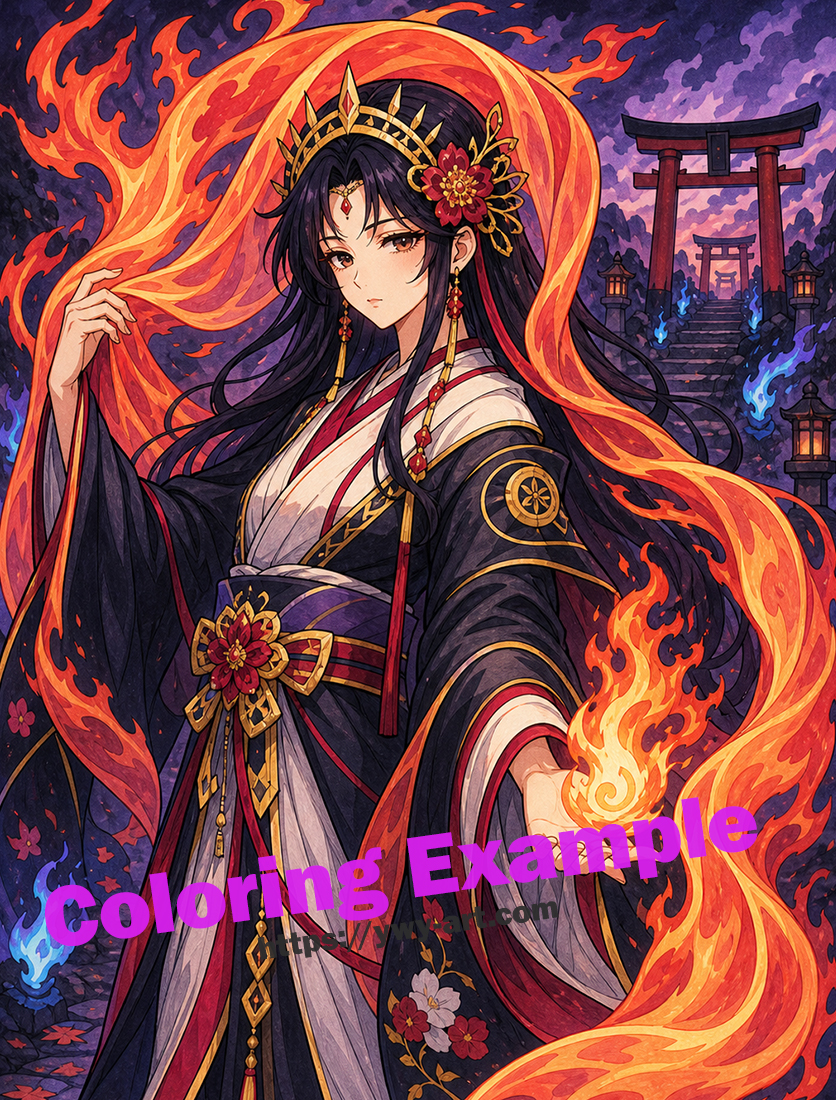
The fire is the most exciting part of the page, and it deserves patience. Start by deciding where the hottest light is. I would make the flame in her palm the brightest point, then let the larger veil glow around it.
A simple order for coloring the fire could be:
- leave the very center of the palm flame white or pale yellow;
- add yellow and golden orange around the center;
- use orange-red along the outer tongues of flame;
- place dark red or burgundy only in small shadow pockets;
- softly echo the orange glow on her fingers, sleeve edge, and nearby hair.
One practical warning: do not outline every flame shape too heavily with red or brown. The line art already gives the fire plenty of shape. If the edges become too dark everywhere, the flame may look solid and heavy instead of glowing.
The Shrine Background
The torii gates in the background create a strong sense of depth. They lead the eye back into the image and make the scene feel like a sacred approach at night. I would color the nearest gate in muted red or dark vermilion, then make the farther gates cooler and less saturated.
The lanterns can carry small warm lights, but they should not be brighter than the flame in Amaterasu’s hand. A little amber glow inside each lantern is enough.
The blue flames are a wonderful detail because they break the warm palette. Use pale cyan in the center, then blue and violet around the edges. These cool flames can suggest spiritual energy, mystery, or supernatural presence. Keep them selective; they are accents, not the main light source.
Small Details to Notice
The floral ornaments are easy to overlook because the fire is so dramatic, but they help soften the page. The flower in her hair and the large decoration at her waist can be deep red, burgundy, or muted pink with gold centers. This connects them to the warm palette without turning them into more fire.
Her eyes and face should stay gentle. Even though the image is intense, Amaterasu herself has a composed expression. Use soft skin shading and keep the eyes clear. A tiny warm reflection in the eyes can make her feel connected to the flame.
The long hair can be black, deep brown, or blue-black. I would add subtle red or violet reflections where the fire passes near it. That will make the hair feel part of the scene instead of a separate flat shape.
Final Note
Amaterasu and the Flame Veil is a strong page for anyone who enjoys dramatic contrast, glowing effects, and detailed costume coloring. It asks for both bold color and careful restraint. The fire should feel alive, but the goddess should remain calm at the center of it.
If you plan the light before filling in the details, this fantasy coloring page can become wonderfully atmospheric: a sacred night path, a quiet goddess of the sun, and a mythic relic that turns flame into flowing silk.
Step into the world of mythology..
Available on Amazon Anime Gods and Mythic Relics Coloring Book Open in a new tab







コメント