The secret experience that joined Demeter's grief, Persephone's return, and mortal hope.
- Afterlife Hope
- Demeter
- Eleusis
- Kykeon
- Persephone
- Sacred Road
- Sacred StoryDemeter reaches Eleusis during the search for Persephone.
- PreparationInitiates purify, gather, and begin the festival cycle.
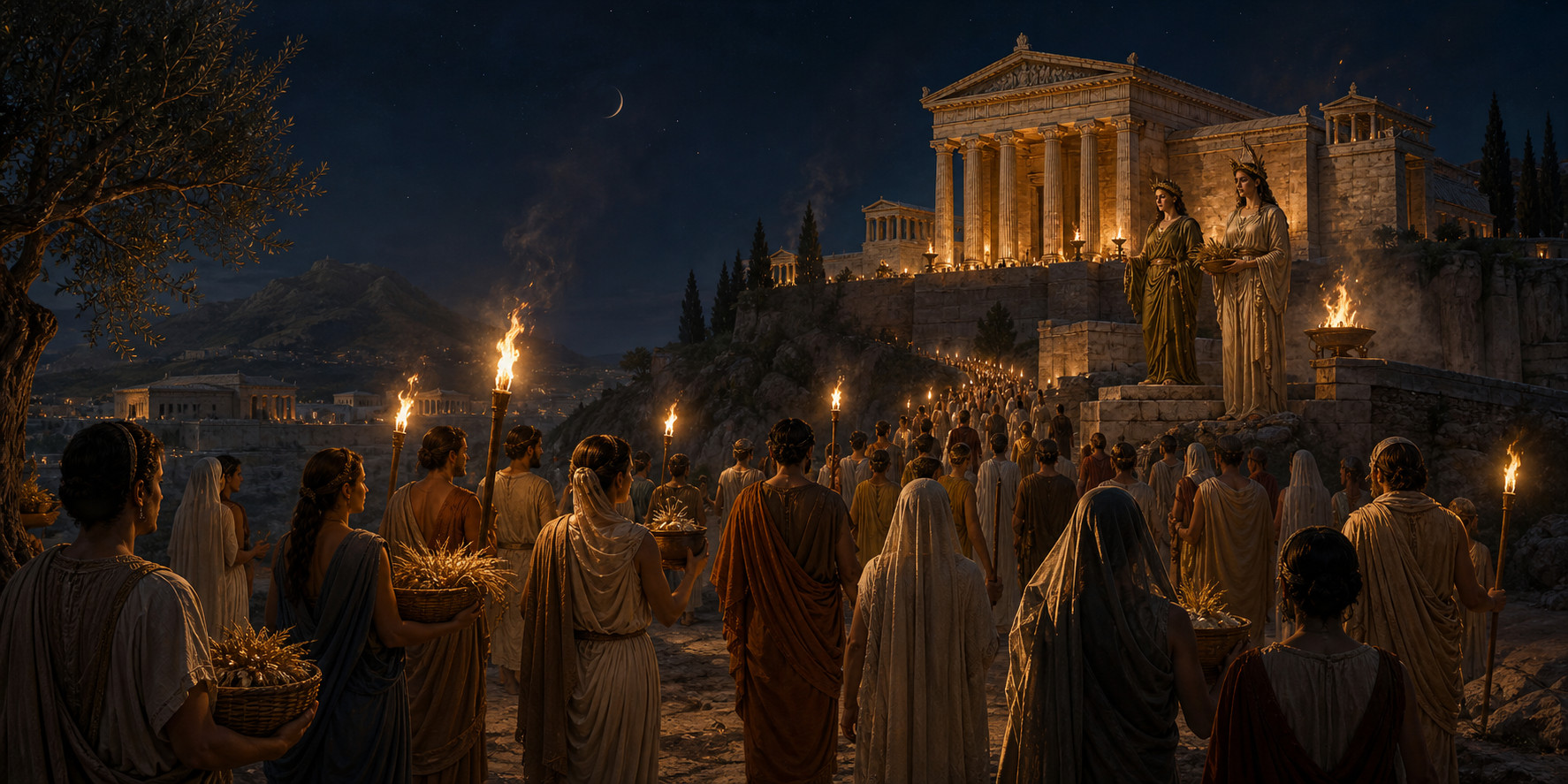
- Sacred RoadThe procession travels from Athens toward Eleusis.
- InitiationSecret acts, words, and revelations occur within the Telesterion.
- PromiseParticipants leave with a transformed hope concerning death.
The Eleusinian Mysteries were secret initiatory rites of Demeter and Persephone celebrated between Athens and Eleusis. Open to a broad range of eligible initiates, they joined procession, fasting, sacred revelation, and hope concerning death.
The Eleusinian Mysteries turned the story of Demeter and Persephone into an experience shared under vows of secrecy. For many centuries initiates traveled to Eleusis, fasted, processed, handled or witnessed sacred things, and left with a changed expectation concerning life and death. Because participants were forbidden to reveal the central rites, the Mysteries remain historically important precisely where modern certainty fails.
Demeter’s Arrival at Eleusis
The Homeric Hymn to Demeter provides the foundational sacred story. Searching for Persephone, Demeter reaches Eleusis in disguise and is welcomed by the daughters of Celeus. In the royal household she nurses Demophon and attempts to make him immortal, but his mother interrupts. Revealing herself, Demeter commands the Eleusinians to build a temple and teach the worship due to her.
After Persephone returns and the earth becomes fertile again, Demeter reveals her rites to local rulers. The hymn links divine grief, human hospitality, failed immortality, agricultural renewal, and ritual knowledge. Eleusis is therefore not merely the location of a festival; it is where disrupted relationships become a sacred institution.
Who Could Be Initiated
The Mysteries were unusually open by ancient standards. Women, men, foreigners, and enslaved people could participate if they met ritual requirements and understood the language used in the ceremonies. Murderers and others considered polluted could be excluded. Initiation did not erase social inequality, but membership crossed boundaries that many civic offices did not.
Individuals might first take part in Lesser Mysteries, associated with purification near Athens, before entering the Greater Mysteries. Details changed across the long history of the cult. A reconstruction must distinguish evidence from different centuries rather than treating Classical Athens, Hellenistic kingdoms, and Roman imperial patronage as one unchanging ceremony.
The Sacred Road
The Greater Mysteries were celebrated in the month Boedromion. Sacred objects traveled between Eleusis and Athens, and initiates gathered before processing back along the Sacred Way. The route included ritual actions, songs, jokes, and crossings remembered through local myths. At the bridge over the Cephisus, ritual mockery may have challenged participants and marked transition.
Procession made sacred geography bodily. Initiates did not simply hear that Demeter wandered; they moved between city and sanctuary. Torches, dust, crowds, fatigue, anticipation, and the approach to the Telesterion shaped the event before the most secret phase began.
Fasting and the Kykeon
Initiates fasted and later drank the kykeon, a mixture associated in the hymn with water, barley meal, and pennyroyal. Demeter accepts such a drink after refusing wine. The ritual meal connected participants to the goddess’s period of grief and to the cultivated grain she controls.
Modern theories sometimes claim that the drink contained a psychoactive substance. No consensus proves that such an ingredient was necessary or universal. Altered experience could arise from fasting, night ritual, expectation, performance, architecture, and collective emotion without reducing the ceremony to a hidden chemical recipe.
Inside the Telesterion
The great initiation hall at Eleusis, the Telesterion, held a large gathering around a central sacred structure called the Anaktoron. Ancient references speak broadly of things said, things done, and things shown. A hierophant and other hereditary officials directed the rites. Beyond such categories, confident narrative becomes difficult.
Later Christian authors offer hostile descriptions, while archaeological remains reveal buildings and objects but cannot reproduce an experience. Famous suggestions include sacred grain, fire, dramatic revelation, and reenactment. Some may reflect genuine elements, yet no surviving source supplies a complete authorized script. Responsible history preserves the boundary between attestation and imaginative reconstruction.
Hope after Death
The hymn declares that whoever has seen the rites is blessed, while the uninitiated does not share the same fate below. Other ancient authors similarly associate initiation with better hopes concerning death. The Mysteries did not necessarily teach one simple doctrine of personal immortality. Their promise may have been experiential, relational, and ritual rather than a creed summarized in a sentence.
Demeter and Persephone offered a pattern in which loss is real but not final, descent is repeated but accompanied by return, and grain emerges through cycles of concealment and growth. Initiates encountered mortality through a story that joined family reunion to the food sustaining civic life.
Political and Historical Life
Although centered on local priestly families, the Mysteries became closely connected to Athens. Athenian power protected, organized, and publicized the sanctuary. Hellenistic rulers and Roman emperors sought initiation and supported construction. The festival could express personal hope, civic identity, and international prestige at the same time.
The sanctuary suffered during wars and was eventually closed as the Roman world Christianized in late antiquity. The end was a historical process, not a single mythic moment. Ruins, inscriptions, art, and literary allusions preserve fragments of an institution whose defining revelation was never meant for public documentation.
What the Mysteries Mean
The Eleusinian Mysteries show that secrecy is not the same as absence. The central experience is hidden, but the roads, laws, buildings, participants, officials, sacrifices, and promises made a visible public world around it. Knowledge could be powerful because it was embodied and restricted rather than written for universal circulation.
They also prevent Demeter’s myth from becoming only an explanation of seasons. At Eleusis, the mother and daughter’s story organized community, memory, agricultural dependence, and hope before death. The ritual did not solve loss; it taught people how to enter a shared pattern of loss and return.
Where the Story Leads
Follow Demeter as founder and Persephone as the returning queen at the center of the promise. Hecate carries torches across the same boundary, and the Underworld gives initiation its mortal horizon. Future entries for Eleusis, Triptolemus, Demophon, and the Sacred Way open the sanctuary, transmission of grain, failed immortality, and ritual landscape.
Trivia
- The Mysteries admitted women, foreigners, and enslaved people as well as citizen men.
- The central rites remained secret despite the festival’s public prominence.
- The Telesterion was designed for a large gathered initiation rather than a conventional temple audience.