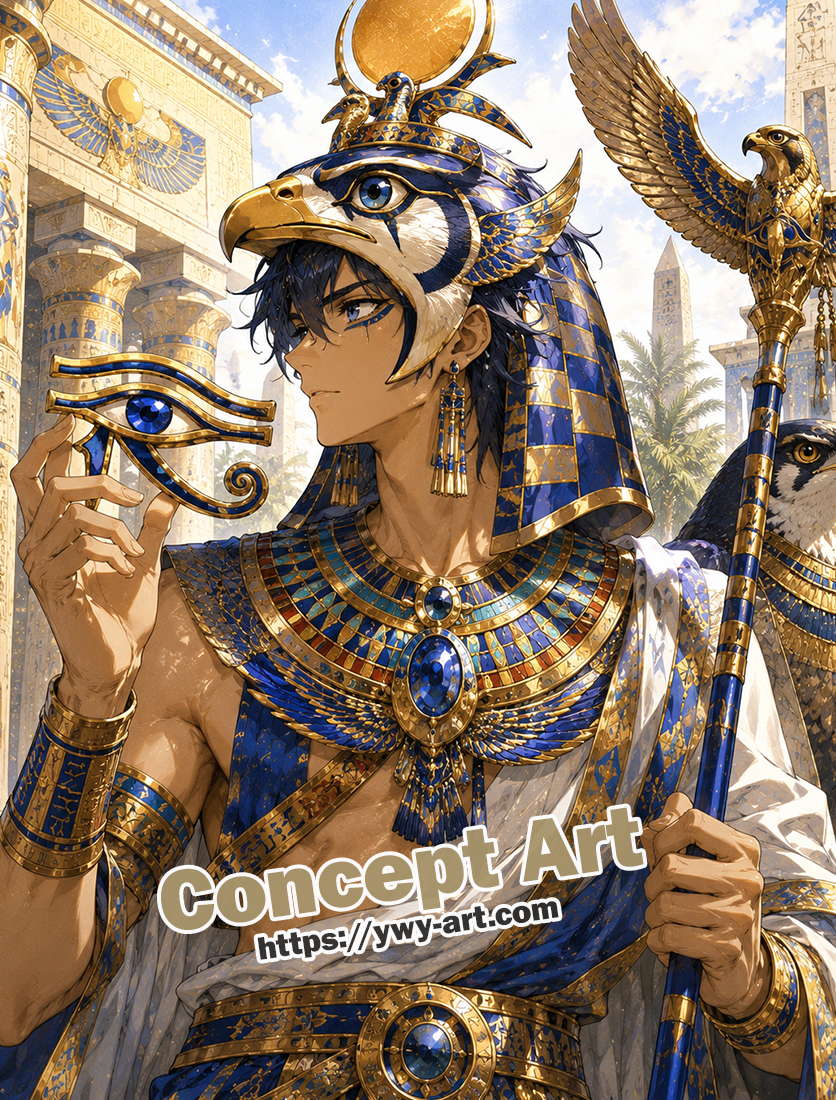
Horus and the Eye of Horus – Protection Beneath the Falcon Sky
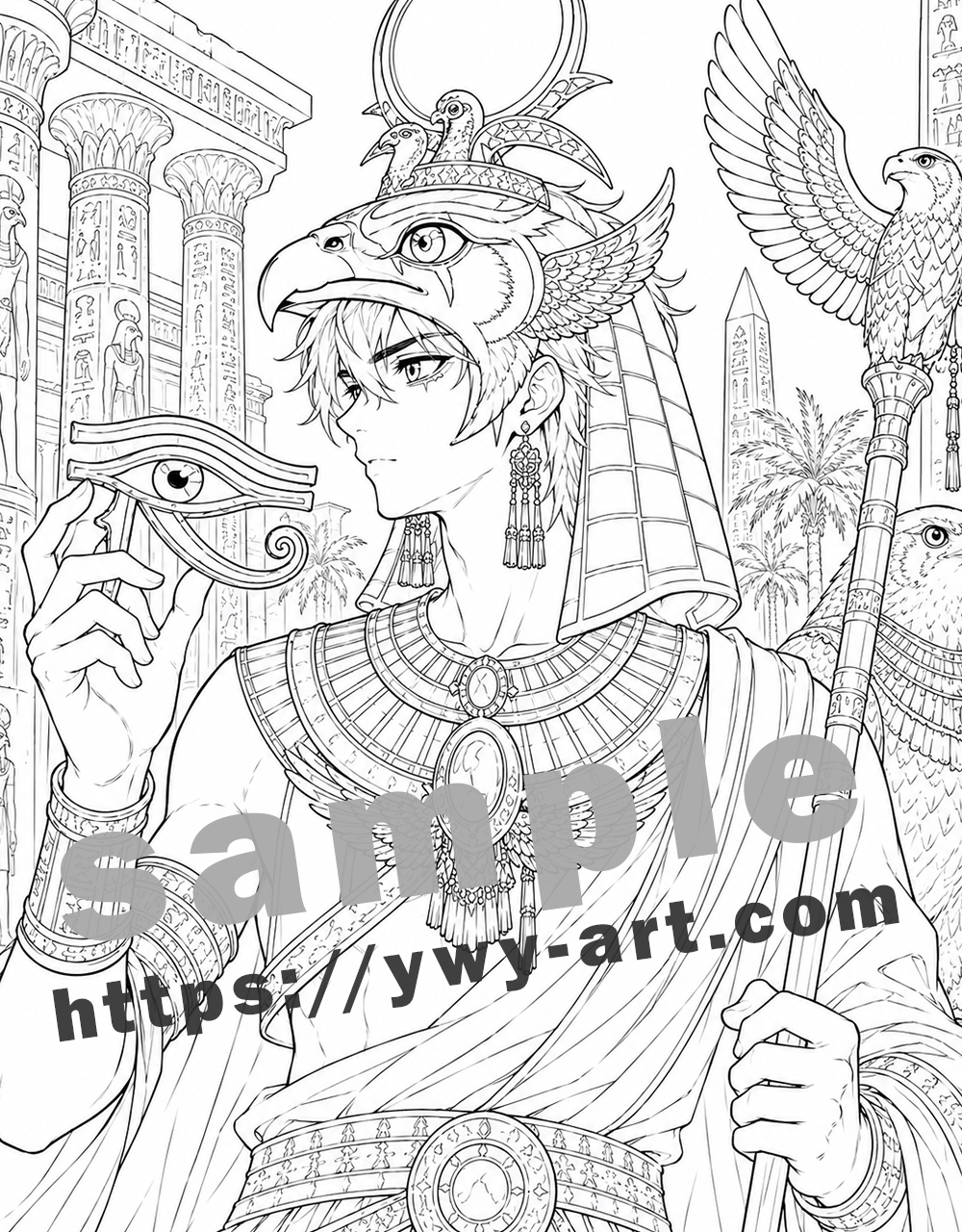
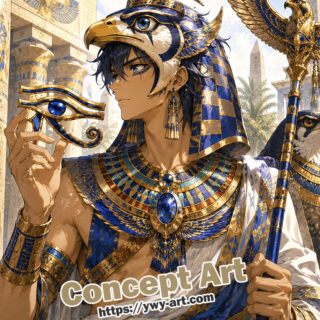
This page has a bright, ceremonial feeling from the first glance. Horus stands in profile, holding the Eye of Horus carefully between his fingers, while a falcon-topped staff rises on the other side of the composition. The background is filled with Egyptian columns, carved figures, obelisks, palm trees, and sunlit stone. It feels less like a battle scene and more like a sacred moment in a temple court.
What I notice most is how much the artwork depends on shape repetition. The eye in Horus’s hand, the falcon eye on the headdress, the blue jewels, the winged chest ornament, and the bird forms in the staff all echo one another. The page is full of symbols, but they are arranged cleanly, so the coloring experience can feel rich without becoming chaotic.
Who Is Horus?
Horus is one of the most recognizable gods of ancient Egypt, usually connected with the sky, kingship, protection, and the divine authority of the pharaoh. He is often represented as a falcon or as a human figure with a falcon head. In many traditions, Horus is the son of Isis and Osiris, and his struggle against Set becomes one of the major mythic stories of restoration and rightful rule.
Because Horus is a sky god, the falcon imagery in this coloring page feels very natural. The headdress has a strong bird-like mask, the staff is crowned with a golden falcon, and another falcon appears behind him like a watchful guardian. Even without reading the mythology, the page communicates sharp sight, high perspective, and royal protection.
In the Anime Gods and Mythic Relics Coloring Book, Horus brings a very different mood from the Mesopotamian water and storm pages nearby. This one is warmer, sunnier, and more architectural. It has the feeling of gold catching the morning light.
The Eye of Horus as a Divine Artifact
The relic in this page is the Eye of Horus, also known as the Wadjet eye. It is one of the most famous protective symbols from ancient Egypt. Traditionally, it is associated with healing, wholeness, royal power, and watchful protection. In mythology, the eye is connected to Horus’s conflict with Set and to the restoration of what was damaged.
That background makes the pose especially meaningful. Horus is not swinging the relic like a weapon. He holds it lightly, almost like he is presenting it or examining it. The object is close to his face, so the viewer’s attention moves from the relic to his eye, then upward to the falcon headdress. It is a smart composition because it keeps the theme of vision running through the entire page.
For coloring, the Eye of Horus should probably be one of the brightest focal points. I would not make it too dark. A strong blue jewel in the center, warm gold around the outline, and a little white highlight can make it stand apart from the surrounding costume details.
Looking at the Artwork
The page is built around a strong vertical rhythm. Horus’s body creates the central figure, the staff forms a tall line on the right, and the temple columns and obelisk continue that upward movement in the background. The curved Eye of Horus breaks up those verticals, giving the page a graceful shape near the hand.
The line-art version also shows how detailed the jewelry is. There are many bands, feathers, small hanging ornaments, collar segments, and tiny carved patterns. This is a page where slow coloring will pay off. It does not need to be rushed. The more carefully the gold and blue areas are separated, the more luxurious the final image will feel.
The falcon staff on the right is especially important. It could be treated as a secondary relic or a ceremonial standard. If it is colored with the same blue and gold language as the Eye of Horus, it will help frame the figure without stealing attention.
A Palette for Horus
This artwork naturally suggests Egyptian blue, bright gold, warm sandstone, ivory, black, and sunlit turquoise. I would choose the main blue first. A royal blue or lapis blue will give the page that classic Egyptian feeling, especially when paired with metallic gold or golden yellow.
A useful palette might include:
- Royal blue or lapis blue for the headdress, collar, staff, and Eye of Horus
- Gold, ochre, and bronze for jewelry and sacred ornaments
- Warm tan, sandstone, and pale beige for the temple architecture
- Ivory or soft white for the robe
- Dark navy or black for hair, shadow lines, and falcon markings
- Turquoise or teal for small accent stones in the collar
One thing to be careful with: do not make every gold part equally bright. Horus has gold on the headdress, collar, arm bands, belt, staff, and background carvings. If all of it is the same yellow, the page can look flat. I would use bright gold only on the closest sacred objects, then use muted ochre or bronze for some background details.
Coloring the Falcon Elements
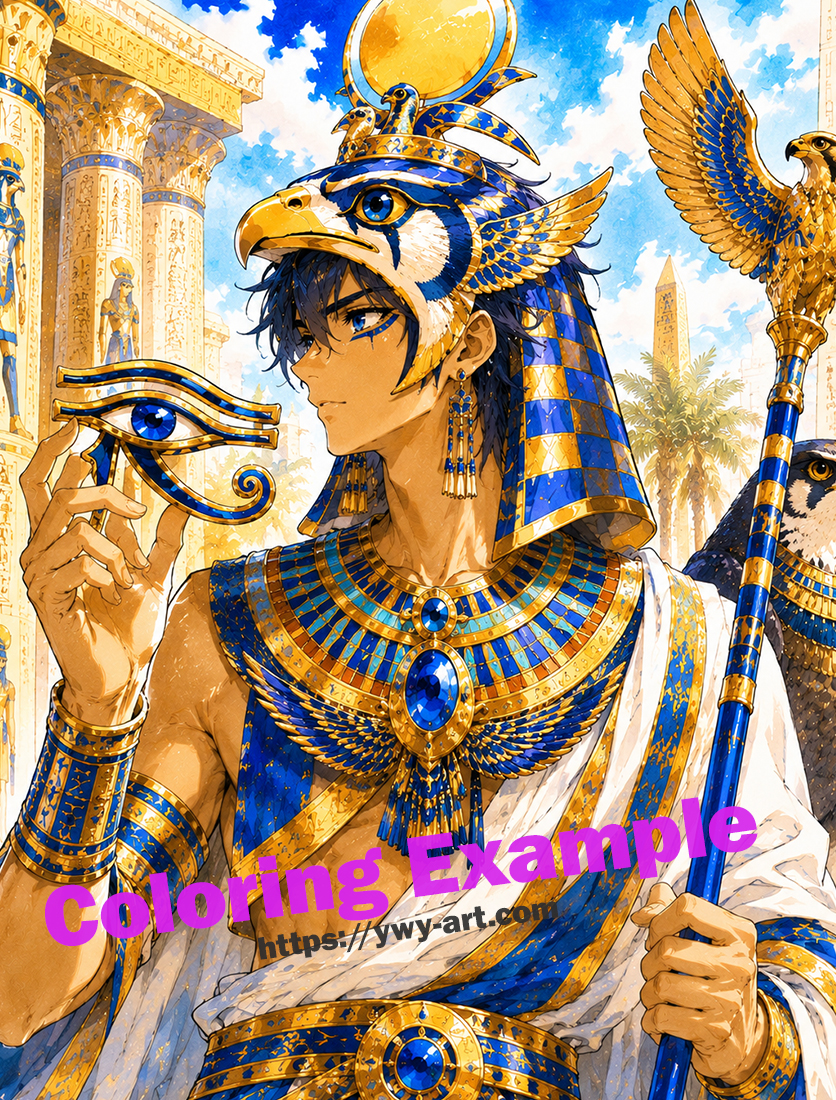
The falcon imagery is what gives this page its personality. The headdress can be colored like a ceremonial mask rather than a realistic bird. Gold for the beak, white or cream for the face area, deep blue around the eye, and black or navy line accents would work beautifully. The large eye on the headdress should stay sharp, since it mirrors the Eye of Horus in his hand.
The falcon on the staff can be more metallic and symbolic. I would use gold for the wings, with blue feathers near the lower sections to connect it to the costume. The real falcon behind Horus can be slightly more natural: brown, cream, dark gray, and gold around the eye. This contrast helps separate living guardian from sacred object.
If you want a bolder fantasy version, you could make all the falcons blue and gold. That would create a very unified design. If you want a softer version, keep the background falcon natural and reserve the strongest blue for Horus himself.
The Background Should Support, Not Compete
The Egyptian temple setting is full of beautiful details: carved columns, wall figures, an obelisk, palm leaves, and sunlit stone. It is tempting to color everything with high contrast, but the background should not fight the face and relic. I would keep the far buildings lighter and dustier, using beige, pale gold, sand, and soft blue shadows.
The carved figures on the left can be simplified. A little blue and gold on the statues is enough; they do not need the same level of detail as Horus’s jewelry. The sky can stay bright, with pale blue and white clouds. This will make the gold elements feel warmer.
The palm trees are a nice place to add natural green, but I would keep the green muted. Too much saturated green may pull attention away from the blue-and-gold theme.
Small Coloring Tips
Start with the focal points: Horus’s face, the Eye of Horus, and the he
Step into the world of mythology..
Available on Amazon Anime Gods and Mythic Relics Coloring Book Open in a new tab






コメント