Impossible service that carried Heracles from local monsters to the boundary of death.
- Athena
- Cerberus
- Hera
- Heracles
- Twelve Tasks
- Service ImposedOracle and purification bind Heracles to Eurystheus.
- Local MonstersThe first tasks confront threats across the Peloponnese.
- World ExpandsLater commands carry the hero across seas and foreign kingdoms.
- Two RejectedEurystheus disallows the Hydra and Stables, extending the count.
- Descent for CerberusThe final Labor crosses the boundary of death without killing its guardian.
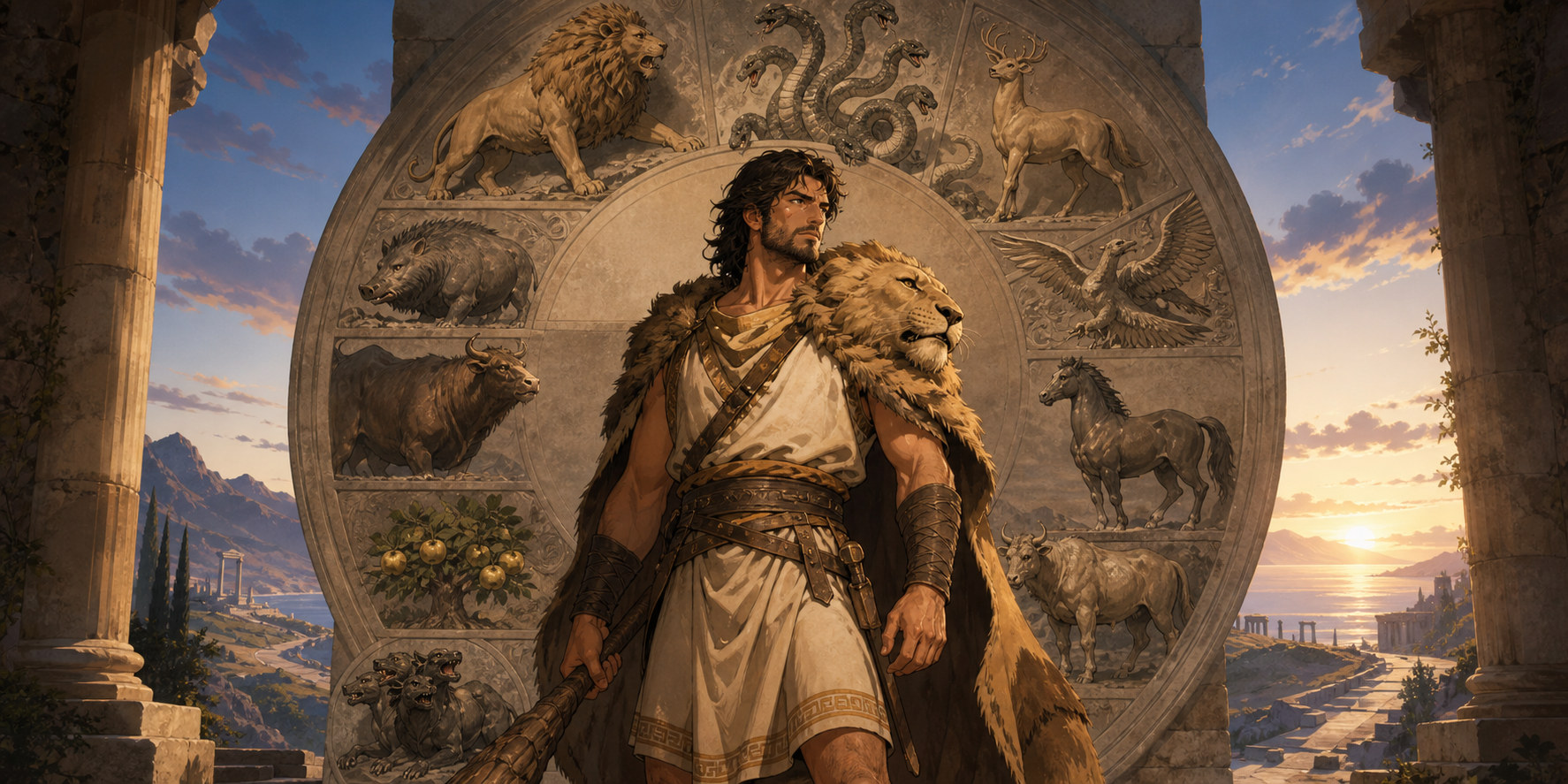
The Twelve Labors are the tasks Heracles performs under King Eurystheus after catastrophe and purification. The familiar ten become twelve when Eurystheus rejects the Hydra and Augean Stables. The cycle expands from Peloponnesian monsters to distant kingdoms, the Hesperides, and finally the Underworld, where Heracles captures Cerberus alive.
The Twelve Labors look like a list only after the suffering has been arranged. For Heracles, they begin as submission: a hero of unmatched strength must obey Eurystheus, a king he considers inferior, and turn impossible tasks into a path through guilt, humiliation, service, and finally the edges of the world.
Why Heracles Serves Eurystheus
Ancient traditions differ in emphasis, but the influential mythographic sequence makes Hera drive Heracles into madness, during which he kills his children. When he seeks purification and guidance, the Delphic oracle orders him to serve King Eurystheus and perform the commanded tasks.
Euripides places the madness after the Labors rather than before them, a major variation that changes the meaning of the entire career. The familiar order is therefore not the only ancient dramatic order.
Ten Tasks Become Twelve
Apollodorus explains why a commanded set of ten becomes twelve. Eurystheus refuses to count the Hydra because Iolaus helped burn the neck stumps, and he rejects the Augean Stables because Heracles sought payment. Two additional tasks—the Apples of the Hesperides and Cerberus—are imposed.
This detail turns counting into conflict. Who decides whether a heroic deed counts: the person who survives it, the ruler who commands it, or the tradition that remembers it?
The Peloponnesian Labors
The early tasks remain close to Eurystheus’s sphere: the Nemean Lion, Lernaean Hydra, Ceryneian Hind, Erymanthian Boar, Augean Stables, and Stymphalian Birds. Together they move through forests, marshes, mountains, farms, and lakes where dangerous animals or impossible conditions disrupt human land.
Heracles does not solve them all by striking harder. He traps the boar, redirects rivers through the stables, uses noise against the birds, and learns how to stop the Hydra’s heads from multiplying.
Beyond Greece
The later tasks widen the map: the Cretan Bull, the man-eating mares of Diomedes, the belt of Hippolyta, and the cattle of Geryon. Heracles crosses seas and enters the territories of rulers, warriors, and beings whose customs are not governed by Eurystheus.
As distance grows, each Labor becomes a chain of encounters rather than one monster fight. Hospitality, misunderstanding, theft, negotiation, and divine interference surround the named objective.
The Apples of the Hesperides
The eleventh Labor sends Heracles toward a guarded divine object whose location is itself difficult to learn. In Apollodorus he travels widely, wrestles the shape-changing Nereus for knowledge, and reaches Atlas. Traditions differ over whether Heracles gathers the apples himself or has Atlas retrieve them.
The task connects the hero to Gaia’s wedding gift for Hera, the Hesperides, a great serpent guardian, and the Titan who holds the sky. It transforms a simple command to fetch fruit into a tour of divine boundaries.
Cerberus and the Underworld
For the final Labor, Eurystheus orders Heracles to bring Cerberus from Hades. The hero must be initiated and purified in some traditions, obtain permission from the rulers below, and overpower the hound without ordinary weapons.
This descent is the strongest possible conclusion because it carries service beyond the world of the living. Heracles does not kill Cerberus. He brings the guardian upward, proves the task complete, and returns him to his proper place.
Helpers Behind the Strongest Hero
Athena repeatedly supports Heracles, and Hermes guides important passages. Iolaus provides decisive help against the Hydra. Other hosts, companions, and informants make individual routes possible. The Labors build Heracles’s fame, but they also expose the limits of solitary strength.
Eurystheus’s rejection of help in one task makes this theme sharper. The tradition celebrates cooperation while the commanding king uses cooperation as a reason to deny credit.
One List, Several Orders
Ancient authors and artworks do not always use the same sequence, names, or details. Some early art depicts individual feats before a canonical list of twelve dominates. Roman Hercules inherits and expands the cycle, and later collections make the numbered order appear more fixed than it was.
Project Mythos uses the common Apollodoran order as a navigational structure while marking meaningful alternatives. Each Labor can later become its own page without pretending that every source tells it identically.
From Punishment to Identity
The Labors begin under compulsion, but they become the visual grammar of Heracles. Lion skin, club, Hydra poison, captured beasts, distant cattle, apples, and Cerberus turn service into a set of attributes recognizable across the ancient world.
The cycle does not erase the deaths that led to service. Its power comes from the tension between atonement and glory. Heracles performs deeds useful to communities, yet his fame grows from a punishment imposed after catastrophic harm.
Where the Story Leads
Follow Heracles for the life surrounding the tasks, Hera for the hostility that shapes his path, Eurystheus for the politics of command, and Athena for divine guidance. The Underworld and Cerberus open the final descent, while each beast, kingdom, and artifact offers a future branch through the heroic age.
Trivia
- Apollodorus says two of the original ten tasks were rejected, producing the final total of twelve.
- The Hydra was disallowed because Iolaus helped, while the Augean Stables were disallowed because Heracles sought payment.
- The final Labor requires Heracles to capture Cerberus without killing the guardian of the dead.