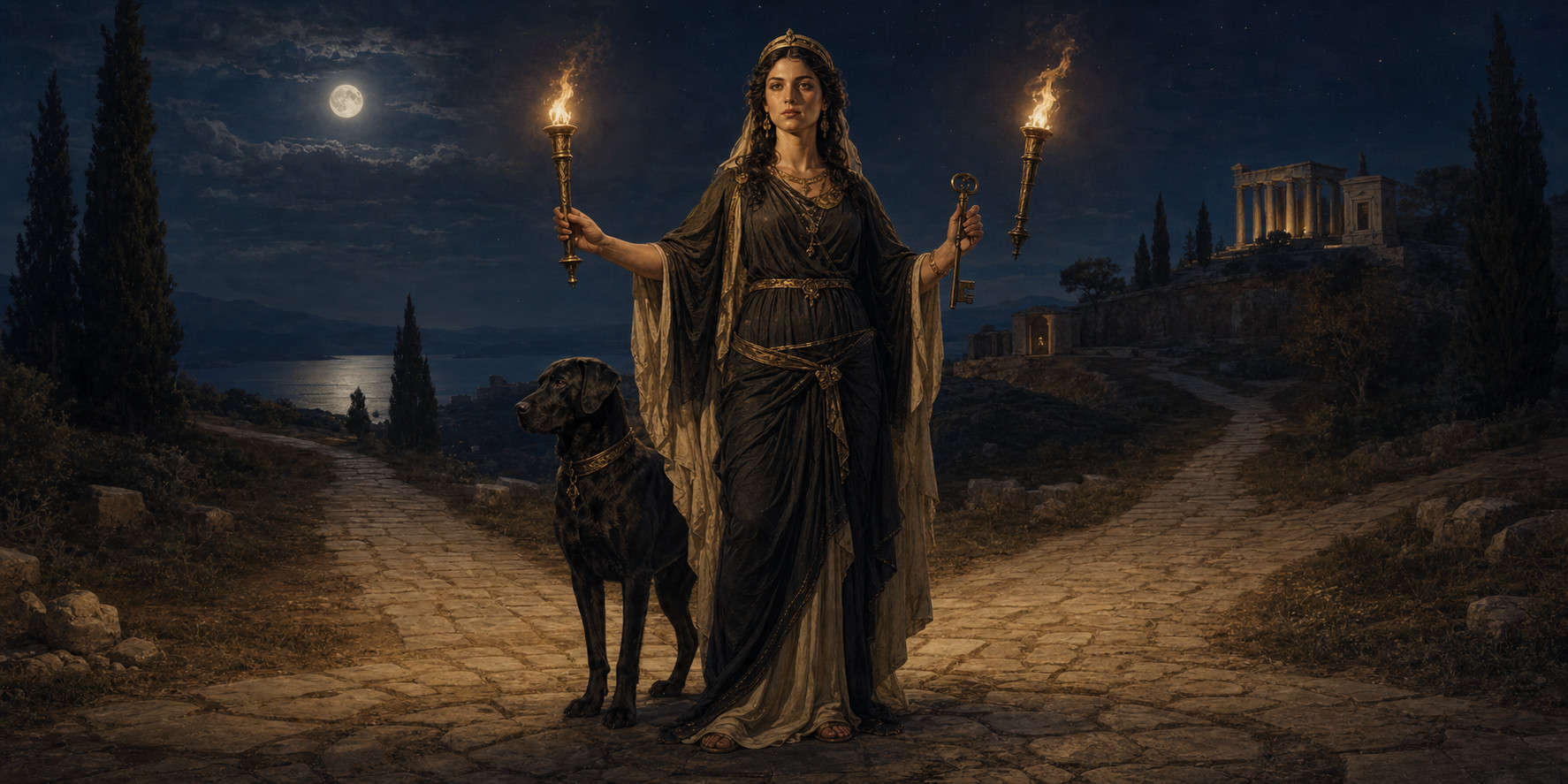
The torch-bearing witness who guides passage where worlds and choices meet.
- Crossroads
- Dogs
- Keys
- Night
- Persephone
- Torches
- Primordial Age
- Titan Age
- Olympian Age
- Heroic Age
- Trojan Cycle
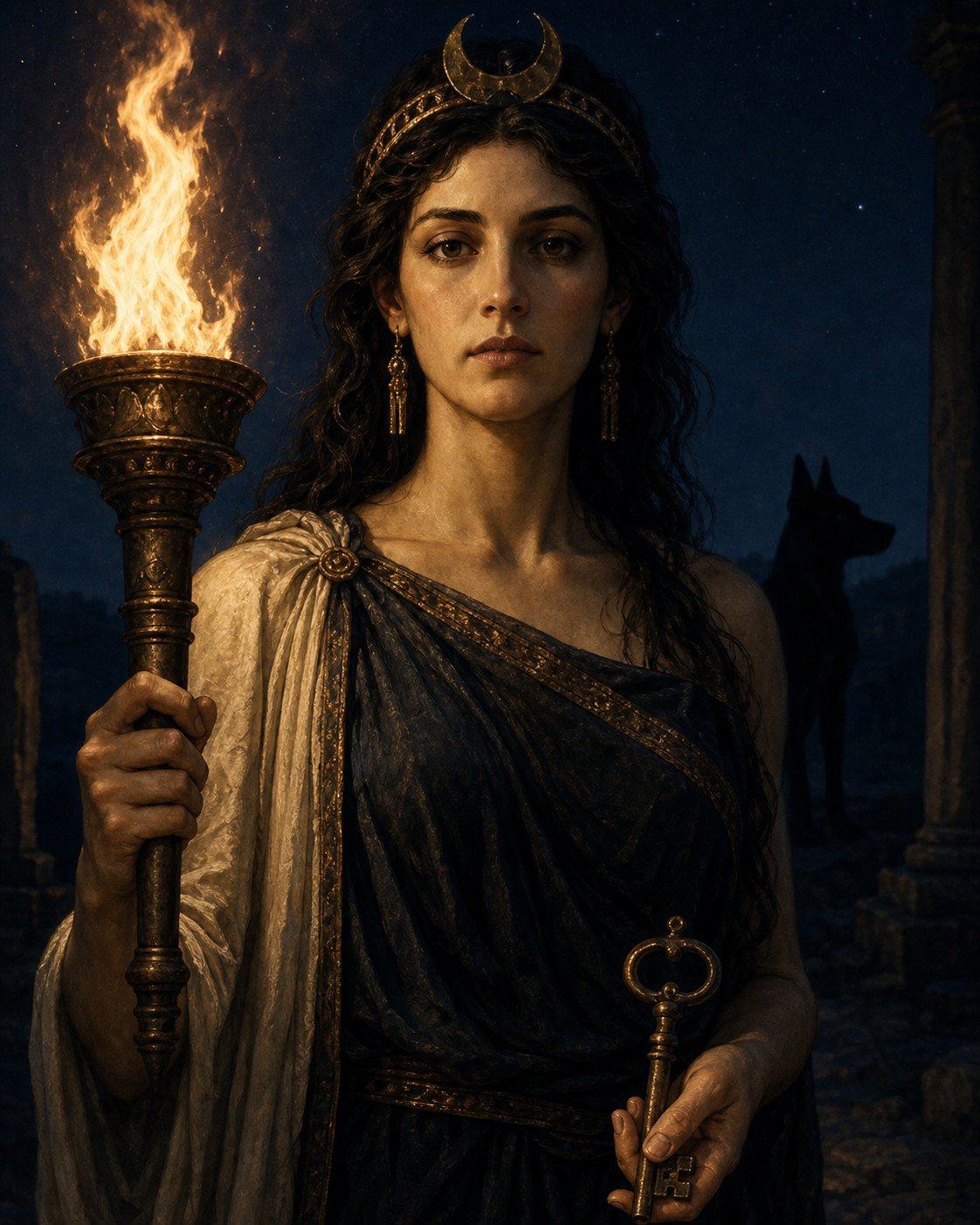
Hecate is a goddess of thresholds, night roads, and divine passage. Honored by Zeus across earth, sea, and heaven, she joins Demeter's search with torches and later accompanies Persephone between worlds.
Hecate enters the best-known story of Demeter and Persephone as a listener in the dark. She hears the abducted girl’s cry, joins Demeter with torches, and later becomes Persephone’s companion between worlds. That role captures her unusual authority: Hecate does not belong to only one realm. She moves across thresholds where households, roads, gods, ghosts, and choices meet.
An Honored Goddess in Hesiod
Hesiod gives Hecate an unexpectedly expansive place in the Theogony. She is the daughter of Perses and Asteria, descendants of the Titans, yet Zeus honors rather than displaces her after his victory. She retains shares in earth, sea, and heaven. She may grant success in assemblies, war, athletics, horsemanship, fishing, and herding, and she assists those who approach her properly.
This early portrait matters because later summaries often reduce Hecate to a goddess of witchcraft. Magic becomes important in her reception, but Hesiod presents a broadly effective divine helper whose privileges cross the new Olympian order. Her survival also differs from simple stories in which every Titan power is imprisoned or erased.
Torches in the Search for Persephone
In the Homeric Hymn to Demeter, Hecate hears Persephone’s cry but does not see the abductor. Carrying torches, she meets Demeter after nine days of searching and helps direct the inquiry toward Helios, who witnessed the event. When Persephone finally returns, Hecate embraces her and becomes her attendant and companion.
The hymn does not make Hecate the architect of the abduction or the settlement. Her importance lies in witness, guidance, and continued accompaniment. She stands beside a daughter whose life is divided between upper and lower worlds. This association helps later tradition place Hecate at night roads, entrances, and transitions involving the dead.
Crossroads and Doorways
Hecate was worshiped at boundaries, especially gates, doorways, and three-way crossroads. Small shrines or images could protect an entrance, while offerings known as Hecate’s suppers were left at crossroads. Ancient practices varied by city and period, so no single ritual should be treated as universal. The shared logic is that uncertain passages require attention.
Triple-bodied or triple-faced images make this power visible in several directions at once. The form does not mean that every early text described three separate goddesses. It is a visual solution for a deity who watches converging roads. Keys, torches, dogs, and entrances similarly mark access and vigilance rather than a single fixed narrative.
Dogs, Night, and Restless Dead
Dogs announce Hecate in literary and ritual imagination. Their barking can signal a divine arrival or unseen presence. Because dogs guard doors and move near human settlements at night, they suit a goddess of thresholds. Later sources also connect her with ghosts, nocturnal processions, and beings who have not settled cleanly into the world of the dead.
These associations can be frightening, but protection and danger are not opposites here. The power that approaches a boundary may also guard it. Household images of Hecate could be apotropaic, turning away harm. Her darkness is therefore not simple evil; it is the charged condition of places where ordinary categories become uncertain.
Magic and Literary Transformation
By the Hellenistic and Roman periods, Hecate becomes increasingly prominent in literary magic. Apollonius links her to Medea’s rites, and later poets combine her with moon goddesses, underworld powers, and terrifying nocturnal imagery. Magical papyri invoke divine names in fluid combinations that do not reproduce one tidy civic theology.
Modern witchcraft often adopts Hecate as a central figure. That reception is historically meaningful but should be distinguished from ancient evidence. There was no single timeless Hecate cult identical in Hesiodic poetry, Classical crossroads practice, Roman literature, late antique ritual texts, and modern spirituality. Continuity exists through names and symbols, while meanings change.
Images, Titles, and Local Emphasis
Hecate’s titles emphasize different settings: of the crossroads, before the gate, light-bringing, nourishing, or underworld-facing. An epithet does not automatically describe a separate goddess. It identifies the relationship a community or ritual needs at a particular moment. Statues might show a single figure, while later triple images face outward around a central pillar.
Coins, reliefs, household shrines, poetry, and ritual texts therefore present different visual priorities. The torch-bearing companion of Persephone, the guardian beside a doorway, and the commanding figure of a magical invocation share a name without becoming interchangeable scenes.
What Hecate Means
Hecate represents useful presence at an uncertain edge. She listens when others do not, brings light without pretending the darkness is gone, and accompanies Persephone without dissolving the division imposed on her. Her honors show that a new divine regime can preserve powers it cannot comfortably confine.
Her mythology also warns against equating classification with understanding. Olympian or Titan, heavenly or chthonic, helper or frightening apparition: each label catches only part of her range. Hecate is most legible where categories overlap.
Where the Story Leads
Follow Demeter through the search Hecate joins, Persephone through the divided passage she accompanies, and the Underworld toward the boundary her torches illuminate. The Eleusinian Mysteries develop the sacred promise surrounding mother and daughter, while future routes to Medea, Artemis, Selene, and crossroads ritual show how Hecate’s identity expands.
Trivia
- Hesiod says Zeus preserved and enlarged Hecate’s honors.
- Her triple form is especially suited to watching a three-way crossroads.
- Dogs, keys, and torches all express aspects of boundary keeping.