The companion whose fire and timing stop the Hydra from multiplying beyond Heracles's strength.
- Burning Brands
- Chariot
- Eurystheus
- Heracles
- Heraclids
- Lernaean Hydra
- Primordial Age
- Titan Age
- Olympian Age
- Heroic Age
- Trojan Cycle
Iolaus is the nephew and charioteer of Heracles whose burning brands cauterize the Lernaean Hydra's severed necks. Eurystheus rejects the labor because of his help, but later tradition also remembers the aged Iolaus defending the descendants of Heracles.
Iolaus stands beside Heracles at the moment when solitary strength stops being enough. As charioteer, nephew, companion, and essential helper against the Lernaean Hydra, he turns one hero’s fame into a story about cooperation. Eurystheus refuses to count the victory precisely because Iolaus helped, yet the rejected labor proves why partnership matters: without the burning brands in Iolaus’s hands, every severed neck would only multiply the danger.
Nephew and Companion of Heracles
Iolaus is commonly named as the son of Iphicles, the mortal half-brother of Heracles, and Automedusa. This makes him Heracles’s nephew, although ancient genealogies and chronologies do not always align neatly. The relationship places him inside the hero’s household while leaving him free to act as a companion rather than another version of Heracles.
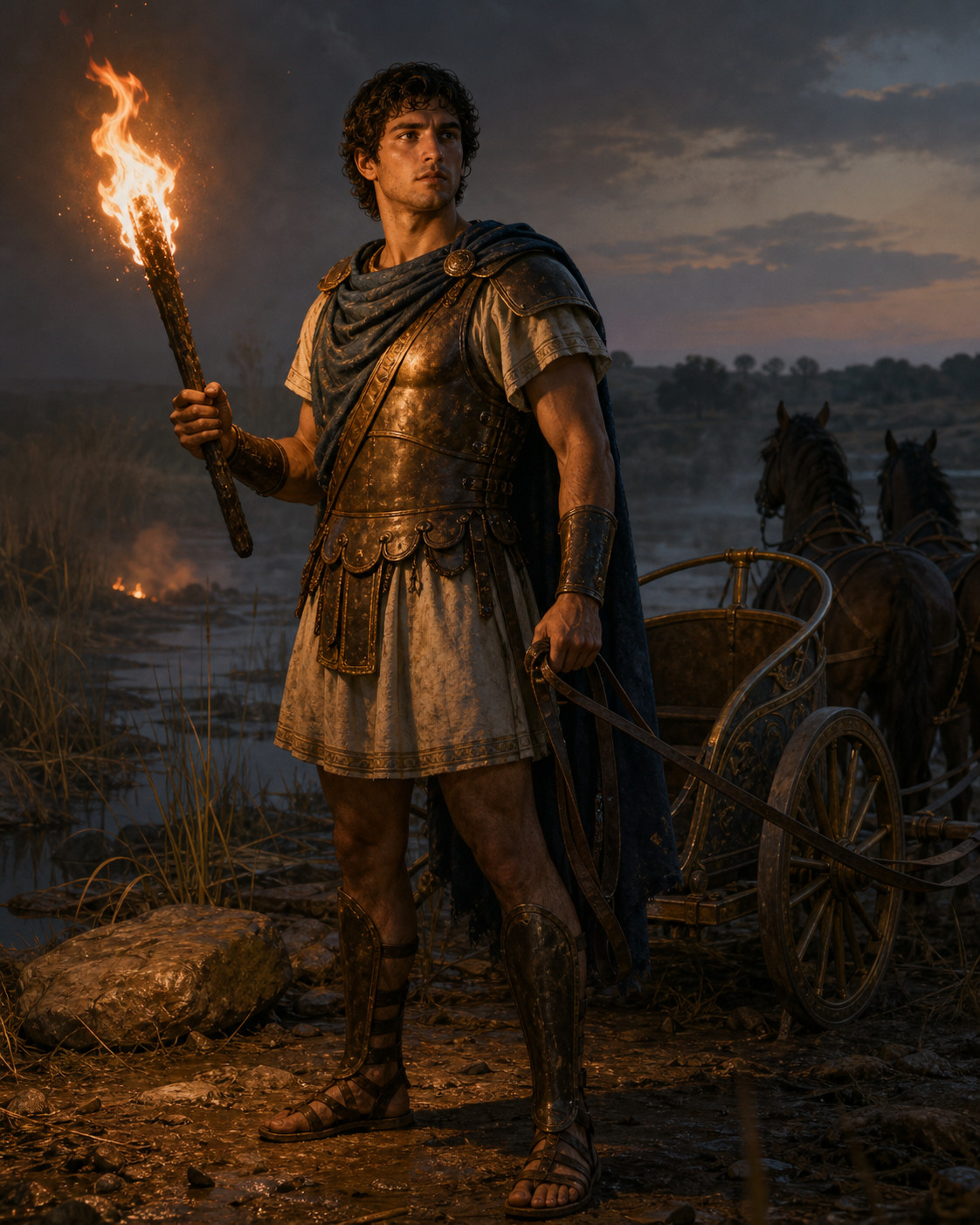
Ancient stories remember Iolaus above all as a charioteer and practical assistant. A chariot companion does more than transport a warrior. He manages horses, watches the field, keeps an escape or pursuit possible, and shares the risks surrounding a famous fighter. That role explains why Iolaus can be present without competing for the central heroic name.
The Road to Lerna
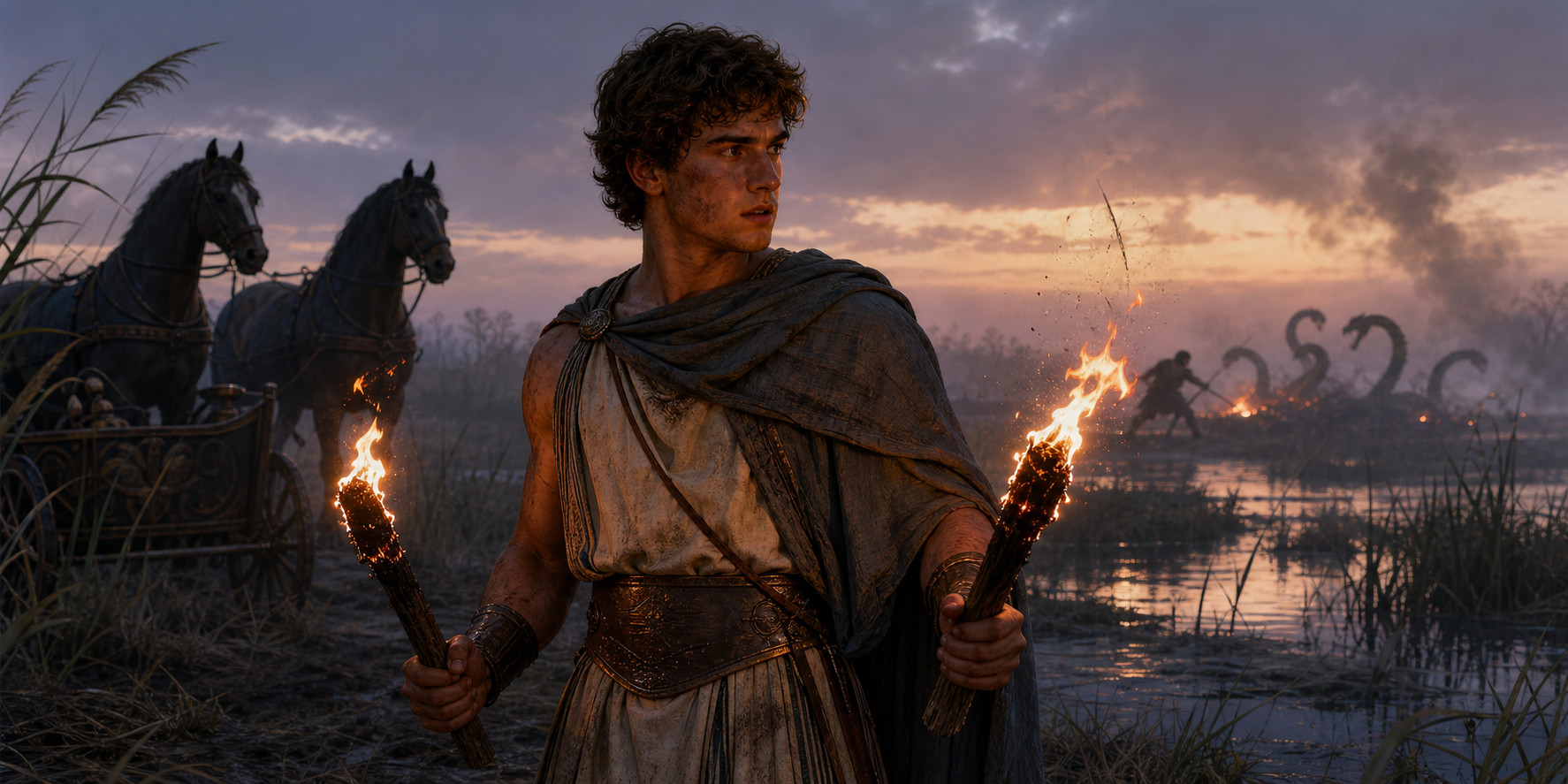
In Apollodorus’s account of the second labor, Heracles mounts a chariot driven by Iolaus and travels to Lerna. The detail establishes cooperation before the monster appears. Heracles may receive the command from Eurystheus, but he does not reach the marsh as an isolated wanderer. The labor begins with two people and a working vehicle.
Lerna is a landscape of springs, marsh ground, and an underground-facing monster tradition. Iolaus halts the horses while Heracles locates the Hydra near the spring of Amymone. The charioteer initially holds the expedition together at its edge. When the battle changes shape, he crosses from support into direct intervention.
Why Cutting the Hydra Fails
Heracles forces the Hydra from its den and attacks its heads, but each destroyed neck produces two more. The familiar heroic action—strike harder and remove the threatening part—makes the problem worse. A crab sent to aid the Hydra adds pressure at the hero’s feet. The labor becomes a system that punishes repetition.
Calling for help is therefore not a lapse in courage. It is the correct response to new information. Iolaus sets fire to nearby wood, brings burning brands, and cauterizes each neck after Heracles cuts it. One warrior creates the opening; the other prevents regeneration. Their alternating actions turn an impossible multiplication into a sequence that can end.
The Labor Eurystheus Rejects
After the immortal head is buried and the Hydra’s gall is used on Heracles’s arrows, Eurystheus refuses to count the labor. His stated reason is that Heracles did not overcome the monster alone. The ruling converts assistance into a technical disqualification, even though the original task could not have been completed without it.
This decision helps explain why the traditional ten tasks become twelve. It also creates an argument inside the heroic cycle: does achievement belong only to the strongest named individual, or to the people whose exact skills make success possible? Eurystheus controls the count, but the story preserves Iolaus’s contribution more vividly than the rejection.
Charioteer beyond the Hydra
Iolaus accompanies Heracles in traditions beyond Lerna and is frequently imagined beside the hero’s chariot. Ancient art can identify him through proximity, equipment, and action rather than through one fixed portrait. His presence reminds viewers that a mobile hero depends on horses, roads, and someone capable of managing both.
Later athletic memory also associates Iolaus with chariot competition. These traditions connect battlefield partnership with disciplined driving, speed, and control. They should not be collapsed into one biography with a single date. Like many heroic companions, Iolaus gathers local, poetic, and visual identities around a stable core of service and skill.
Megara and the Heroic Household
Apollodorus reports that Heracles later gives Megara in marriage to Iolaus, after the catastrophe involving the children of Heracles and Megara. Other sources, especially Euripidean drama, arrange the deaths and survivors differently. The marriage belongs to one important mythographic settlement, not to every surviving version.
The tradition places Iolaus in the difficult work of continuing a household after heroic violence. He is neither simply a younger Heracles nor an untouched observer. Kinship draws him into the consequences of the hero’s life, where loyalty includes care for people and obligations that remain after a celebrated task ends.
Defender of the Heraclids
In Euripides’s Children of Heracles, Iolaus appears in old age protecting the descendants of Heracles from Eurystheus. He can no longer rely on youthful strength, yet he remains responsible for the vulnerable family. The former helper becomes a guardian who carries heroic loyalty beyond Heracles’s lifetime.
A miraculous rejuvenation allows him to take part in the conflict and capture Eurystheus. The scene reverses the judgment of the Labors: the king who once dismissed Iolaus’s help is finally defeated by the helper he treated as a technical problem. Age, divine favor, and memory combine to give cooperation its own late victory.
What Iolaus Means
Iolaus represents competence that becomes visible when a famous hero reaches a limit. He does not replace Heracles; he changes what Heracles can accomplish. Fire, timing, driving, and trust are not lesser forms of heroism. They are the methods that keep strength from repeating a failed action.
His story also exposes the politics of credit. Eurystheus can exclude the Hydra from the official count, but he cannot remove Iolaus from the narrative. The rejected labor becomes one of the best-known examples of heroic teamwork. Authority controls a list; memory preserves the person who made victory possible.
Where the Story Leads
Follow the Lernaean Hydra to the second labor, Heracles to the wider cycle, and Eurystheus to the rules that turn ten assignments into twelve. The poisoned arrows created after Iolaus’s intervention continue through later stories, showing that a solved monster can leave dangerous material behind.
Megara and the Heraclids open paths into the hero’s household and descendants. Hebe and the rejuvenation tradition connect Iolaus with Heracles’s divine family. Chariot imagery leads toward ancient athletics and the practical companions who stand just outside the brightest center of heroic fame.
Trivia
- Iolaus cauterizes the Hydra’s necks so that new heads cannot grow.
- Eurystheus rejects the Hydra labor because Heracles received Iolaus’s help.
- Later tradition remembers the aged Iolaus defending the children of Heracles.