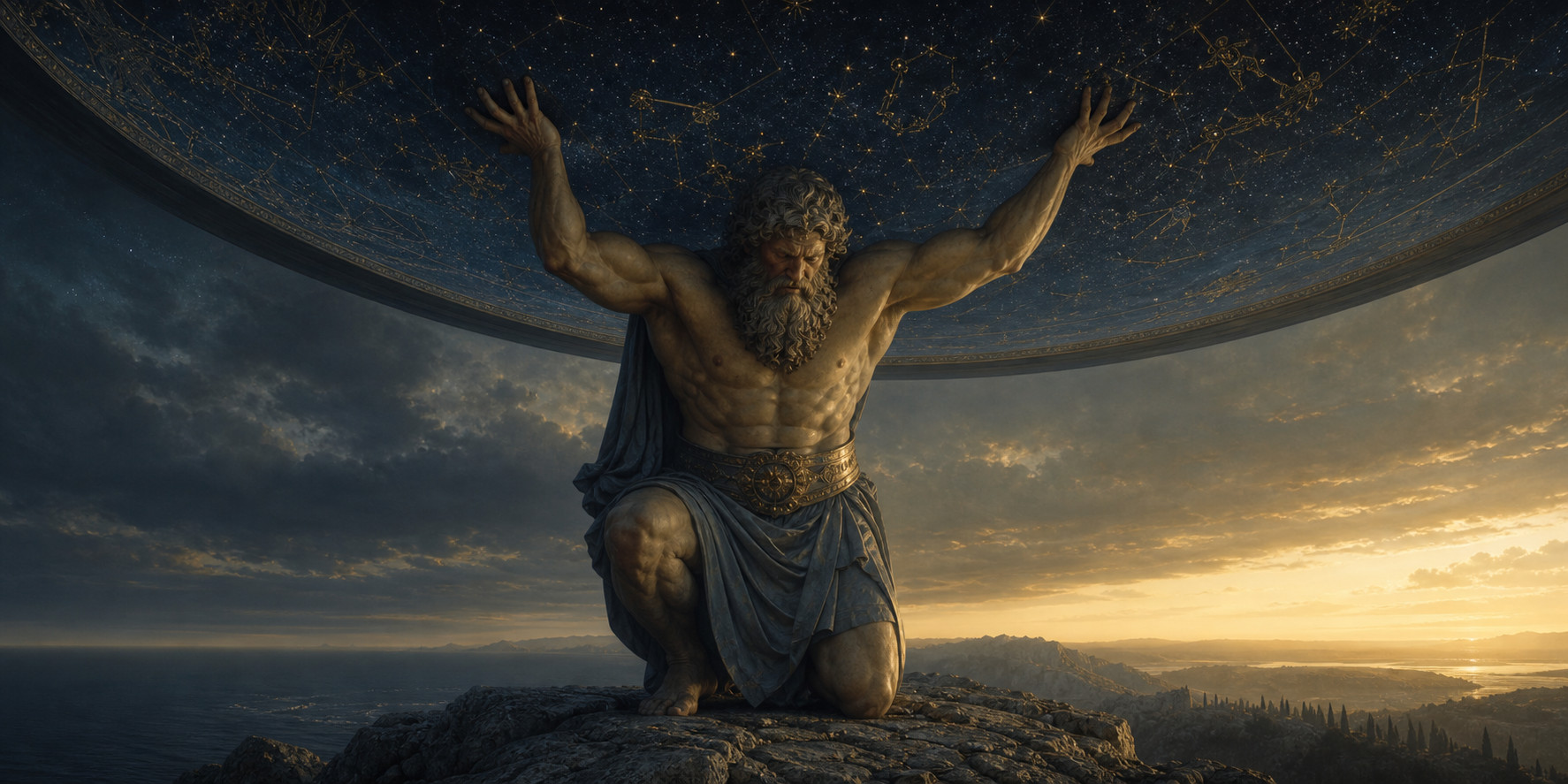
The defeated Titan whose endless burden holds the celestial vault at the edge of the world.
- Far West
- Golden Apples
- Heavens
- Heracles
- Hesperides
- Titanomachy
- Primordial Age
- Titan Age
- Olympian Age
- Heroic Age
- Trojan Cycle
Atlas is the Titan condemned to support the heavens after Zeus's victory. At the far edge of the world, his unending burden later intersects Heracles' quest for the golden apples of the Hesperides.
Atlas is remembered as the figure who bears an impossible weight, but the weight in Greek myth is the heavens, not the planet Earth. Hesiod places him at the far limits of the world, holding the broad sky with unwearying head and arms under Zeus’s necessity. Later stories bring Heracles briefly beneath that burden and connect Atlas with the Hesperides, golden apples, western geography, navigation, and the danger of mistaking temporary relief for freedom.
Son of Iapetus
Hesiod makes Atlas a son of the Titan Iapetus and the Oceanid Clymene, alongside Menoetius, Prometheus, and Epimetheus. Other sources offer the mother Asia or vary details of his family. The Iapetid brothers form a striking group: one bears the sky, one is struck down, one challenges Zeus through foresight, and one accepts the gift that introduces Pandora.
Atlas is usually counted among the Titans even though his exact battlefield role is not narrated at length in the earliest surviving account. Later mythographers understand his punishment as a consequence of opposition to Zeus. The cosmic sentence distinguishes him from Titans confined in Tartarus: he remains at the world’s edge, visible in imagination, performing labor that stabilizes the new order.
Holding Heaven Apart
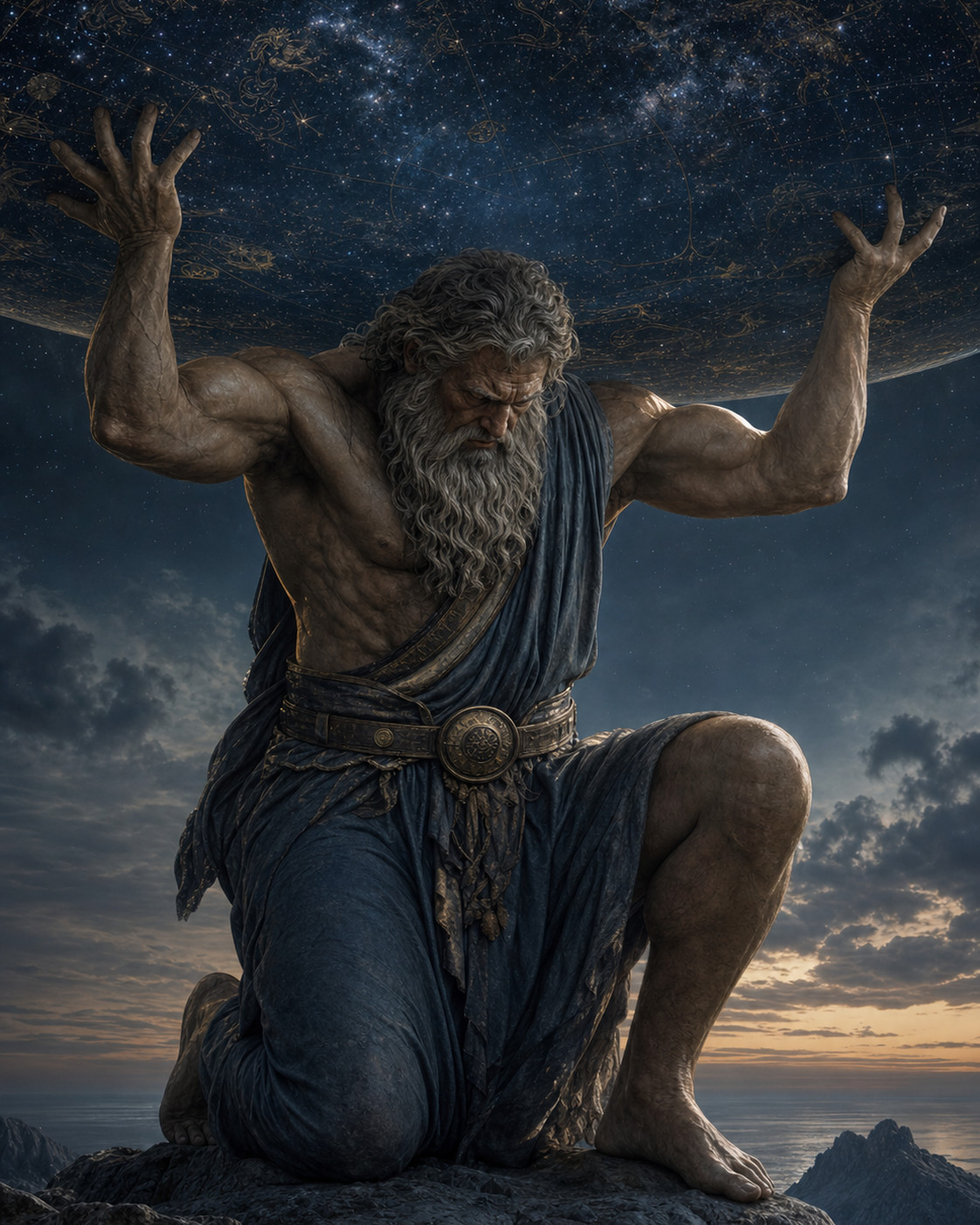
Theogony places Atlas before the Hesperides at the limits of earth, standing and holding the wide heaven with head and tireless hands. The image belongs to an ancient cosmology in which sky and earth require separation. His task is not decorative. The space inhabited by gods and mortals depends upon a condemned body maintaining a boundary.
Modern images often show Atlas supporting a terrestrial globe because later art and cartography transformed the motif. That convention is familiar but should not be projected backward without explanation. In the Greek poetic image, Atlas bears the celestial vault or sphere. Stars, not continents, make the original burden immediately legible.
Punishment after the Titanomachy
Zeus’s victory reorganizes where defeated powers may exist. Cronus and many Titans are sent below, while Atlas is fixed at the far boundary. Punishment becomes cosmic employment: the defeated opponent is compelled to support the structure of the victor’s universe. His endurance is admirable, but it does not mean the sentence is voluntary.
This makes Atlas a useful counterpoint to the Hundred-Handers. They also stand near the border of Tartarus, but as honored guards after aiding Zeus. Atlas occupies another border through compulsion. The same new order converts primordial strength into different forms of service according to alliance, defeat, and trust.
The Far West and the Hesperides
Atlas becomes associated with the remote west, the Hesperides, and the garden containing divine golden apples. Genealogies of the Hesperides vary: they can be daughters of Night, Atlas, or other figures. Geography varies too, moving between west, north, Libya, and an imagined edge where ordinary directions meet.
The uncertainty is part of the mythic function. Atlas stands where mapped travel gives way to cosmic limit. Mountains, sunset, ocean, and stars converge around him. Later geographical naming, including the Atlas Mountains and the Atlantic, extended that edge-of-world identity into learned attempts to organize real space.
Heracles Takes the Burden
In Apollodorus’s account of the Hesperidean apples, Prometheus advises Heracles not to enter the garden himself. Heracles should ask Atlas to retrieve the fruit and temporarily relieve him of the celestial sphere. The exchange creates one of mythology’s clearest images of transferred labor: for a moment, the hero famous for movement must become the fixed support of the sky.
Atlas returns with three apples but does not wish to resume his sentence. He proposes carrying them to Eurystheus while Heracles remains beneath the heavens. The offer is understandable after ages of burden, yet it converts temporary cooperation into attempted substitution. Atlas’s freedom would require another body to inherit his place.
The Trick That Restores the Sky
Heracles agrees, then asks Atlas to take the sphere for a moment while he arranges padding on his head. Atlas sets down the apples and resumes the burden, allowing Heracles to depart. The trick echoes other succession stories in which intelligence redirects overwhelming force. Neither figure wins through strength alone in this episode.
Alternative traditions let Heracles obtain the apples directly, sometimes by killing the guardian serpent. Ancient art also presents different moments and relationships among Atlas, Heracles, Athena, and the Hesperides. The famous exchange is therefore one strong version, not the only possible route through the labor.
Father, Mountain, and Map
Atlas acquires an extensive family in later genealogy, including the Pleiades, Hyades, Hesperides, Calypso, and others depending on the source. Through these daughters he connects heroic lines, constellations, sailors, seasonal signs, and distant islands. The bearer of heaven becomes a father of figures who help humans read the sky he supports.
His name also passes into the Atlas Mountains and, much later, the modern word for a book of maps. Those developments are reception history rather than episodes of Greek myth. They show how strongly Atlas came to represent a framework that holds and organizes the world, even after the celestial burden was redrawn as a globe.
What Atlas Means
Atlas embodies endurance without release. He is mighty enough to hold heaven, but that strength is exactly what makes him usable by the victorious order. The image asks whether extraordinary capacity is a gift when it binds its possessor permanently to one task. It also asks what happens when relief can be achieved only by passing suffering to someone else.
Heracles survives the burden because he treats it as temporary and keeps thinking while under pressure. Atlas fails to escape because hope makes him accept one more transfer. Their meeting joins two labor cycles: the Titan’s unending sentence and the hero’s numbered task. One returns to movement; the other remains the boundary.
Where the Story Leads
Follow the Titans and Titanomachy to the defeat behind Atlas’s sentence, Zeus to the ruler who imposes it, and Mount Othrys toward the older divine coalition. Heracles and the Twelve Labors lead to the brief exchange of the heavens and the quest for the golden apples.
Prometheus explains the advice that makes the encounter possible, while the Hesperides, Ladon, and the western garden open future pages about divine property and guarded boundaries. Astronomy, the Pleiades, and ancient navigation offer another route: Atlas supports not only a roof of stars but a network by which later readers imagined orientation itself.
Trivia
- Ancient Greek Atlas bears the heavens or celestial sphere, not the planet Earth.
- The Hesperides have several different genealogies in ancient sources.
- The modern map book called an atlas belongs to the figure’s later reception history.