Athena's olive and Poseidon's salt-water sign turn divine rivalry into the civic identity of Athens.
- Acropolis
- Athena
- Athens
- Cecrops
- Olive
- Poseidon
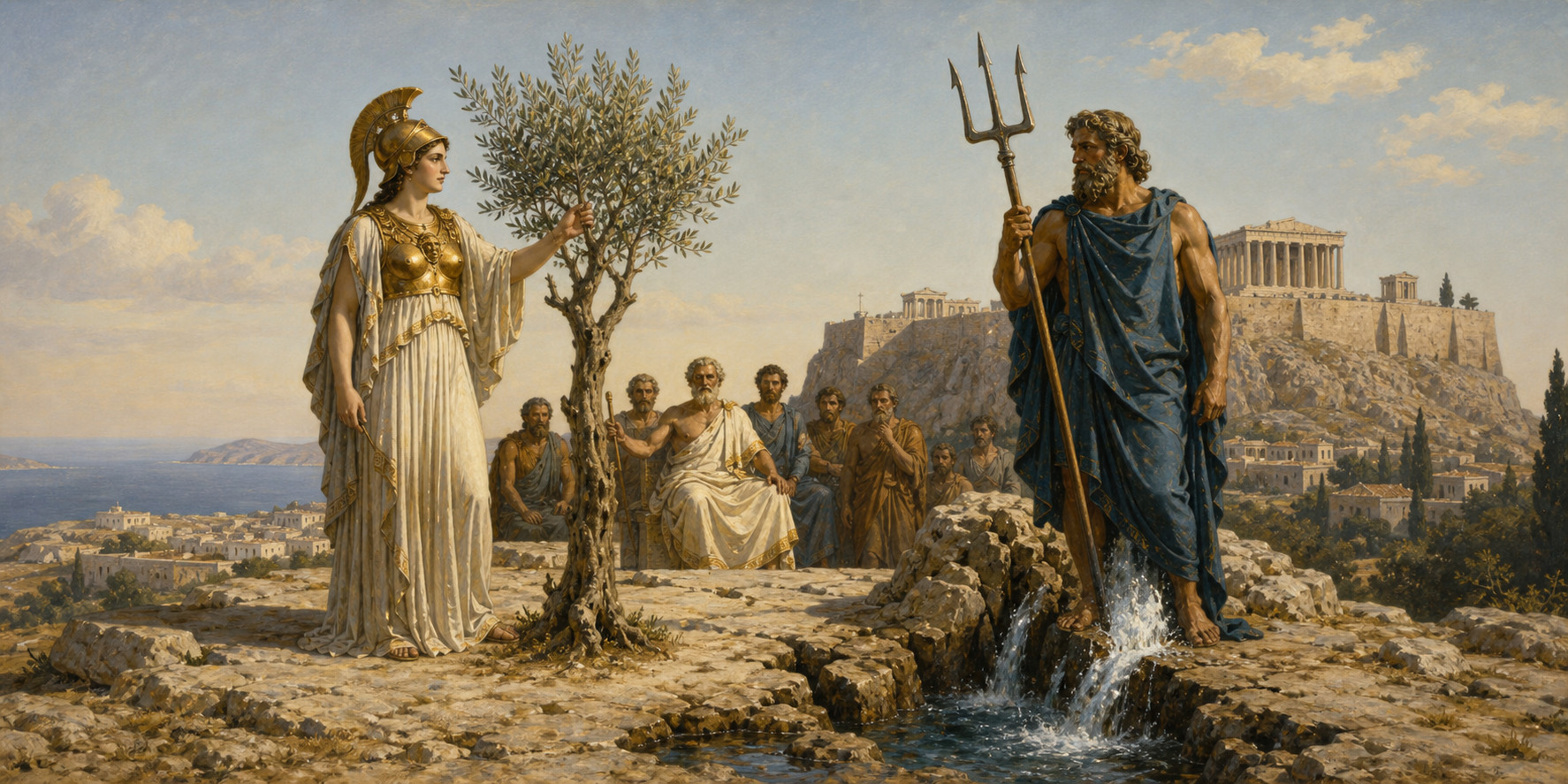
- Rival ClaimsAthena and Poseidon seek patronage of Attica.
- The Sea SignPoseidon strikes the Acropolis and produces salt water.
- The OliveAthena establishes the tree that becomes her civic sign.
- JudgmentCecrops or divine judges award the land to Athena.
- Shared Sacred GroundAthens preserves and honors the marks of both powers.
Athena and Poseidon compete for Attica by presenting signs on the Acropolis. Athena's olive is judged victorious over Poseidon's salt-water spring, giving the city her name while preserving both claims within Athenian sacred geography.
Greek Mythology Timeline
Move through broad mythic ages and open the events that connect one story to the next. The sequence is a reading path, not an exact historical calendar.
The Contest for Athens is the mythic decision by which Athena and Poseidon compete to become the protecting deity of Attica. On the Acropolis, Poseidon strikes the rock and produces a salt-water sign, while Athena grows the olive. Cecrops or another group of judges recognizes Athena’s gift, and the city takes her name. Poseidon’s loss does not remove him from Athenian religion; the marks of both claims remain together in the sacred landscape. The event explains civic identity as a choice that must continue honoring the rival power it does not choose.
Two Divine Claims
Athena and Poseidon each seek possession of Attica. Apollodorus places the dispute during the reign of Cecrops, the earth-born king whose hybrid form embodies local antiquity. Zeus appoints judges rather than allowing the competitors to settle ownership through direct combat.
The judges vary by source: Cecrops, the gods, or later assemblies may decide. These differences change the politics of the story. Divine arbitration emphasizes Olympian order, while civic voting traditions turn the foundation into a myth about participation and social authority.
Poseidon’s Sign
Poseidon strikes the Acropolis with his trident and produces a sea or salt-water spring, called the Erechtheis in Apollodorus. Ancient visitors were shown a trident mark and a well whose sound evoked waves. The sign brings the distant sea into the city’s highest rock.
Later Latin accounts sometimes make the gift a horse. Greek evidence more strongly supports salt water for the central Acropolis contest, though Poseidon is deeply associated with horses elsewhere. Project Mythos keeps the maritime sign primary and identifies the horse as a later or variant presentation.
Athena’s Olive
Athena plants or reveals the first olive in the Pandrosium. The tree offers food, oil, light, ritual use, wood, trade, and a symbol able to regenerate after damage. Her claim translates divine wisdom into a resource that can sustain households and civic economy.
Herodotus reports that the sacred olive sprouted again after the Persian burning of the Acropolis. Historical ritual memory thus renews the mythic sign: the tree’s resilience becomes evidence that the city’s relationship with Athena survives physical destruction.
Judgment for Athena
Athena wins because Cecrops testifies she planted first or because the judges prefer her gift. The exact criterion varies. The outcome gives Athenians their civic name and establishes Athena Polias as central guardian of the city.
Victory does not mean every Athenian myth treats the choice as effortless. Later voting stories make women decisive and then punished, reflecting much later arguments about citizenship and naming. Such accounts should not be projected backward as the single classical version.
Poseidon’s Anger
Poseidon responds by flooding the Thriasian plain or otherwise afflicting Attica in some traditions. The losing god remains powerful enough that the city must honor him. Divine adjudication resolves the title but not the need for ritual accommodation.
This aftermath turns the myth away from a simple contest between useful and useless gifts. Sea power, earthquakes, horses, and water remain essential to Athens. The civic order succeeds by giving Athena priority while retaining Poseidon’s dangerous presence.
The Erechtheion Landscape
On the classical Acropolis, the Erechtheion gathered cults and signs associated with Athena, Poseidon, Erechtheus, Cecrops, and the city’s layered past. The olive, salt-water well, and trident mark were remembered in close proximity.
Architecture did not erase rivalry; it housed it. A visitor encountered several claims, ancestors, and divine powers within one sacred complex. The city’s identity was therefore materially plural even when its name announced Athena’s victory.
From Gift to Civic Character
The olive is often explained as the wiser gift because it supports peace and prosperity, while the trident or sea represents force. Ancient reality is more complicated: Athens became a naval power, and Athena herself is martial. The symbols should not be reduced to a modern moral fable.
The event instead compares modes of sustaining a city and asks who can judge divine value. Agriculture, seafaring, warfare, craft, and ritual all belong to Attica. Choosing a patron establishes emphasis, not exclusion.
Timeline and Reading Path
The contest belongs to the Olympian age of civic foundations rather than a datable historical year. It follows divine succession and precedes the heroic dynasties through which Athens tells stories of Cecrops, Erichthonius, Erechtheus, and Theseus.
Follow the event toward Athena and Poseidon for the rival claims, Zeus for arbitration, Acropolis and Erechtheion for place, and future Cecrops and Theseus routes for civic genealogy. It makes a city name into a continuing negotiation among landscape, resource, memory, and power.
Trivia
- The primary Greek sign of Poseidon is salt water, not necessarily a horse.
- Ancient visitors were shown both the olive and trident-related marks.
- Athena’s victory did not end Poseidon’s Athenian worship.
Reading the Traditions
The contest is known through sources separated by genre and century: mythography, local history, travel description, visual art, and later Roman retelling. Each preserves a different interest. Apollodorus supplies a compact sequence, Herodotus connects the olive with Persian destruction, Pausanias describes surviving sacred signs, and later writers develop voting or horse-gift versions. A responsible account does not treat every detail as simultaneous. The most stable structure is rivalry, signs on the Acropolis, Athena’s victory, Poseidon’s continuing anger or honor, and a landscape that preserves both gods. That structure explains why civic identity can be decisive without becoming exclusive.