The legendary city and archaeological landscape where poetry, dynasty, siege, and four thousand years of settlement meet.
- Hector
- Helen
- Hisarlik
- Paris
- Priam
- Trojan Horse
- Origin
- Divine Occupation
- Major Myths
- Cult / Tradition
- Legacy
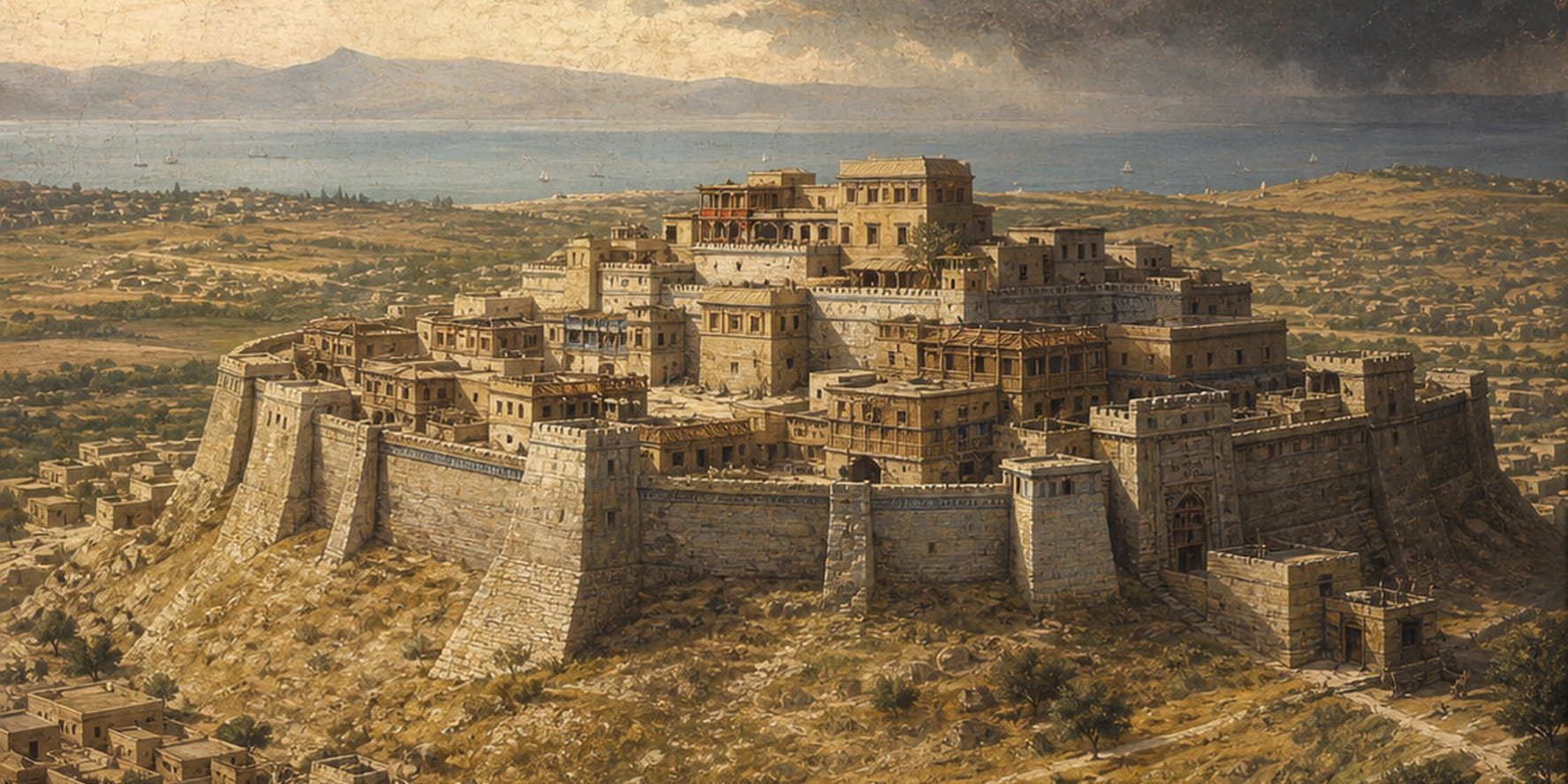
Troy is the fortified city defended by Hector and ruled by Priam in Greek epic. The archaeological mound at Hisarlik preserves many settlement phases, including major Bronze Age fortifications, but material evidence and poetic tradition must remain carefully distinguished.
Greek Mythology Timeline
Move through broad mythic ages and open the events that connect one story to the next. The sequence is a reading path, not an exact historical calendar.
Troy is the fortified city at the center of the Trojan War and a place where mythic geography, poetic memory, archaeology, and later civic history must be held together without being confused. In Greek epic it is Ilios, Ilion, or Troy, ruled by Priam and defended by Hector. At Hisarlik in modern Türkiye, a long sequence of settlements preserves thousands of years of occupation, including major Bronze Age fortifications, but no excavated layer can simply certify every person and event in Homer.
Names and Landscape
Ancient poetry uses Troy for city and region, while Ilios or Ilion often names the citadel. The surrounding Troad includes the plain, rivers Scamander and Simois, Mount Ida, coast, islands, routes, and allied communities that make the war a landscape rather than one wall.
Its position near the Dardanelles connects Anatolia, the Aegean, and routes toward the Black Sea. Strategic geography helps explain why a real settlement could matter without proving the particular ten-year siege of epic.
Walls Made with Divine Labor
Myth says Poseidon and Apollo served the Trojan king Laomedon and built or supported the city’s walls. When payment was withheld, divine hostility and a sea monster followed. Heracles then attacked Troy in an earlier generation.
This earlier sack warns that Priam’s city is not eternally secure. The famous walls carry both divine prestige and a history of broken obligation, conquest, survival, and rebuilding.
Priam’s City
The Iliad shows gates, towers, palace chambers, temples, streets, meeting places, walls crowded with observers, and houses filled with extended royal families. These poetic spaces organize action even when they cannot be mapped as an excavator’s plan.
Troy is also a community of Trojans and allies, not only Priam’s palace. Funeral, assembly, worship, defense, marriage, craft, and food continue under siege, keeping the city alive beyond its military function.
The Scaean Gate
Hector and Andromache meet near the Scaean Gate, armies pass between city and plain, and Priam watches from the walls. The gate becomes a threshold where domestic and martial worlds repeatedly touch.
Later readers have tried to identify poetic gates with excavated entrances. Comparison can be illuminating, but names from epic should not be attached to archaeology as certain labels without evidence.
Horse and Sack
After direct assault fails, the Achaeans leave a wooden horse and appear to sail away. Trojans debate whether to destroy, discard, or dedicate it, then bring the object within the walls. Hidden warriors open the city from inside.
The fall turns fortification into a trap. Troy’s greatest defense is bypassed because a crafted object is misread through ritual hope, persuasion, exhaustion, and divine signs.
Hisarlik and Many Troys
The archaeological mound at Hisarlik contains successive settlement levels rather than one preserved Homeric city. Troy VI and VIIa are often discussed in relation to the Late Bronze Age because of fortifications, scale, regional connections, and destruction, but scholarly interpretation remains more complex than a single identification.
Excavation history also includes damage, sensational claims, contested removals, and changing methods. Archaeology has refined the site from treasure hunt into a study of architecture, environment, trade, chronology, and long urban life.
Greek and Roman Ilion
The site continued after the Bronze Age. Greek and Roman communities built Ilion, cultivated Homeric memory, honored Athena, welcomed rulers, and connected local identity to the legendary war.
These later monuments are authentic parts of Troy’s history but do not belong to Priam’s skyline. A visual or article must distinguish Bronze Age reconstruction from Classical, Hellenistic, and Roman remains.
World Heritage and Living Memory
UNESCO inscribed the Archaeological Site of Troy in 1998, emphasizing its long settlement sequence, role between Anatolia and the Mediterranean world, and extraordinary influence through the Iliad and later arts.
World Heritage status recognizes archaeological and cultural significance; it is not a declaration that Homer’s narrative is literal history. The site’s value includes exactly this layered relation between material place and creative memory.
How to Read Troy
Troy should be read in parallel columns: poetic city, mythic dynasty, archaeological mound, later Ilion, and modern heritage site. Connections matter, but each column asks different questions and uses different evidence.
This layered method improves visual reconstruction as well as writing. A Late Bronze Age scene should avoid importing the monumental temples, theaters, and marble streets of later Ilion, while an archaeological view should not populate every wall with named Homeric characters. Landscape, fortification technique, and settlement density can remain historically plausible without pretending certainty where the evidence is incomplete.
Troy’s cultural afterlife is itself historical evidence of a different kind. Pilgrims, rulers, poets, excavators, museums, and visitors have continually remade the meaning of the mound. Their interest cannot verify Priam’s biography, but it does explain how an Anatolian settlement became a shared reference point for ideas about war, ruin, recovery, and the authority of story.
Follow Troy toward Priam and Hector for rule and defense, Helen and Paris for the threatened household, Trojan Horse for the breached boundary, and the Trojan War for the narrative network that made the city globally famous.
Trivia
- Troy is located at Hisarlik in modern Türkiye near the Dardanelles.
- The mound preserves many settlement phases, not one single city.
- UNESCO inscribed the Archaeological Site of Troy on the World Heritage List in 1998.