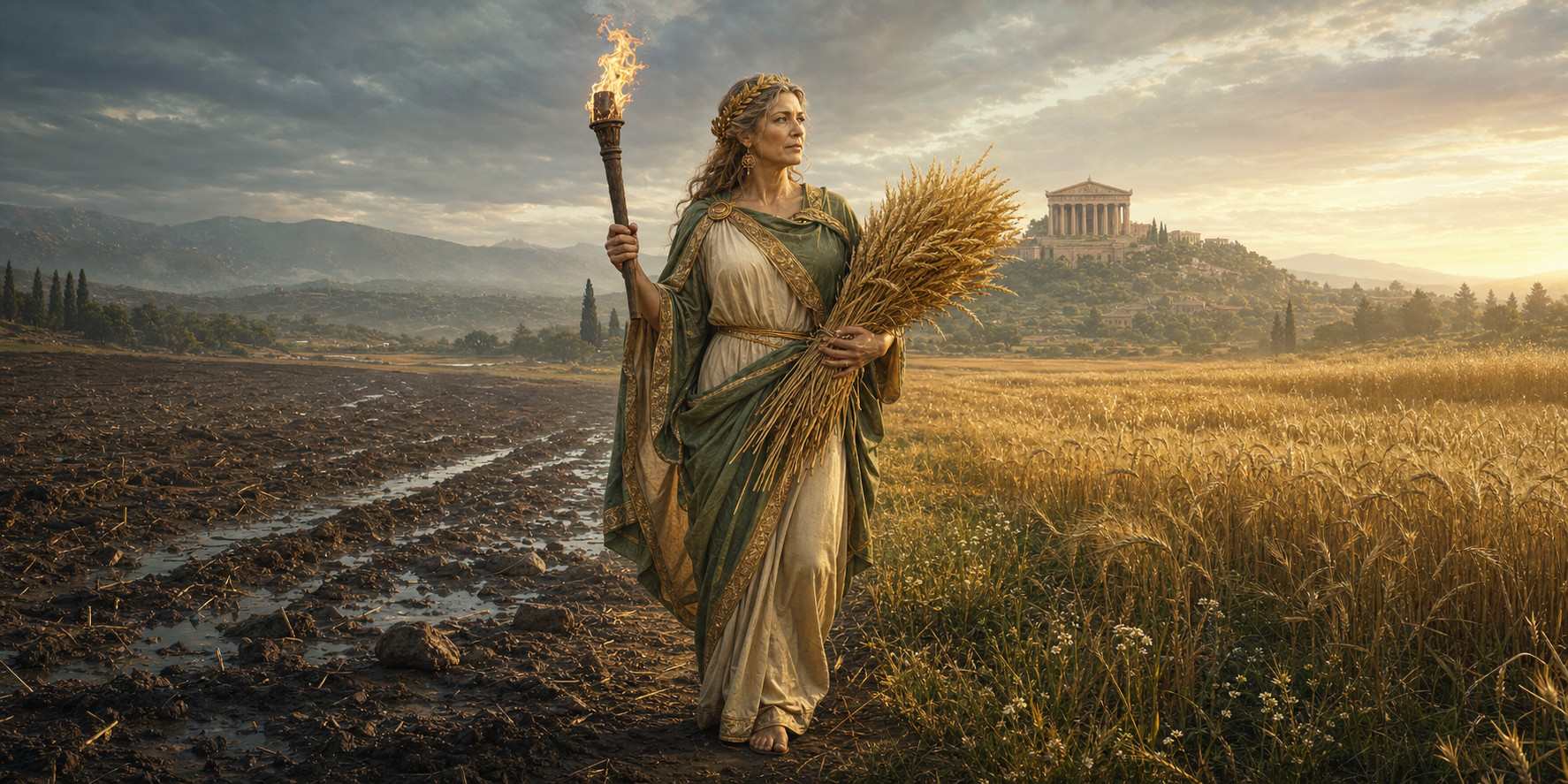
The mother whose grief stopped the harvest and forced Olympus to negotiate.
- Agriculture
- Famine
- Persephone
- Sacred Return
- Torches
- Wheat
- Primordial Age
- Titan Age
- Olympian Age
- Heroic Age
- Trojan Cycle
Demeter is the Olympian goddess of grain and mother of Persephone. When Hades takes her daughter with Zeus's consent, Demeter's search and withdrawal make the earth barren. The resulting famine forces a settlement and anchors the sacred traditions of Eleusis.
Demeter’s mythology begins with abundance but becomes most powerful when abundance stops. As goddess of grain and cultivated fertility, she sustains the human communities that honor the gods. As Persephone’s mother, she also proves that divine government cannot treat a daughter’s disappearance as a private inconvenience. Her grief becomes famine, and famine forces Olympus to negotiate.
Goddess of the Cultivated Earth
Demeter is a daughter of Cronus and Rhea and a sister of Zeus, Hera, Poseidon, Hades, and Hestia. Her name was often understood in antiquity through the idea of a mother, though its precise linguistic history remains debated. She is not simply the Earth itself; Gaia fills that broader primordial role. Demeter presides especially over grain, agriculture, and the ordered work that turns land into a dependable human food supply.
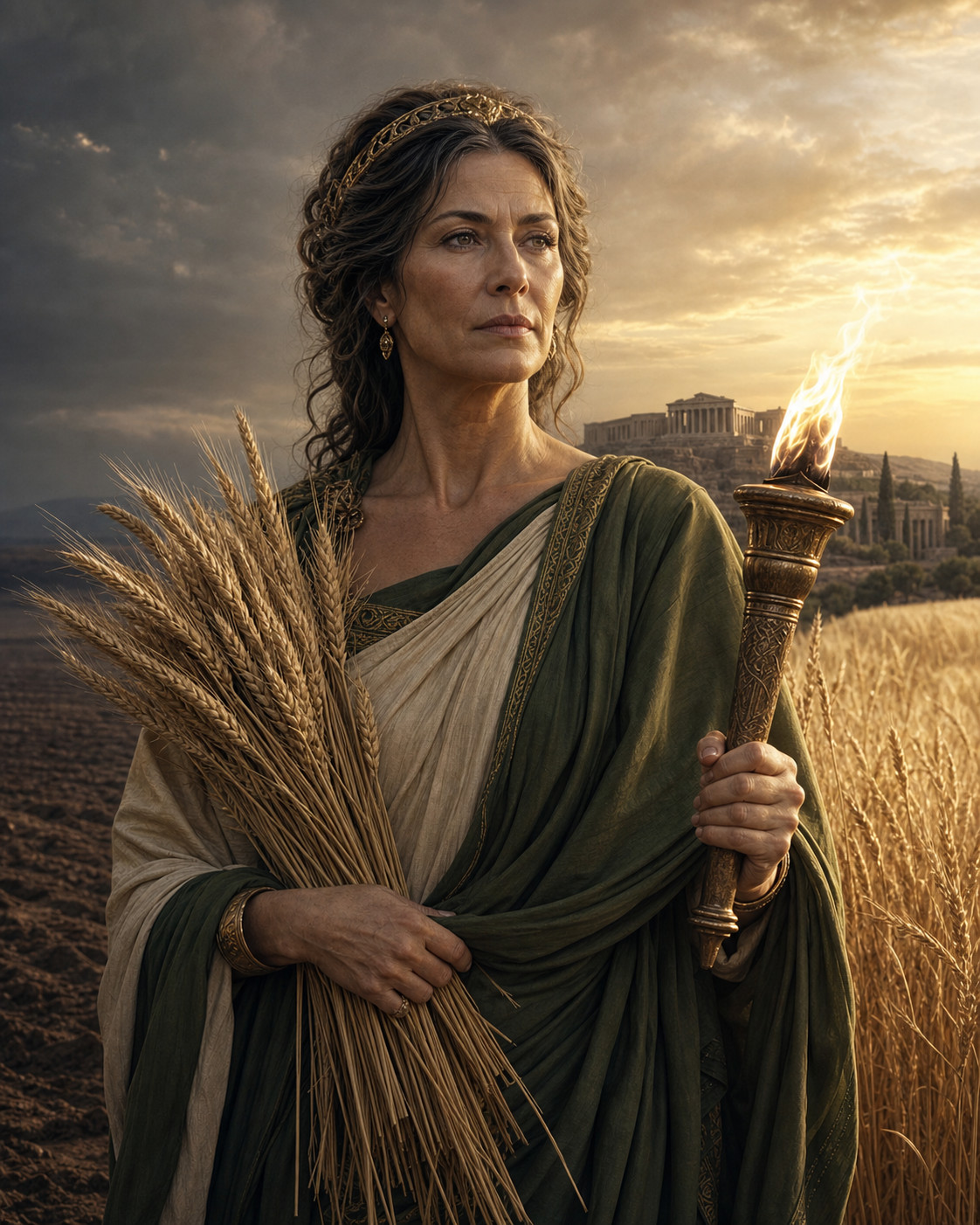
Ancient worship connected her with wheat and barley, sheaves, torches, baskets, and the cycle of sowing and harvest. These signs are practical as well as poetic. A city depends on stored grain, seasonal labor, and knowledge passed through generations. Demeter’s gifts therefore support law, settlement, and ritual community. Later art may make her a generalized nature goddess, but Greek cult keeps her closely tied to cultivated food and the institutions surrounding it.
The Daughter Who Vanished
The most influential account is the Homeric Hymn to Demeter. Persephone gathers flowers when the earth opens and Hades carries her below. Zeus has consented to the marriage without informing Demeter. The mother hears an echo of her daughter’s cry and searches for nine days with burning torches, refusing ambrosia and nectar. Hecate joins her, and Helios finally identifies the abductor and Zeus’s hidden decision.
Demeter’s response separates her from Olympus. She disguises herself as an elderly woman and reaches Eleusis, where the daughters of King Celeus welcome her. In the royal household she nurses Demophon and attempts to make him immortal by anointing him and placing him in fire at night. His frightened mother interrupts the process. Demeter reveals her divine form and commands the people to build a temple where she can receive rites.
Famine as Divine Protest
Seated in her new sanctuary, Demeter withholds seed from the earth. Fields fail, mortals face destruction, and the gods risk losing the sacrifices that sustain their honors. Zeus sends divine messengers with gifts, but Demeter refuses to return until she sees Persephone. Her grief becomes leverage because agriculture links mortal survival to divine prestige.
This is not a passive picture of seasonal sadness. Demeter challenges a settlement arranged by more powerful male relatives and makes the cost visible across the world. Zeus must send Hermes to Hades. Persephone returns, but because she has eaten pomegranate seed below, she cannot remain with her mother continuously. The resulting division of time recognizes both her marriage and Demeter’s claim.
Return and the Grain’s Renewal
Mother and daughter reunite in a scene of intense joy and questioning. After the terms are understood, Demeter restores fertility. The hymn describes the earth sending up leaves and flowers, and the goddess teaches her rites to the rulers of Eleusis. The story links a household reunion, agricultural recovery, and sacred knowledge without reducing any one of them to a decorative metaphor.
Popular summaries say Persephone’s absence creates winter and her return creates spring. That is a useful first image, but ancient Mediterranean farming does not map neatly onto a northern four-season calendar. Grain could be sown after autumn rains and harvested before the harshest summer dryness. The myth is better approached as a recurring pattern of loss, barrenness, return, and renewed abundance whose exact agricultural resonance varied by place.
Eleusis and the Mysteries
Demeter and Persephone stand at the center of the Eleusinian Mysteries, celebrated for centuries near Athens. Initiates were forbidden to disclose the central rites, so surviving literature and archaeology provide only partial views. The Homeric Hymn promises a blessed difference for those who have seen the rites when they go beneath the earth. Grain and reunion thus become part of a sacred hope concerning mortality.
Modern accounts should resist claiming complete knowledge of the ceremony. Processions, fasting, ritual drink, sacred objects, and revelations are attested in different ways, but their precise integration remains uncertain. The secrecy is part of the historical evidence. Demeter’s gift is not only an agricultural technique but an experience preserved by an initiated community.
Other Myths and Local Forms
Demeter’s mythology extends beyond the hymn. Poseidon pursues her in an Arcadian tradition when she takes the form of a mare; their children include the divine horse Arion and a mysterious daughter often called Despoina. The story belongs to local cult and should not be blended casually into the Eleusinian narrative. In another cycle, Demeter loves the mortal Iasion, and Zeus strikes him. Such accounts connect fertility, desire, horses, and local landscapes in ways that differ from the famous mother-daughter plot.
Her Roman counterpart Ceres gives English words such as “cereal” and becomes central to Roman agricultural and political life. Greek Demeter and Roman Ceres overlap strongly but belong to distinct civic systems and literary histories. Later images of a serene grain mother preserve only one side of a goddess who can withdraw, wander, rage, teach, and negotiate with kings.
What Demeter Means
Demeter turns care into cosmic authority. Her power is visible not through a thunderbolt but through the absence of ordinary growth. The myth recognizes that food systems, family bonds, ritual obligations, and political decisions cannot be separated. Zeus’s order remains incomplete until the goddess whose work sustains mortals consents to a settlement.
Her reunion with Persephone does not cancel the abduction or guarantee permanent happiness. The daughter will depart again. What returns is a rhythm that can be endured, marked, and made meaningful through agriculture and ritual. Demeter’s story therefore holds grief and productivity together without pretending that renewal erases loss.
Where the Story Leads
Follow Persephone into the divided life created by the agreement, Hades into the marriage negotiated below, and Zeus into the politics that famine forces him to revise. The Underworld shows the realm Demeter cannot abolish, while future paths to Hecate, Eleusis, and Triptolemus open the witnesses, rites, and transmission of agricultural knowledge.
Trivia
- Demeter is the cultivated-grain goddess, while Gaia more broadly personifies Earth.
- The Eleusinian Mysteries remained deliberately secret, limiting confident reconstruction.
- Roman Ceres is related but should not erase Demeter’s specifically Greek cult histories.