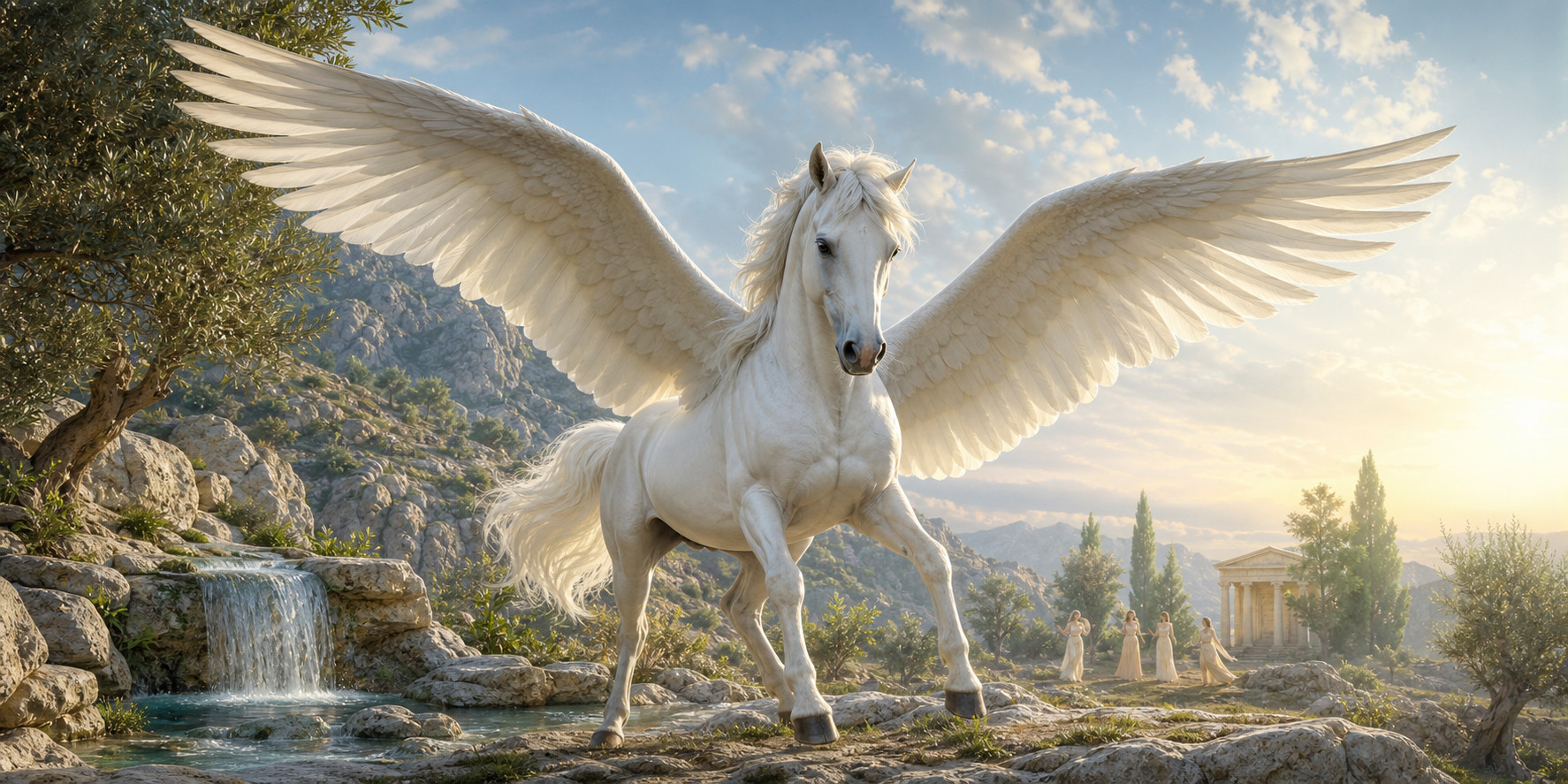
Medusa's sky-born son who carried a hero, served Zeus, and opened the springs of poetry.
- Bellerophon
- Hippocrene
- Medusa
- Poseidon
- Wings
- Zeus
- Primordial Age
- Titan Age
- Olympian Age
- Heroic Age
- Trojan Cycle
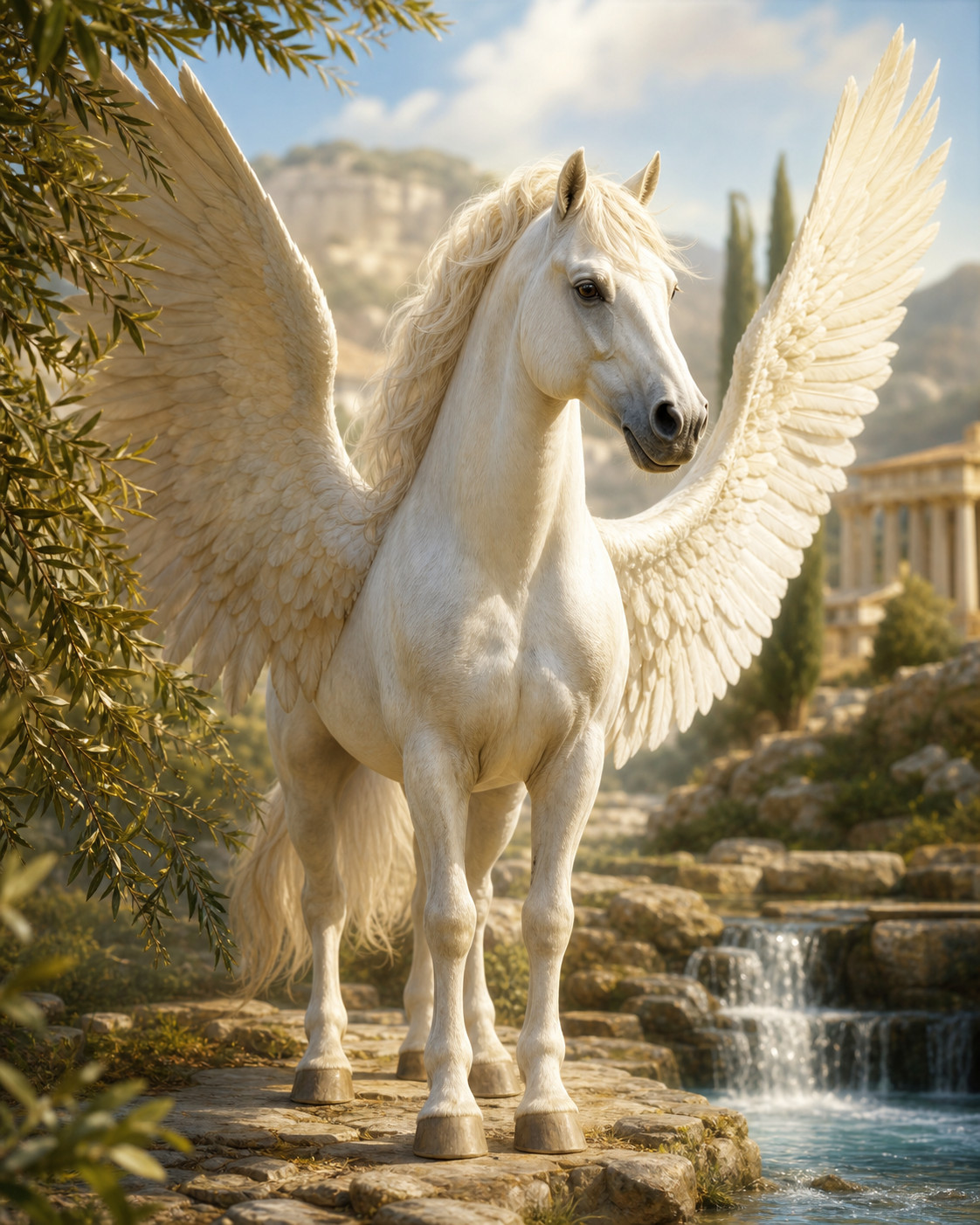
Pegasus is the winged horse born from Medusa when Perseus beheads her. His principal ancient rider is Bellerophon, who uses Athena's bridle and fights the Chimera. Pegasus later reaches Olympus, carries thunder for Zeus, and becomes linked with the Muses' spring.
Pegasus begins where Medusa’s life ends. The winged horse springs from the Gorgon’s severed body and rises from a scene of death into stories of springs, poetry, heroic flight, and Zeus’s thunder. Although Perseus is present at his birth, Pegasus’s defining mortal partnership belongs to another hero: Bellerophon.
Born from Medusa
Hesiod names Pegasus and Chrysaor as the children of Poseidon and Medusa. They emerge when Perseus cuts off Medusa’s head. The birth joins sea power, Gorgon danger, and aerial freedom in one startling transformation. Pegasus receives a name ancient readers connected with springs or water, and later traditions repeatedly associate his hoof with the sudden release of fountains.
Accounts and images vary over whether the children emerge from Medusa’s neck, blood, or body. The central genealogy remains earlier than Ovid’s later transformation story for Medusa. Pegasus is therefore not a reward created especially for Perseus. He is Medusa’s son and part of the Gorgon aftermath, carrying her family line into a very different visual and moral register.
Perseus Is Not His Rider
Modern retellings frequently place Perseus on Pegasus during the rescue of Andromeda. Ancient sources instead equip Perseus with winged sandals, while Pegasus becomes the mount of Bellerophon. The two figures are easy to combine because Perseus’s act causes the horse’s birth and both heroes travel through the air. Separating them preserves the specific divine aid and achievement of each quest.
In art, the merger becomes common because a winged horse gives the Andromeda scene an instantly readable silhouette. That later image has its own history, but it should not rewrite the older story. Pegasus may connect Perseus, Medusa, and Andromeda conceptually without carrying the hero between them in the best-attested Greek accounts.
Bellerophon and the Golden Bridle
Bellerophon must confront the Chimera, a fire-breathing hybrid creature. To master Pegasus he receives divine help, especially from Athena, who supplies a golden bridle in a major tradition. The hero captures the horse at the spring Peirene near Corinth. Mounted above the monster’s flames, Bellerophon gains the position needed to attack safely.
The partnership continues through battles against the Solymi and Amazons and through plots by King Iobates. Pegasus turns a persecuted exile into an apparently invincible hero. Yet the horse is not simply equipment. His divine origin makes flight a privilege that Bellerophon can use but does not own without limit.
The Failed Ascent
After his victories, Bellerophon attempts to fly to Olympus. The act transforms heroic confidence into transgression. Zeus sends a gadfly in a familiar later version, Pegasus throws his rider, and Bellerophon falls back to earth. Sources differ in the mechanism and the hero’s fate, but the separation is decisive: mortal achievement cannot carry its claimant into the divine assembly on demand.
Pegasus completes the ascent without him. The contrast makes the horse a measure of proper belonging. Bellerophon can ride through divinely assigned danger, but Olympus is not another battlefield to conquer. Pegasus, born from two divine or monstrous parents, crosses the boundary the mortal rider cannot.
Servant of Zeus
Hesiod says Pegasus reaches the gods and dwells in Zeus’s house, carrying thunder and lightning for the king. This role connects him with the Cyclopes’ weapons and with Olympian authority. A creature born from the slain Medusa becomes part of the machinery of Zeus’s rule.
The movement is characteristic of Greek myth: dangerous or marginal powers are not always destroyed but redirected. Medusa’s head becomes Athena’s Gorgoneion, and Pegasus becomes a bearer of thunder. Both children of the Gorgon episode acquire places inside divine order while retaining the memory of their extraordinary origin.
Springs, Muses, and Poetry
Later traditions connect Pegasus’s hoof with Hippocrene, the “Horse’s Spring,” on Mount Helicon. The spring becomes sacred to the Muses and a symbol of poetic inspiration. Another hoof-created spring is associated with Troezen. These stories expand the horse from heroic mount to cultural emblem: sudden water from stone resembles sudden song from inspired thought.
The poetic Pegasus became especially influential in Roman and later European literature. Writers invoke mounting Pegasus or drinking from Hippocrene when speaking about artistic ambition. This is an afterlife of the myth rather than the sole meaning of the early horse, but it grows naturally from his link to springs, sky, and divine service.
Constellation and Immortality
Pegasus is placed among the stars in later astronomical tradition. The constellation does not reproduce a horse’s full outline intuitively for every viewer, yet its great square became one of the sky’s recognizable patterns. Celestial placement confirms the separation from Bellerophon: the immortal horse remains visible above while the mortal hero’s attempt to reach heaven ends in loss.
Across coins, pottery, mosaics, heraldry, and modern fantasy, the winged horse becomes a general sign of speed and imagination. That popularity can detach him from Medusa, Poseidon, Athena, and Zeus. Restoring those relationships reveals a more surprising figure—one whose story travels from violence through heroic partnership to divine labor and poetry.
What Pegasus Means
Pegasus repeatedly crosses categories: monster’s child and beautiful wonder, wild animal and bridled ally, heroic mount and Olympian servant, force of war and source of poetry. His wings do more than make travel easier. They expose who may cross a boundary, under what authority, and at what cost.
Bellerophon’s fall is therefore as important as the Chimera’s defeat. Skill and divine gifts enable great action, but they do not erase the distinction between mortal and god. Pegasus carries the hero where the quest requires, then continues into a realm the hero cannot claim.
Where the Story Leads
Follow Medusa and Poseidon for Pegasus’s parentage, Perseus for the act that releases him, and Zeus for his later service carrying thunder. Athena opens the golden bridle tradition, while future entries for Bellerophon, the Chimera, Mount Helicon, and the Muses continue the paths of heroic flight and poetic inspiration.
Trivia
- Pegasus is Medusa’s son, born when Perseus beheads her.
- His principal ancient rider is Bellerophon, not Perseus.
- Hesiod places him in Zeus’s house carrying thunder and lightning.