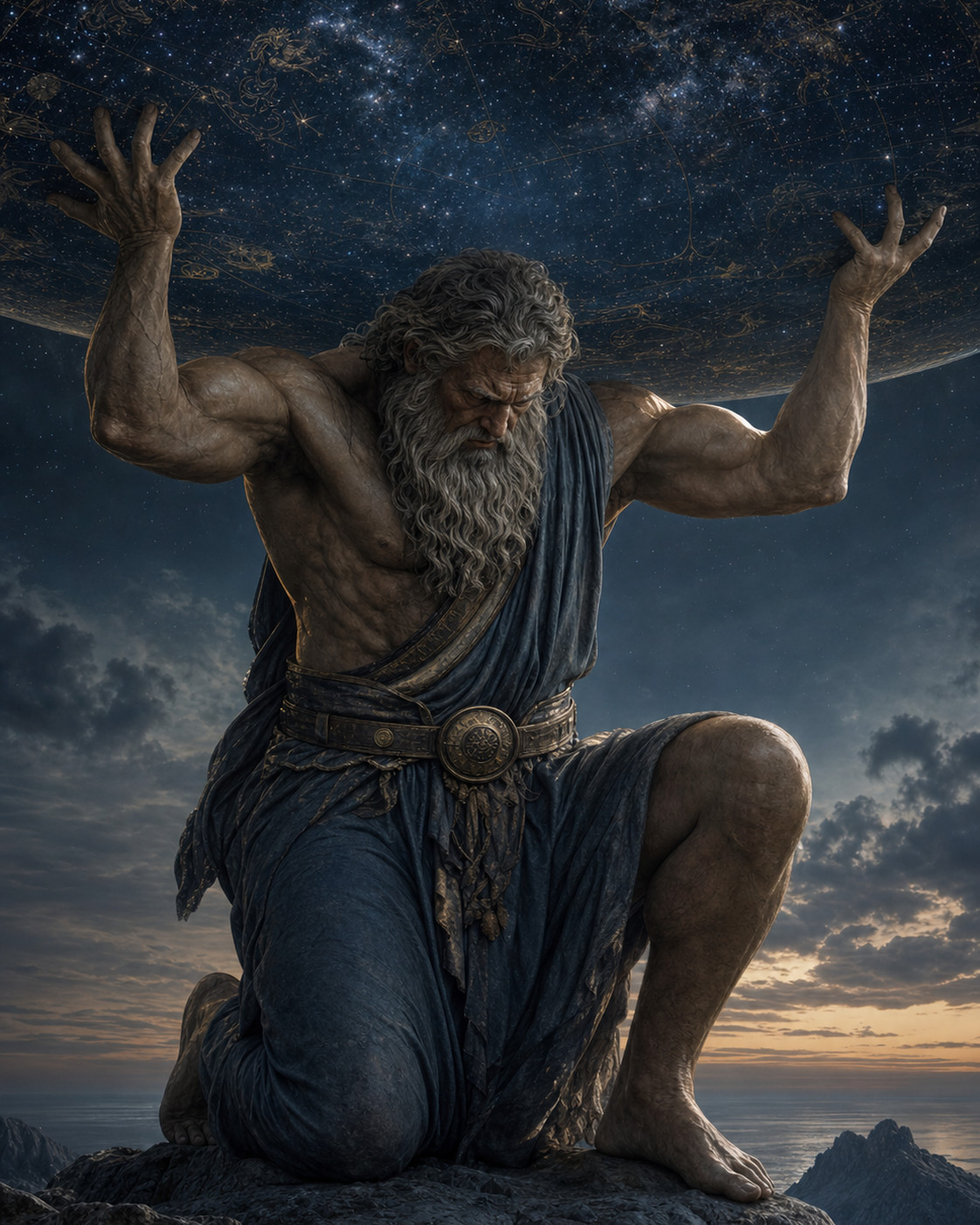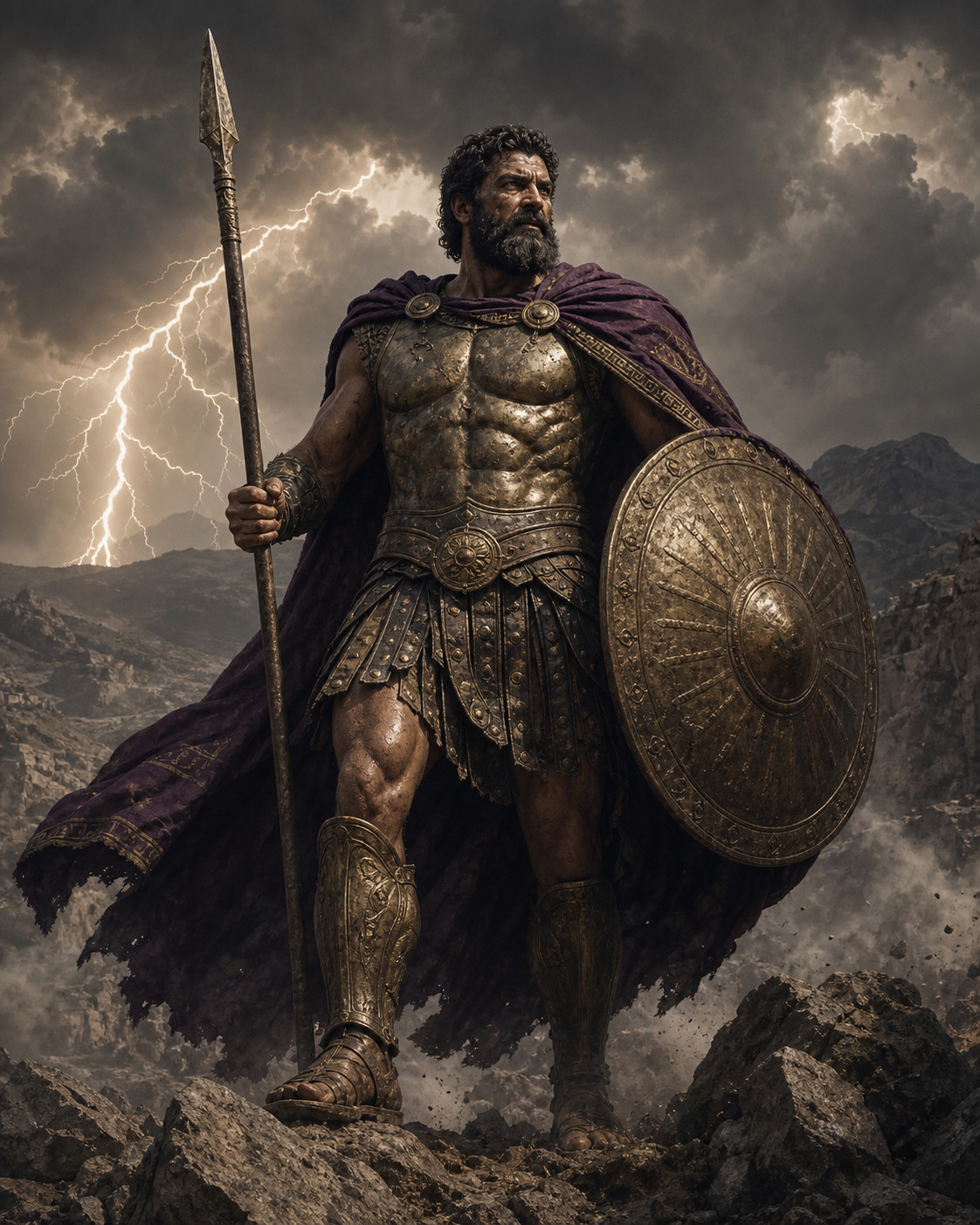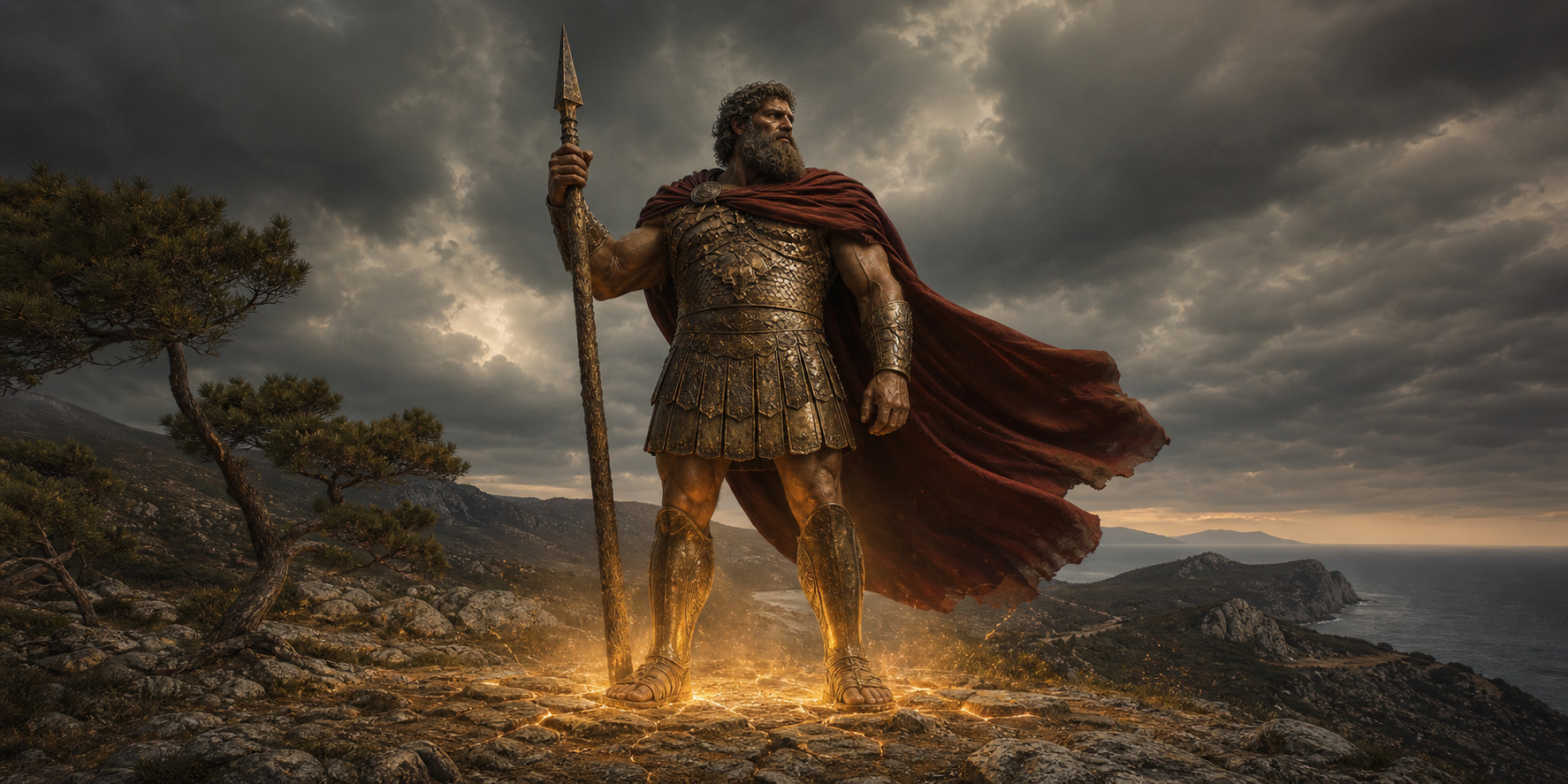
The foremost Giant whose native land restores him until Heracles moves the battle beyond its boundary.
- Athena
- Gaia
- Gigantomachy
- Heracles
- Native Earth
- Pallene
- Primordial Age
- Titan Age
- Olympian Age
- Heroic Age
- Trojan Cycle
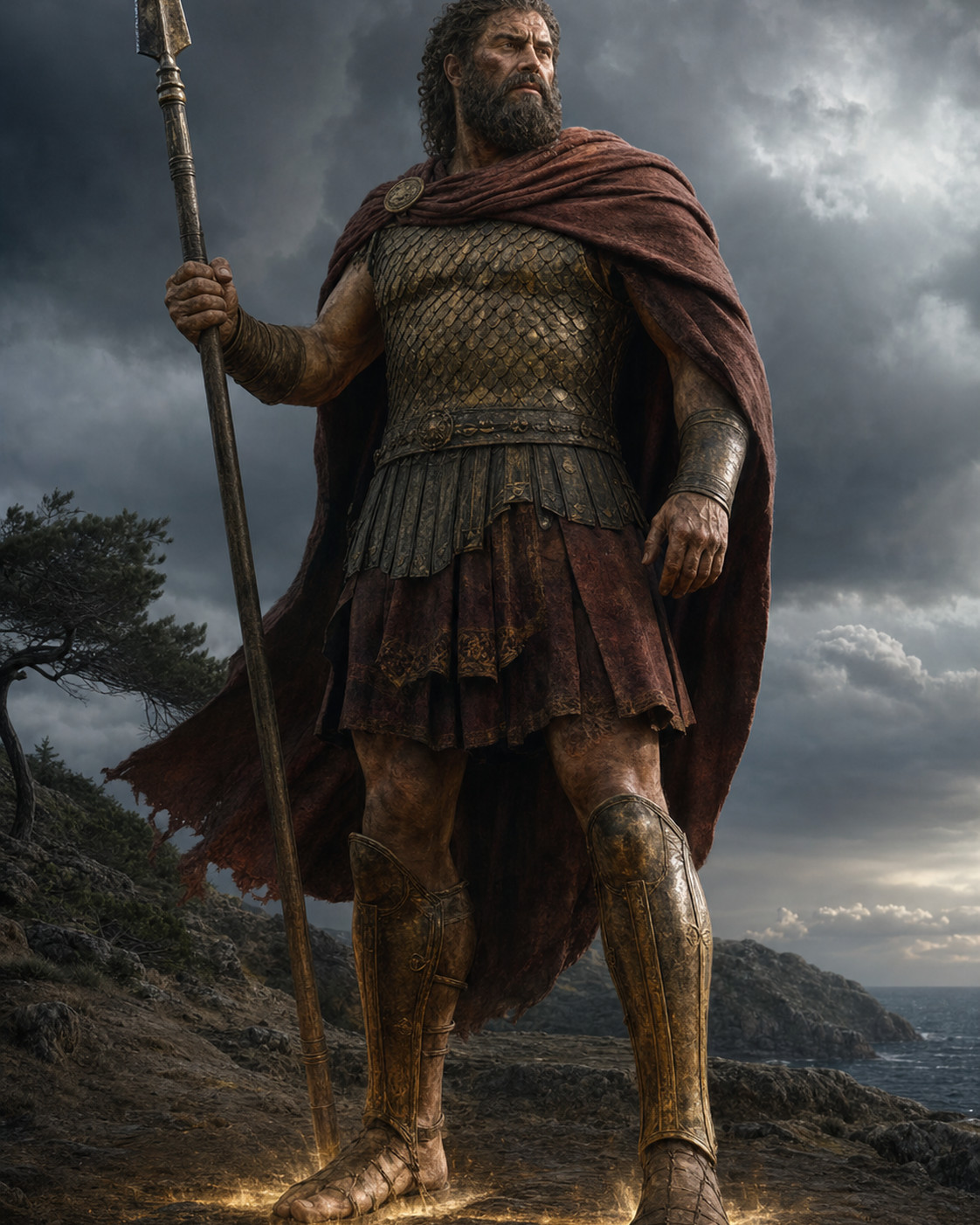
Alcyoneus is a foremost Giant who cannot die while fighting in his native land. Heracles defeats him only after Athena advises moving him beyond Pallene, turning place itself into the decisive condition.
Alcyoneus stands out among the Giants because his immortality has a boundary. Apollodorus says that he cannot die while fighting in the land of his birth. Heracles must therefore do more than strike him: the hero drags the fallen Giant beyond Pallene before the victory can hold. The episode turns place into a source of life and makes the Gigantomachy depend on a mortal who understands that changing the ground can change the rules.
Born from an Injured Earth
The Giants arise from Gaia in traditions connected with the violence done to Uranus, or are described by Apollodorus as children of Earth and Sky. Their birth carries the older cosmos back into conflict after the Titanomachy. They are not simply very tall people. They are a new challenge produced by unresolved injury, divine punishment, and the fertility of Earth herself.
Ancient art and literature vary in their appearance. Early Giants may look like armed human warriors, while later representations often give them serpent-scaled legs. Alcyoneus can therefore be shown as an enormous archaic fighter without claiming that every source imagined the same body. His defining feature is not anatomy but the condition tied to his native land.
Greatest with Porphyrion
Apollodorus names Alcyoneus and Porphyrion as surpassing the other Giants. The pairing gives the Gigantomachy leaders rather than an indistinguishable horde. Porphyrion directs his violence toward Hera and Olympus; Alcyoneus is rooted in Pallene and carries the mystery of a life that the battlefield itself renews.
The two are often grouped in summaries, but their stories should remain distinct. Alcyoneus explains territorial immortality and Heracles’s removal tactic. Porphyrion explains coordinated action by Zeus and Heracles. Together they demonstrate why the oracle requires a mortal ally without making every Giant fall in the same way.
Pallene and the Land of Birth
The place of the Giants’ birth is variously called Phlegra or Pallene. Ancient geography associated Pallene with the westernmost peninsula of Chalcidice. For Alcyoneus, this is more than scenery: his native earth protects or renews him. The myth gives location an active role comparable to armor, medicine, or divine favor.
The condition does not make Alcyoneus universally immortal. It creates a precise boundary that an opponent can discover. His body may be overwhelmed, yet the victory fails while he remains within the sustaining territory. Heroic success therefore requires interpretation of the rule, not simply a larger blow.
The Cattle of Helios
Apollodorus adds that Alcyoneus drove away the cattle of the Sun from Erytheia. The detail links him with distant western cattle myths, including the later labor against Geryon. It also enlarges his offense: he does not only attack the gods in battle but interferes with the property and ordered movement of Helios.
Sources and later commentators do not provide one seamless chronology for every cattle episode. The theft is best treated as a separate sign of Alcyoneus’s reach and aggression rather than forced into an exact campaign map. It nevertheless connects Pallene, the far west, sunlight, and Heracles within a wider heroic geography.
The Oracle Needs a Mortal
The gods learn that no Giant can be destroyed by divine hands alone. A mortal must participate. Gaia seeks a plant that would protect her children even from that mortal contribution, but Zeus prevents the heavenly lights from revealing it and gathers the plant first. Athena then summons Heracles to the divine war.
The rule protects Olympian importance without making the gods sufficient. Heracles does not replace Zeus and Athena; he completes their power. Alcyoneus becomes the clearest test of this shared requirement because even the mortal’s successful strike must be joined with movement beyond the land.
Dragged Beyond the Border
Heracles shoots Alcyoneus, but the Giant revives or remains deathless upon his native ground. Athena advises the hero to drag him outside Pallene. Once removed from the sustaining land, Alcyoneus dies. The action is visually simple and conceptually sharp: the hero defeats not only a body but a relationship between body and place.
The episode should not be embellished into graphic spectacle. Its importance lies in the transfer across a boundary. A few steps can matter more than another weapon. The same Heracles who later lifts Antaeus away from Earth repeatedly confronts opponents whose strength depends on contact with the ground.
Giant in Poetry and Art
Alcyoneus appears in literary summaries, scholia, vase painting, and later Gigantomachy programs, though identification can be difficult when inscriptions are absent. Artists could emphasize falling, sleep, struggle, or the approach of Heracles. The wider battle often surrounds individual duels with dense movement and divine attributes.
His name also appears in traditions beyond the single Apollodoran account. Variants may connect daughters called the Alcyonides with mourning and transformation. These should be marked as later or local developments rather than treated as necessary parts of the battlefield narrative.
What Alcyoneus Means
Alcyoneus turns belonging into both strength and vulnerability. His native land sustains him, but the visible boundary of that protection lets an enemy separate him from it. The myth recognizes that power may be relational: a person, creature, or god can be invincible only within the network that feeds that power.
Heracles succeeds by refusing to repeat a strike that does not work. He accepts Athena’s knowledge and changes the conditions of the encounter. The story therefore fits Project Mythos’s larger pattern: victory emerges from alliance, information, and altered context rather than an endless escalation of force.
Where the Story Leads
Follow the Giants and Gaia to the generation that rises against Olympus, the Gigantomachy to the oracle requiring a mortal, and Heracles to the arrow and boundary-crossing that complete the defeat. Porphyrion offers a contrasting leader whose fall joins lightning with a mortal shot.
Pallene and Phlegra invite a future place page about local landscape and competing birth traditions. Helios’s cattle open another line toward Erytheia and Geryon. Zeus and Athena explain how divine planning makes room for Heracles, while the Titanomachy shows the earlier conflict whose aftermath has not silenced Earth.
Trivia
- Alcyoneus is immortal only while he fights in his native land in Apollodorus’s account.
- Ancient sources vary between Phlegra and Pallene as the Giants’ birthplace.
- Heracles succeeds only after Athena tells him to move Alcyoneus beyond the boundary.