The crafted offering whose hollow body turns sacred appearance and Trojan interpretation into the final breach of the city.
- Athena
- Helen
- Hidden Warriors
- Odysseus
- Trojan War
- Troy
- Origin
- Creation
- Major Appearance
- Later Tradition
- Legacy
The Trojan Horse is the hollow wooden structure built after direct assault fails. Hidden Achaean warriors enter Troy inside it, emerge at night, and open the city to the returning fleet.
Greek Mythology Timeline
Move through broad mythic ages and open the events that connect one story to the next. The sequence is a reading path, not an exact historical calendar.
The Trojan Horse is the wooden structure that converts Achaean failure at Troy’s walls into victory by concealment, staged departure, persuasion, and the defenders’ own decision to bring the object inside. Ancient sources agree on the core deception but vary over its builder, occupants, warnings, divine meaning, and exact sequence. It is best understood not as a magical object, but as crafted space whose apparent identity hides military contents.
A Plan after Direct Assault
After years of siege, prophecies, recovered weapons, and the deaths of major heroes, direct pressure still has not opened Troy. Odysseus is commonly credited with the horse’s strategy, while Epeius constructs it with Athena’s help in important traditions.
The plan combines craft and theater. Building the object is only one part; the fleet must appear to leave, selected warriors must accept confinement, and a story must make Trojan hands complete the movement.
Timber, Hollow Space, and Wheels
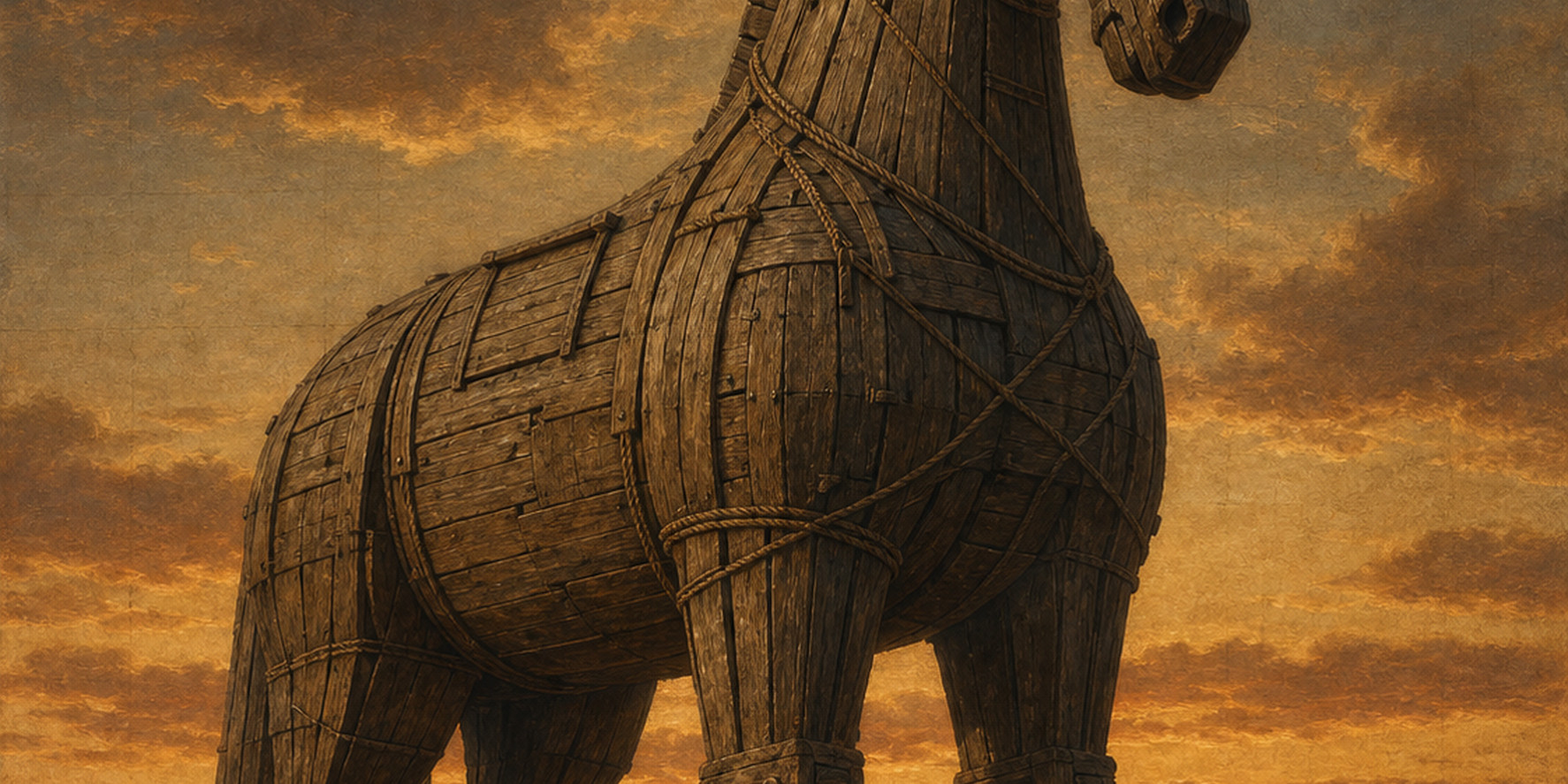
Sources describe a hollow wooden horse large enough to hold a chosen force. Later images and texts vary its size, wheels, openings, surface, and method of construction. No single surviving ancient blueprint exists.
Mechanical plausibility matters less than narrative function, but a responsible reconstruction should show heavy timber, joined planks, access, ventilation, movement, and the difference between sacred-looking exterior and occupied interior.
The Hidden Company
Lists of warriors differ. Odysseus, Menelaus, Neoptolemus, Diomedes, and others appear in various accounts, while Epeius may enter or manage the opening. The changing roster reflects the needs of different poems and local traditions.
Inside, elite heroes exchange battlefield visibility for silence and dependence. The bravest action is temporarily to remain unseen while enemies debate inches away.
Sinon and the False Story
The Achaeans burn their huts and hide the fleet. Sinon remains to explain the object, presenting himself as abandoned or threatened and framing the horse as an offering connected to Athena.
His story weaponizes hospitality, ritual caution, and the desire to believe the war has ended. Troy is not defeated because its people cannot see wood; it is defeated because they must interpret a persuasive sign under exhaustion and uncertainty.
Cassandra and Laocoon
Warnings become central in later accounts. Cassandra recognizes danger but is not believed. Laocoon attacks or distrusts the horse, and serpents kill him and his sons in influential versions, though causes and details vary.
The deaths are read as proof that the warning offended a god rather than proof that the horse is dangerous. The episode demonstrates how true evidence can be absorbed into a false interpretive frame.
Helen at the Horse
In the Odyssey, Helen circles the horse and imitates the voices of the hidden warriors’ wives. Men inside nearly answer, but Odysseus restrains them. Her motive remains ambiguous and is remembered differently by participants.
The test makes sound as dangerous as sight. The horse conceals bodies, but memory and desire threaten to reveal them from within.
Entering Troy
The Trojans consider cutting the horse open, throwing it from a height, or preserving it as a sacred offering. They ultimately bring it into the city, sometimes by breaching or altering part of their own defenses.
The movement is the strategy’s decisive stage. An enemy construction becomes protected cargo, and the wall changes from barrier to enclosure around the attackers.
Night and the Sack
At night the hidden warriors emerge, signal the returning fleet, open access, and begin the sack. The object does not conquer by itself; it creates the conditions for a wider army to enter a city whose vigilance has collapsed into celebration or exhausted sleep.
What follows includes killing, enslavement, sacrilege, and broken returns. Celebrating cleverness without its aftermath would detach the artifact from the human cost it delivers.
Reading the Traditions
Homer remembers the horse in the Odyssey but does not offer the longest surviving continuous account. Epic Cycle summaries, Apollodorus, Tryphiodorus, Quintus, and Virgil preserve overlapping and sometimes incompatible detail. Visual tradition adds further engineering choices.
Ancient audiences therefore encountered the horse as a familiar episode retold from different positions: a singer’s subject, a survivor’s memory, a mythographer’s sequence, a poem of the sack, or an image on pottery and relief. Agreement on the core device did not require agreement on every passenger, speech, warning, or signal.
Modern language often uses “Trojan horse” for hidden danger inside an apparently useful carrier, including malicious software. The metaphor preserves concealment and voluntary admission, but usually drops the ritual framing, exhausted population, returning fleet, and catastrophic sack. Distinguishing the ancient object from its modern shorthand keeps both meanings precise.
For museum or educational presentation, the best image therefore shows both craftsmanship and scale while avoiding claims of a recovered historical design. Wheels, plank seams, rope, access points, and the nearby wall communicate function without presenting one speculative reconstruction as ancient fact.
Follow the horse toward Odysseus for strategy, Athena for sacred framing, Helen for the voice test, Troy for the breached boundary, and the Trojan War for the sack and returns that make one crafted object consequential.
Trivia
- The Odyssey already treats the horse as a famous song within the story world.
- Ancient sources disagree about the complete list of hidden warriors.
- The horse succeeds through construction, performance, interpretation, and a returning fleet—not through magic.