The hidden force opens Troy, turning deceptive victory into sacrilege, captivity, exile, and the beginning of punishment.
- Aeneas
- Ajax the Lesser
- Andromache
- Cassandra
- Helen
- Neoptolemus
- Horse AcceptedHope and false ritual meaning carry the concealed force inside Troy.
- Signal and ReturnSinon signals the fleet while the hidden warriors prepare to emerge.
- Gates OpenedThe force inside joins the returning army and overwhelms the sleeping city.
- Sanctuary BrokenPriam, Cassandra, and other victims expose the collapse of protected space.
- Captivity and ExileSurvivors are assigned, displaced, or sent toward new foundation stories.
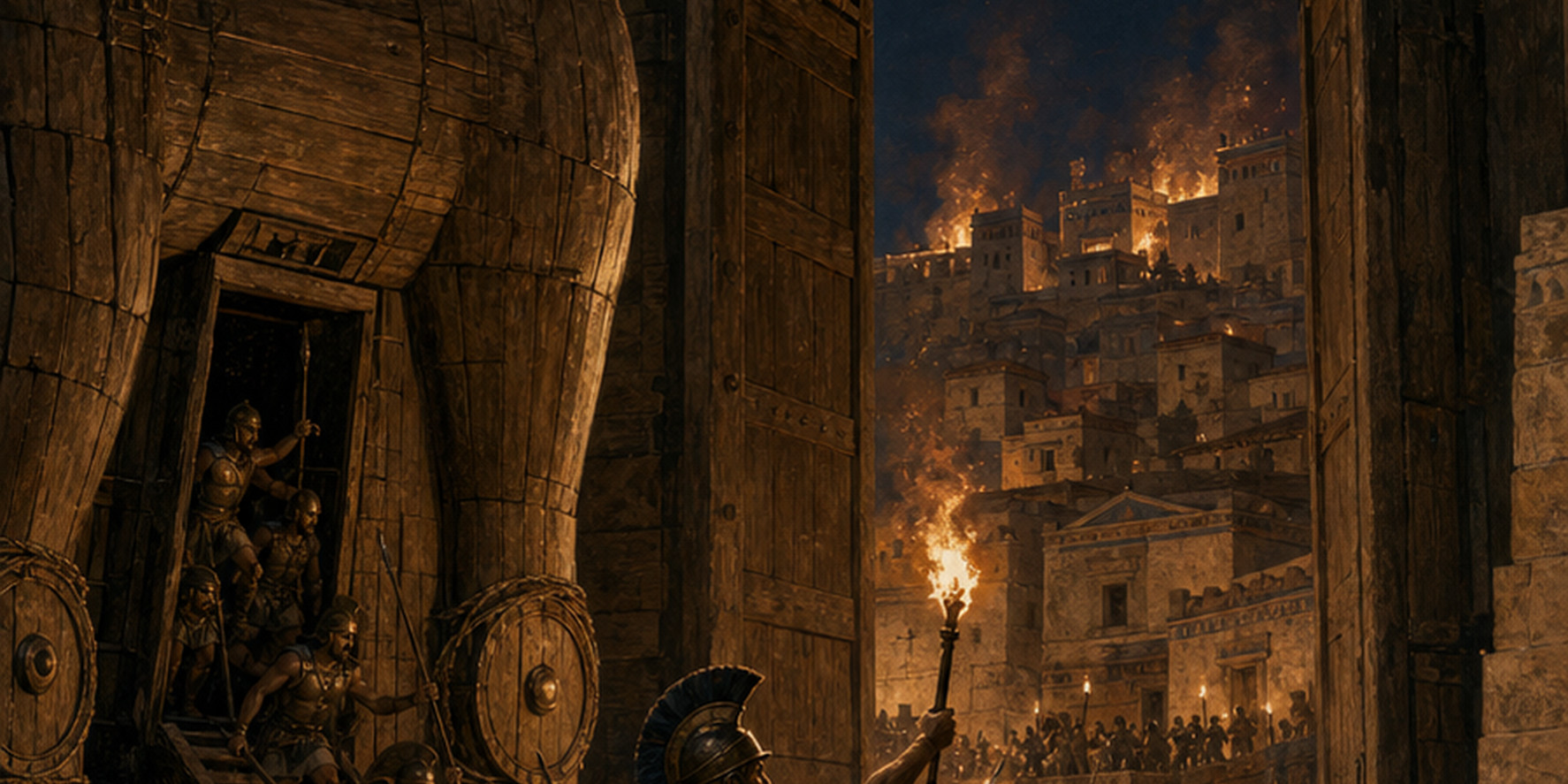
After Troy accepts the wooden horse, concealed warriors emerge at night and admit the returning fleet. Priam is killed, sanctuaries are violated, captives are assigned, and survivors scatter. Victory ends the siege but creates the disasters of the Returns.
Greek Mythology Timeline
Move through broad mythic ages and open the events that connect one story to the next. The sequence is a reading path, not an exact historical calendar.
The Sack of Troy is the night when the wooden horse, the returning Achaean fleet, and a city convinced the war has ended turn ten years of siege into sudden destruction. The lost epic Iliou Persis, known through Proclus’ summary and fragments, organized the episode; the Odyssey remembers key moments, while tragedy, mythography, art, and Roman epic preserve competing details. The event is not simply victory after delay. It is the collapse of boundaries, sanctuary, household, and the moral discipline of the victors.
The Horse Is Accepted
Trojans debate whether to destroy the horse, throw it from a height, or dedicate it to Athena. The choice to preserve it wins. Feasting and relief follow because the vanished camp and apparent offering seem to announce an end to war.
Warnings by Cassandra and Laocoon become decisive in later versions, but their exact sequence and divine explanation vary. The deception succeeds through interpretation: exhaustion and hope make threatening evidence appear compatible with safety.
Sinon and the Returning Fleet
Sinon remains behind to support the false story and eventually signals the Achaeans. The fleet has not truly departed; it waits near Tenedos or another concealed station until night and signal restore the attacking force.
The plan therefore joins several coordinated acts: construction, hidden passengers, staged abandonment, persuasive speech, Trojan transport, a signal, and naval return. Removing any one step makes the famous object less effective.
Warriors Leave the Horse
The concealed company emerges after the city sleeps or celebrates. Ancient lists of occupants differ, but Odysseus, Menelaus, Neoptolemus, Diomedes, and others recur. Epeius may manage the opening of the structure he built.
Their first objective is not to defeat an entire city alone. They open access, attack guards, and connect the force inside with the fleet outside. The horse converts Troy’s own walls into an enclosure around the attackers until the gates are breached.
Priam at the Altar
Priam’s death becomes one of the sack’s defining images. Neoptolemus kills the old king at or near the altar of Zeus Herkeios after the royal household has already suffered further loss. Sanctuary fails at the center of domestic and civic religion.
The scene deliberately reverses Priam’s achievement in the Iliad, where supplication before Achilles restores Hector’s body and a temporary limit on violence. At the sack, the next generation does not preserve that restraint.
Cassandra and Athena’s Image
Ajax the Lesser drags Cassandra from the image or sanctuary of Athena in major traditions. The outrage implicates the Achaean coalition even when leaders condemn it, because punishment, purification, and accountability fail or arrive too late.
Athena’s anger helps explain disasters during the returns. A goddess who supported the Achaeans can oppose them when victory becomes sacrilege. Divine alliance is conditional rather than permission for unlimited conduct.
Women, Children, and Captivity
Andromache, Hecuba, Cassandra, and other Trojan women are assigned to victors. Astyanax is killed in prominent cyclic and tragic traditions, and Polyxena may be sacrificed at Achilles’ tomb in later accounts. The royal family becomes captive labor, spoil, memorial victim, or exile.
Greek tragedy moves these outcomes to the center. The event must therefore show more than burning walls and successful strategy. Conquest redistributes bodies, households, names, and futures long after the fire is extinguished.
Helen, Menelaus, and Recognition
Menelaus recovers Helen after killing Deiphobus in the cyclic summary. Other sources dramatize an intended punishment interrupted by beauty, recognition, divine influence, or uncertainty about Helen’s responsibility.
Her return does not resolve the war into a simple rescue story. Helen has been cause, captive, chooser, weaver, observer, tester at the horse, and mourner across different texts. The sack preserves those contradictions rather than deciding them once.
Aeneas and Other Survivors
Some traditions have Aeneas withdraw before the final destruction after interpreting the portent around Laocoon; others emphasize his escape carrying family and sacred objects. Greek and Roman receptions develop different routes from Trojan survival.
Survivors prevent the city from becoming only an ending. Captives establish new households, exiles claim new lands, and memorial communities reproduce Trojan names elsewhere. Ruin becomes a source of further foundation stories.
From Sack to Returns
At dawn the Achaeans possess Troy, but the coalition immediately faces division, pollution, offended gods, dangerous sea, and unstable homes. Victory completes the siege while beginning the Nostoi.
Material survival also complicates the image of total annihilation. Epic sack, archaeological destruction, later Ilion, displaced Trojan communities, and Roman claims about Aeneas belong to different bodies of evidence. The event page can show literary ruin without treating one excavated layer as a photograph of this particular night.
That separation keeps both archaeology and epic meaningful.
It also prevents false certainty.
Follow the sack toward Troy for the breached city, Trojan Horse for the device, Priam and Andromache for household destruction, Athena for violated sanctuary, Helen for contested recovery, Trojan War for the siege, and Nostoi for the victors’ scattered consequences.
Trivia
- The lost Sack of Ilium is known chiefly through Proclus’ summary and fragments.
- Ancient sources disagree about the horse’s occupants and several deaths during the sack.
- Sacrilege at Troy becomes a major cause of disaster during the Achaean returns.