The victorious coalition breaks into storms, safe arrivals, murder, wandering, and homes transformed by absence.
- Agamemnon
- Ajax the Lesser
- Athena
- Clytemnestra
- Diomedes
- Ithaca
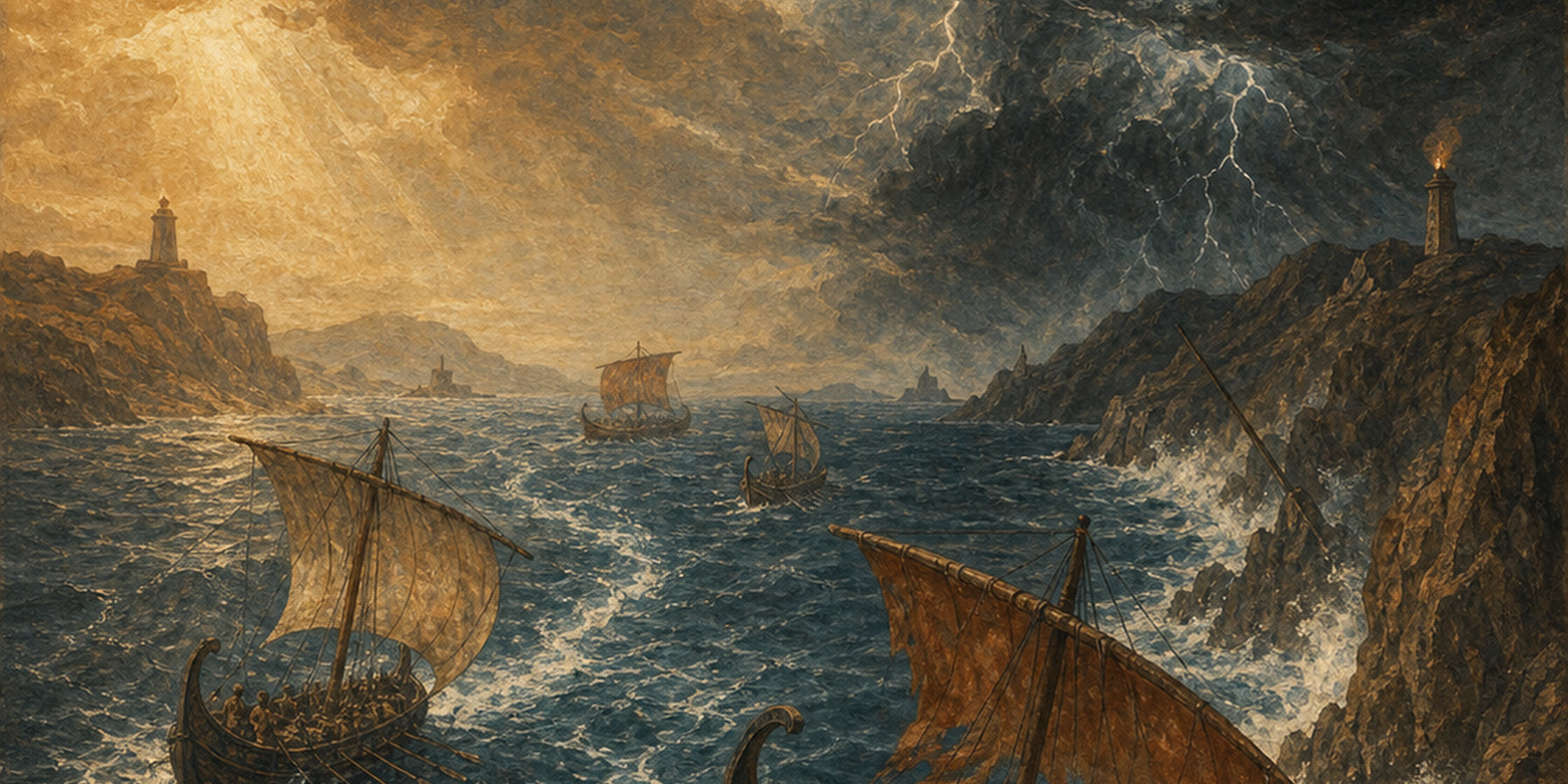
- Leaders DivideAgamemnon and Menelaus disagree over departure and appeasing Athena.
- Storm and PunishmentFleet routes scatter under divine anger and dangerous seas.
- Different HomesNestor and others return while Menelaus continues through distant regions.
- Murder at MycenaeAgamemnon reaches home only to die within his own royal house.
- Odysseus RemainsThe longest surviving return continues until disguise and recognition in Ithaca.
The Nostoi are the Achaean returns after Troy and the title of a lost Epic Cycle poem. Offended gods, divided leaders, dangerous seas, murder at home, and prolonged wandering make each victory produce a different aftermath.
Greek Mythology Timeline
Move through broad mythic ages and open the events that connect one story to the next. The sequence is a reading path, not an exact historical calendar.
The Nostoi are the returns of the Achaean leaders after Troy, a network of voyages in which the coalition that sailed together breaks into different routes, storms, murders, delays, and partial restorations. Nostoi was also the title of a lost poem in the Epic Cycle. Its surviving summary and fragments, together with the Odyssey, tragedy, lyric poetry, and mythography, show that homecoming is not the reward automatically granted by victory. It is another test of divine relations, leadership, memory, and the condition of the homes left behind.
A Coalition Divides
After the sack, Agamemnon and Menelaus quarrel over departure. One group sails while another remains to appease Athena. The unified army separates before the sea has imposed any distance.
This division makes return a moral and ritual problem as well as navigation. The victors must respond to sacrilege, distribute spoil, bury the dead, choose routes, and decide which leaders still deserve trust.
Athena’s Anger
The violation of Cassandra at Athena’s image and failures of punishment contribute to the goddess’ hostility. Storms strike fleets that had previously benefited from divine support. Alliance during war does not erase accountability after victory.
Different sources distribute responsibility among Ajax the Lesser, the leaders, and the wider army. The important pattern is collective exposure: one outrage can endanger ships whose crews did not commit the original act but remain part of the same failed response.
Ajax the Lesser
Ajax the Lesser dies during the return in prominent traditions. Athena or Poseidon destroys him after he boasts of surviving divine attack, and he is thrown from or clings to a rock before the sea finishes the punishment.
His death turns survival into renewed offense. Escaping one storm is not proof of innocence or superiority. Speech after danger can reactivate the conflict between mortal pride and divine power.
Nestor and Diomedes
Nestor reaches Pylos safely in the Odyssey’s memory, and Diomedes also receives a comparatively direct return in several traditions. Their success provides contrast rather than a general rule.
Telemachus visits Pylos to ask Nestor about the returning generation. A safe home becomes an archive where sacrifice, storytelling, and hospitality preserve information for a son who cannot remember his own father’s departure.
Menelaus across the Mediterranean
Menelaus wanders through Cyprus, Phoenicia, Egypt, Libya, and other places in different accounts before returning to Sparta with Helen. In the Odyssey he acquires wealth and knowledge through delay, including prophecy from Proteus.
His homecoming is successful but not immediate. The route widens the aftermath of Troy into a Mediterranean geography and keeps Helen’s return connected to stories about doubles, responsibility, wealth, and altered identity.
Agamemnon’s Murder
Agamemnon reaches Mycenae only to be killed by Clytemnestra and Aegisthus, with sources varying the exact setting and agency. Cassandra, brought from Troy, is killed with him in tragedy.
The commander’s failure is domestic and political rather than nautical. Sacrifice at Aulis, long absence, adultery, inherited violence in the House of Atreus, and Trojan captivity all enter the home at the same moment as the returning king.
Odysseus Alone
The Odyssey begins by distinguishing Odysseus from other survivors: the rest who escaped war and sea are home, while he remains detained and opposed by Poseidon. His ten-year delay becomes the largest surviving branch of the return tradition.
Stories of Polyphemus, Circe, the dead, Sirens, Scylla, Charybdis, Helios’ cattle, Calypso, and Phaeacia connect local adventures to one governing desire for Ithaca. Every detour tests whether identity and purpose can survive prolonged displacement.
Homes Changed by Absence
Returnees do not reenter houses frozen in time. Penelope’s suitors consume Odysseus’ wealth, Telemachus grows without a father, Clytemnestra and Aegisthus rule at Mycenae, and stories of the dead circulate before the travelers arrive.
Nostos therefore includes recognition, judgment, and political repair. Reaching the shoreline is necessary but insufficient. A person must learn what home has become and whether restoration will require disguise, violence, negotiation, or a new departure.
Reading the Return Cycle
The lost Nostoi cannot be reconstructed as one complete surviving text. Proclus offers a compact sequence, while Homeric and tragic works focus on particular households. Contradictions should remain labeled because they reveal how communities selected different moral centers from the same scattered generation.
The cycle also gives the word nostalgia its distant ancestry, although modern nostalgia means more than the ancient noun for return. Greek nostos combines movement, survival, recognition, ritual standing, and the political ability to occupy home again. Longing alone cannot complete it, and arrival may expose rather than heal an old conflict.
Reading several returns side by side prevents Odysseus from becoming the only model. Nestor’s safety, Menelaus’ delay, Ajax’s destruction, Agamemnon’s murder, and Trojan exile show that the same war produces radically different temporal and moral endings.
Follow the Nostoi toward the Sack of Troy for the offenses that launch it, Agamemnon for the murdered return, Odysseus for the longest voyage, Athena and Poseidon for divided divine power, the Underworld for testimony of the dead, and Odysseus’ Homecoming for the final Ithacan test.
Trivia
- Nostoi is the plural of nostos, a return home.
- A lost Epic Cycle poem titled Nostoi treated several Achaean homecomings.
- Reaching home safely does not guarantee political or familial restoration.