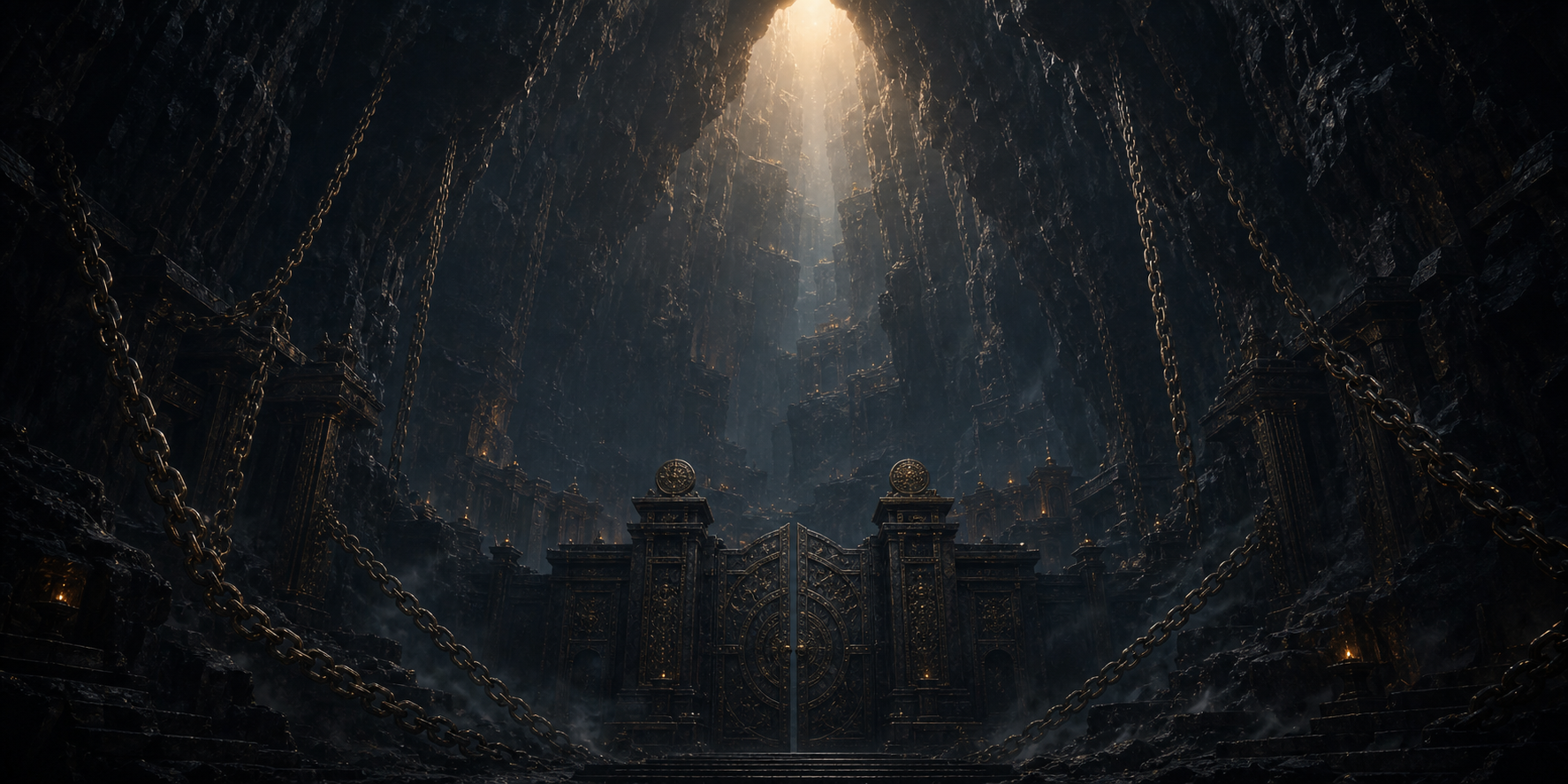
The depth that existed before its prisoners—and preserved the hidden cost of every divine reign.
- Cyclopes
- Hundred-Handers
- Punishment
- Titans
- Underworld
- Origin
- Divine Occupation
- Major Myths
- Cult / Tradition
- Legacy
Tartarus is both a primordial power and the deepest abyss of Greek cosmology, distinct from the Underworld as a whole. It imprisoned the Cyclopes and Hundred-Handers before their liberation, then held defeated Titans under Hundred-Hander guard. Later traditions increasingly made it a place of punishment for exceptional mortal offenders.
Tartarus begins before any prison has a prisoner. It is already present near the first moments of the cosmos: a depth as fundamental as Earth, then a locked boundary where divine rulers hide what they fear. To enter Tartarus is to discover that Greek mythology’s Underworld has an abyss beneath its familiar kingdom.
Primary Tradition: A Primordial Depth
Hesiod places dim Tartarus among the earliest powers, after Chaos and alongside Gaia and Eros. Like Gaia, Tartarus can be understood as both a cosmic region and a primordial being. Later genealogy can join Tartarus with Gaia in the parentage of Typhon, while the Theogony most vividly develops Tartarus as a place.
Is Tartarus a god or a location? Greek cosmogony does not demand a modern choice. A foundational region can possess divine identity, just as Earth is both ground and Gaia.
Not the Whole Underworld
Hades can name the god who rules the dead or, by extension, his Underworld realm. Tartarus is not simply another name for that whole kingdom. It is the deepest and most restrictive region, associated first with primordial confinement and defeated divine enemies rather than with the ordinary destination of every mortal soul.
This distinction prevents a common flattening of Greek afterlife geography. The Underworld includes roads, rivers, judges, shades, and the palace of Hades. Tartarus is a remote abyss within or beneath that broader map, defined by distance, gates, and containment.
The Measure of the Abyss
Hesiod imagines a bronze anvil falling from heaven for nine days and nights before reaching Earth on the tenth, then falling the same length of time from Earth to Tartarus. The image is poetic cosmography, not a measurement that should be converted into miles.
The distance makes Tartarus more than a basement beneath Olympus. It marks a cosmic separation. What kind of danger requires the same gulf below Earth that heaven holds above it? The prison’s scale answers by making escape almost unthinkable.
The First Divine Prisoners
Uranus hides the Cyclopes and Hundred-Handers within Gaia, and later mythographic tradition describes Cronus confining them in Tartarus under the guard of Campe. Their imprisonment shows the abyss before it becomes an Olympian institution. Fearful rulers use depth to remove relatives whose power they cannot govern.
Zeus changes the Titanomachy by opening the prison. The Cyclopes reward liberation with the Thunderbolt, Trident, and Helmet of Invisibility. The Hundred-Handers bring the overwhelming barrage that ends the war. Tartarus releases the allies who make Olympus possible.
Prison of the Titans
After the Titanomachy, many defeated Titans are driven into Tartarus behind bronze gates. The new ruler uses the same abyss that held his allies, but now against the generation that opposed him. Mount Othrys loses its defenders, and the war’s vertical movement ends below Earth.
This reversal creates a difficult discovery hook: does Zeus transform the prison, or inherit the methods of earlier rulers? Hesiod emphasizes justice, security, and cosmic order, while Gaia’s later anger keeps the cost of the settlement visible.
Why the Hundred-Handers Remain
The Hundred-Handers become guardians of the imprisoned Titans. At first the role seems to return former captives to the place of their suffering. Yet Hesiod presents them as honored allies entrusted with a boundary only their strength can secure.
They do not live there as forgotten prisoners. Their position confirms an ongoing relationship with Zeus and gives primordial force a recognized office. The same beings once hidden as threats now decide what Tartarus contains.
Alternative Traditions and Typhon
Apollodorus tells that Zeus imprisons the defeated Titans and later casts Typhon into Tartarus in some strands, while other traditions locate Typhon beneath particular mountains. Genealogies can also name Tartarus as Typhon’s father with Gaia. These accounts should remain labeled rather than assembled into one literal map.
Variation is expected in a place imagined at the edge of cosmic description. Authors use Tartarus to express ultimate depth, but they attach different enemies, guardians, gates, and landscapes to it.
From Divine Prison to Place of Punishment
In later Greek and Roman imagination, Tartarus becomes increasingly associated with the punishment of exceptional mortal offenders. Figures such as Tantalus, Sisyphus, Ixion, and the Danaids acquire famous penalties, though their locations and details vary by source.
This development should not be projected backward as though Hesiod’s Tartarus were a universal hell for all dead humans. The earlier emphasis lies on cosmic enemies and divine incarceration; the moralized prison of notorious mortals grows through later afterlife traditions.
Symbolism and Meaning
Tartarus represents exclusion made architectural. Bronze, gates, distance, darkness, and guardians turn political fear into cosmic geography. Every ruling order defines what it cannot allow to return, and Tartarus is the place where that definition becomes visible.
It also preserves memory. The defeated do not vanish; they remain beneath the world, close enough to require guards. Olympus shines more brightly when read above Tartarus, but its stability looks less effortless.
Legacy and Paths Forward
Later literature made Tartarus a powerful name for hellish imprisonment, influencing Roman poetry and much later fantasy. Modern retellings often merge it with Hades, but the older network becomes richer when the divine ruler, the broad Underworld, and the primordial abyss remain distinct.
Follow the Cyclopes and Hundred-Handers to liberation, the Titans and Mount Othrys to defeat, Gaia to the grievance that survives victory, and Hades to the larger realm of the dead. Tartarus is not the end of the journey. It is the hidden junction beneath several divine ages.
Seen from that junction, the same gates tell opposite stories. To the Cyclopes they are the barrier Zeus breaks; to the defeated Titans they are the boundary Zeus closes; to the Hundred-Handers they mark a new responsibility. Place does not carry one fixed moral meaning. Tartarus becomes liberating, punitive, protective, or terrifying according to who approaches it and which ruler controls passage.
This is why the abyss matters to more than afterlife lore. It records the political architecture of divine succession. Every ascent toward Olympus has a descent beside it, and every celebrated weapon begins with someone opening a prison. Tartarus preserves the part of victory that triumphal stories might prefer to leave unseen.
Its darkness is therefore not empty. It holds relationships under pressure: ruler and captive, liberator and ally, victor and defeated, guardian and gate. Reading those roles separately prevents Tartarus from becoming generic scenery and restores it as one of the most connected places in the mythic cosmos.
Trivia
- Hesiod uses a falling bronze anvil to imagine the immense distances between heaven, Earth, and Tartarus.
- Tartarus appears both as a primordial power and as a cosmic location in ancient genealogy.
- The association with punishments for famous mortal offenders became more prominent in later afterlife traditions.