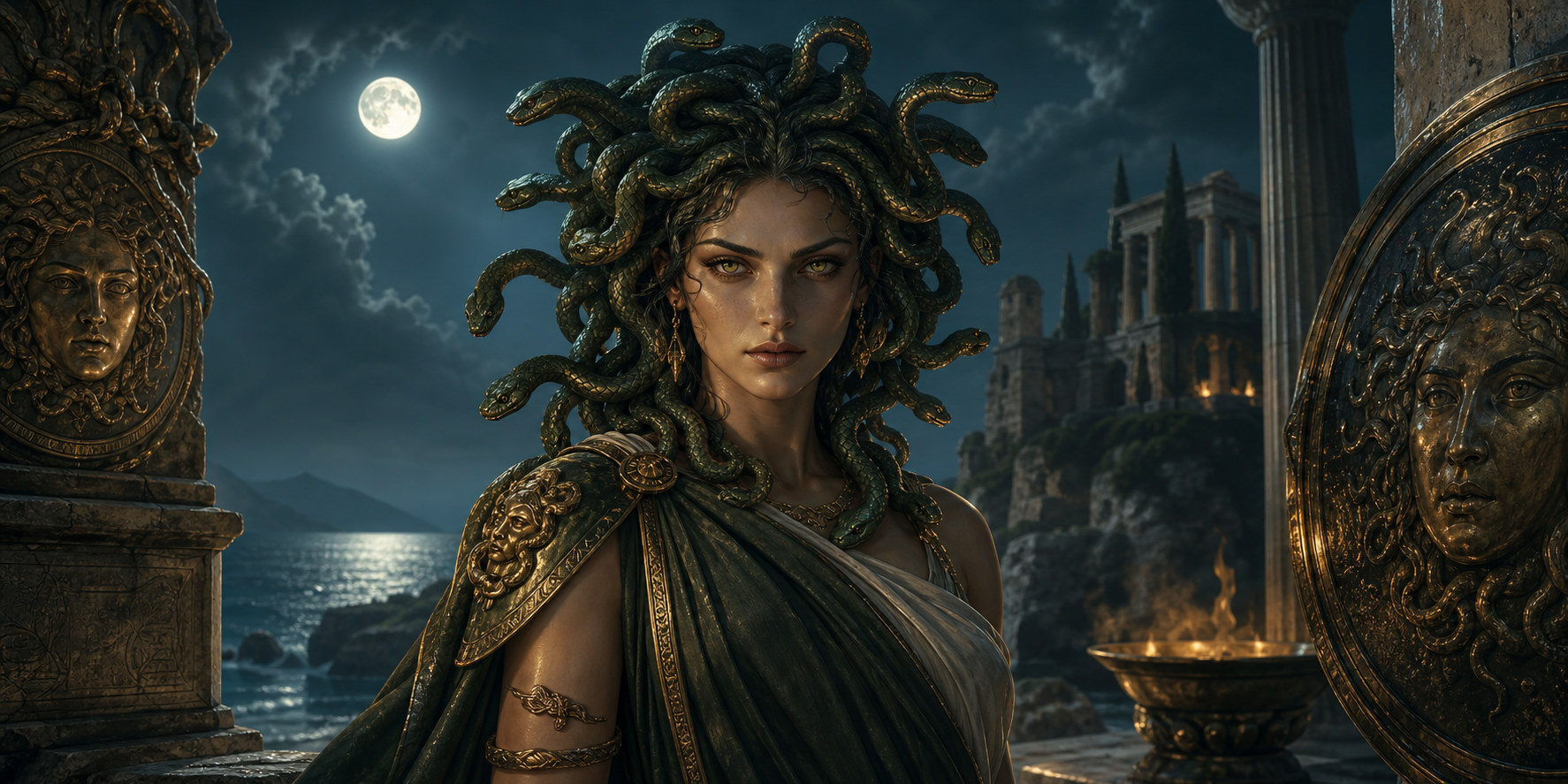
The mortal Gorgon whose severed gaze became a lasting emblem of divine protection.
- Apotropaic
- Athena
- Gorgon
- Petrifying Gaze
- Snakes
- Primordial Age
- Titan Age
- Olympian Age
- Heroic Age
- Trojan Cycle
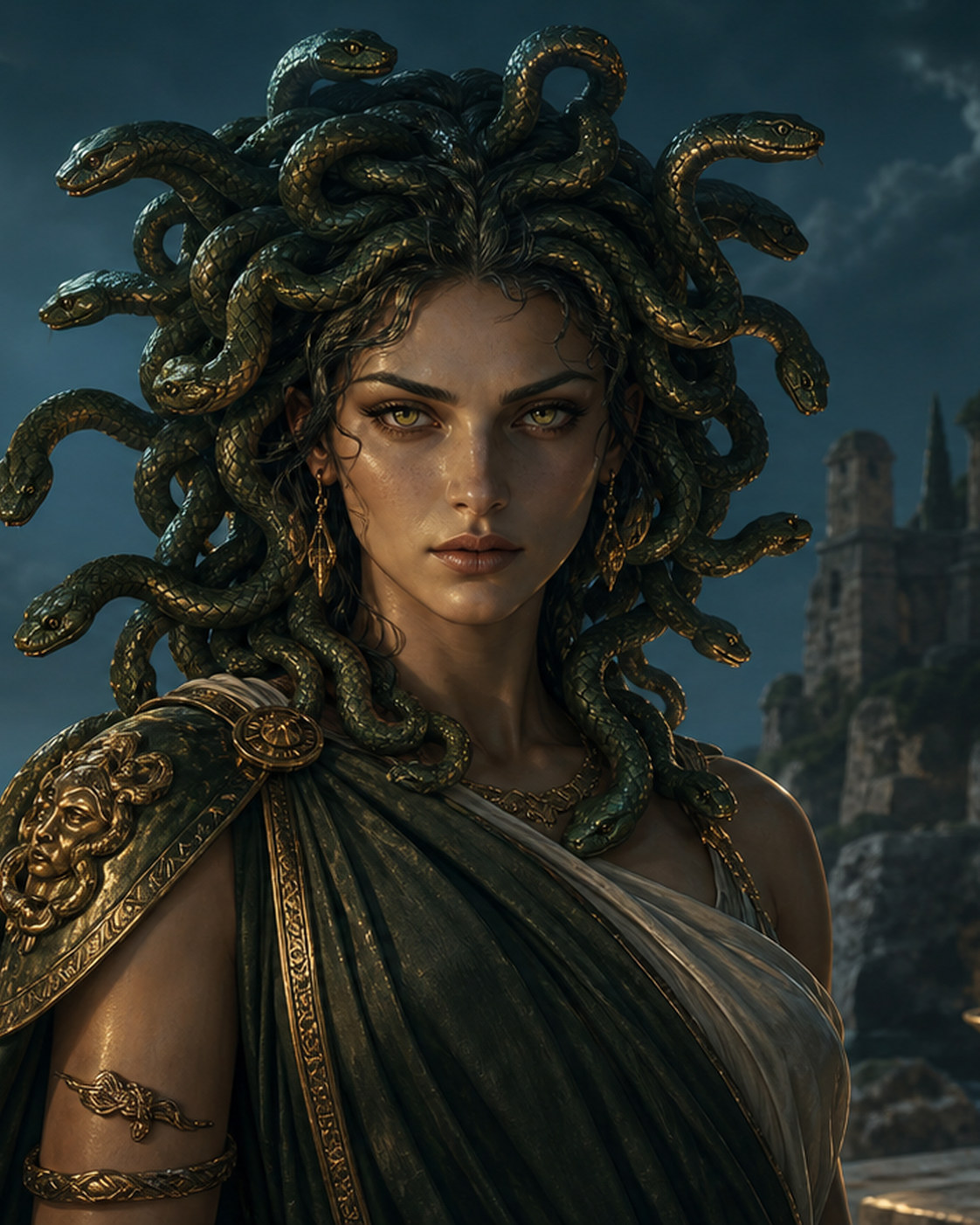
Medusa is the only mortal sister among the three Gorgons. Perseus beheads her with Athena's guidance, and Pegasus and Chrysaor emerge from her body. Her still-powerful head later becomes Athena's Gorgoneion. The famous transformation from beautiful maiden to snake-haired monster belongs especially to Ovid's later Roman account.
Medusa’s story does not end when Perseus cuts off her head. Only then does her image begin its longest life: on Athena’s protection, on temple roofs, on shields, coins, jewelry, and every object meant to meet danger with a more dangerous gaze.
One Mortal Gorgon
Hesiod names three Gorgon sisters born to Phorcys and Ceto: Stheno, Euryale, and Medusa. They dwell far from gods and mortals near the edge of the world. Medusa alone is mortal, a difference that later makes her the possible target when her sisters cannot be killed.
Early genealogy does not begin with Medusa as a human maiden transformed by Athena. It presents her within a monstrous divine family. That distinction matters because the famous transformation story belongs to a later Roman poetic tradition, not to every ancient account.
Poseidon and the Children Yet Unborn
Hesiod says that Poseidon lay with Medusa in a meadow among spring flowers. When Perseus later beheads her, Pegasus and Chrysaor spring from her body. Chrysaor becomes father of Geryon, while Pegasus rises into a separate heroic and divine career.
Birth and death occupy the same instant. The scene prevents Medusa from being reduced to a trophy: even after the fatal strike, her genealogy expands into stories Perseus does not control.
Why Perseus Seeks Her Head
In the mythographic account attributed to Apollodorus, King Polydectes sends Perseus for the Gorgon’s head after the young hero boasts that he could obtain it. The mission removes a protector from Danae and appears impossible because direct sight of the Gorgons turns a viewer to stone.
Perseus succeeds through a network of help. Hermes and Athena guide him; divine equipment gives him flight, concealment, storage for the head, and a weapon fit for the task. The victory is never merely one man’s sword against a sleeping monster.
The Averted Gaze
Apollodorus describes Perseus looking at Medusa’s image in a bronze shield while Athena directs his hand. Later art and retellings develop the idea of a mirror-like surface. The core strategy is indirect sight: he acts without meeting the deadly face on its own terms.
Does the shield defeat Medusa, or does it teach the hero how to approach power that cannot be confronted directly? The episode links intelligence, divine guidance, and equipment as closely as physical courage.
The Head That Remains Alive
After the beheading, Medusa’s head retains its petrifying force. Perseus uses it against enemies, including Polydectes and, in some accounts, opponents surrounding Andromeda. The head shifts between weapon, proof of accomplishment, and protection for those the hero rescues.
Because its power survives death, the face becomes separable from Medusa’s biography. This is the beginning of the Gorgoneion as an emblem—but the emblem should not erase the person and family from whom it came.
Athena Receives the Gorgoneion
When the quest ends, Perseus returns the divine equipment and gives Medusa’s head to Athena. Apollodorus says that the goddess places it in the center of her shield. Other texts and artworks associate the Gorgon face with the Aegis, which can appear as a mantle, breast covering, or shield-like protection.
The transfer creates one of Greek mythology’s most powerful object networks: Medusa leads to Perseus, Perseus to Athena, Athena to the Gorgoneion and Aegis, and those emblems to later battles such as the Gigantomachy.
The Transformation Story
Ovid’s Metamorphoses gives the influential Roman story in which Medusa was once renowned for beauty, especially her hair. After Neptune violated her in Minerva’s temple, the goddess transformed that hair into snakes; Perseus later explains why Minerva bears the head on her breast.
This version has shaped modern sympathy for Medusa and modern criticism of divine punishment. It should be told clearly, but labeled as Ovid’s later account rather than projected backward into Hesiod. Ancient myth preserves several Medusas because different authors ask different questions of her.
Face of Terror, Face of Protection
Greek artists used the frontal Gorgon face to stare outward from architecture, armor, pottery, and small protective objects. Wide eyes, tusks, tongue, snakes, and an emphatic frontality made the image confront the viewer even when surrounding figures appeared in profile.
The logic is apotropaic: danger is turned against danger. A terrifying face guards a boundary by warning hostile powers that something equally terrible is already watching. Later art increasingly makes Medusa beautiful or tragic, but the protective gaze remains central to her legacy.
That long visual afterlife also changes how readers return to the myth. Medusa can be encountered first as a temple guardian, a coin image, or a modern symbol, and only afterward as one of three sisters in an archaic genealogy. Reading in both directions keeps the famous face connected to its older family and quest traditions.
Where the Story Leads
Follow Athena to understand who guides Perseus and inherits the head, the Aegis to see how protection and terror combine, and the Gorgoneion to trace the face after it becomes an object. Poseidon opens the genealogy of Pegasus and Chrysaor, while Perseus leads into the larger quest that brought a mortal hero to the edge of the world.
Trivia
- Medusa is the only mortal sister among the three Gorgons in Hesiod and Apollodorus.
- Pegasus and Chrysaor emerge when Medusa is beheaded.
- The familiar story of snake hair as a punishment is especially associated with Ovid’s Roman Metamorphoses.