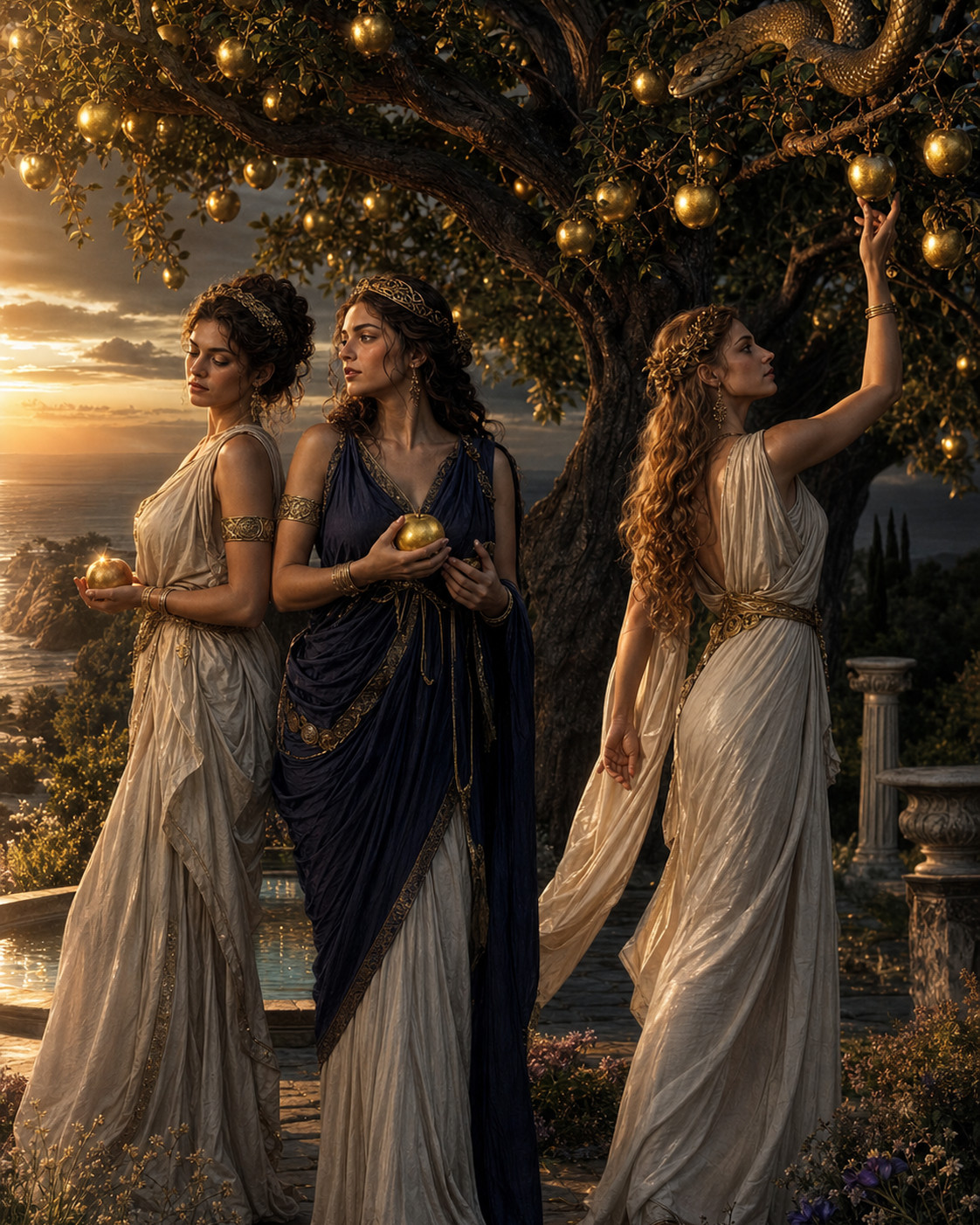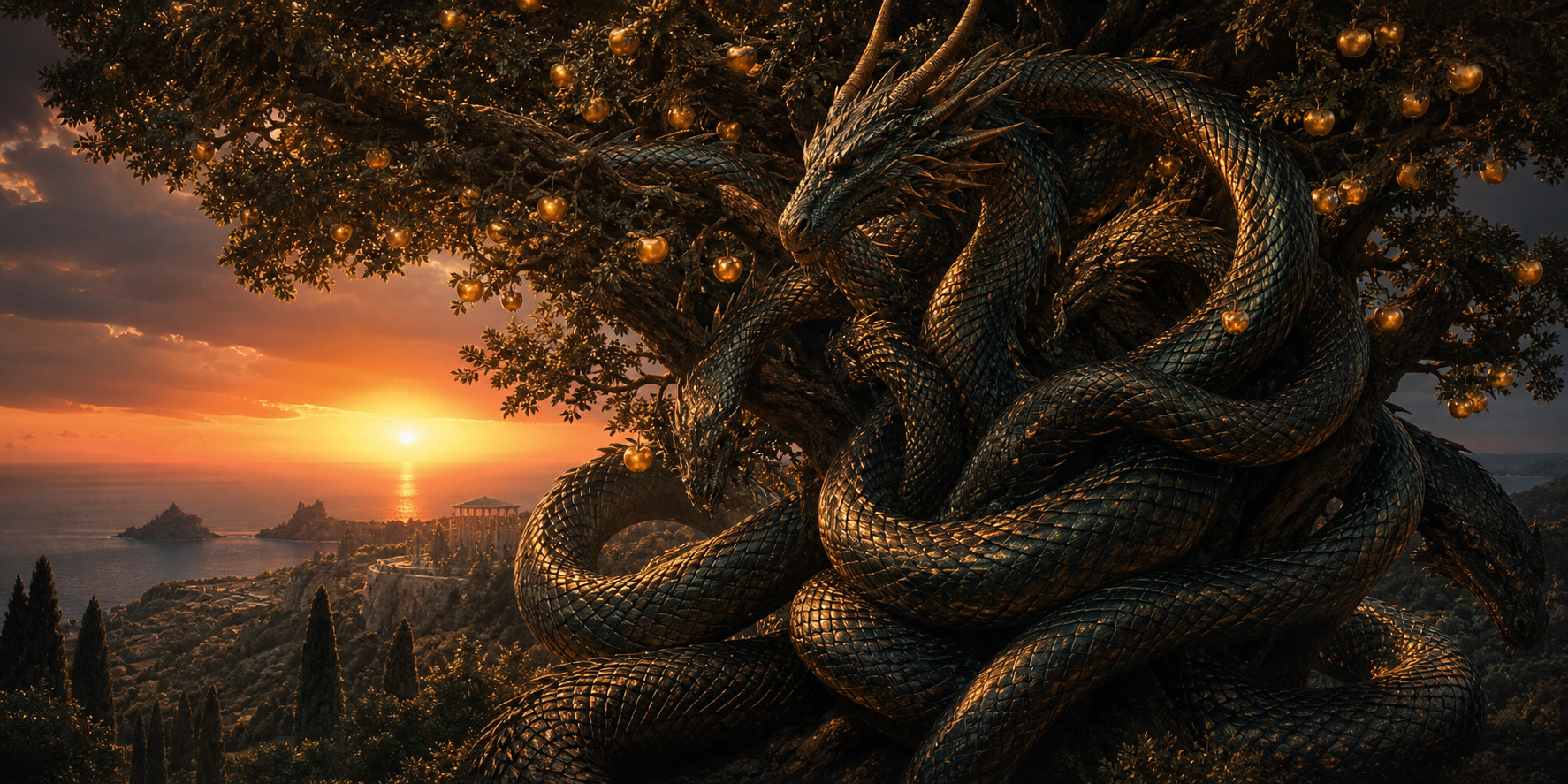
The sleepless many-headed serpent whose coils make Hera's golden tree impossible to approach unseen.
- Draco
- Garden of the Hesperides
- Golden Apples
- Heracles
- Hesperides
- Hydra Venom
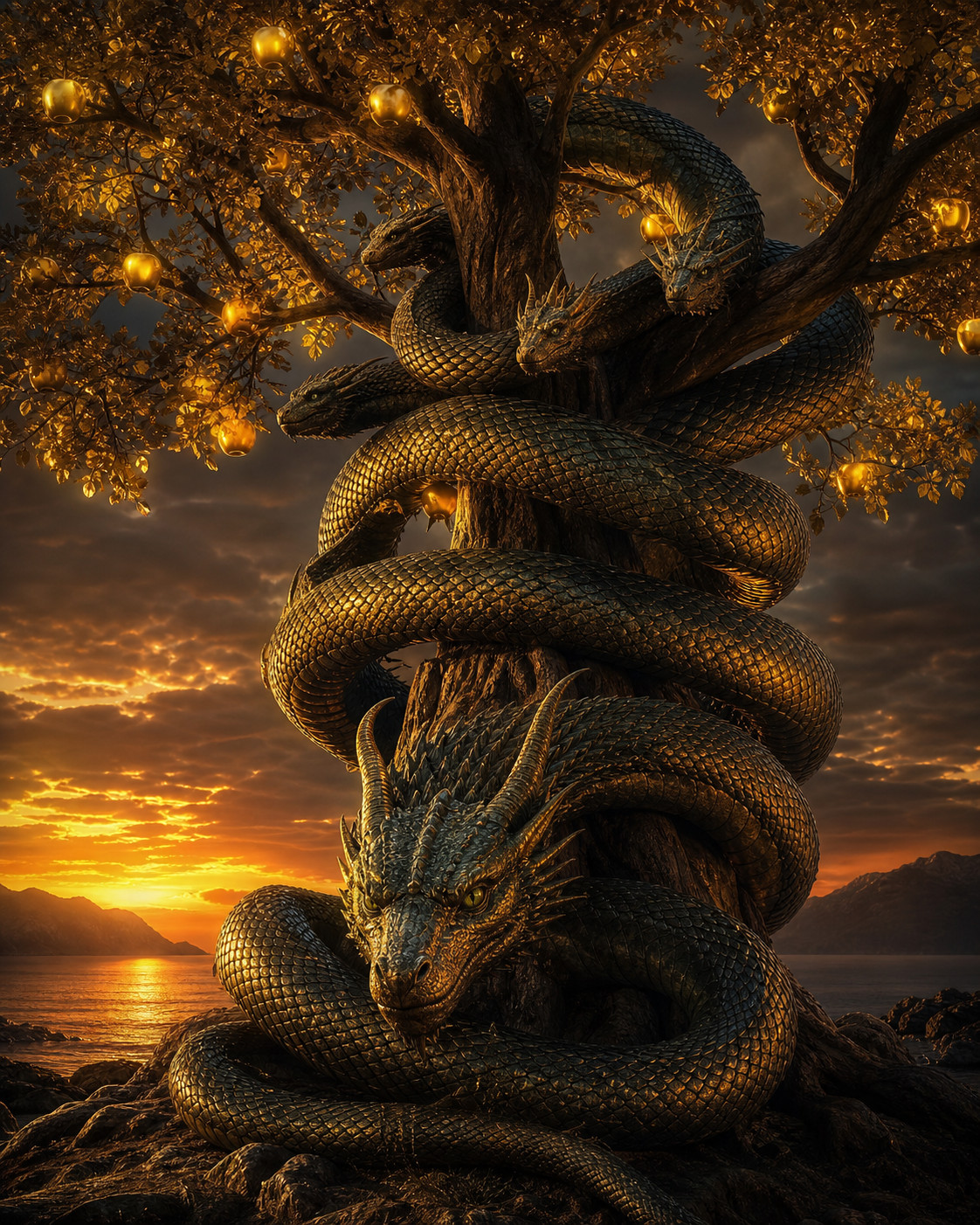
Ladon is the great serpent guarding the Golden Apples in the Garden of the Hesperides. Sources vary his parentage and number of heads; some labor traditions have Heracles kill him, while the Atlas version reaches the fruit without making Ladon the central opponent.
Greek Mythology Timeline
Move through broad mythic ages and open the events that connect one story to the next. The sequence is a reading path, not an exact historical calendar.
Ladon is the sleepless serpent of the Hesperides, coiled around the tree that bears Hera’s golden apples. Ancient descriptions expand him from a great snake into a many-headed dragon whose voices and watchfulness fill the garden. His death can be a necessary step in Heracles’s labor, but other versions let Atlas retrieve the fruit without that encounter. Ladon therefore stands at the meeting point of several traditions: monster, guardian, cosmic boundary, and casualty of heroic access.
The Dragon of the Far West
Early Greek poetry describes a terrible serpent guarding golden fruit at the world’s dark edge. The creature later receives the name Ladon and the title Hesperian Dragon. His body belongs to the garden’s geography: long coils repeat the encircling Ocean, while wakeful eyes make the distant orchard impossible to approach unseen.
The familiar word dragon originally points toward a great serpent rather than a medieval winged beast. Ancient artists often show Ladon as a snake wound around the trunk, sometimes with one head and sometimes with several. His defining traits are vigilance, enclosure, and intimate contact with the forbidden tree.
Parents of a Boundary Monster
Hesiod places the guardian serpent among the offspring of Phorcys and Ceto, a family filled with marine and liminal dangers. Apollodorus instead calls the dragon a child of Typhon and Echidna, parents of many monsters defeated by heroes. Other traditions make Earth itself his mother.
Each genealogy interprets Ladon differently. Marine parents align him with Ocean and perilous edges; Typhon and Echidna place him inside a heroic monster family; Earth makes him native to the ground he protects. The versions should remain separate because their differences reveal how ancient authors understood his role.
One Head, Many Heads, Many Voices
Some accounts imagine a single serpent, while later descriptions give Ladon a hundred heads. Multiplication makes perfect vigilance visible: a guardian with many faces can watch every direction. Ancient commentary also associates him with varied voices, turning the orchard’s soundscape into something stranger than simple hissing.
The exact number matters less than the principle. Ladon cannot be distracted like an ordinary animal. The Hesperides sing nearby, but the dragon remains awake. He is the living answer to theft, a defense that wraps itself around the desired object so tightly that tree, fruit, and guardian become one visual system.
Why Hera Needs a Serpent
The apples belong to Hera through the wedding-gift tradition. Nymph attendants tend the garden, yet some sources imply that Hera appoints Ladon because the fruit requires an incorruptible watch. His service is not random aggression. He enforces the difference between divine custody and mortal appetite.
Greek sanctuaries and myths often place serpents near guarded springs, earth-born powers, or sacred precincts. Ladon intensifies that pattern at a cosmic scale. Anyone who confronts him is not merely fighting wildlife; they are challenging the protection surrounding a goddess’s possession at the end of the world.
Heracles and the Eleventh Labor
When Eurystheus commands Heracles to bring back the apples, the hero first faces a problem of knowledge. The garden is difficult to locate, and its defenses are not described consistently. In one major narrative, Prometheus advises Heracles to ask Atlas to retrieve the fruit while the hero bears the sky. Ladon need not be the decisive opponent there.
Other sources and images make Heracles the dragon’s killer. He may shoot Ladon from outside the garden or confront the serpent near the tree. These accounts give the labor a recognizable monster battle, but they should not erase the Atlas exchange. The tradition preserves both negotiation with a burdened Titan and violence against a guardian.
Hydra Venom at the Garden
Apollonius Rhodius describes the Argonauts arriving one day after Heracles. Ladon has been struck by arrows poisoned with the Lernaean Hydra’s gall, and the wound still kills insects that approach it. The detail links distant labors into a chain: the substance gained after Iolaus helps defeat one monster becomes fatal to another.
This continuity is morally uneasy. A successful labor leaves dangerous material that travels through later stories. Ladon’s death is not cleanly contained at the moment of victory; poison remains active in the landscape. The Hesperides’ lament gives that consequence witnesses and turns the silent guardian into someone whose absence changes the garden.
Ladon among the Stars
Later astronomical tradition associates Ladon with Draco, the long constellation circling the northern sky. Catasterism—the placing of a figure among the stars—does not simply undo death. It converts a defeated guardian into a permanent celestial image, still coiled and still visible to those who know the story.
The identification also shifts direction. A creature of the far west appears around the northern celestial pole, showing how mythic geography can move when stories enter astronomy. The enduring shape matters more than a literal route: the coiled watcher becomes part of the ordered heavens.
Monster or Faithful Guardian?
From Heracles’s perspective, Ladon blocks a commanded task. From Hera’s perspective, he performs exactly the service assigned to him. Calling him a monster describes form and danger, but it does not settle the ethics of the encounter. He protects rather than raids; the hero is the one seeking entry.
This reversal makes Ladon useful for reading heroic myths critically. A quest can be justified within one narrative and still destroy a loyal guardian within another. The story becomes larger when victory and loss are allowed to coexist. Ladon’s many eyes suggest that the garden has its own way of seeing the intruder.
What Ladon Means
Ladon personifies a boundary that does not sleep. His coils make law physical, surrounding the tree with a body that must be negotiated, avoided, or broken. Unlike a locked door, he is alive, responsive, and woven into the sacred ecosystem he protects.
Follow his story toward the Hesperides for the keepers’ viewpoint, the Golden Apples for the question of ownership, the Garden for competing geographies, and Heracles for the labor’s variants. The Hydra connection leads backward to Iolaus, while Draco carries the guardian forward into the night sky.
Trivia
- Ladon is shown with one head in some traditions and a hundred in others.
- Apollonius Rhodius links his death to arrows poisoned with Hydra venom.
- Later astronomy identifies the guardian serpent with the constellation Draco.