The Giant leader whose assault on Hera ends under Zeus's lightning and Heracles' mortal arrow.
- Arrow
- Gigantomachy
- Hera
- Heracles
- Thunderbolt
- Zeus
- Primordial Age
- Titan Age
- Olympian Age
- Heroic Age
- Trojan Cycle
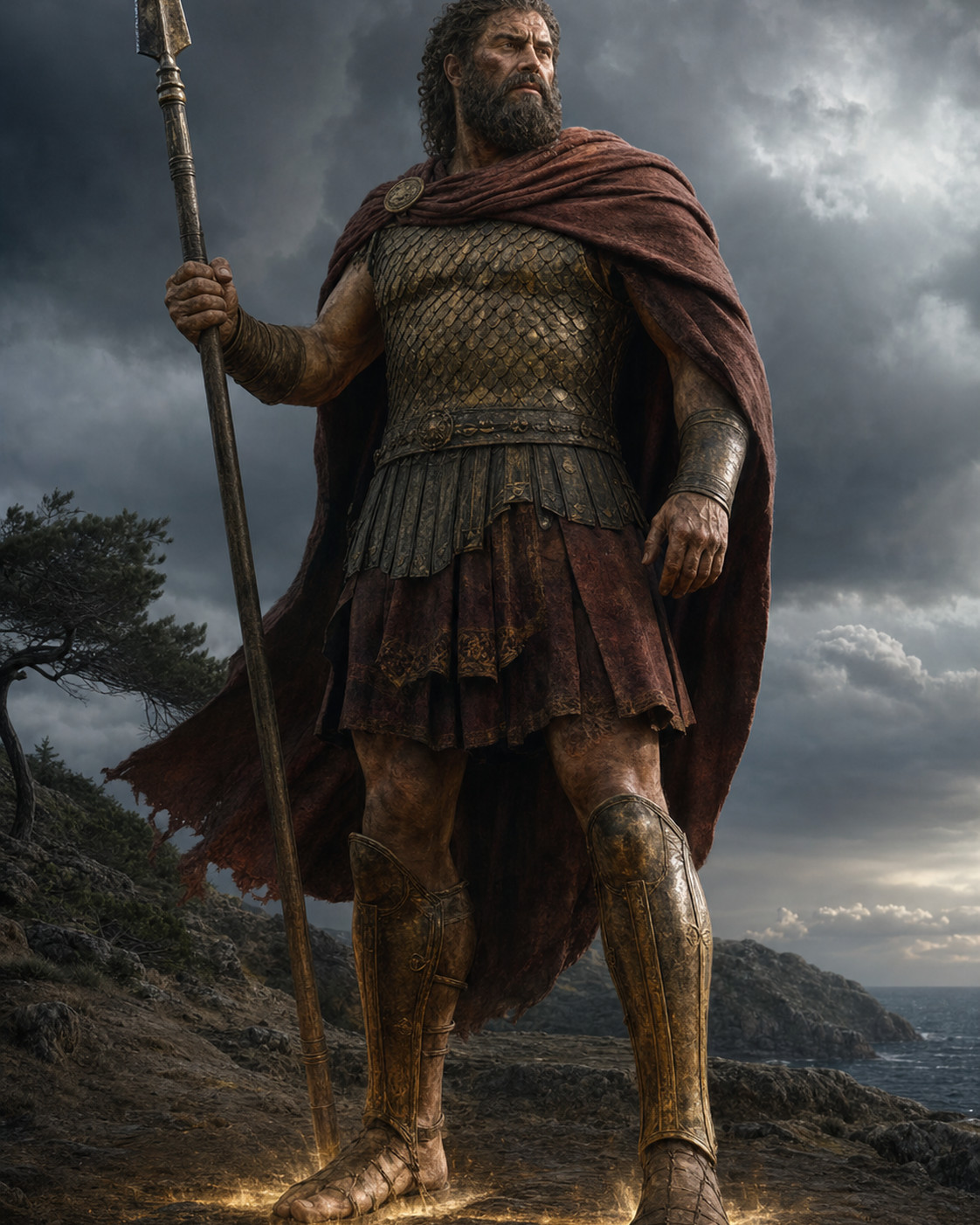
Porphyrion is one of the foremost Giants in the Gigantomachy. When he attacks Hera, Zeus strikes him with a thunderbolt and Heracles completes the defeat with an arrow, fulfilling the war's divine-mortal requirement.
Porphyrion is one of the foremost Giants of the Gigantomachy and a direct threat to Olympian rule. His most famous surviving episode is deliberately disturbing: Zeus causes desire for Hera to seize him during battle, Porphyrion attacks her, Zeus strikes him with lightning, and Heracles completes the kill with an arrow. The sequence concentrates the war’s central rule—god and mortal must act together—inside a scene of power, manipulation, and attempted violation.
A Leader among the Giants
Apollodorus names Porphyrion with Alcyoneus as surpassing the other Giants. His name may evoke purple or surging force, and later retellings often call him a king. The ancient narrative gives him prominence through target and manner of death: he presses toward Hera and is stopped by the combined actions of Zeus and Heracles.
The Giants themselves arise from Gaia and are linked with Uranus in genealogy. They embody Earth’s answer to the treatment of the Titans and the consolidation of Olympian power. Porphyrion’s leadership therefore belongs to a conflict over cosmic authority, not merely an attack by an isolated monster.
How Giants Were Imagined
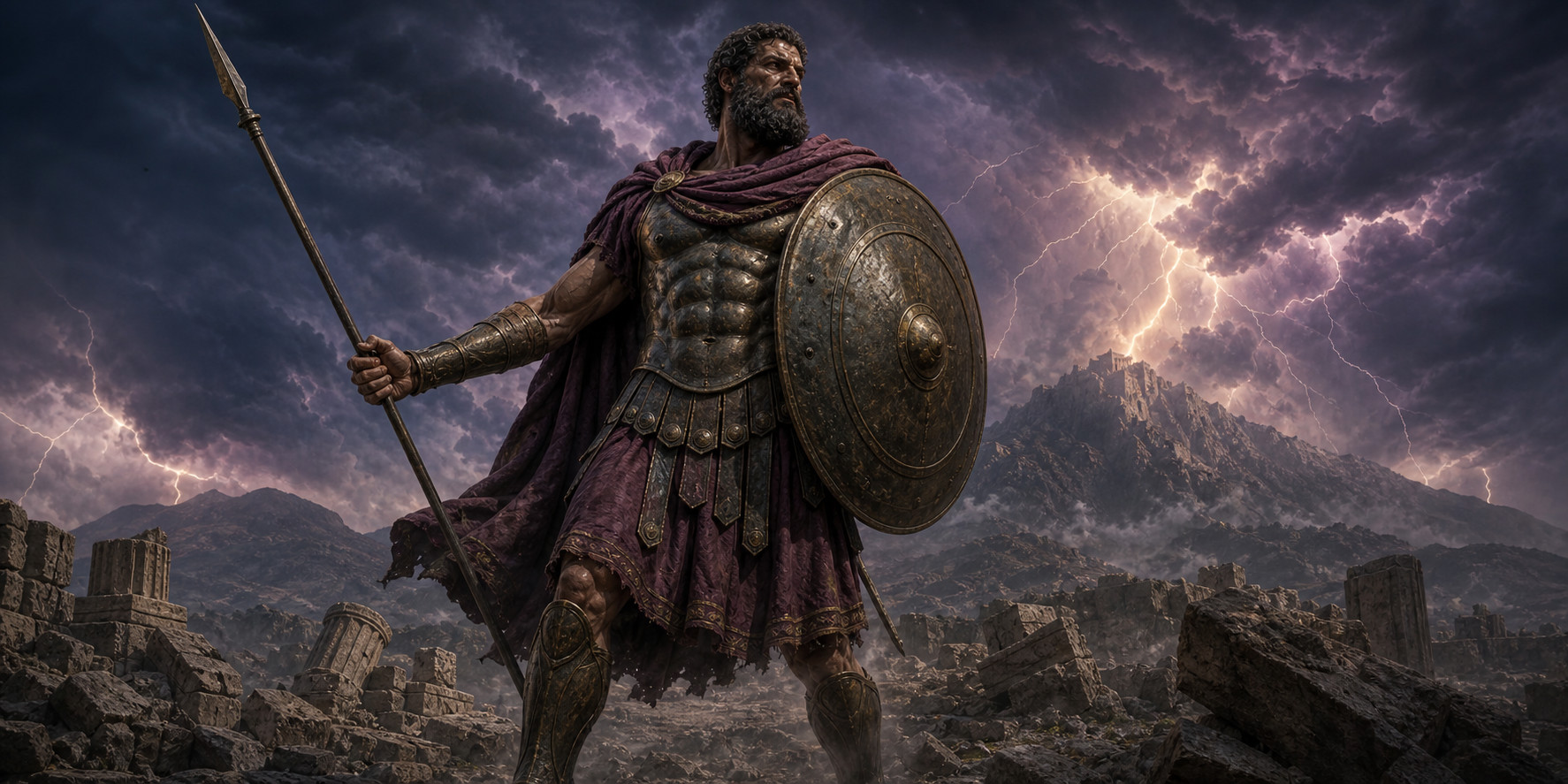
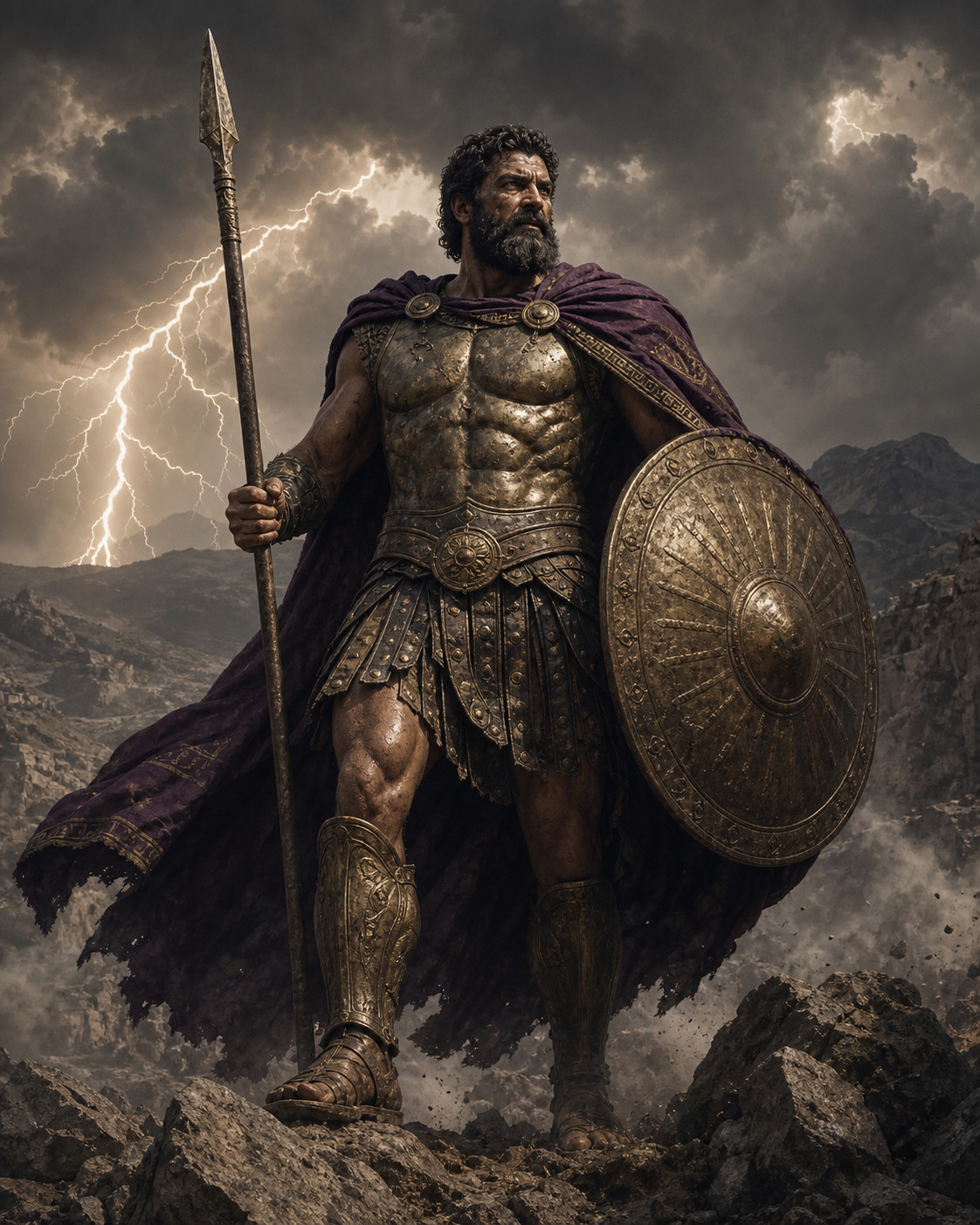
Apollodorus describes terrifying size, long hair and beards, and serpent scales for feet. Earlier vase painting can represent Giants as hoplite-like warriors with human legs, while later monumental art favors more visibly hybrid bodies. No single visual formula governs every period.
Project Mythos uses the armed human form to keep Porphyrion distinct and historically plausible within an archaic battle image. The choice does not deny the serpent-legged tradition. It reflects one ancient visual possibility and lets shield, spear, purple cloth, and colossal scale carry his identity without generic fantasy horns or armor.
War against Olympus
The Giants throw rocks and burning trees toward the sky. Their assault reverses ordinary vertical order: children of Earth attempt to reach and dislodge the gods above. Mountains and projectiles become weapons because the battlefield spans the structure of the cosmos. Olympus is not just a palace under siege but the visible height of a new regime.
Porphyrion belongs near the front of this upward challenge. His target, Hera, is queen of Olympus and a central symbol of legitimate divine marriage. An attack on her body and status threatens the household through which Olympian sovereignty presents itself as ordered and enduring.
The Mortal Required
An oracle declares that gods alone cannot kill the Giants. A mortal ally is necessary. Gaia searches for a protective plant, but Zeus prevents Sun, Moon, and Dawn from revealing it and gathers it first. Athena calls Heracles, whose mortal birth and divine parentage make him uniquely suited to cross the oracle’s categories.
This requirement shapes Porphyrion’s death. Zeus may interrupt and weaken him, but Heracles’s arrow must also land. The story does not assign one hero the whole victory. Divine strategy, lightning, mortal weapon, and the wider Olympian coalition combine to close a conflict generated by Earth.
The Attack on Hera
According to Apollodorus, Porphyrion rushes against Heracles and Hera. Zeus causes desire for Hera to seize him, and the Giant tears at her clothing in an attempt to violate her. Zeus then strikes him with a thunderbolt, and Heracles kills him with an arrow. The episode is brief in the source but morally and narratively dense.
The scene should be described without turning attempted sexual violence into spectacle. Zeus weaponizes desire to expose Porphyrion to attack; Hera is placed in danger within a strategy she does not control; Heracles completes the oracle’s mortal requirement. The victory protects Olympus while also displaying the unsettling methods available to its ruler.
Lightning and Arrow
Porphyrion’s fall joins Zeus’s defining weapon with Heracles’s ranged strike. The pairing visually condenses the entire Gigantomachy. Lightning alone is insufficient under the oracle, and the human arrow alone would not carry the authority or opening created by Zeus. Two forms of force meet in one defeated body.
Heracles later uses arrows poisoned with Hydra venom in many traditions, though a specific source should be checked before assigning that detail to every Gigantomachy image. The important point here is mortal participation. The arrow marks the small human component without which the largest divine weapon cannot finish the war.
Porphyrion in the Battle’s Memory
Gigantomachy scenes decorated temples, treasuries, pottery, and major monuments because the war could stand for order overcoming rebellion. Individual Giants are not always labeled, so modern identifications depend on inscriptions, attributes, and comparison. Porphyrion’s literary prominence does not guarantee that every leading warrior beside Zeus or Hera is him.
Later mythographic and artistic traditions expand names, pairings, and deaths. Responsible retelling keeps Apollodorus’s clear sequence separate from reconstructions based on damaged art or much later summaries. Variation reveals how communities reused the divine war to imagine political, civic, and cosmic victory.
What Porphyrion Means
Porphyrion represents power that mistakes access for possession. He can reach the divine household but cannot transform assault into sovereignty. His attack exposes the difference between challenging a regime and building an alternative order. The Giant brings force upward; Olympus answers with coordination, foresight, and a rule already understood through prophecy.
His defeat is not morally simple. Zeus preserves his reign through manipulation as well as defense, and Hera becomes the endangered point around which male combat closes. The story invites attention to who controls strategy, who absorbs risk, and how official order narrates the violence by which it remains official.
Where the Story Leads
Follow the Giants and Gaia to the origin of the assault, Gigantomachy to the shared divine-mortal battle, and Zeus and Heracles to the lightning and arrow that fulfill the oracle. Hera reveals why Porphyrion’s chosen target carries political and marital meaning within Olympus.
Alcyoneus offers the other foremost Giant and a completely different condition of defeat. Athena explains the recruitment of Heracles, while the Hydra and Twelve Labors explain the hero’s weapons and developing role. Mount Olympus provides the threatened center; Phlegra and Pallene provide the disputed ground from which the attack rises.
Trivia
- Apollodorus names Porphyrion and Alcyoneus as the foremost Giants.
- Porphyrion is defeated through both Zeus’s thunderbolt and Heracles’s arrow.
- Ancient art represents Giants in both human-legged and serpent-legged forms.