Three imprisoned brothers whose storm of stones ended the Titans’ resistance.
- Boulders
- Fifty Heads
- Hundred Arms
- Strength
- Tartarus
- Primordial Age
- Titan Age
- Olympian Age
- Heroic Age
- Trojan Cycle
Cottus, Briareus, and Gyges were the Hundred-Handers, primordial sons of Uranus and Gaia with one hundred arms and fifty heads each. Zeus released them from Tartarus, and their barrage of stones broke the Titanomachy’s deadlock. After victory, they became trusted guardians of the defeated Titans.
The last assault of the Titanomachy did not begin with a new speech from Zeus. It began when the ground disappeared beneath a storm of stone. Three brothers, once hidden because even the sky feared their strength, raised so many hands that the battlefield itself became their weapon.
The Brothers Beneath the World
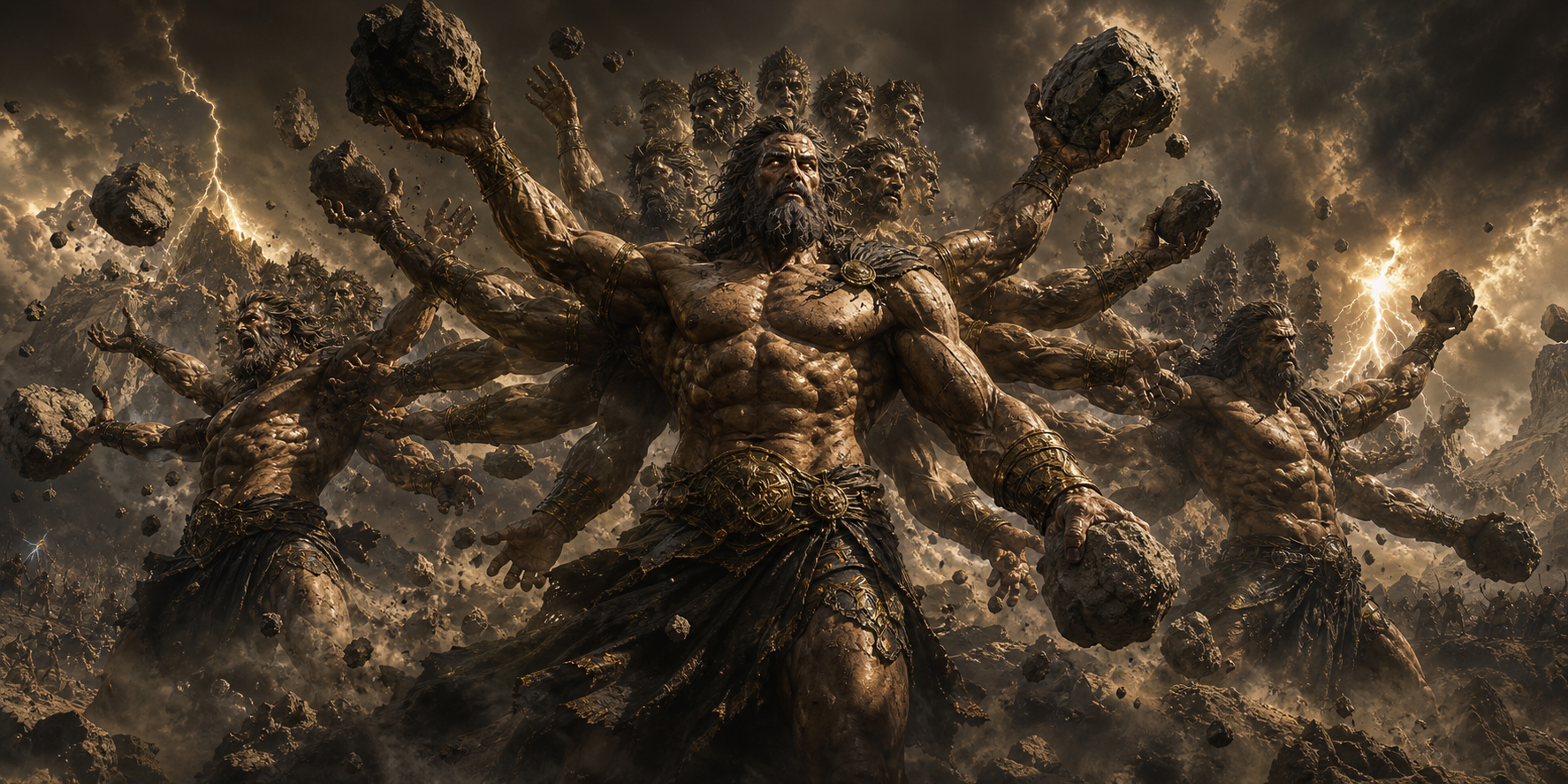
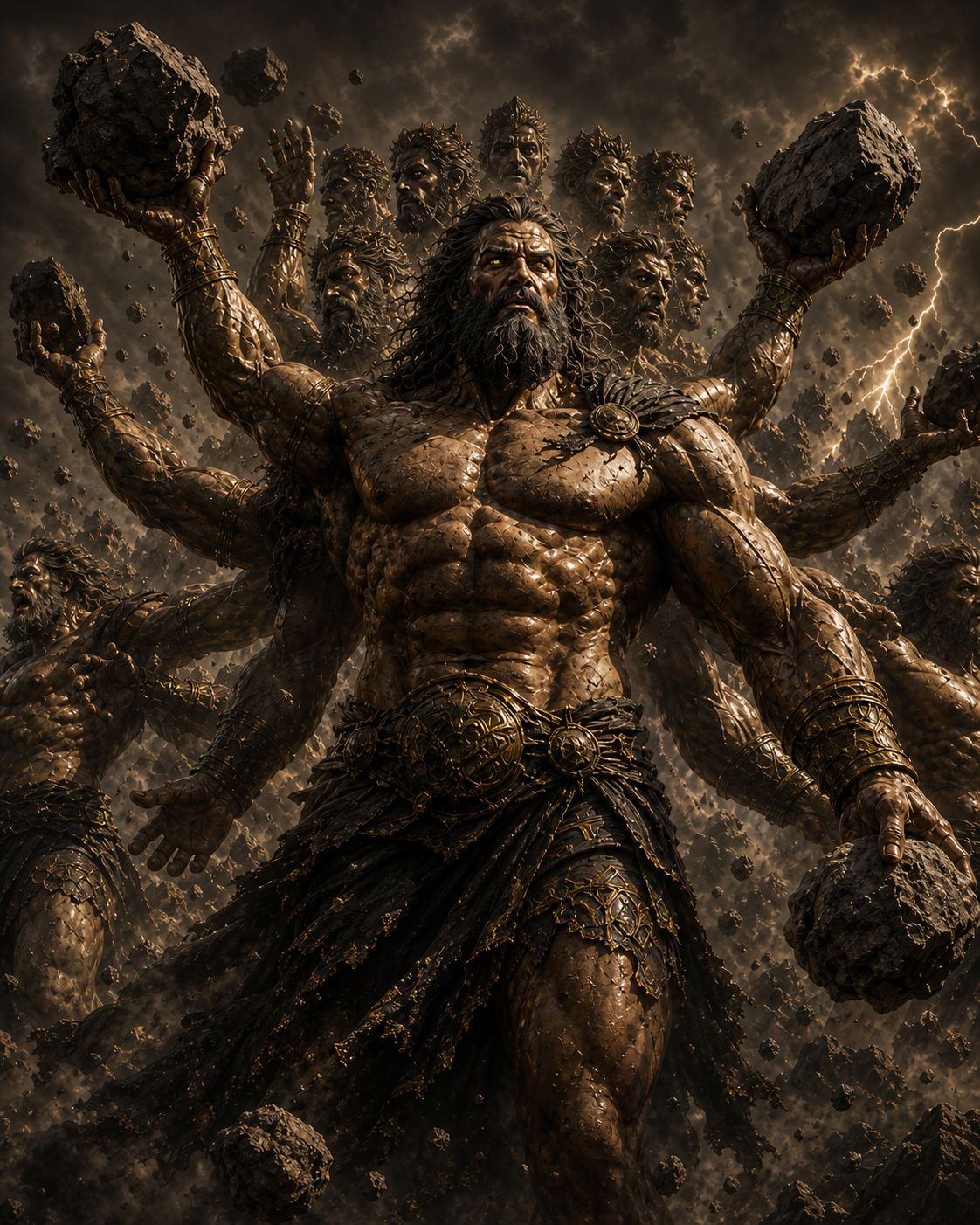
Cottus, Briareus, and Gyges are the Hundred-Handers, also called the Hecatoncheires. Hesiod describes each as having one hundred arms and fifty heads growing from immense shoulders. They are children of Gaia and Uranus, siblings of the Titans and of the divine Cyclopes. Their bodies mark them as primordial powers rather than enlarged mortals.
Calling them monsters captures the fear they inspire but not their full place in the divine family. They speak, choose allies, receive honors, and guard the defeated. Are they monsters, gods, or something older than that distinction? Greek poetry leaves the category productively unsettled.
Two Rulers, the Same Chains
Uranus hates or fears his extraordinary children and pushes them into the depths of Gaia. When Cronus overthrows him, the succession does not secure their lasting freedom. In mythographic tradition Cronus imprisons the Hundred-Handers in Tartarus, watched by the dragon Campe, just as he confines the Cyclopes.
The repeated imprisonment makes them witnesses to two failed reigns. Uranus and Cronus both respond to unmanageable power by hiding it. Their decision also creates a strategic blindness: the very allies who might have stabilized a reign become the force that ends it.
Zeus Chooses Release
For ten years, according to Hesiod, Titans and Olympians struggle without a decisive result. Gaia reveals that victory will come if Zeus brings the Hundred-Handers up from their confinement. Zeus gives them nectar and ambrosia and asks them to fight. Cottus answers with gratitude and recognizes that Zeus has brought them back from darkness.
The meal is more than refreshment. It marks their reception among the divine allies. Why does Zeus succeed where Cronus failed? He does not merely open a gate; he establishes obligation through hospitality, honor, and a shared enemy.
The Barrage That Ends the War
In the climactic battle, the brothers stand in the front line. Hesiod describes three hundred rocks flying together from their massive hands, overshadowing the Titans before they are driven beneath the earth. Their intervention changes the scale of combat. The Olympians bring divine weapons; the Hundred-Handers turn the landscape into an overwhelming assault.
This is why Mount Othrys and Mount Olympus matter as more than names on a map. The war moves between rival heights, while the decisive power rises from below both of them. The prisoners whom neither side originally placed at the center become the force that breaks the deadlock.
Guardians of Tartarus
After the victory, the defeated Titans are confined in Tartarus, and the Hundred-Handers become their guards. At first this seems cruelly circular: beings who suffered imprisonment now stand at the prison of others. Yet ancient poetry presents the appointment as an honor and a position of trust near the foundations of the reordered cosmos.
Why remain beside Tartarus after freedom? The myth does not give a private motive. Their strength makes them uniquely suited to prevent another uprising, and their experience makes them guardians who understand the danger of the boundary. They do not return as forgotten captives; they hold an office essential to Zeus’s settlement.
Briareus and Aegaeon
Homer preserves another strand. In the Iliad, the being whom gods call Briareus is called Aegaeon by mortals. His great strength helps Zeus when other Olympians plan to bind their king. The episode does not retell the Titanomachy, but it shows Briareus as a stabilizer of Zeus’s authority beyond the war.
Later traditions sometimes treat Aegaeon differently or connect him more strongly with the sea. These alternatives should be identified rather than merged into a single biography. The double name is itself a discovery hook: divine and mortal speech can preserve different identities for the same overwhelming figure.
Brothers of the Cyclopes
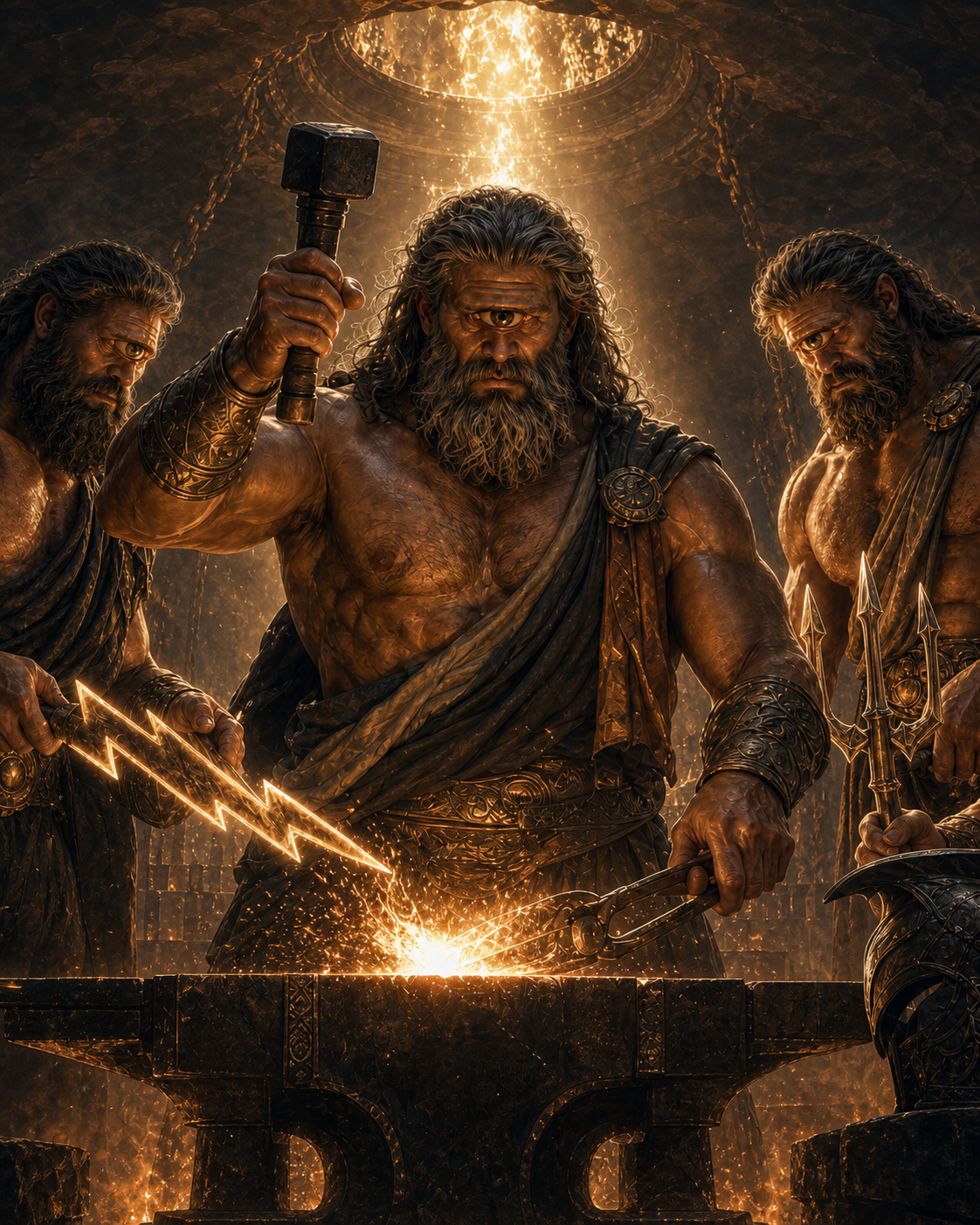
The Hundred-Handers and Cyclopes share ancestry, imprisonment, liberation, and alliance, but not function. The Cyclopes craft precise instruments of divine rule. The Hundred-Handers provide irresistible mass and force. One group arms the Olympians; the other ensures that those arms can decide the war.
Together they complicate any version of the Titanomachy focused only on Zeus and Cronus. Victory depends on those excluded by both earlier rulers. The path from Tartarus to Olympus runs through acts of recognition: hidden relatives become partners, and neglected power becomes the foundation of order.
Power Given a Place
Primordial strength is often dangerous in Greek succession myth because it seems impossible to measure. The Hundred-Handers do not become harmless after the Titanomachy. Instead, Zeus’s settlement gives their power a recognized place. They receive gratitude, a dwelling, and responsibility at the deepest border of the new cosmos.
That outcome separates alliance from exploitation. Zeus certainly needs them, but Hesiod also allows Cottus to speak and acknowledge what release means. The brothers are not mute weapons. Their decision enters the story, and their later office confirms that the alliance continues after immediate military need has passed.
Remembering the Decisive Allies
The Olympians dominate later stories, while Cottus and Gyges rarely return to the foreground. Briareus remains more visible because the Iliad preserves his second name and his intervention on Zeus’s behalf. Yet the silence around the other brothers should not make their earlier role smaller. The cosmic order depends on guardians most stories no longer need to visit.
Following them toward Tartarus changes the reader’s map of Olympus. The shining court above is secure because immense allies remain at a boundary below. Their story ends not with domestication, but with trust placed in strength that two former rulers could only fear.
Trivia
- Hecatoncheires means Hundred-Handers, while some texts also call them the hundred-handed ones.
- Hesiod places homes for the brothers near the stream of Ocean after the war, while also associating them with the guarding of Tartarus.
- Briareus appears separately in the Iliad as a mighty ally whose presence is enough to stop a plot against Zeus.