The hidden serpent-nymph whose children guard the dangerous boundaries of heroic myth.
- Cave
- Cerberus
- Chimera
- Hydra
- Serpent
- Typhon
- Primordial Age
- Titan Age
- Olympian Age
- Heroic Age
- Trojan Cycle
Echidna is the ageless serpent-nymph who mates with Typhon and mothers Cerberus, Orthrus, the Hydra, and the Chimera in Hesiod. Later genealogies extend her family to other famous monsters, connecting heroic dangers across gates, marshes, roads, and mountains.
Echidna is the mother behind many of Greek mythology’s most famous monsters. Half beautiful woman and half enormous serpent in Hesiod’s description, she remains in a hidden cave while her children spread across heroic landscapes. Through Cerberus, the Hydra, the Chimera, and others, her family turns genealogy into a map of dangers guarded at the edges of civilization.
The Nymph and the Serpent
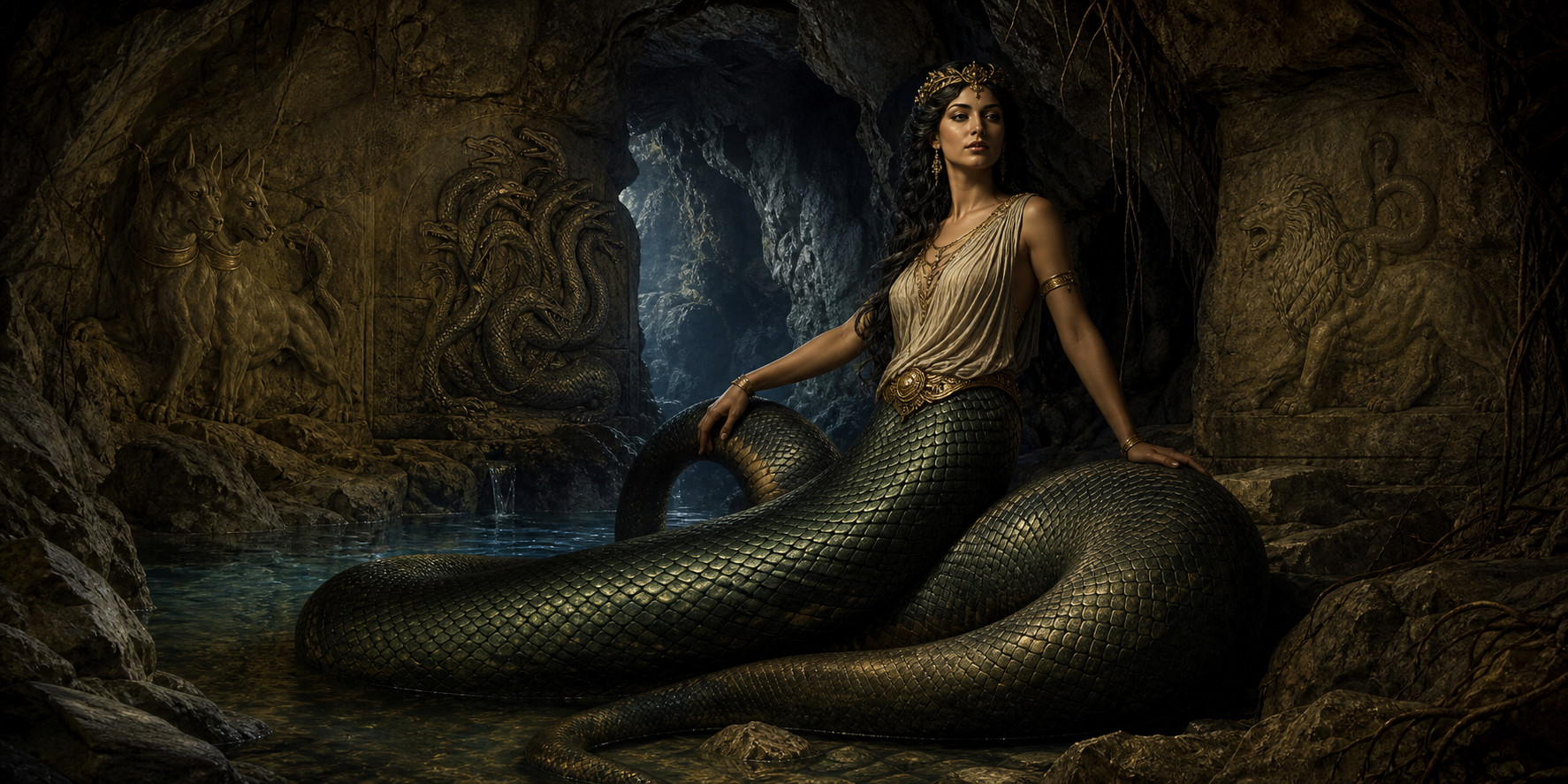
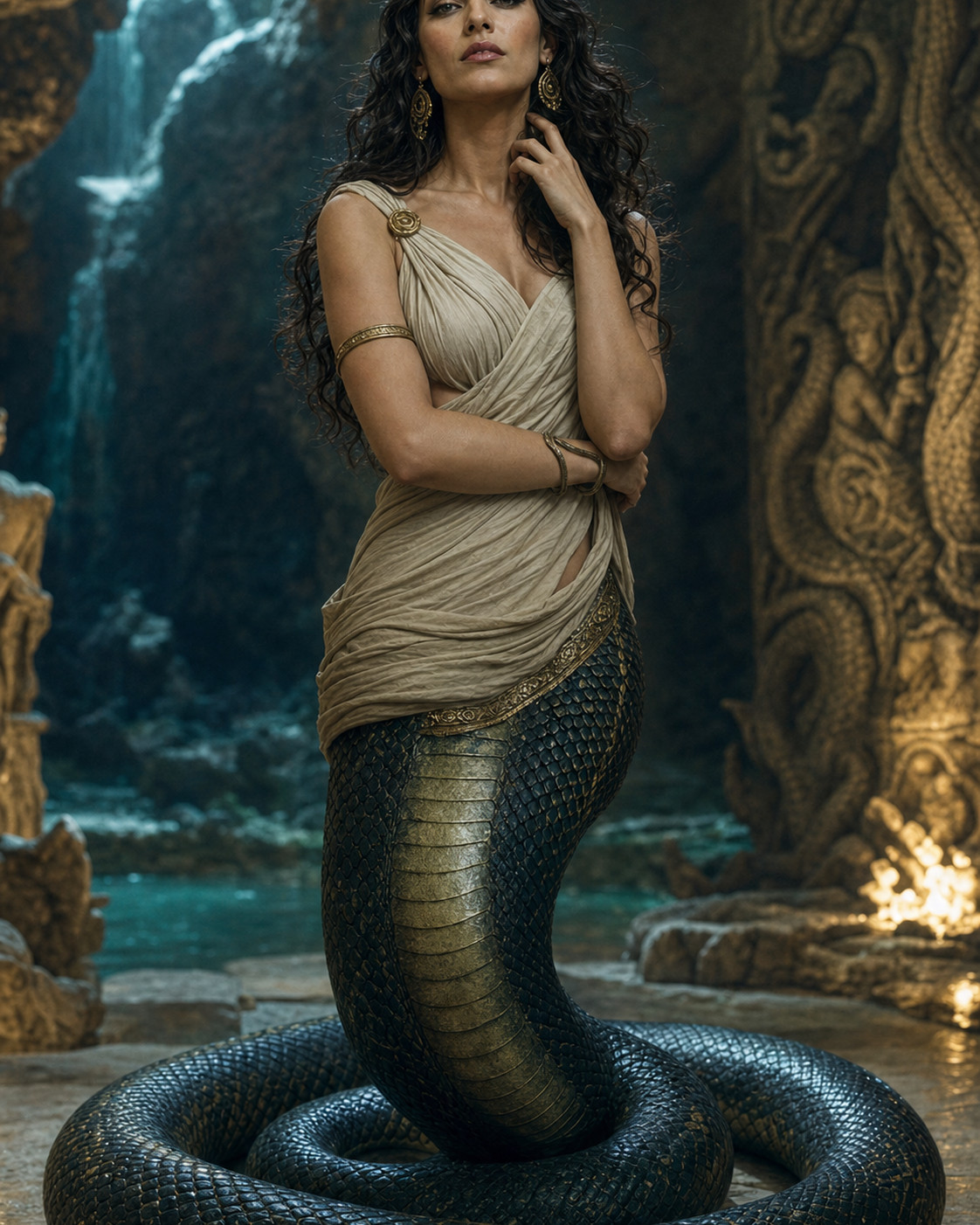
Hesiod calls Echidna a divine, ageless nymph with bright eyes and fair cheeks above, but a vast speckled snake below. She eats raw flesh and lives beneath the earth in a cave far from gods and mortals. The combination is not a disguise with a true form hidden underneath. Her divided body is her nature, joining attraction, immortality, earth, and predation.
Her parentage varies. Hesiod’s phrasing has produced debate and can be read within the sea-god genealogy around Phorcys and Ceto, while later mythographers give alternatives such as Tartarus and Gaia. These versions should remain distinct. What stays stable is her position near the generative roots of monstrous life.
Typhon and a Monstrous Dynasty
Echidna mates with Typhon, the great challenger associated with storms, serpents, and a direct assault on Zeus. Their children in Hesiod include Orthrus, Cerberus, the Hydra of Lerna, and the Chimera. Further genealogical links extend the family to the Sphinx and Nemean Lion, although ancient sources arrange parents differently.
The family is not a random catalog of strange bodies. Each child occupies a strategic boundary. Cerberus guards the dead, the Hydra inhabits the marsh at Lerna, the Chimera devastates a distant kingdom, the Sphinx blocks the road to Thebes, and the Nemean Lion makes a region impassable. Echidna’s offspring convert caves, gates, wetlands, roads, and mountains into tests.
Cerberus and the One-Way Gate
Cerberus is among her most enduring children. The many-headed hound admits shades into the Underworld and prevents escape. Her serpent nature continues in his snake features and tail, while Typhon’s multiplicity appears in the many heads. The guardian combines parental traits without becoming a smaller copy of either.
Heracles captures Cerberus alive as his final Labor. The hero’s encounter with Echidna’s family is broader: he kills the Nemean Lion and Hydra and, in many genealogies, confronts creatures connected through her line. The Labors can therefore be read partly as the repeated penetration of one monstrous family’s territories.
The Hydra and Reproducing Danger
The Lernaean Hydra makes regeneration itself threatening. When Heracles cuts one head, more grow in its place until Iolaus cauterizes the necks. Hera sends a crab to assist the creature, and Eurystheus later rejects the Labor because Heracles received help. The poisonous blood then remains active in the hero’s arrows and contributes to later tragedies.
As Echidna’s child, the Hydra expresses a family theme: danger survives transformation. Medusa’s gaze lives after death; Cerberus returns to his gate after capture; Hydra poison continues after the body is destroyed. Heroic victory controls or redirects monstrous power but rarely makes every consequence disappear.
Chimera, Sphinx, and Lion
The Chimera combines lion, goat, serpent, and fire and is defeated from the air by Bellerophon on Pegasus. The Sphinx joins a woman’s head to a winged lion’s body and turns knowledge into a lethal roadblock. The Nemean Lion’s impenetrable hide forces Heracles to abandon ordinary weapons and later becomes his armor.
Not every source makes Echidna mother of every famous monster, and “monster family tree” diagrams often flatten disagreements. Hesiod can make Orthrus and the Chimera parents of later creatures, while Apollodorus supplies other pairings. Genealogy in myth explains resemblance and recurring conflict, but poets adapt it to the story they need.
Where Does Echidna Live?
Hesiod places her cave among the Arimoi, a location ancient and modern interpreters have identified in different regions. Later authors localize her elsewhere. Another Echidna appears in Herodotus’s account of Heracles in Scythia: a snake-woman steals his horses, bears sons by him, and becomes an ancestor of Scythian peoples. Scholars debate how directly this figure should be identified with Hesiod’s monster mother.
The uncertainty suits a being defined by hidden generation. Heroes meet her children in named landscapes, while the mother remains remote. Her cave is less a stop on an itinerary than a mythic source from which boundary dangers continue to emerge.
Monster, Mother, and Category
The Greek word echidna can mean a viper, and later scientific naming preserves it in several forms. Yet the mythic Echidna is not simply a snake enlarged. Her human and serpentine halves make familiar categories fail. She is female without belonging to the domestic world, maternal without creating a protected household, and immortal while producing children heroes can kill.
Calling her the “Mother of Monsters” is useful if it does not turn motherhood itself into the explanation for evil. Her genealogy organizes narrative resemblance: multiple heads, mixed bodies, venom, guarded spaces, and powers that persist. The children become heroic opponents because of where they live and what they prevent, not merely because their mother is unusual.
What Echidna Means
Echidna gives Greek heroes a connected world of danger. Her offspring link the Labors of Heracles, the flight of Bellerophon, the riddle of Oedipus, and the government of Hades. Separate stories become branches of one family, allowing each victory to echo others.
She also remains largely undefeated in the oldest account. Some later sources give her a death, but Hesiod leaves her ageless in the cave. Heroes may clear individual roads and gates; the generative possibility of disorder remains beneath the mapped world.
Where the Story Leads
Follow Cerberus to the Underworld gate and the Twelve Labors to Heracles’s repeated encounters with the family. Gaia and Tartarus open variant genealogies, while future entries for Typhon, the Hydra, Chimera, Sphinx, and Nemean Lion reveal how Echidna’s children turn different boundaries into heroic tests.
Trivia
- Hesiod describes Echidna as half fair-cheeked nymph and half enormous serpent.
- Ancient sources disagree about the exact parents of several monsters in her family.
- Her children connect the myths of Heracles, Bellerophon, Oedipus, and the Underworld.