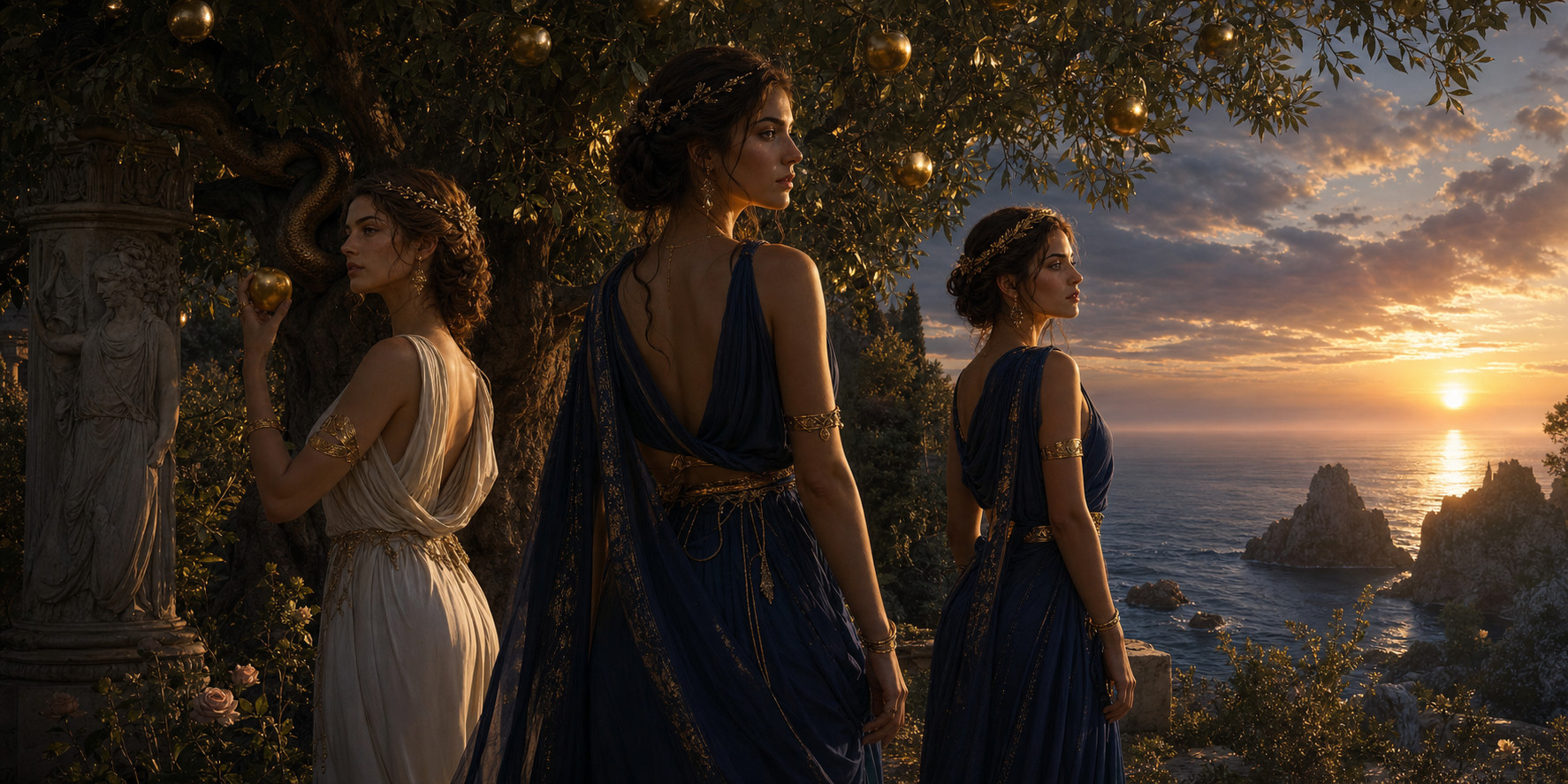
The singing keepers of Hera's golden fruit at the western edge of the world.
- Atlas
- Garden of the Hesperides
- Golden Apples
- Hera
- Ladon
- Sunset
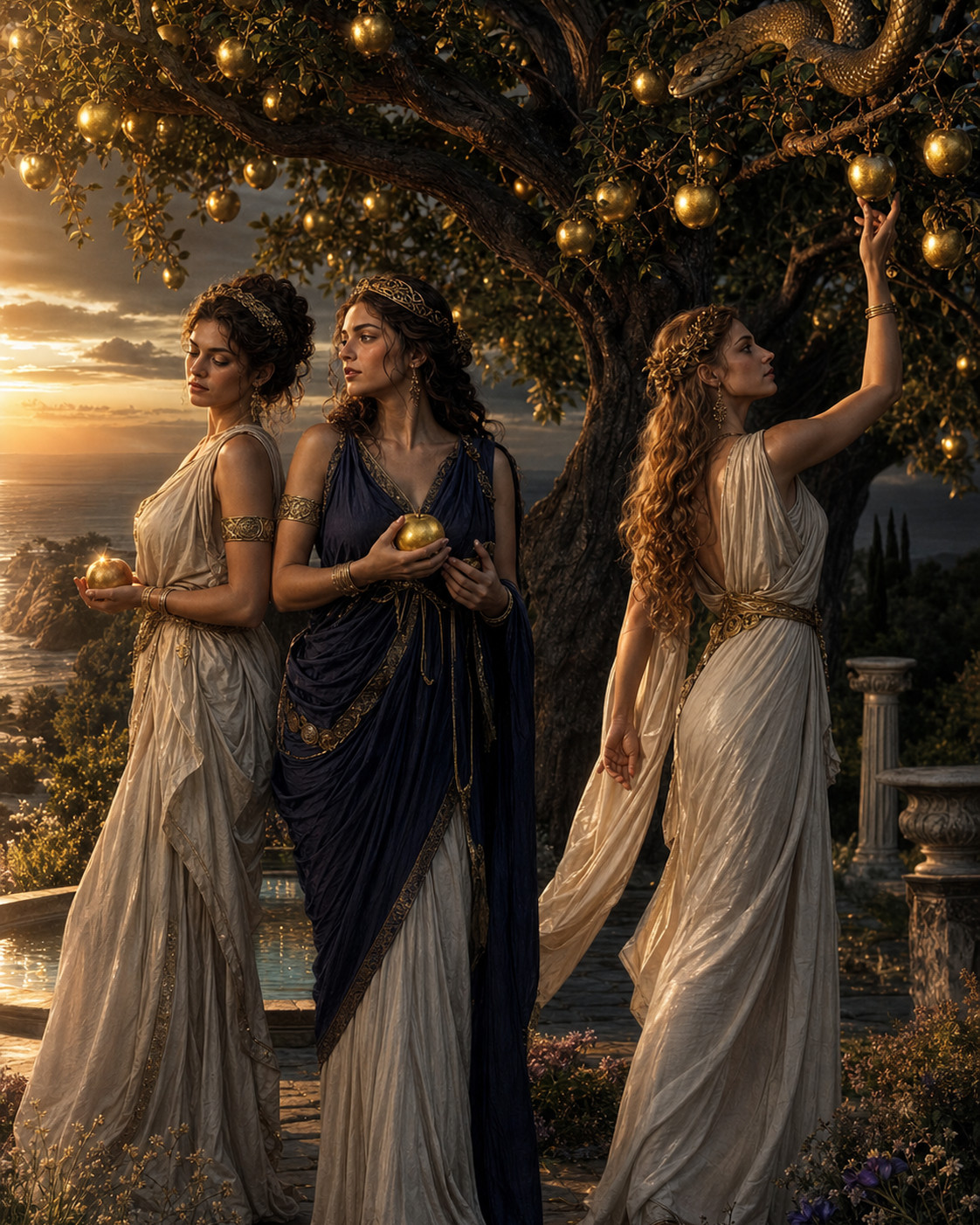
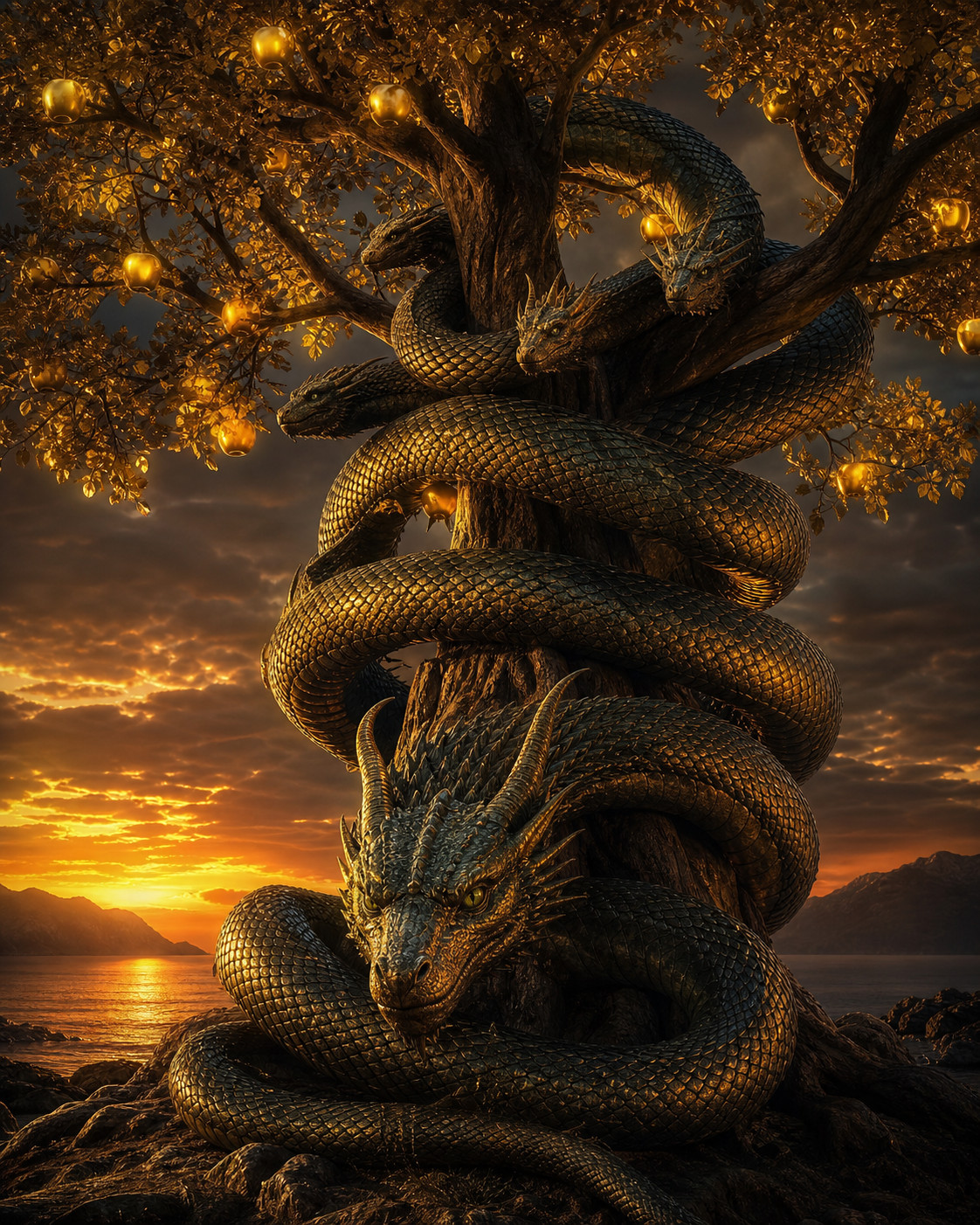
The Hesperides are nymphs of evening who tend Hera's golden apples in a remote western garden. Ancient sources vary their number, names, and parentage, while consistently connecting them with sunset, sacred custody, Ladon, and Heracles's eleventh labor.
Greek Mythology Timeline
Move through broad mythic ages and open the events that connect one story to the next. The sequence is a reading path, not an exact historical calendar.
The Hesperides are the nymphs of evening who keep the golden fruit at the far edge of the known world. Their story joins sunset, song, sacred custody, and uncertainty: ancient authors disagree about their number, names, parents, and exact home, yet repeatedly return to the same image of female guardians beside a miraculous tree. They are not merely scenery for Heracles. They define the garden as a place tended by living powers, where beauty and prohibition exist together.
Nymphs of Evening and the West
Their collective name is tied to hespera, evening, and early poetry places them beyond Ocean toward the setting sun. Hesiod situates them at the world’s remote margin near the voices and dangers of Night. The west is therefore more than a compass direction. It is a threshold where daylight withdraws, ordinary geography loosens, and divine possessions can remain outside human circulation.
Later writers locate the garden in Libya, near Atlas, on islands, or in the far Atlantic west. These proposals should not be forced into one map. Each translates remoteness for a different audience. What remains stable is the journey’s difficulty: anyone seeking the Hesperides must travel beyond familiar roads and learn where evening itself seems to live.
How Many Hesperides?
Ancient lists do not agree on a fixed membership. Apollodorus names four—Aegle, Erytheia, Hesperia, and Arethusa—while other traditions use three, seven, or different names. Art often favors three figures because a triad balances naturally around a tree, but visual convenience is not proof of one canonical census.
The shifting roster is meaningful. Collective nymph groups often express a place or recurring natural condition more strongly than individual biography. Aegle suggests radiance, Erytheia redness, and Hesperia evening or westernness. Their names can make the changing colors of sunset feel like persons without reducing every source to the same genealogy.
Daughters in Competing Genealogies
Hesiod calls the Hesperides daughters of Night, fitting their place near evening and darkness. Other accounts connect them with Atlas and Hesperis, or with Zeus and Themis, Phorcys and Ceto, or other divine parents. These are not minor errors waiting for correction. Genealogy is one way ancient storytellers explain what kind of powers the nymphs are.
Children of Night belong to the cosmic sequence of dusk. Daughters of Atlas belong to the western bearer of heaven and to the landscape around his burden. Marine parentage brings them close to Ocean and the dangerous creatures of the world’s edge. The variants overlap geographically and symbolically even when their family trees cannot be combined.
Tending Hera’s Golden Tree
In the best-known labor tradition, Gaia gives golden apples to Hera at her marriage to Zeus. Hera plants or keeps the gift in a remote garden and appoints the Hesperides as attendants. Their work is active custody: they tend a living tree whose fruit remains divine property rather than treasure available to the first traveler who reaches it.
Some accounts imply that Hera adds Ladon because she does not fully trust the nymphs around such tempting fruit. That detail complicates their office. They are guardians who are themselves guarded, singers whose beautiful presence does not erase suspicion. The garden becomes a layered system of ownership, care, surveillance, and sacred restriction.
The Serpent Beside the Singers
Ladon coils around the tree while the Hesperides remain close by, often singing. The combination is central to the garden’s atmosphere. Song invites attention and makes the remote place seem harmonious; the wakeful serpent makes approach dangerous. Neither role cancels the other. Sacred beauty can attract a visitor while still denying permission.
Ancient vase painters arrange the nymphs, tree, serpent, and Heracles in many ways. Sometimes the meeting seems calm or negotiated; elsewhere the monster is attacked. These images preserve alternatives that literary summaries can flatten. The Hesperides may gesture, observe, flee, or remain within their orchard as the hero confronts its defenses.
Heracles Reaches the Garden
For the eleventh labor, Heracles must bring Eurystheus the apples, but first he must discover their location. In Apollodorus, the search passes through a chain of encounters before Prometheus advises him to use Atlas. Atlas retrieves the fruit while Heracles temporarily bears the heavens, turning the labor into an exchange of burdens rather than a simple raid.
Other traditions show Heracles himself overcoming Ladon or receiving the apples more directly. The Hesperides stand at the point where these versions diverge. Their presence keeps attention on custody: whether Atlas enters, Heracles fights, or a nymph assists, the fruit leaves a garden whose guardians normally prevent such removal.
Grief after Ladon
Apollonius Rhodius imagines the Argonauts reaching the garden after Heracles has passed. Ladon lies dead, wounded by arrows poisoned with Hydra venom, while the Hesperides lament. This aftermath grants the guardians an emotional history beyond the victorious labor. A celebrated heroic success is, from their perspective, a damaged home and a fallen companion.
The poem also lets the nymphs transform and help the thirsty travelers find water, showing that their power is not limited to guarding fruit. They can mourn, change shape, sing, and respond to newcomers. The garden remains a living divine landscape after the famous object has been taken and returned.
Keepers Rather Than Owners
The Hesperides are closely identified with the apples, yet Hera is usually their divine owner. This distinction between custody and ownership explains why the nymphs matter. They embody responsibility for something precious that does not become theirs to spend. Their authority is real but bounded by a larger sacred order.
That position resembles many attendants in Greek myth who stand between a god and the mortal world. The keeper controls access without creating the law. When a hero receives exceptional passage, the exception does not abolish the boundary. Athena ultimately restores the apples because their proper place remains with the garden and its custodians.
What the Hesperides Mean
The Hesperides turn sunset into a social and ethical landscape. Evening is beautiful because it glows at a distance, but it also marks an ending and a limit. Their garden offers abundance that cannot become ordinary possession. A visitor may see, seek, borrow, or prove a task through the fruit, yet permanent ownership remains unavailable.
They also remind readers that famous quests have resident viewpoints. To Heracles, the garden is a destination in a list of labors. To the Hesperides, it is home, workplace, sanctuary, and the site of loss. Reading both perspectives makes the episode richer than a trophy story and opens the route toward Ladon, Atlas, Hera, and the Golden Apples.
Trivia
- Ancient sources give the Hesperides several different names, numbers, and genealogies.
- Their name and western home connect them with evening and the setting sun.
- Apollonius Rhodius portrays them mourning Ladon after Heracles has left the garden.