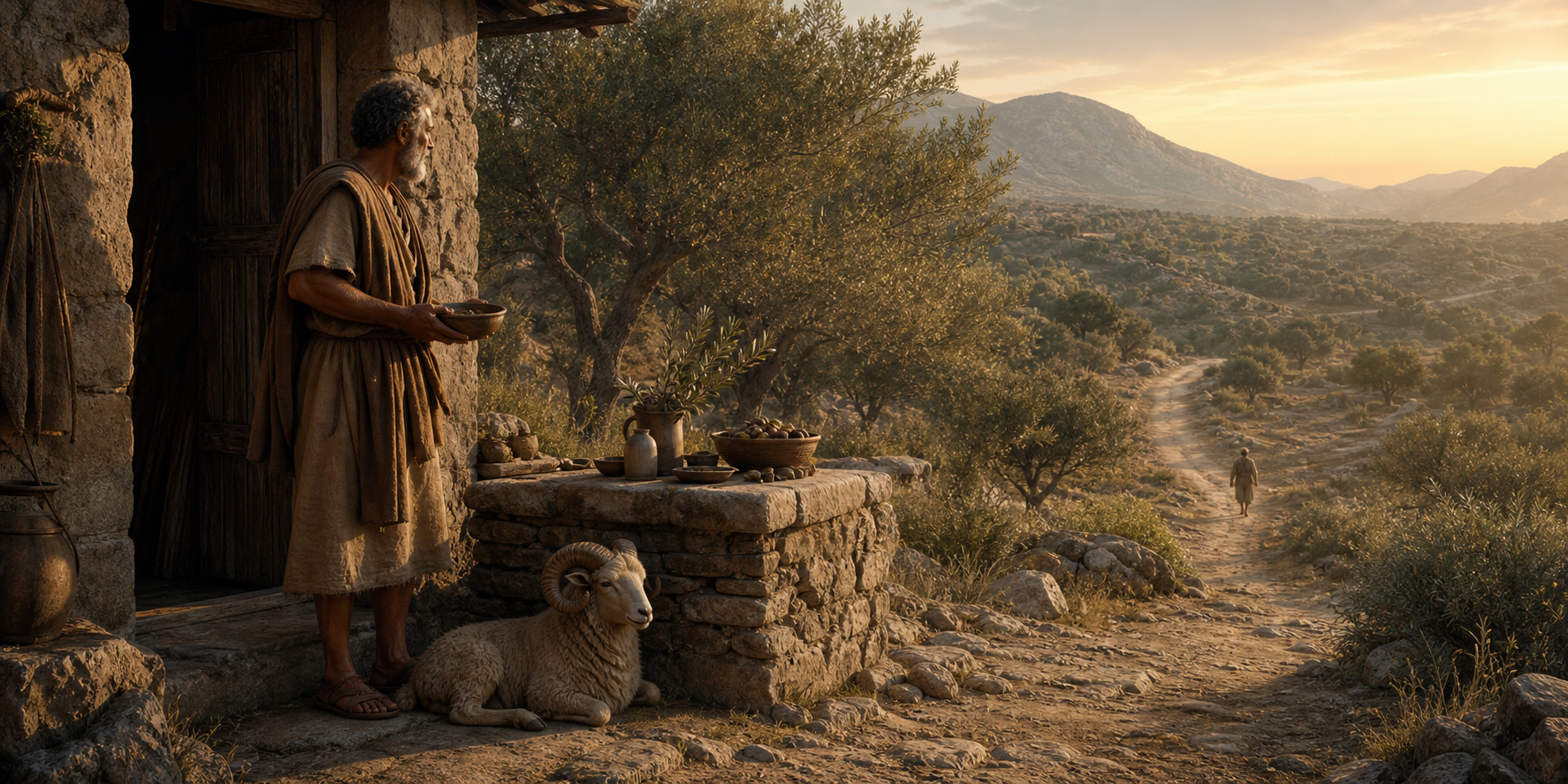
The poor host whose thirty-day wait measures whether the first labor ends in thanksgiving or funeral honor.
- Cleonae
- Heracles
- Nemea
- Nemean Lion
- Thirty Days
- Zeus
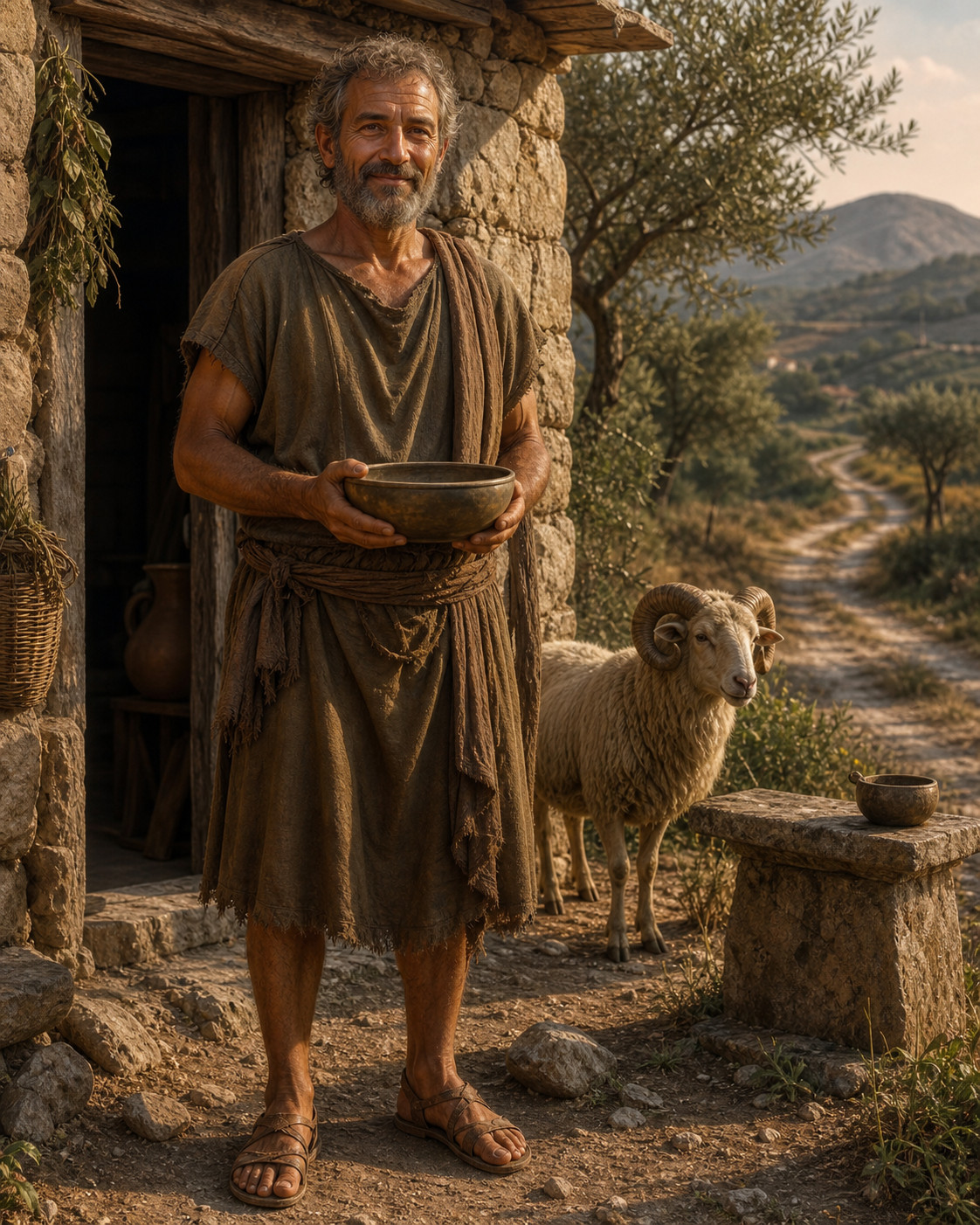
Molorchus is the poor worker near Cleonae who hosts Heracles before the Nemean Lion. He waits thirty days to sacrifice either to Zeus the Savior if Heracles returns or to Heracles as a dead hero if he does not.
Greek Mythology Timeline
Move through broad mythic ages and open the events that connect one story to the next. The sequence is a reading path, not an exact historical calendar.
Molorchus is the poor worker near Cleonae who receives Heracles before the first labor. He owns little, yet prepares to sacrifice from that little when the stranger arrives. Heracles asks him to wait thirty days: if the hero returns alive from the Nemean Lion, the offering will honor Zeus the Savior; if he dies, Molorchus will sacrifice to Heracles as a hero. The agreement turns a monster hunt into a measured interval of hospitality, faith, and uncertainty.
A Humble Host near Cleonae
Pseudo-Apollodorus calls Molorchus a day laborer. Later tradition can describe him as a farmer or poor countryman, but the economic point remains clear. He is not a king furnishing a hero with a palace, army, or treasure. His household stands close to the dangerous road with limited resources.
Greek hospitality stories often test wealthy hosts, yet Molorchus reverses the scale. Generosity matters because it costs him something. The first labor begins not at Eurystheus’s court or the lion’s cave, but at a modest doorway where food, shelter, and ritual intention are offered.
The Offered Sacrifice
When Heracles arrives, Molorchus prepares to sacrifice. Ancient summaries differ on the animal and context, and later sources expand the rustic scene. What matters is his willingness to honor the guest and gods before knowing whether the expedition will succeed.
Heracles does not simply accept. He transforms the offering into a conditional promise tied to time. The host must wait, keep the victim, and interpret the hero’s absence. Ritual becomes a calendar for uncertainty.
Thirty Days
The thirty-day interval gives the first labor an unusually precise human measure. Monster time is indefinite: the lion seems invulnerable and its cave dangerous. Household time is counted day by day as Molorchus waits for footsteps on the road.
On the thirtieth day, Heracles returns as Molorchus is about to carry out the funeral alternative. The timing converts expected death into thanksgiving. A hero’s victory becomes real when someone waiting at home sees him cross the threshold alive.
Zeus the Savior or Heracles the Hero
The two possible dedications mark Heracles’s uncertain status. If he survives, Zeus receives thanks as Savior. If he dies, Heracles himself receives honor as a dead hero. Before the first labor is complete, the ritual already imagines both mortal death and heroic cult.
This does not mean Heracles has achieved full divinity. It shows how heroic memory can begin at the moment a community prepares for loss. Molorchus stands at the boundary between living guest and remembered protector.
The Lion and the Road
Molorchus does not accompany Heracles into the cave. His courage is different from combat. He lives near a predator’s territory, maintains a household under threat, and commits himself to receiving the outcome, whether celebration or mourning.
Some later traditions say the lion killed Molorchus’s son, intensifying the host’s personal stake. This detail is not present in every source and should remain a variant. It emphasizes how local suffering precedes the famous hero’s arrival.
Callimachus and Rustic Detail
The Hellenistic poet Callimachus gave Molorchus a larger place in a poem about Nemean origins, though the work survives only in fragments. Later scholars reconstruct episodes involving the poor host, rural pests, and the contrast between great heroic action and small domestic struggle.
Fragmentary survival requires caution. We should not treat every reconstruction as complete narrative fact. Still, the poetic interest is clear: Molorchus lets epic scale and household scale occupy the same story.
A Different Kind of Heroism
Molorchus has no divine weapon, royal genealogy, or public command. His virtues are attention, generosity, patience, and readiness to remember. These qualities create the moral setting in which Heracles’s strength can matter to ordinary life.
The host also holds the hero accountable to return. The lion skin is not only proof for Eurystheus. It is the sign that changes what a poor household will do at its altar and how it will understand the stranger who slept beneath its roof.
Molorchus and the Nemean Games
Later foundation traditions connect Heracles’s lion victory with the Nemean Games, and Molorchus can appear near that origin story. The connection should remain distinct from the better-known funeral games for Opheltes. One emphasizes a returned hero and Zeus; the other preserves a dead child and ominous expedition.
Nemea holds both forms of memory. Molorchus represents thanksgiving after danger, while Opheltes represents mourning that cannot be reversed. The festival landscape can carry them together without requiring one to replace the other.
What Molorchus Means
Molorchus shows that a labor is not complete when the monster falls. It must return along roads to the people who waited. His thirty days give suspense a domestic witness and turn hospitality into part of heroic achievement.
Follow him toward Heracles and the Nemean Lion for the hunt, Nemea and Cleonae for the landscape, Zeus for the promised thanksgiving, and the Nemean Games for the later ritual memory surrounding the first labor.
Trivia
- Molorchus is described as a poor day laborer rather than a king.
- His agreement with Heracles is measured by a thirty-day wait.
- The planned offering changes between Zeus the Savior and Heracles as a dead hero.