
The first wife and hidden counselor whose cunning helps Zeus gain rule before he swallows the succession she carries.
- Athena
- Counsel
- Cronus
- Oceanus
- Succession
- Zeus
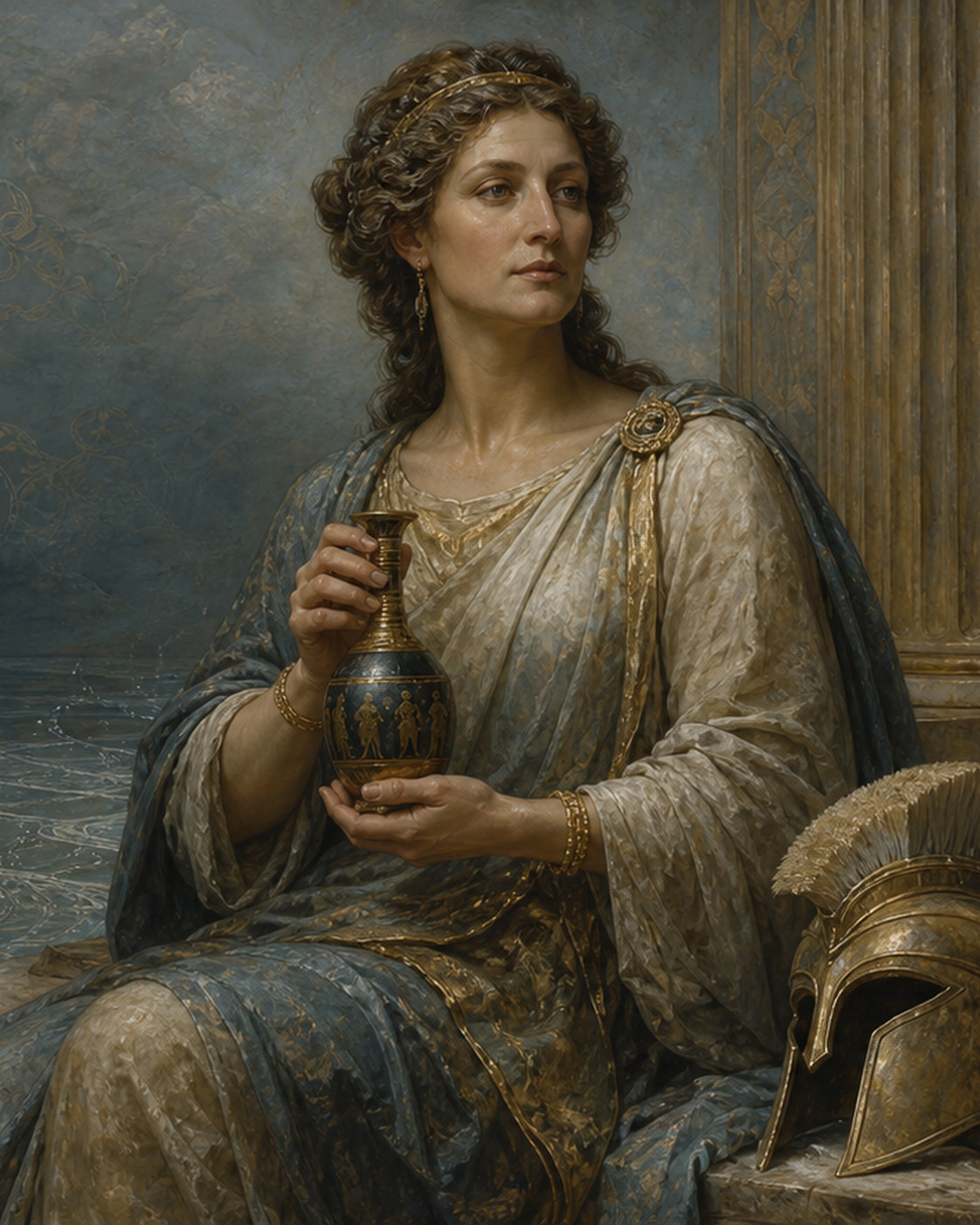
Metis is the Oceanid of cunning counsel who helps Zeus free his siblings and becomes his first wife. Warned that she will bear Athena and then a ruling son, Zeus swallows her; she remains within him as Athena's hidden mother and maker.
Greek Mythology Timeline
Move through broad mythic ages and open the events that connect one story to the next. The sequence is a reading path, not an exact historical calendar.
Metis is the Oceanid goddess of wise counsel, cunning intelligence, and adaptable strategy whose knowledge helps Zeus end Cronus’s rule and whose threatened children reshape Olympian succession. Hesiod calls her wiser than gods and mortals and names her Zeus’s first wife. When she becomes pregnant, Gaia and Uranus warn that after Athena she will bear a son destined for kingship. Zeus deceives and swallows Metis, preventing the prophesied successor while internalizing the counsel on which his own rule depends.
Oceanid of Counsel
Metis is a daughter of Oceanus and Tethys, part of the vast Oceanid generation. Her name can mean counsel, plan, or cunning intelligence—the capacity to change approach rather than meet force directly. She is a divine person and a concept active within heroic thought.
Greek metis is not simply abstract wisdom. It appears in traps, navigation, persuasion, disguise, timing, and the ability to see several moves ahead. The goddess gives that quality genealogy and places it beside water’s flexible, encircling movement.
The Draught for Cronus
Apollodorus says Metis gives Cronus a drug that forces him to disgorge the stone and the children he swallowed. Zeus supplies the opening, but her preparation converts a closed body into a reversed birth and restores the allies required for the Titanomachy.
Other accounts assign the device differently or compress it. Metis’s role is important because the new order begins through technique before open war. The Olympians win not only by thunder and strength, but through a woman’s knowledge of mixture, body, sequence, and deception.
First Wife of Zeus
Hesiod calls Metis the first wife of Zeus. The marriage joins sovereignty with counsel at the opening of his reign. It also immediately reproduces the succession problem that shaped Uranus and Cronus: a ruler fears a child stronger or more entitled than himself.
The cycle changes form. Uranus hides children and Cronus swallows them; Zeus swallows the pregnant mother after learning the prophecy. The younger king prevents an external overthrow while making Metis internal to his own body and decisions.
Prophecy of Two Children
Gaia and Uranus warn that Metis will bear bright-eyed Athena, equal to Zeus in strength and wise understanding, followed by a son of overmastering spirit who would rule gods and mortals. Zeus acts before the second child can appear.
The unborn son never receives a developed mythology in surviving early poetry. He functions as possibility—the succession that Zeus closes. Athena, by contrast, is not erased. The prophecy is managed selectively, allowing a daughter who strengthens rule while preventing the son who would replace it.
Swallowing Metis
Hesiod says Zeus deceives Metis with cunning words and puts her in his belly. Apollodorus adds that she changed into many forms. The god uses metis against Metis, appropriating the very adaptable intelligence she embodies.
The scene can be read as consolidation rather than simple consumption. Zeus gains a counselor who devises good and evil within him, but Metis loses independent visibility. Divine kingship stabilizes itself by absorbing a female source of knowledge and reproductive possibility.
Athena’s Birth
Athena later emerges from Zeus’s head fully armed in the familiar tradition. Different sources name Hephaestus, Prometheus, or another figure as opening the head. Hesiod emphasizes that Metis remains within and supplies the armor that makes Athena formidable.
Athena is therefore both mothered and publicly born from a father. The spectacular head birth can obscure Metis, yet the Theogony preserves her as hidden maker and mother. Strategy survives the swallowing and appears as the defining quality of Zeus’s daughter.
Counsel Inside Sovereignty
After the swallowing, Metis has few independent narrative appearances. This absence is meaningful. Zeus becomes the ruler who possesses counsel within himself rather than consulting a visibly separate first wife. Political intelligence has been incorporated into kingship.
That structure differs from Hera’s public queenship, Themis’s ordering unions, or Mnemosyne’s relation to song. The sequence of Zeus’s marriages in Hesiod maps functions required by rule. Metis stands first because authority must acquire planning before it can administer law, memory, and alliance.
The Question She Opens
Follow Metis toward Zeus for managed succession, Athena for hidden maternity, Cronus for the reversing drug, and Gaia and Uranus for the warning. Cyclopes and Titanomachy show what her first counsel makes militarily possible.
Metis asks whether knowledge remains its own power after a ruler absorbs it. Zeus avoids replacement, Athena inherits strategy, and the counselor disappears from view without becoming ineffective. Her story keeps the foundation of stable Olympian rule intellectually and ethically unsettled.
Trivia
- Hesiod calls Metis Zeus’s first wife.
- Apollodorus credits her with the drug given to Cronus.
- The prophesied son after Athena is never born in the surviving central tradition.
Reading the Traditions
Metis survives mainly through genealogical poetry and mythographic summary, so later retellings often turn a compact succession episode into a detailed domestic scene unsupported by the sources. The most secure structure is enough: indispensable counsel, first marriage, pregnancy, prophecy, deception, swallowing, and Athena’s armed emergence. Whether Zeus’s act represents fear, political calculation, appropriation, or all three remains open to interpretation. Keeping Metis visible prevents Athena’s birth from becoming a story of fatherhood alone and reveals that Olympian stability rests on intelligence acquired through the same kind of cunning that once freed Zeus’s siblings.