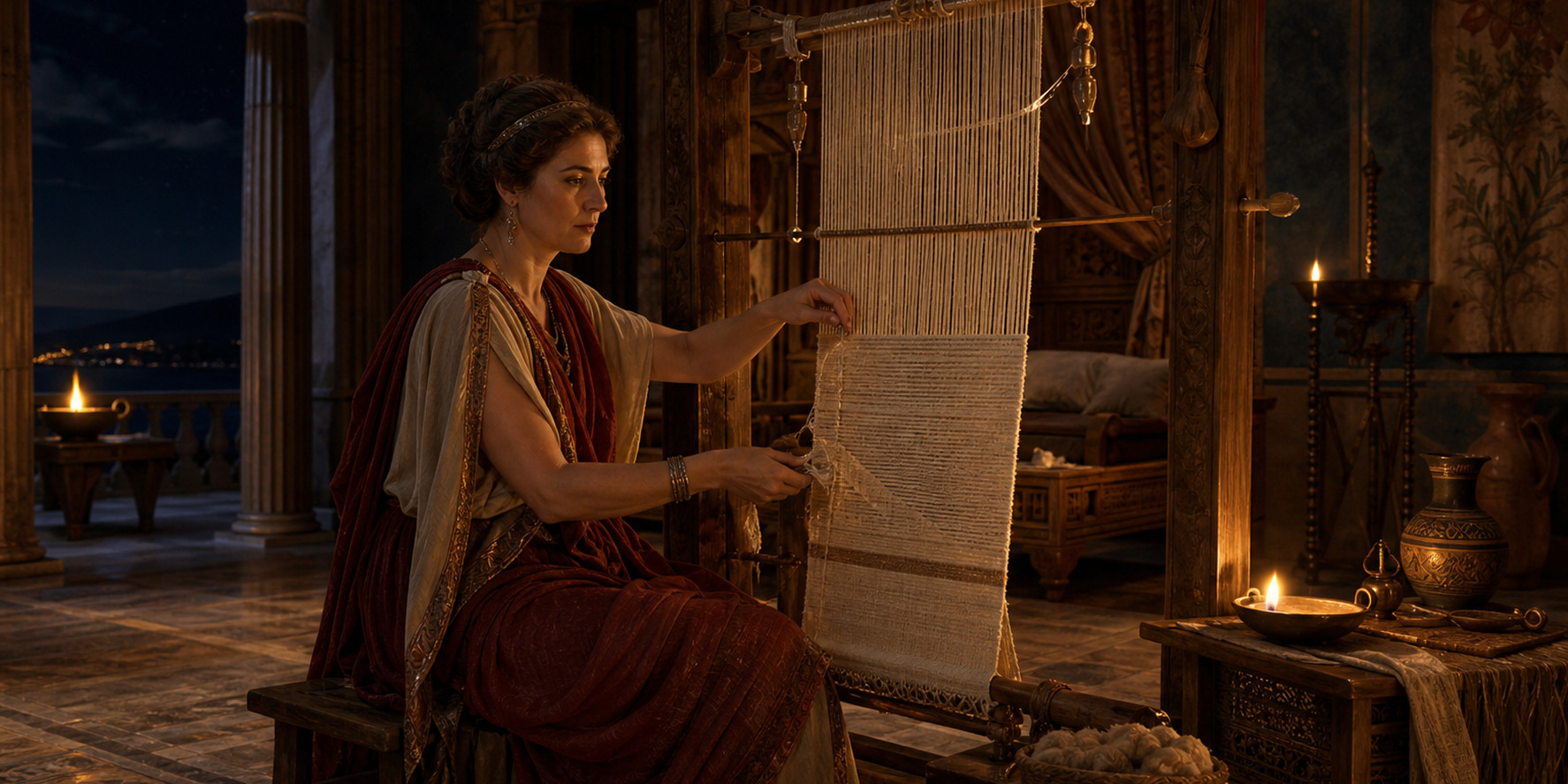
The patient strategist whose loom, bow, and rooted bed protect a threatened marriage and kingdom.
- Bow
- Ithaca
- Loom
- Marriage Bed
- Odysseus
- Telemachus
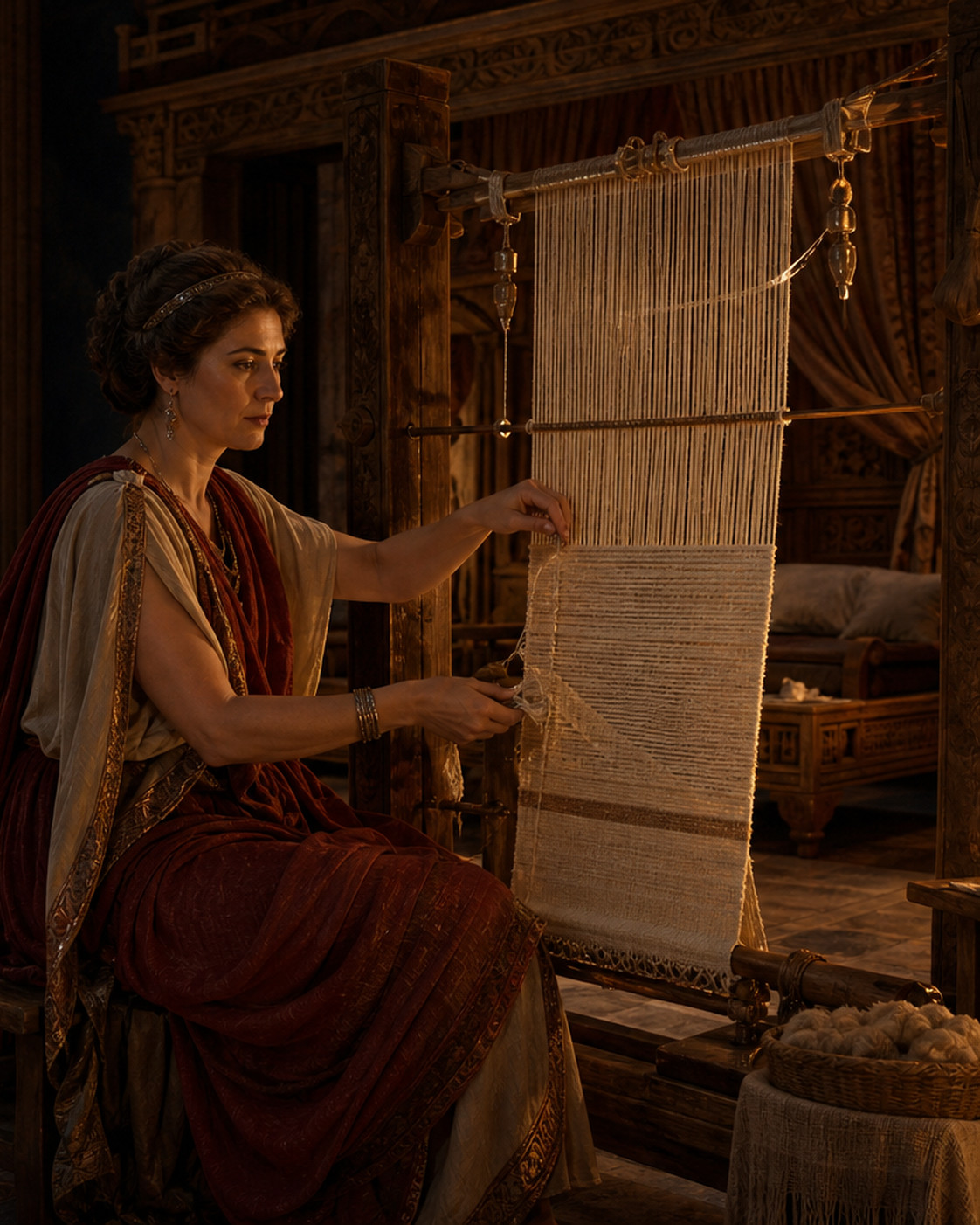
Penelope preserves Odysseus' household through twenty years of absence, delaying the suitors with the shroud, testing stories and identity, and recognizing her husband through the secret of their rooted olive-wood bed.
Greek Mythology Timeline
Move through broad mythic ages and open the events that connect one story to the next. The sequence is a reading path, not an exact historical calendar.
Penelope is the queen of Ithaca whose intelligence preserves Odysseus’ household during his twenty-year absence. Daughter of Icarius, wife of Odysseus, and mother of Telemachus, she is surrounded by suitors who consume the estate and press her to choose a new husband. Her woven delay, guarded speech, dream, bow contest, and final test of the rooted marriage bed make recognition a contest between two people skilled at concealing what they know.
Queen of an Occupied Household
Penelope does not rule an empty palace in peace. More than a hundred suitors from Ithaca and neighboring islands occupy the hall, slaughter livestock, drink wine, pressure servants, and treat Odysseus’ resources as their own. The abuse is political as well as domestic: marriage to the queen may carry influence over the kingdom, while Telemachus’ adulthood threatens their plans.
The Odyssey gives Penelope limited direct control over armed men, travel, and public assembly. Her power works through timing, reputation, household labor, gifts, servants, and incomplete information. These are not lesser forms of action. They are the tools available inside a structure designed to force a decision while pretending that decision remains freely hers.
The Shroud of Laertes
Penelope tells the suitors she must finish a burial cloth for Laertes before remarrying. By day she weaves; by night she secretly unravels the work. The scheme holds for three years until a maid reveals it. Weaving becomes a form of time management: visible progress satisfies public expectation, while hidden reversal protects the possibility of Odysseus’ return.
The shroud is not merely an excuse. It concerns the honor of Odysseus’ aging father and therefore binds future marriage to the duties of the existing household. Penelope creates a task whose completion can always be deferred, making textile production into political resistance. Her strategy resembles Odysseus’ disguises because both use a true social role to conceal a second purpose.
News, Rumor, and Controlled Hope
Travelers repeatedly bring claims about Odysseus. Penelope cannot afford simple belief: false hope can be exploited, while open despair would strengthen the demand for remarriage. She questions the disguised Odysseus closely and asks for details of clothing and companions that a genuine witness should know. Information must be tested before emotion is allowed to act.
Her caution is not coldness. The poem shows long grief, tears, sleeplessness, and uncertainty. Endurance requires that she keep these feelings from becoming a predictable weakness. Like the returning king, she divides inner knowledge from outer performance and changes what she reveals according to the listener.
The Dream of the Geese
Penelope tells the disguised stranger a dream in which an eagle kills twenty geese and then identifies itself as Odysseus destroying the suitors. She asks how the dream should be interpreted and discusses deceptive and truthful gates of dream. The scene appears to promise the ending while leaving her degree of belief deliberately uncertain.
Readers have long debated when Penelope suspects the beggar’s identity. The poem does not give one simple moment in which all uncertainty disappears. Her words can test, invite, protect, or delay simultaneously. That ambiguity makes her a participant in recognition rather than a passive object waiting for proof.
The Contest of the Bow
Penelope brings out Odysseus’ bow and declares that she will marry the man who can string it and shoot through the line of axe heads. The suitors fail. The disguised Odysseus receives the weapon despite their objections, strings it, completes the shot, and turns the contest into the beginning of their destruction.
Whether Penelope intends the contest as a hidden opportunity for Odysseus or as a desperate conclusion remains open to interpretation. The choice of weapon nevertheless makes identity measurable through intimate competence. The bow belongs to the absent household and cannot be mastered by those who claim its wealth.
The Rooted Marriage Bed
After the suitors are dead, Penelope still refuses immediate recognition. She orders that the marriage bed be moved. Odysseus reacts because he built it around a living olive tree rooted in the ground; moving it would require cutting or destroying the structure. His knowledge proves that the stranger is the husband who made their private chamber.
The test is perfectly matched to their marriage. It uses craft, secrecy, memory, and controlled provocation rather than appearance. The bed is both object and architecture, joining cultivation to construction. After years in which identities and loyalties have shifted, the rooted center remains knowable only to the two people who formed it.
Penelope and Telemachus
Telemachus grows from child to young adult during his father’s absence, complicating authority inside the palace. He can order Penelope to return to her room, organize an assembly, and join the violence against the suitors, yet he still depends on her protection of the household and on the identity she has preserved for him.
Their relationship includes affection, frustration, secrecy, and changing rank. Odysseus and Telemachus plan without telling Penelope, partly to test the servants and control risk. The queen who has managed uncertainty for years must endure one final period in which her son knows more than she does.
Later Traditions
Post-Homeric traditions do not all preserve the Odyssey’s final stability. Some give Penelope children by Odysseus beyond Telemachus; others connect her with Telegonus or even with Pan through sharply different genealogies. These accounts belong to later mythic experimentation and should not be inserted into Homer’s reunion as though the poem predicts them.
Penelope became an emblem of fidelity in later moral culture, but that label can narrow her. Her defining capacity is not waiting alone. She speaks strategically, manages symbols, evaluates evidence, and makes recognition occur on terms she can verify. Constancy and intelligence are inseparable in her story.
How to Read Penelope
Penelope and Odysseus are not simple opposites of home and travel. Both survive through metis, changing speech to match danger and using crafted objects to control time. His adventures occupy more geography; her struggle occupies the same rooms repeatedly. The poem makes those spaces equally capable of concealment, violence, and discovery.
Follow Penelope toward Odysseus for the marriage and recognition, Telemachus for the threatened succession, Athena for divine guidance, and the Trojan War for the absence that creates the crisis. Future routes to the suitors, Eurycleia, Ithaca, and the rooted bed can deepen the household as its own mythic world.
Trivia
- Penelope’s weaving trick delays remarriage for three years before a servant exposes it.
- The marriage bed test concerns knowledge of construction, not merely an emotional password.
- The Odyssey leaves room for debate about when Penelope begins to suspect the stranger’s identity.