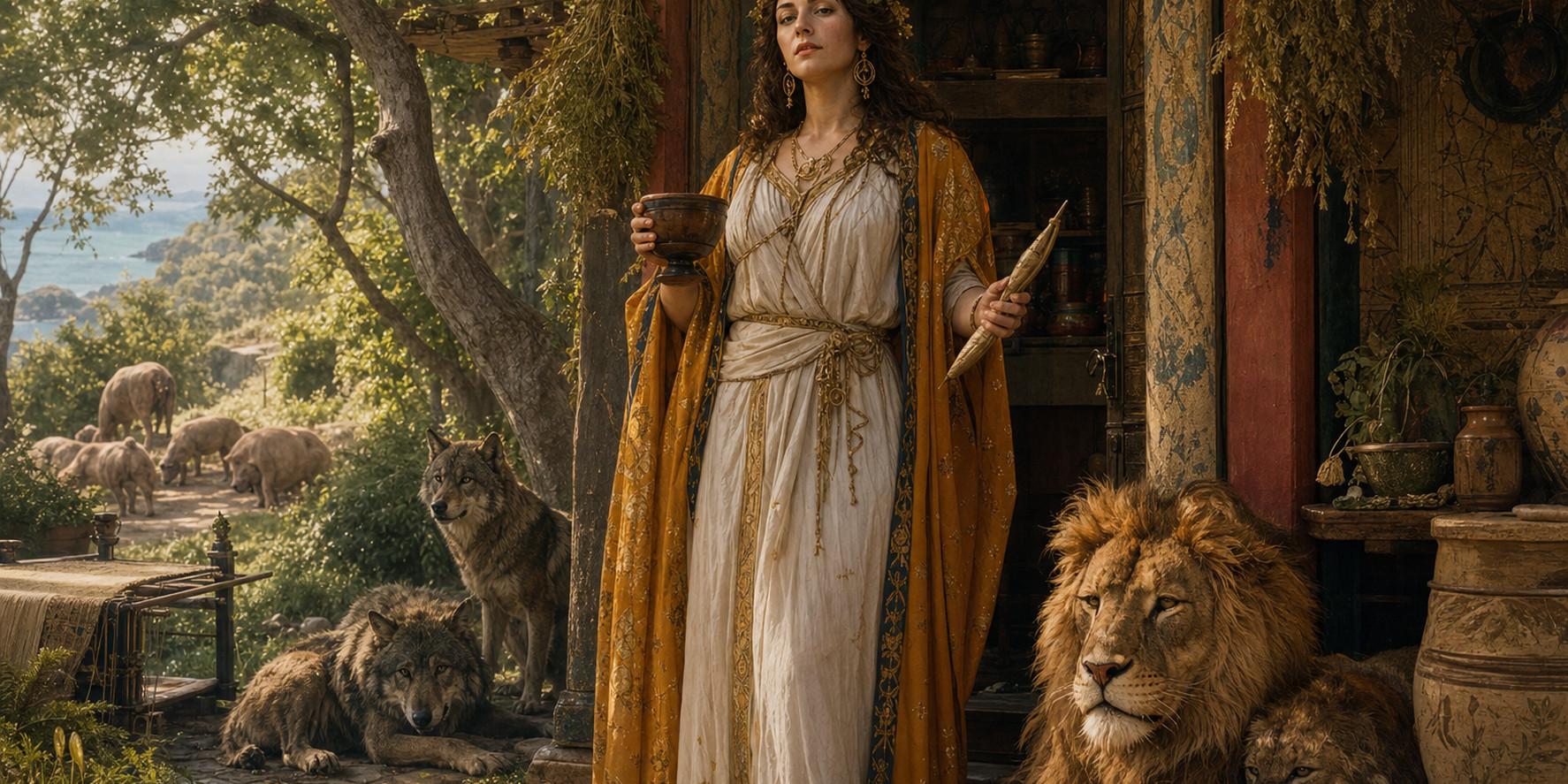
The daughter of Helios whose dangerous hospitality becomes the gateway to the dead and the route beyond them.
- Aeaea
- Helios
- Medea
- Odysseus
- Pharmaka
- Underworld
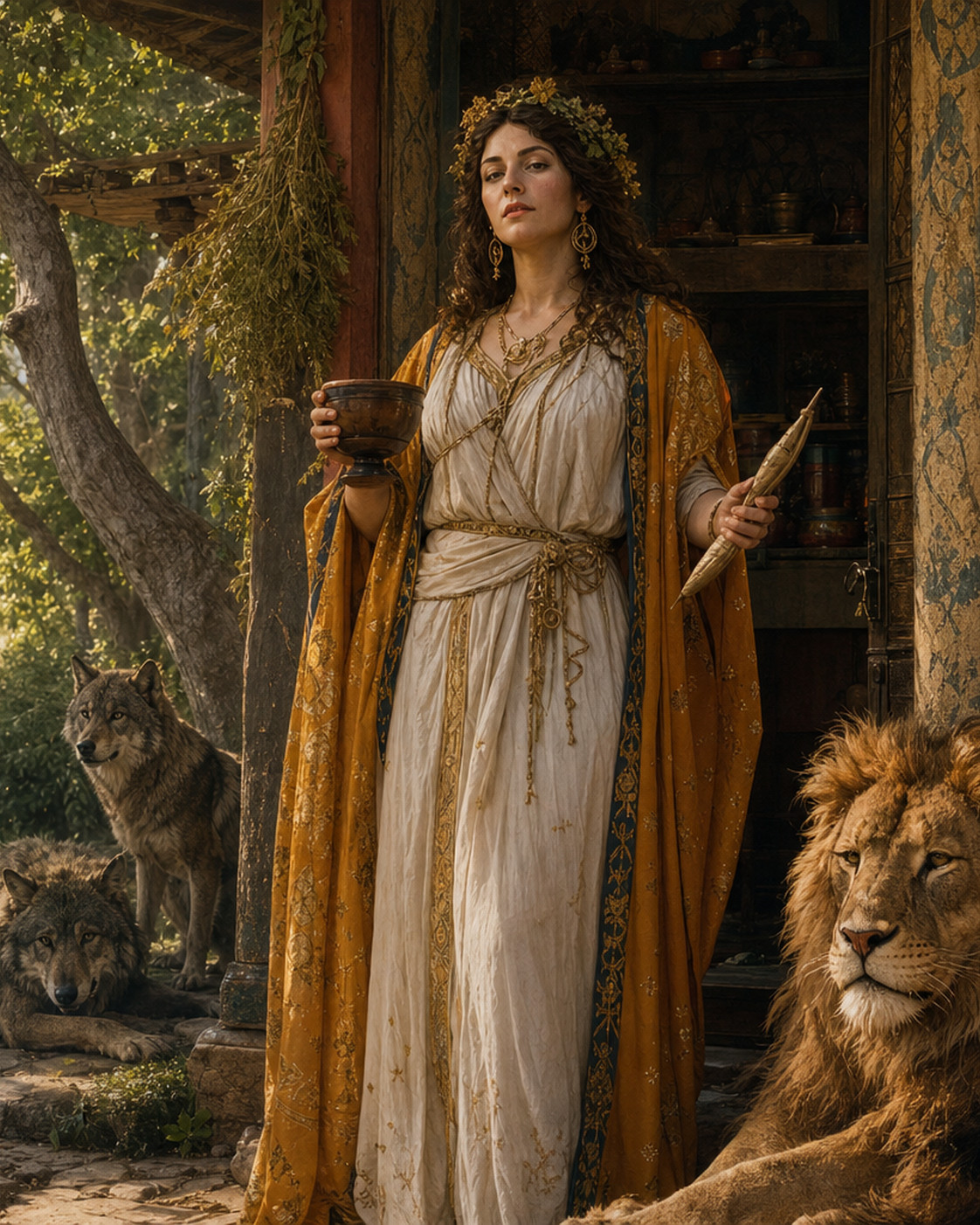
Circe transforms Odysseus' companions, then becomes host and guide after he resists her drug with Hermes' help. She directs the living hero to the Underworld and warns him about the dangers beyond it.
Greek Mythology Timeline
Move through broad mythic ages and open the events that connect one story to the next. The sequence is a reading path, not an exact historical calendar.
Circe is the divine daughter of Helios who lives on Aeaea, where she transforms Odysseus’ companions into swine, becomes his host and lover, and directs him toward the Underworld. Homer calls her a goddess of human speech, not simply a mortal witch. Her episode moves from violated hospitality to negotiated safety and finally to indispensable guidance, making transformation only one part of a broader power over bodies, knowledge, and passage.
Daughter of the Sun
In the Odyssey, Circe and Aeetes are children of Helios and the Oceanid Perse. Hesiod also places them in this solar and Oceanic family. Through Aeetes, Circe is aunt to Medea, creating a lineage of divine women associated with drugs, transformation, difficult hospitality, and journeys at the edge of familiar geography.
Later sources expand her siblings and genealogy, sometimes connecting Pasiphae directly to the same family. These links are powerful, but the Odyssey does not pause to build a complete sorcerous dynasty. It introduces Circe through voice, weaving, animals, and an isolated house in the woods.
Aeaea and the Enchanted Animals
Odysseus’ scouts find Circe singing at her loom while wolves and lions move tamely around the house. The animals have been subdued by her drugs and inspire fear while behaving unlike wild predators. Domestic craft and animal transformation occupy the same space, making the palace both inviting and deeply unstable.
Aeaea’s exact location cannot be fixed from epic geography. Later Greeks and Romans attached it to particular islands or Italian landscapes. The uncertainty suits its narrative role: the crew reaches a house that resembles ordered hospitality but lies outside the protections they expect among human communities.
The Cup and the Swine
Circe welcomes the men, mixes food with a drug, and strikes them with a wand after they drink. Their bodies become swine while their minds remain human. Eurylochus stays outside, witnesses the disappearance, and reports to Odysseus. The horror depends on preserved consciousness inside an altered and socially degraded form.
The transformation is sometimes treated as a moral revelation of men’s animal nature, but Homer does not explicitly say they deserved it. They are trapped guests. Circe initially uses hospitality as a delivery system for control, reversing the protection a host should offer to strangers.
Hermes and Moly
On the way to the palace, Odysseus meets Hermes in the form of a young man. The god gives him moly, a plant difficult for mortals to uproot, and explains how to resist the drug and compel an oath of safety. Divine instruction, not Odysseus’ unaided cleverness, makes the confrontation possible.
Moly’s botanical identity has inspired many proposals, but the poem presents it as a divine plant with black root and white flower. Treating one modern species as certainly correct replaces poetic function with false precision. The herb marks a boundary between mortal vulnerability and protected knowledge.
From Threat to Host
Circe’s spell fails, Odysseus draws his sword, and she recognizes the man Hermes had foretold. He requires a binding oath before entering intimacy with her. She restores the companions, who emerge younger and more beautiful, and receives the whole crew. The relationship changes through resistance, negotiation, and ritual promise.
Odysseus remains for a year while the men feast. This delay complicates any simple picture of urgent return. Aeaea becomes refuge after catastrophic encounters, but comfort can also suspend the journey. The crew eventually reminds its leader of home.
Guide to the Dead
When Odysseus asks to leave, Circe does not send him directly toward Ithaca. She tells him he must consult Tiresias in the realm of the dead and gives detailed instructions for reaching the edge of Ocean and performing the rite. The dangerous enchantress becomes the source of knowledge no ordinary navigator possesses.
After the Underworld journey, the crew returns to Aeaea. Circe then explains the Sirens, Scylla, Charybdis, and the cattle of Helios. Her warnings organize the next stage of the voyage, although knowing a danger does not guarantee that the crew can pass without loss.
Circe Beyond Homer
Apollonius makes Circe purify Jason and Medea after the killing of Apsyrtus, bringing aunt and niece together during the Argonautic Voyage. The scene expands her role from transformer to ritual specialist. Kinship does not make her approve of every act, and purification does not erase guilt.
Later traditions give Circe children by Odysseus, especially Telegonus, and build the hero’s death beyond the Odyssey from that genealogy. Roman poetry and later art make her an enduring figure of dangerous desire and magic. These afterlives should remain labeled rather than folded into Homer’s island episode.
Goddess, Witch, or Sorceress?
Modern categories can obscure the ancient wording. Homer calls Circe a goddess and emphasizes pharmaka, drugs or potent substances, along with wand, voice, and divine knowledge. ‘Witch’ is useful for reception history but can import later European stereotypes such as broom, cauldron, or diabolic magic that do not define Aeaea.
Her power is relational. She overcomes unprotected visitors, fails against a divinely protected one, accepts an oath-based settlement, and becomes a guide. No single label captures transformation, hospitality, sexuality, purification, prophecy, and navigation together.
How to Read Circe
Circe marks a turning point where the wanderer must learn that survival requires more than refusing temptation. Odysseus needs divine help, negotiated trust, and knowledge from a former enemy. Her house becomes a threshold through which the living hero reaches the dead and returns with a route forward.
Follow Circe toward Odysseus for the encounter, Medea and the Argonautic Voyage for her family role, and the Underworld for the journey she requires. Future routes to Helios, Hermes, Scylla, and Telegonus can reveal how her island connects cosmic family, bodily transformation, and the final edges of Odysseus’ life.
Trivia
- Circe’s loom and singing appear before her wand, making craft and voice central to her introduction.
- The Odyssey presents moly as a divine plant and does not provide a secure modern botanical identification.
- Odysseus returns to Aeaea after visiting the dead, so Circe frames the Underworld journey on both sides.
YWY Artwork Connection
Explore coloring pages and studio articles connected to this mythology entry.