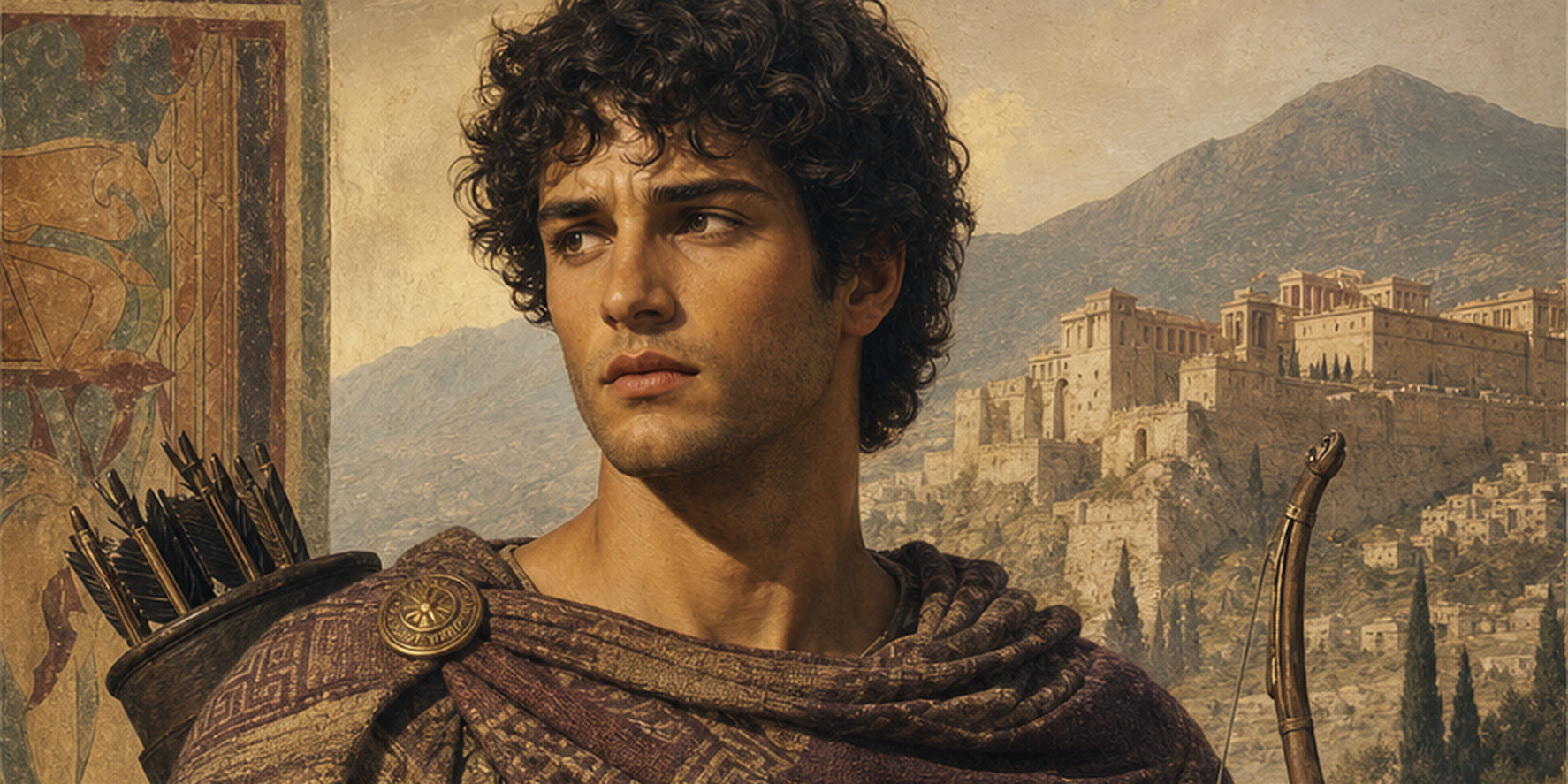
The archer whose choice of Aphrodite's promise turns divine rivalry into a war his family must defend.
- Aphrodite
- Apollo
- Golden Apple
- Hector
- Helen
- Trojan War
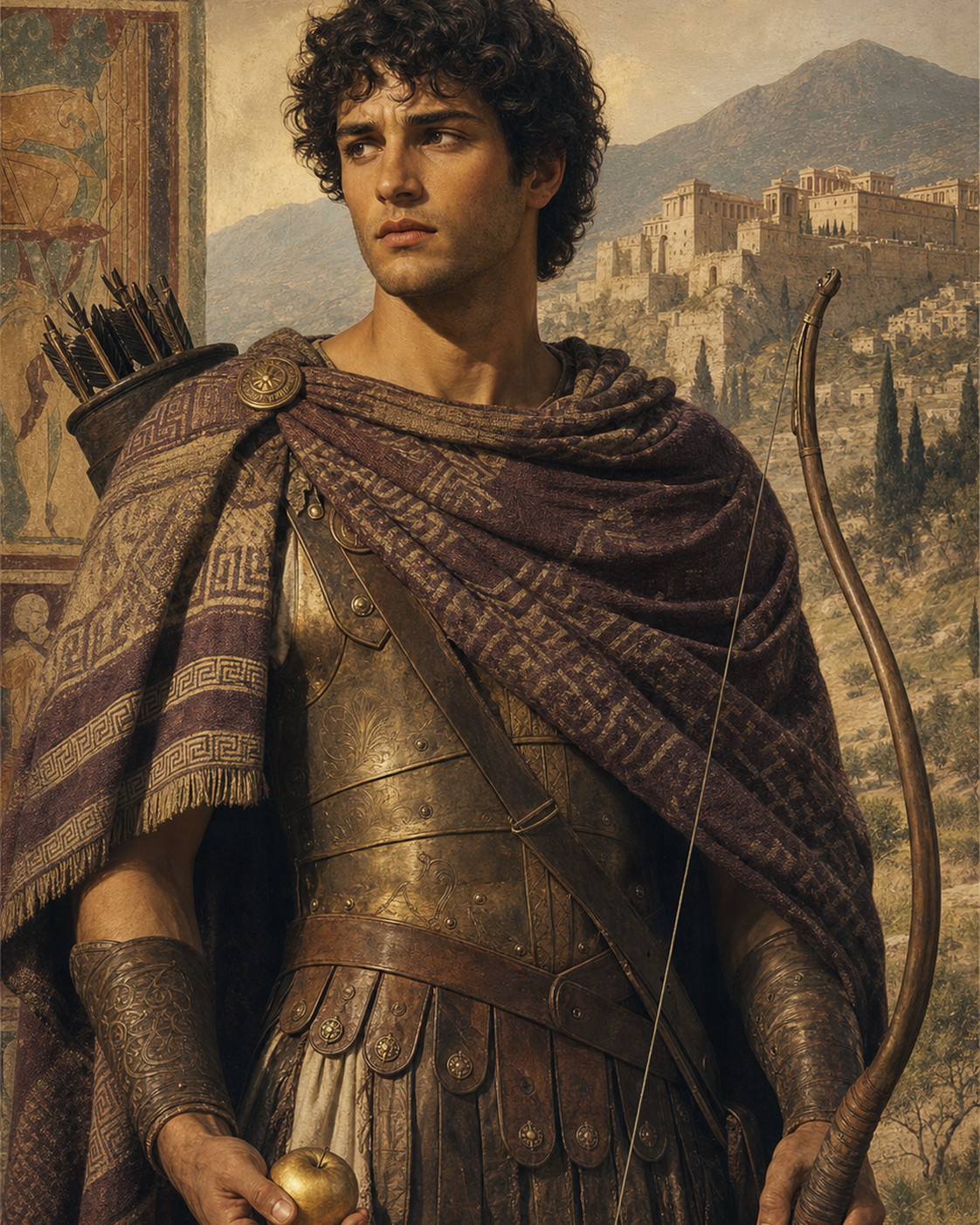
Paris awards Aphrodite victory in the divine beauty contest, leaves Sparta with Helen, and fights as a Trojan archer. His choices operate within prophecy and divine promise without losing their human consequences.
Greek Mythology Timeline
Move through broad mythic ages and open the events that connect one story to the next. The sequence is a reading path, not an exact historical calendar.
Paris is the Trojan prince whose judgment awards Aphrodite the prize of beauty and whose departure from Sparta with Helen helps ignite the Trojan War. Also called Alexandros, he is a son of Priam and Hecuba, connected with Mount Ida, archery, beauty, desire, and a difficult contrast with Hector. His story asks how a celebrated choice remains a choice when gods offer rewards and dynasties must absorb the cost.
The Exposed Prince
Later mythographers tell that Hecuba dreamed she would give birth to a firebrand that burned Troy. The infant Paris was exposed but survived among shepherds on Mount Ida before being recognized as a royal son.
This childhood is not developed by Homer and should be labeled as later tradition. It gives the war a pattern familiar from succession myths: attempts to escape prophecy help create the conditions through which prophecy returns.
Judge on Mount Ida
At the wedding of Peleus and Thetis, a dispute arises among Hera, Athena, and Aphrodite. Paris is chosen to judge. Later accounts describe offers of kingship, martial success, and the most beautiful woman.
Paris chooses Aphrodite. The golden apple becomes the familiar emblem, though details develop across post-Homeric sources. The judgment translates divine rivalry into a reward that can only be realized inside a mortal marriage.
Helen and Hospitality
Paris arrives at Sparta as a guest of Menelaus and leaves with Helen and treasure. Ancient accounts differ over consent, seduction, abduction, and divine compulsion, but violation of hospitality remains a major frame for Trojan guilt.
The dispute cannot be explained by romance alone. Helen’s marriage is protected by oath, Menelaus’ household has been crossed, and the prince acts with a goddess’s promise behind him. Personal desire activates international obligations.
Paris and Hector
The Iliad contrasts Paris’ attractiveness and archery with Hector’s endurance and public duty. Hector rebukes his brother for standing apart while others fight to defend consequences associated with his actions.
Paris can accept criticism and return to battle, so the poem does not portray him as permanently cowardly. Yet he never bears the city’s weight in the same way. Their fraternal conflict is about uneven responsibility as much as courage.
Duel with Menelaus
Paris agrees to single combat with Menelaus, a solution that appears capable of ending the war. Menelaus gains the advantage and drags him by the helmet strap, but Aphrodite breaks the strap and carries Paris away.
Divine rescue prevents a clean settlement. The goddess who made the original promise preserves its beneficiary when mortal combat threatens to reverse it. War continues because human agreements remain vulnerable to divine investment.
Archer of Troy
Paris fights primarily with the bow, a weapon that epic culture can admire and distrust depending on context. He wounds major Achaeans and remains dangerous without matching Hector or Ajax in close combat.
Epic Cycle tradition makes Paris, aided by Apollo, responsible for Achilles’ death. The famous arrow to the heel is a later specification; early summaries securely preserve the combined agency of prince and god without one universal wound account.
Oenone and the End
Later sources give Paris an earlier wife, the nymph Oenone, who knows healing. When he is mortally wounded by Philoctetes, she refuses or arrives too late to cure him, then dies in grief in several versions.
The story turns abandoned relationship into failed rescue. It also resists treating Helen as the only woman in Paris’ history, placing the celebrated choice beside a prior bond and its consequences.
Reading the Traditions
Paris is distributed across sources more unevenly than Hector. The Iliad supplies the duel, Aphrodite’s rescue, his relation to Helen, archery, and Hector’s criticism. Epic Cycle material and mythographers supply the judgment’s fuller bargain, exposure and recognition, Oenone, Achilles’ death, and Paris’ own fatal wound. Details familiar today often belong to different layers.
The golden apple is a useful emblem, but it can make the judgment look like an isolated fairy-tale contest. In the larger network it connects the wedding of Peleus and Thetis, divine rivalry, a guest relationship at Sparta, Helen’s marriage oath, and Troy’s royal house. Each link distributes causation while leaving Paris accountable for the actions assigned to him. Iconography also changes his appearance across time, from youthful archer or shepherd to richly dressed eastern prince, so costume should never be treated as one fixed ancient biography. The stable narrative markers are judgment, Helen, bow, family, and the war that follows.
How to Read Paris
Paris is neither the war’s sole cause nor innocent equipment of Aphrodite. His decisions matter inside structures of prophecy, divine competition, oath, hospitality, and dynastic honor. The story remains powerful because responsibility is shared without disappearing.
Follow him toward Helen for contested departure, Hector for unequal duty, Aphrodite and Athena for the judgment, Achilles for the later fatal shot, and the Trojan War for the city-wide cost of his prize.
Trivia
- Paris is also called Alexandros in ancient sources.
- Aphrodite rescues him from his duel with Menelaus in the Iliad.
- Early tradition links Paris and Apollo to Achilles’ death; the heel detail becomes dominant later.