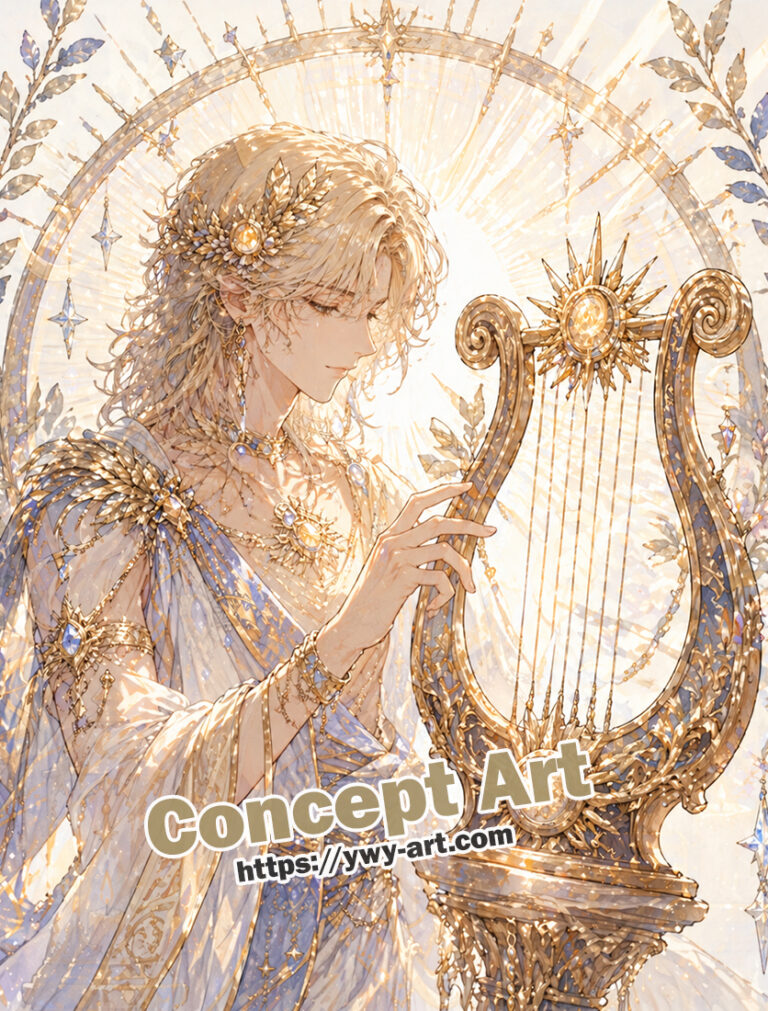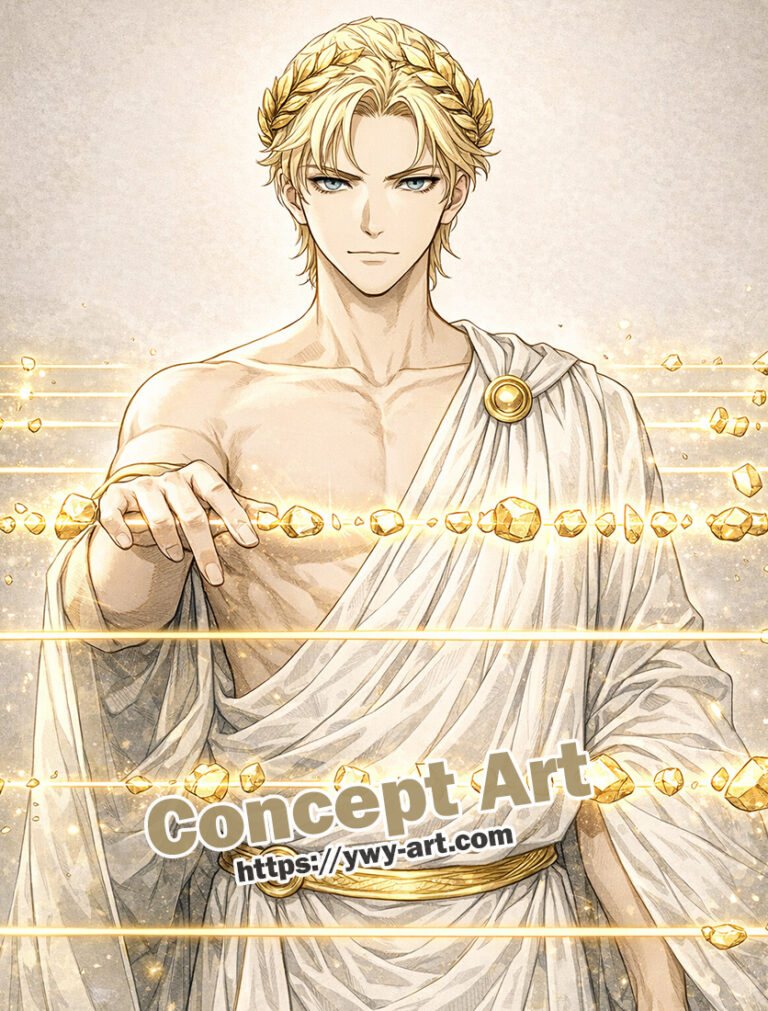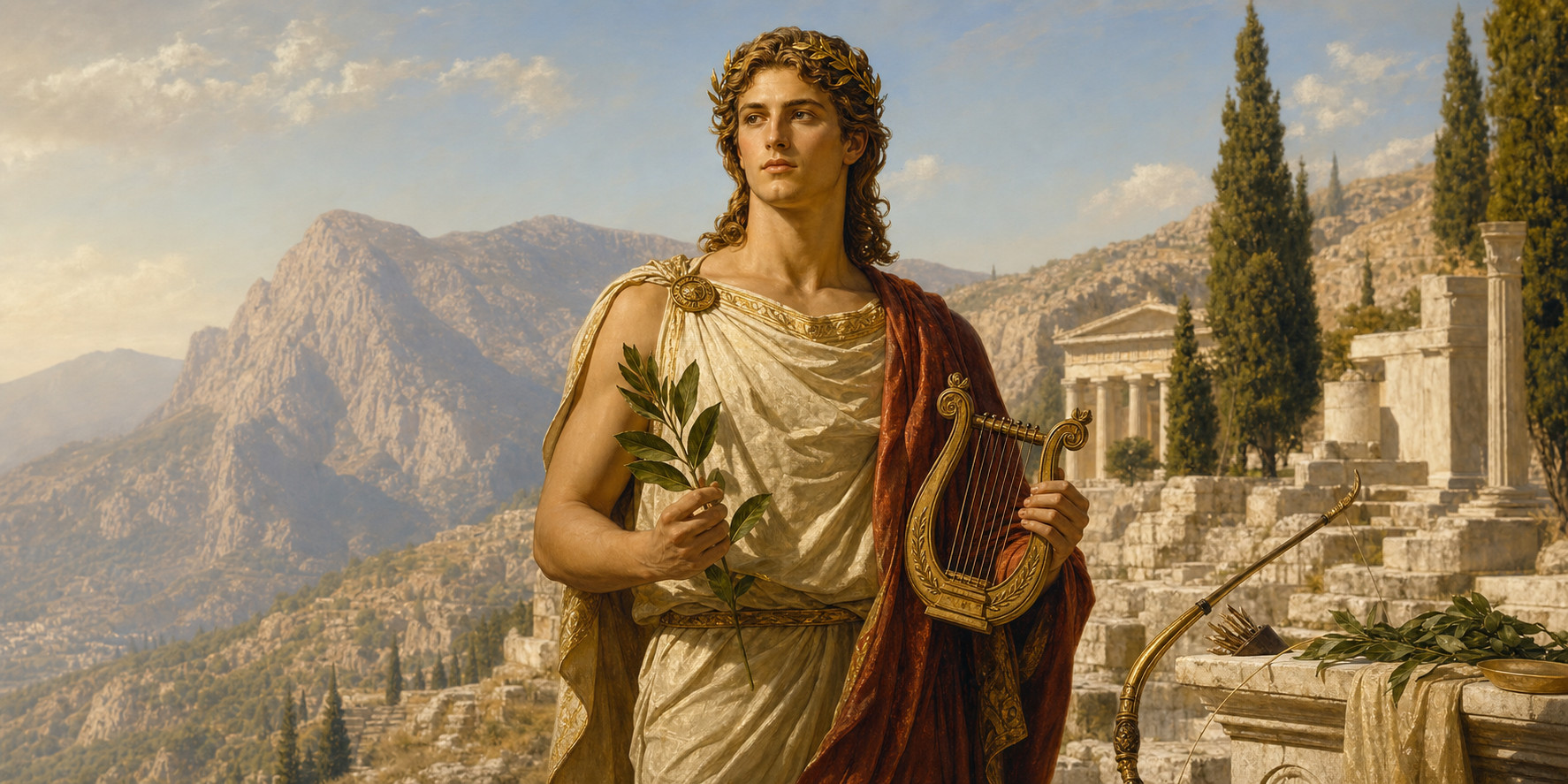
The archer and musician whose clear answers, healing, and order remain dangerous when misunderstood.
- Artemis
- Delos
- Delphi
- Laurel
- Lyre
- Zeus
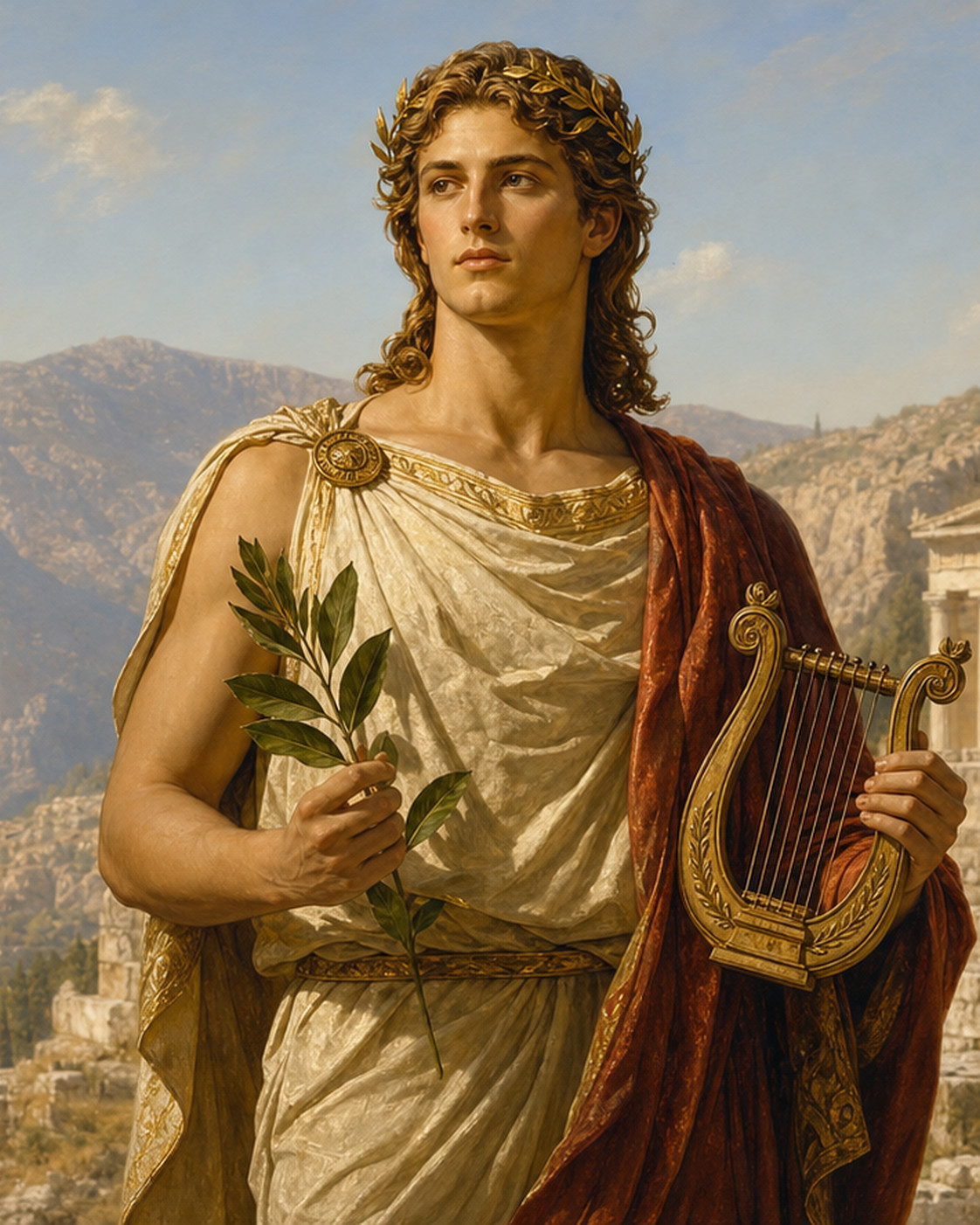
Apollo is son of Zeus and Leto and twin of Artemis, governing prophecy, music, archery, healing, plague, and purification. Delos preserves his birth and Delphi makes his speech a center whose answers demand interpretation.
Greek Mythology Timeline
Move through broad mythic ages and open the events that connect one story to the next. The sequence is a reading path, not an exact historical calendar.
Apollo is the Greek god whose far-reaching power joins prophecy, music, archery, healing, plague, and purification. Son of Zeus and Leto and twin of Artemis, he is both the musician at Olympian feasts and the terrifying archer whose unseen shafts bring disease. Delos preserves his difficult birth, while Delphi makes his speech a center of consultation. His domains concern distance, measure, interpretation, and the movement from dangerous uncertainty toward form.
Birth on Delos
The Homeric Hymn tells how Leto wanders in labor while places fear receiving Zeus’s child. Rocky Delos accepts after promises of honor. Leto braces against a palm and gives birth while goddesses attend her; Hera’s hostility and Eileithyia’s delayed arrival make the birth a struggle for recognition.
After divine food, the newborn claims the lyre, curved bow, and interpretation of Zeus’s will. Delos becomes a festival center where Ionian communities gather in song and competition. Apollo’s arrival creates both a birthplace and a network sustained by recurring performance.
The Road to Delphi
The Pythian hymn follows Apollo searching for an oracle site. He chooses Crisa beneath Parnassus, defeats the female serpent of the place, later called Python, and establishes a sanctuary whose names preserve both victory and decay.
Local layers and variant names should not be flattened into one modern dragon fight. The narrative explains how prophetic order replaces danger and why purification matters even to a victorious god. Authority grows through the organization of place, ritual, priesthood, and speech.
The Oracle
At Delphi the Pythia delivers responses sought by cities and individuals about colonization, war, law, purification, cult, and family crisis. Consultation is not a prediction machine. It requires offerings, procedure, interpretation, and responsibility for the action built from an answer.
Apollo speaks truly, yet myth shows humans hearing what expectation permits. Oedipus flees an oracle and enters it; Croesus mistakes the destruction of an empire for assurance about whose empire will fall. Prophecy reveals pattern without removing human judgment.
The Far-Shooting Archer
The Iliad opens with Apollo descending after Agamemnon dishonors his priest Chryses. His arrows strike animals and soldiers, bringing plague through the camp. Restitution and ritual end the crisis. Archery makes divine action distant: the wound arrives before the attacker can be confronted.
The same bow protects, punishes, and kills suddenly. Apollo and Artemis are linked with deaths that appear swift and unseen. Healing is not contradicted by disease; in Greek religion, power over danger often includes the capacity to send as well as remove it.
Healing and Purification
Apollo bears healing titles and fathers Asclepius, whose cult becomes a great system of divine medicine. Myths of Coronis and Asclepius vary over betrayal, death, rescue of the unborn child, and Zeus’s lightning, connecting medical skill with mortality’s limit.
Purification is equally important. Apollo guides killers away from pollution, yet some traditions make him serve labor or exile after divine violence. The god of clean boundaries is not merely spotless; his myths ask how destructive action can be acknowledged and transformed.
Music and Hermes
Apollo’s lyre accompanies the Muses and gives order to feast, hymn, dance, and poetry. In the Hymn to Hermes, newborn Hermes invents the lyre and exchanges it with Apollo. Reconciliation converts theft and anger into shared honors and complementary divine roles.
Musical contests show a harsher measure. Marsyas challenges Apollo and suffers after defeat; other rivals meet other consequences. Inspired skill does not erase hierarchy. Harmony is precious precisely because sound can also become excess, insult, or failed comparison.
Love and Distance
Apollo’s courtships do not form one stable marriage biography. Daphne escapes through transformation in a famous later account; Cassandra receives prophecy but is cursed not to be believed; Hyacinthus dies in a discus accident shaped differently by authors. Desire repeatedly ends in distance.
These stories should be separated by date and genre. Together they show that mastery of prophecy and music grants no control over consent, trust, jealousy, or mortality. Laurel, prophetic isolation, and the hyacinth become symbols made from relationships Apollo cannot preserve.
Difficult Clarity
Follow Apollo toward Artemis for the twin household, Zeus for authority, Orpheus for music, Oedipus for interpreted prophecy, and Dionysus for another sacred mode later placed in a complex Delphic relationship. Delphi and Delos keep prophetic and natal geography distinct.
Apollo is often called a sun god today, but early Apollo is not simply identical with Helios. Solar association grows later. His enduring center is broader: the force that strikes from afar, names pollution, measures music, and gives an answer whose clarity still demands understanding.
Trivia
- Apollo and Helios are distinct in much early tradition.
- Laurel is one of his central plants.
- His Roman name remains Apollo.
Reading the Traditions
Apollo’s breadth makes later shortcuts especially tempting. Delphi should not swallow Delos, prophecy should not erase plague, and a later solar identity should not be projected unchanged into every early poem. Cult titles often isolate a local concern: protection of flocks, purification, healing, civic foundation, or the approach of enemies. Narrative sources likewise select the Apollo needed for a scene. The Iliad’s archer, the Hymn’s sanctuary founder, and tragedy’s prophetic authority are compatible powers without becoming one continuous day-by-day biography. Reading him well therefore requires keeping place, genre, and ritual function visible.
YWY Artwork Connection
Explore coloring pages and studio articles connected to this mythology entry.