The first differentiation of chasm, earth, depth, desire, darkness, light, sky, mountain, and sea.
- Aether
- Chaos
- Day
- Erebus
- Eros
- Gaia
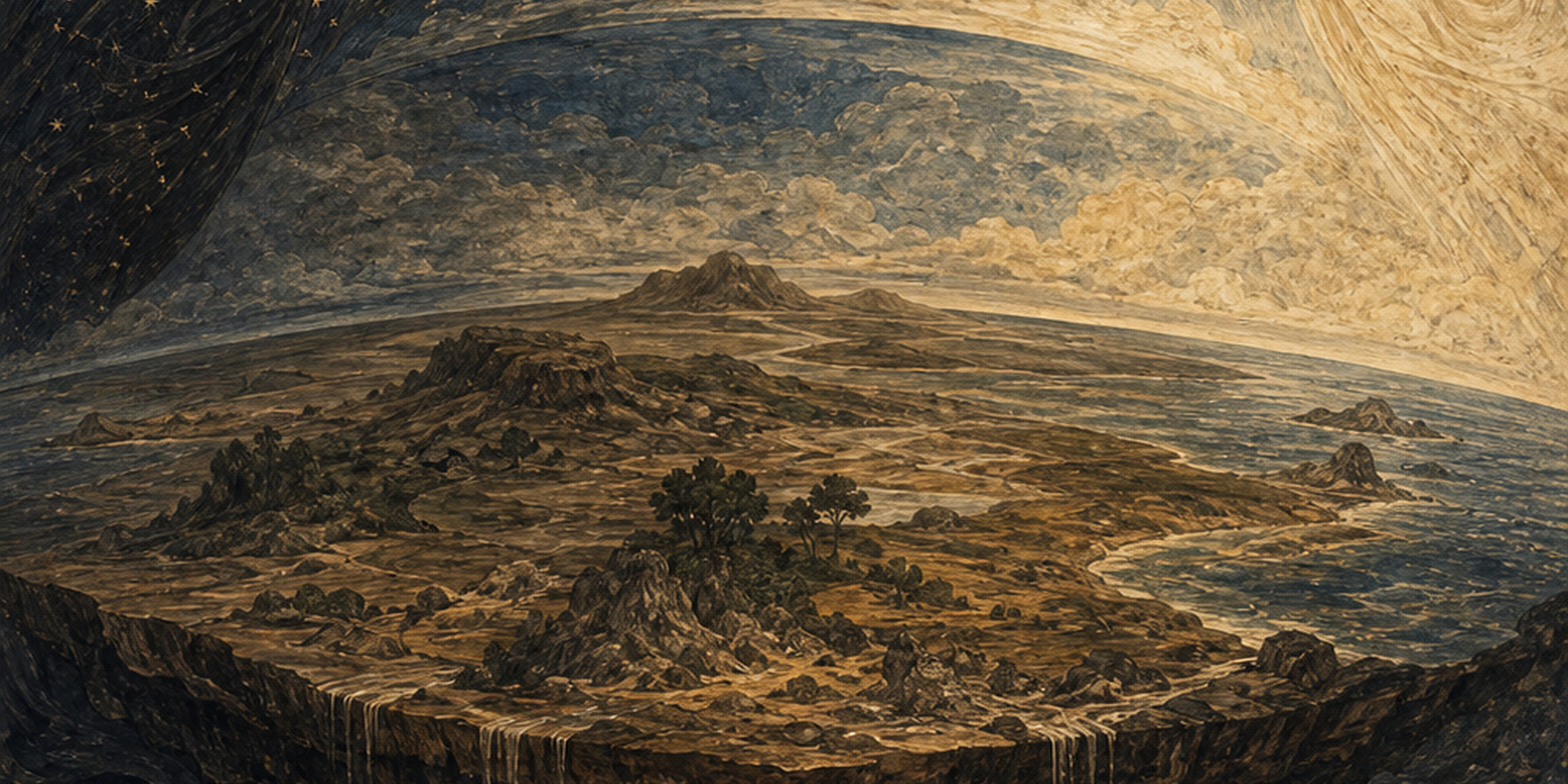
- Chaos FirstA yawning gap or chasm precedes the differentiated world.
- Earth and DepthGaia and Tartarus establish foundation and the deep below.
- Dark and BrightNight and Erebus generate Day and bright Aether.
- Sky, Mountain, SeaGaia bears the great regions that surround and shape mortal experience.
- First GenerationsEarth and Sky produce the dynasty whose blocked births create the first succession crisis.
Hesiod's cosmogony begins with Chaos, followed by Gaia, Tartarus, and Eros. Darkness, night, day, bright air, starry sky, mountains, sea, and the first divine generations give the world structure before it receives stable government.
Greek Mythology Timeline
Move through broad mythic ages and open the events that connect one story to the next. The sequence is a reading path, not an exact historical calendar.
The Birth of the Cosmos is the first differentiation of the Greek mythic world: not a creation from absolute nothing by a single craftsman, but the emergence of elemental conditions, places, powers, and generations. Hesiod begins with Chaos, then Gaia, Tartarus, and Eros. Night, darkness, day, bright air, starry Heaven, mountains, and sea follow through several forms of birth. The sequence gives the universe structure before it gives that structure a stable ruler.
Beginning with Chaos
Hesiod says that Chaos came first. The Greek word can suggest a gap, yawning space, or chasm rather than the modern idea of random disorder. Chaos is therefore best pictured as an opening condition in which distinctions can appear, not as a cloud of debris waiting for a designer.
Other ancient accounts begin differently. Orphic traditions introduce Night, Chronos, an egg, or Phanes in changing arrangements, while philosophical cosmogonies reorganize inherited divine names. A Project Mythos event should identify the Hesiodic sequence clearly instead of blending every Greek origin story into one supposedly universal version.
Gaia, Tartarus, and Eros
After Chaos come broad-breasted Gaia, dim Tartarus, and Eros. They are not merely later residents of a completed map. Earth provides foundation, Tartarus marks the deep below, and desire supplies a principle through which beings join, reproduce, and generate further order.
Their arrival creates orientation: surface, depth, and relation. Greek cosmology often speaks through genealogy because kinship can describe dependence and sequence. To say that one power bears another is also to explain how a domain, boundary, force, or recurring process enters the world.
Night, Darkness, Day, and Aether
From Chaos come Erebus and Night; from Night and Erebus come Aether and Day. Darkness does not simply vanish when brightness appears. The alternating and layered powers remain members of the cosmos, each with its own place, descendants, and ritual or poetic associations.
This coexistence matters visually and conceptually. Creation is differentiation without total erasure. Night and Day can meet at the edges of the world in later cosmographic language, while the bright upper air differs from the ordinary air experienced near earth.
Earth Brings Forth Sky
Gaia bears starry Uranus equal to herself so that he may cover her on every side. She also brings forth mountains and Pontus, the unfruitful sea, without sexual union. Earth is therefore both stable place and active generative power before the first divine marriage begins.
Sky and Earth establish the first great vertical pair. Their fit seems complete, but perfect enclosure soon becomes oppressive when Uranus prevents children from emerging. The same cosmic architecture that gives the world a roof also produces the first crisis of blocked succession.
Sea, Mountains, and Boundaries
Mountains provide homes for nymphs, and sea opens a domain whose genealogies will produce currents, calm, storms, creatures, and distant edges. Hesiod does not pause to describe an empty physical planet. Landscape arrives already alive with divine identity and future relationships.
Boundaries remain permeable. Rivers descend from mountains, sea surrounds land, roots reach toward Tartarus, and the sky meets earth at imagined horizons. Mythic geography explains the world by making its regions active participants rather than inert containers.
The First Generations
Once Gaia and Uranus unite, the Titans, Cyclopes, and Hundred-Handers enter the genealogy. Their different forms embody cosmic functions, craft, strength, and the dangers perceived by rulers who cannot tolerate powerful descendants.
Calling this a birth of the cosmos does not mean every later god appears at once. The event is a reading frame covering the first separations and generations before kingship passes through Uranus, Cronus, and Zeus. Sequence must remain legible even when genealogy branches quickly.
Cosmos before Government
The world has earth, sky, depth, sea, night, day, desire, and divine families before it has a durable political order. Cosmic existence and cosmic government are separate problems. The first explains what domains exist; the succession myths ask who may distribute honors and rule among them.
That distinction prevents Zeus from being miscast as the creator of everything. His later achievement is to win a succession struggle, secure allies, assign honors, and stabilize a world whose oldest powers precede him.
Sources and Alternative Beginnings
Hesiod’s Theogony supplies the most influential surviving continuous Greek account, but it is a poem of genealogy, praise, and divine order rather than a neutral scientific diagram. Homer assumes many cosmic structures without narrating the same opening sequence.
Orphic fragments, local traditions, cult hymns, tragedians, mythographers, and philosophers preserve other beginnings. They should be placed beside Hesiod as alternatives or reinterpretations. Combining them without labels would create a modern synthesis no ancient audience necessarily heard.
How to Read the Event
Read the Birth of the Cosmos as a movement from undifferentiated gap toward named relationships: below and above, dark and bright, land and sea, solitary birth and paired generation. Its drama lies in structure becoming possible, then immediately producing tensions inside that structure.
Follow the event toward Gaia for generative Earth, Uranus for the enclosing Sky, Tartarus for cosmic depth, the Titans for the first dynasty, and the Overthrow of Uranus for the moment formation turns into succession conflict.
Trivia
- Hesiod’s Chaos is commonly understood as a gap or chasm, not simply modern chaos.
- Gaia bears Uranus, mountains, and Pontus before uniting with Sky.
- Greek traditions preserve several alternative cosmogonies besides Hesiod’s sequence.