The many-minded survivor whose disguises, losses, and recognitions turn a voyage home into a test of identity and rule.
- Athena
- Penelope
- Poseidon
- Telemachus
- Trojan War
- Underworld
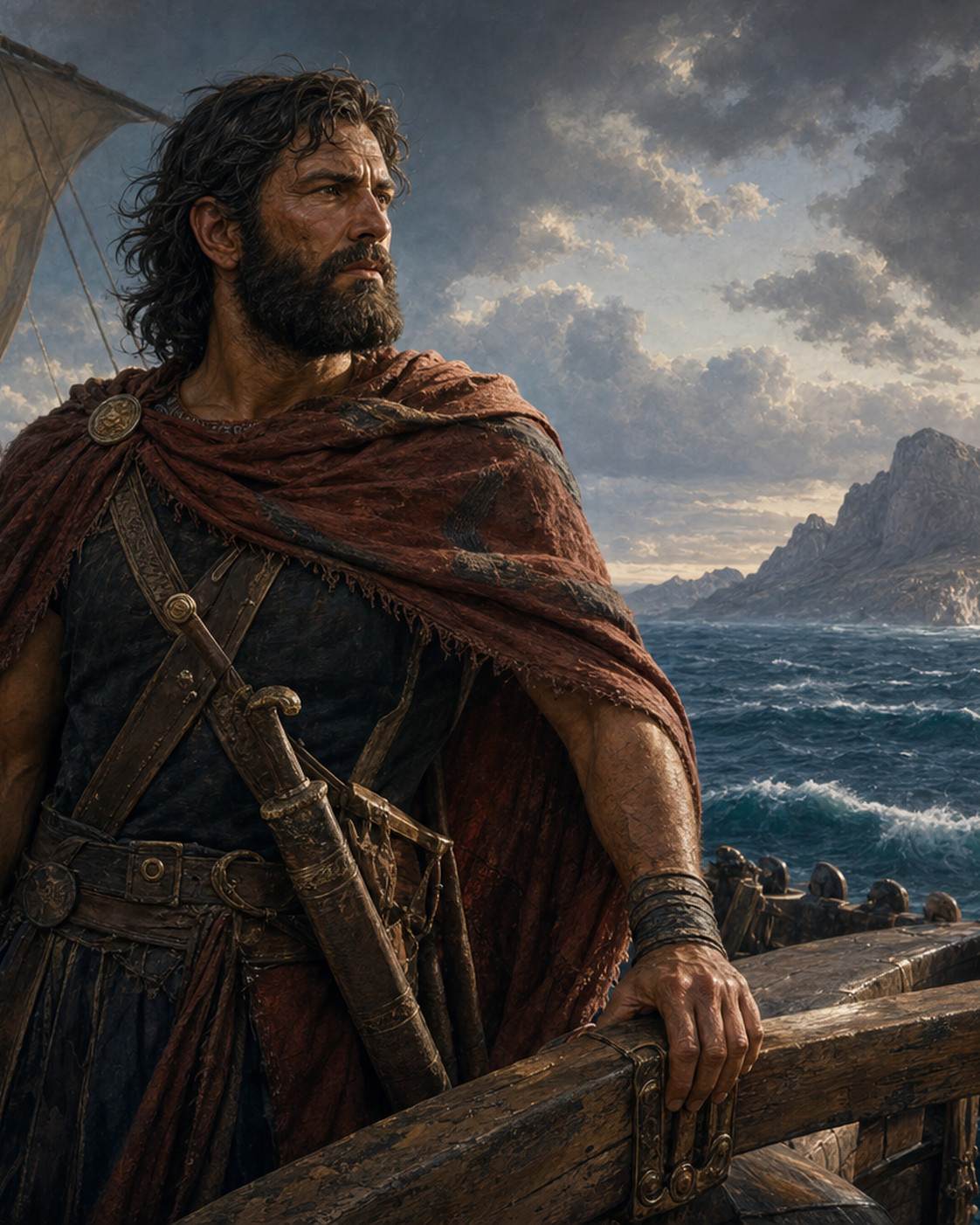
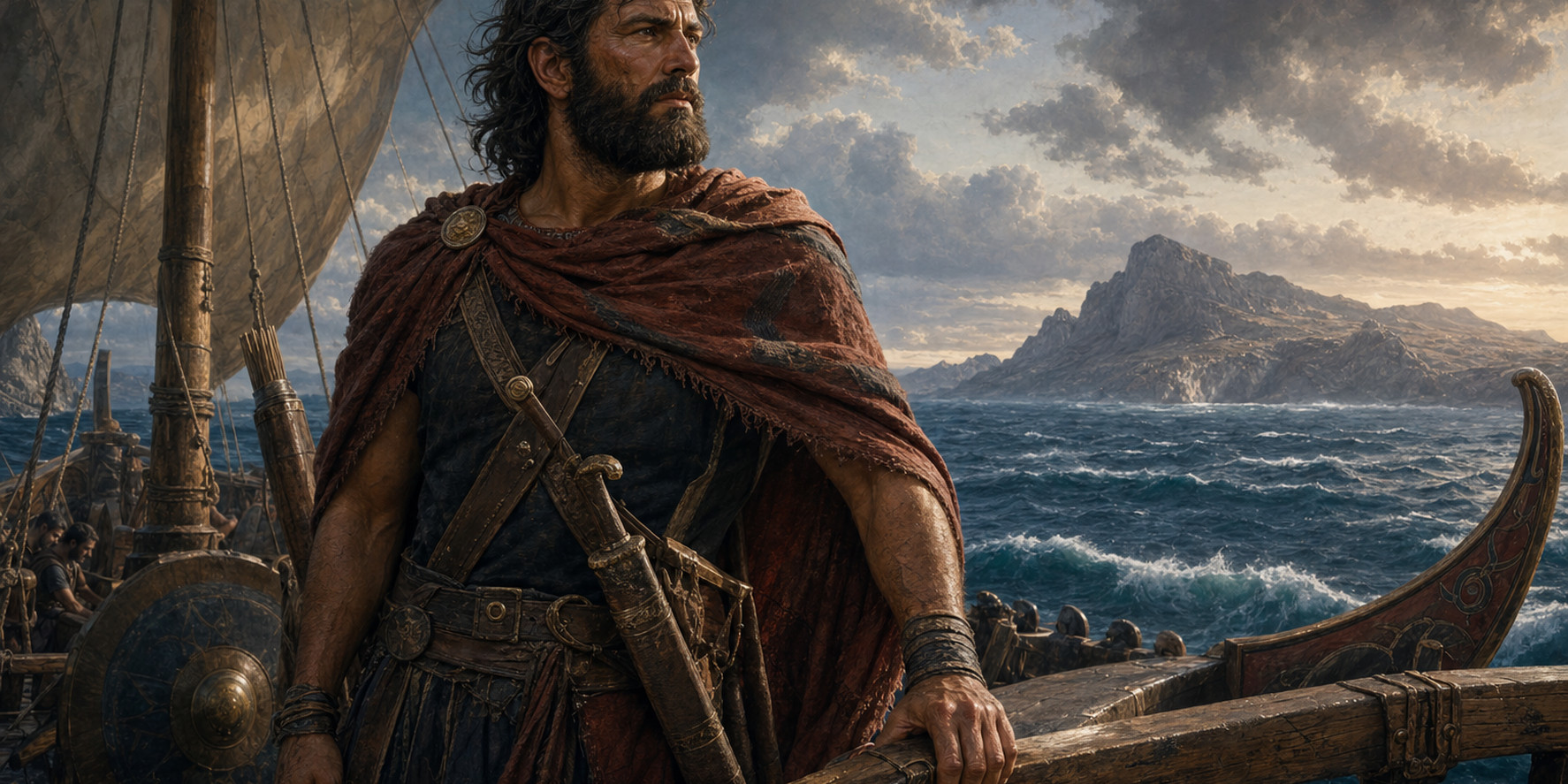
Odysseus is the king of Ithaca whose strategic intelligence helps end the Trojan War and whose ten-year return is told in the Odyssey. Athena aids him, Poseidon obstructs him, and recognition restores his threatened household.
Greek Mythology Timeline
Move through broad mythic ages and open the events that connect one story to the next. The sequence is a reading path, not an exact historical calendar.
Odysseus is the king of Ithaca whose intelligence shapes the end of the Trojan War and whose difficult return becomes the Odyssey. He is a persuasive speaker, patient planner, deceptive survivor, curious traveler, violent raider, husband, father, and restored ruler. The Greek quality metis—adaptive cunning—makes him effective, but it does not make every decision wise. His story repeatedly tests whether a person skilled at inventing identities can finally return to one life and be recognized.
King of Ithaca
Odysseus is son of Laertes and Anticleia in the dominant genealogy, husband of Penelope, and father of Telemachus. Some traditions whisper that Sisyphus is his true father, using cunning itself as a kind of inherited resemblance. Homer does not require that alternative for the hero’s intelligence, but later mythographers preserve it as a revealing rumor.
Ithaca is a small, rugged island kingdom rather than a vast imperial center. Odysseus’ authority depends on household, assembly, alliances, and personal reputation. His twenty-year absence exposes how fragile that order is: suitors consume the estate, pressure Penelope, and treat Telemachus as an obstacle to be removed.
Reluctant Warrior at Troy
Later tradition says Odysseus attempts to avoid the Trojan expedition by pretending madness, but Palamedes exposes him by placing the infant Telemachus before the plow. Whether or not this episode belongs to the earliest epic layer, it frames the war as a duty that tears him from a newly formed family rather than a quest he eagerly seeks.
At Troy he becomes indispensable through speech, reconnaissance, negotiation, and deception. He helps recruit Achilles, retrieves or contests sacred objects in later accounts, enters the city in disguise, and is central to the wooden horse strategy. The Iliad also shows him as a battlefield leader, but his distinctive power is the ability to read changing human situations.
The Man of Many Turns
The Odyssey opens by invoking a man described with the difficult word polytropos: of many turns, ways, or devices. The term fits travel and character at once. Odysseus changes direction, story, name, and social role while trying to preserve a route home. Translation choices such as cunning, resourceful, or complicated each capture only part of the range.
His intelligence is not abstract cleverness. It works through timing, endurance, controlled speech, observation, and the ability to imagine what another person believes. Athena supports him because her strategic power resembles his. Their alliance is strongest when plans must remain hidden until the correct moment.
The Cyclops and the Cost of a Name
Trapped in Polyphemus’ cave, Odysseus gives his name as Nobody, blinds the Cyclops, and escapes beneath the sheep. The plan is a masterpiece of preparation and linguistic misdirection. Yet once safely offshore, he reveals his true name in triumph. Polyphemus then asks Poseidon to punish him, turning victory into the cause of prolonged wandering.
The episode prevents a simple celebration of cunning. Anonymity saves Odysseus; the desire for lasting fame endangers him. Poseidon’s anger does not arise from every voyage in the same way but is focused through the injury to his son. The sea becomes the arena in which one boast repeatedly returns as consequence.
Circe, the Dead, and Knowledge
On Circe’s island, Odysseus resists transformation with Hermes’ aid and compels the goddess to restore his companions. He remains for a year, then must travel to the edge of Ocean and consult the dead seer Tiresias. The route home requires entering a place no living traveler can treat as ordinary geography.
In the Underworld he meets Anticleia, fallen comrades, heroic women, and famous dead. Knowledge carries grief: he learns what has happened at home and sees how heroic glory ends. The episode deepens his desire for return while expanding the Odyssey into a reflection on memory, mortality, and the stories the living tell about the dead.
Sirens, Scylla, and the Cattle of Helios
Odysseus listens to the Sirens while bound to the mast, allowing curiosity under a structure designed by Circe’s warning. He then must choose a route past Scylla and Charybdis, accepting limited loss rather than risking the entire ship. His leadership is repeatedly defined by decisions made when no harmless option exists.
On Thrinacia his starving crew kill the cattle of Helios despite explicit prohibition. Zeus destroys the ship, and Odysseus alone survives. The poem blames the companions’ recklessness, yet Odysseus’ command has failed to bring them home. His singular survival is achievement, burden, and narrative condition all at once.
Calypso, the Phaeacians, and Return
Calypso keeps Odysseus on Ogygia and offers immortality, but he longs for Penelope and Ithaca. The gods finally order his release. After another wreck he reaches the Phaeacians, whose hospitality, games, songs, and ship allow him to tell his own adventures and complete the physical return.
He wakes on Ithaca without recognizing it because Athena has covered the land in mist. Recognition is therefore not automatic even at home. The hero must learn where he is, accept disguise as a beggar, test loyalties, and enter his own palace as though it were hostile territory.
Penelope and the Bow
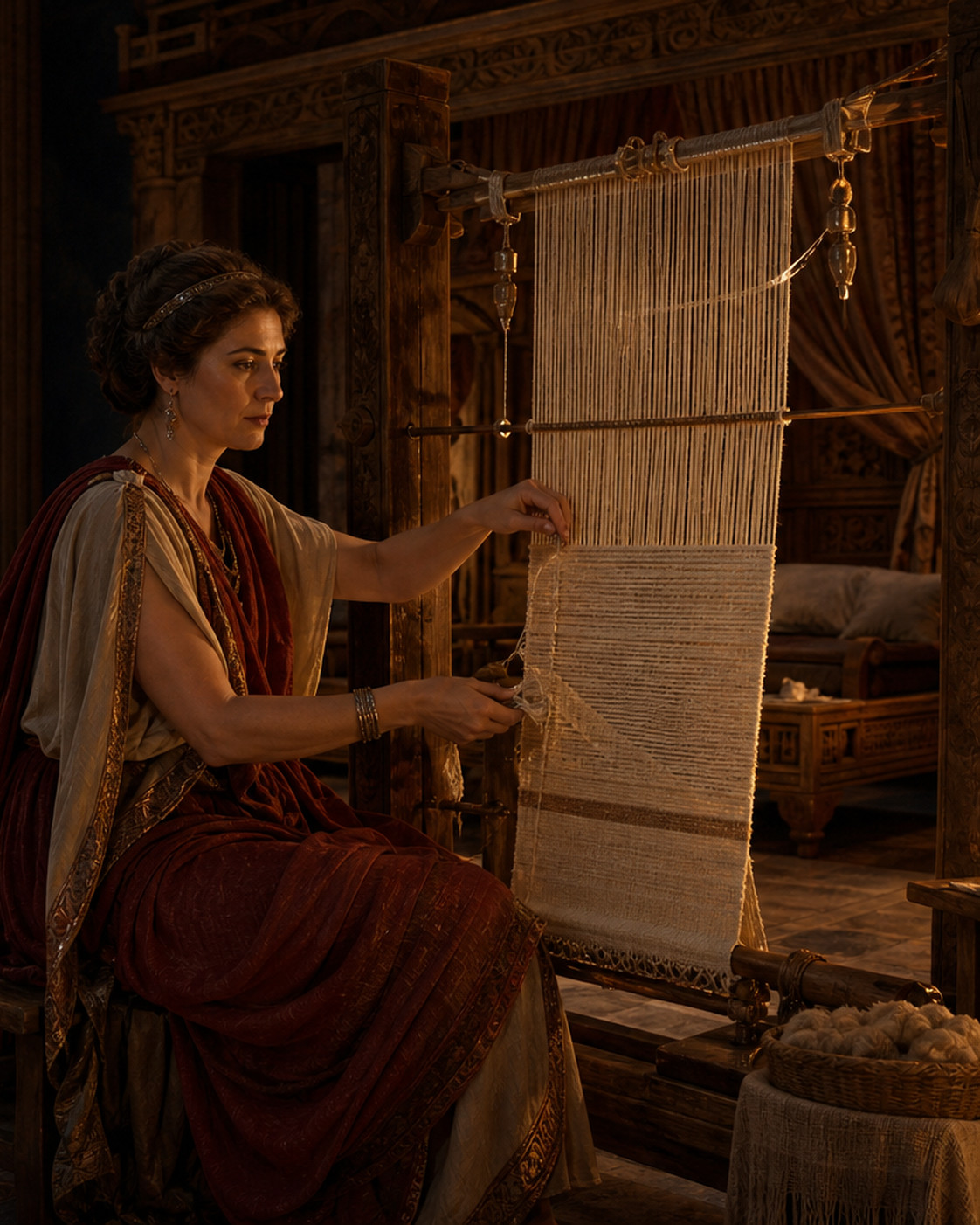
Penelope preserves the household through her own metis, delaying the suitors with the woven shroud and managing incomplete information. Odysseus cannot simply announce himself and resume rule. Recognition unfolds through scars, memories, the bow contest, Telemachus’ cooperation, and finally the secret of the rooted marriage bed.
The killing of the suitors restores the household through extreme violence. Ancient audiences could understand them as violators of hospitality and royal property while still recognizing the danger of renewed blood feud. Athena’s final intervention prevents the revenge cycle from consuming Ithaca after the apparent homecoming.
After the Odyssey
Tiresias predicts another journey inland carrying an oar until people mistake it for a winnowing fan. There Odysseus must establish sacrifice to Poseidon, then return home and eventually meet a gentle death from the sea or away from it, depending on translation. The Odyssey leaves fulfillment partly beyond its final book.
Later works give conflicting deaths and descendants, most famously the Telegony tradition in which Telegonus, his son by Circe, unknowingly kills him. Tragedy and philosophy also judge him differently—as brilliant survivor, manipulator, impious liar, or political mind. There is no single later moral verdict.
How to Read Odysseus
Odysseus should not be reduced to either hero or trickster. His flexibility saves lives and destroys trust; his curiosity gains knowledge and creates risk; his longing for home coexists with years spent in war and wandering. The poem asks whether identity is what a person says, what others recognize, what memory preserves, or what conduct finally proves.
Follow him toward Athena for strategic partnership, Poseidon for the obstructed return, the Underworld for knowledge of home, and the Argonautic Voyage for an earlier generation of maritime heroes. Future routes to Penelope, Circe, Polyphemus, and the Trojan War will turn this page into a major bridge between divine conflict, voyage myth, and household restoration.
Trivia
- The Odyssey begins in the tenth year after Troy rather than narrating the voyage in chronological order from the start.
- Odysseus tells many of the famous wanderings himself at the Phaeacian court, so narration and self-presentation are part of their meaning.
- His Roman name Ulysses comes through a different form of the Greek name and became especially influential in later literature.