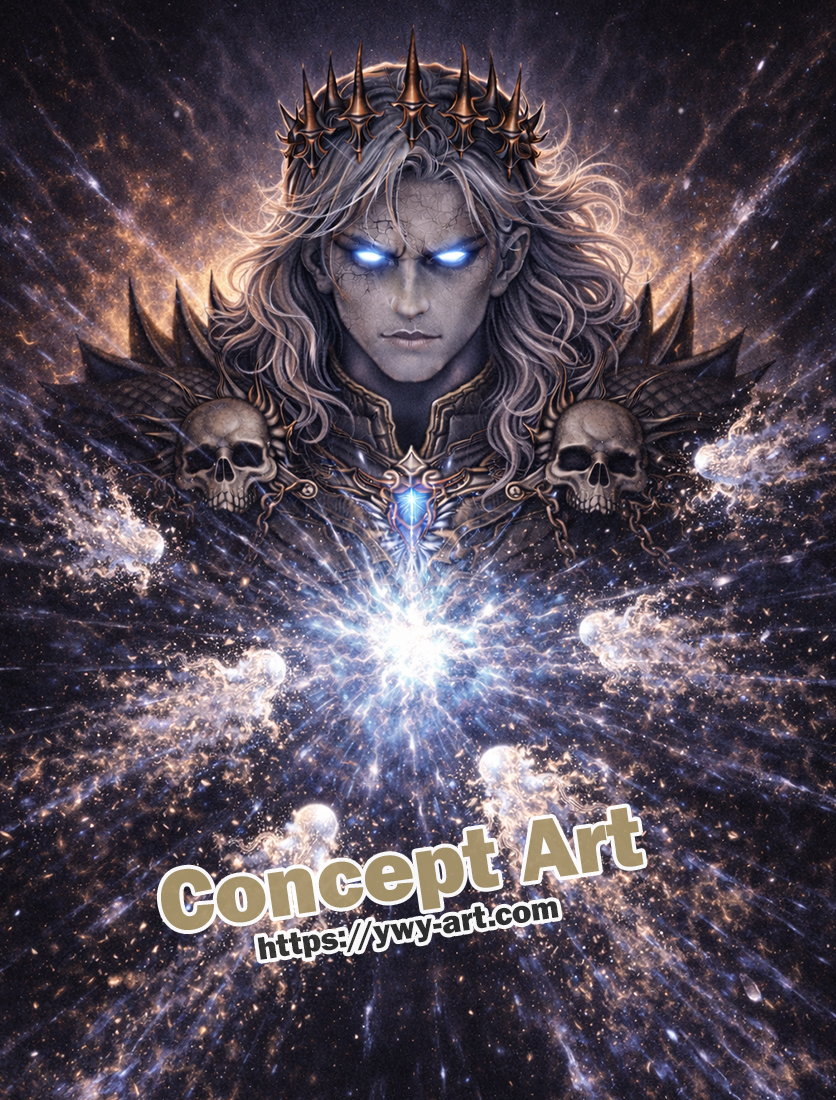
Hades – Sovereign of the Final Domain
There is a silence deeper than war, a presence that does not shout, yet cannot be ignored. Hades stands there, unmoving, as if the outcome has already been decided long before the first blow was struck.
Basic Profile
| Name | Hades |
|---|---|
| Mythology | Greek |
| Gender | Male |
| Region | Greece |
| Era | Ancient Greek Mythology |
| Domain | Underworld, Death, Wealth |
| Symbol | Helm of Darkness, Scepter, Cerberus, Skull Motifs |
| Culture / Religion | Ancient Greek Religion |
| Main Role | Ruler of the Underworld |
| Rank | Olympian (King of the Underworld) |
| Position in Titanomachy | Allied with Olympians, operates from the unseen domain |
| Associated Deity | Zeus, Poseidon, Persephone |
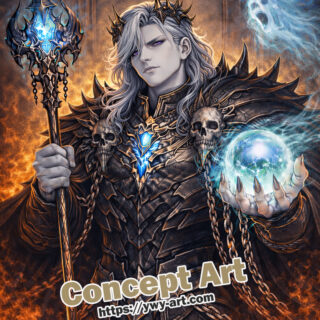
| Common Depiction | Dark regal figure, crown, stern expression, surrounded by souls or skulls |
| Alignment | Neutral – Absolute Order |
| Creative Reference | Silent ruler controlling energy, souls, and the inevitable end |
Overview
Hades is not a god of chaos or destruction, but of inevitability. He governs what comes after, the domain that no being can escape, and for that reason his power is often misunderstood. Unlike Zeus or Poseidon, he does not assert dominance through force, but through certainty. Everything returns to him in time, and that alone defines his authority.
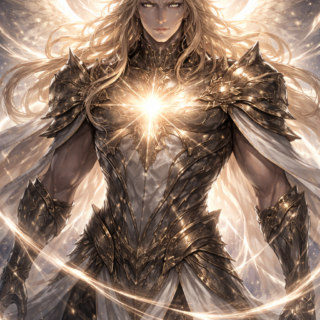
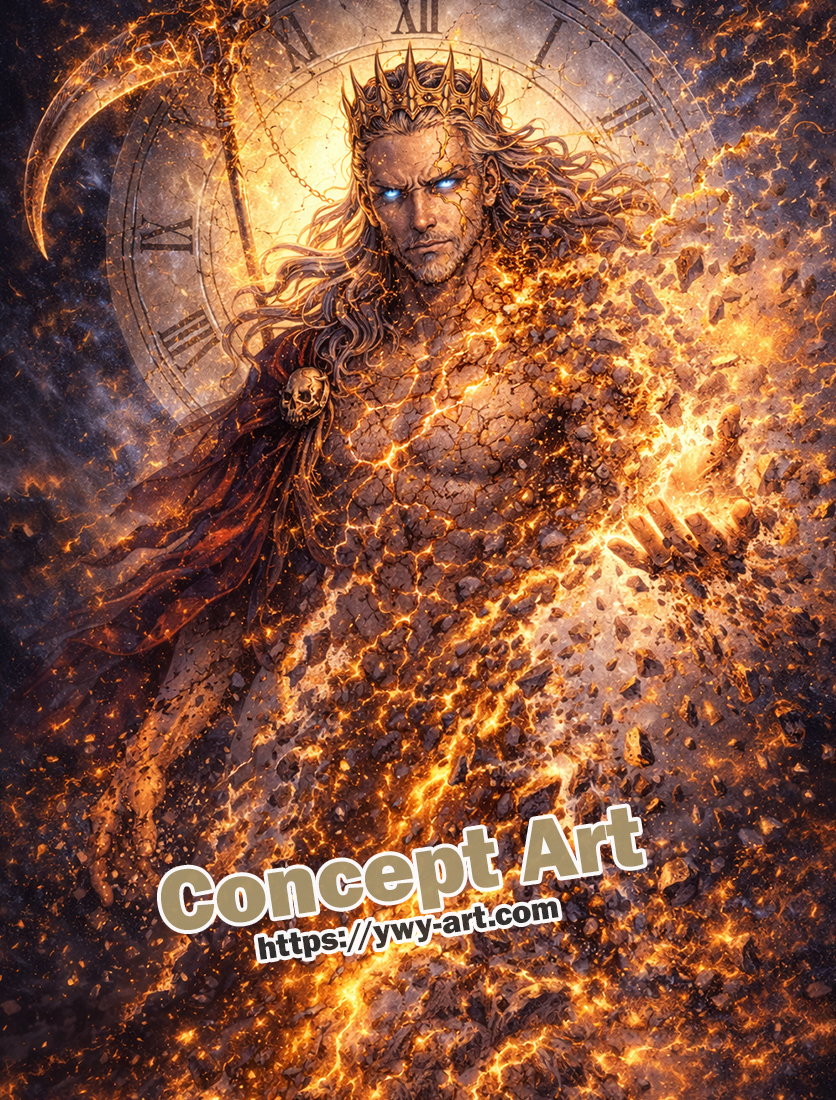
In the Titanomachy, Hades does not stand at the forefront of battle. Instead, he exists just beyond it, watching as gods and titans clash. This scene captures the moment where he begins to act, not by charging forward, but by gathering the consequences of war itself. The energy forming at his core represents the convergence of fallen power, a silent preparation to claim what remains once the conflict ends.
Characteristics
- Calm and calculating, never driven by impulse
- Embodies inevitability rather than aggression
- Observes before acting, always several steps ahead
- Commands control over souls, death, and unseen forces
- Maintains absolute authority without visible exertion
Symbolism and Meaning
Hades symbolizes the final boundary, the unavoidable truth that all things must come to an end. His domain is not simply death, but transition, the passage from existence into something beyond. This gives him a unique position among the gods, one that is both feared and respected.
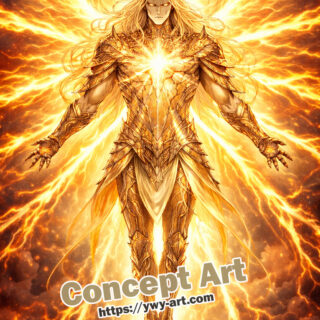
In this artwork, the radiating energy is not destruction, but collection. Each fragment represents something that has already fallen or will inevitably fall. The skulls on his armor reinforce this idea, not as trophies, but as confirmations. Hades does not take life, he receives it.
Quick Creative Reference
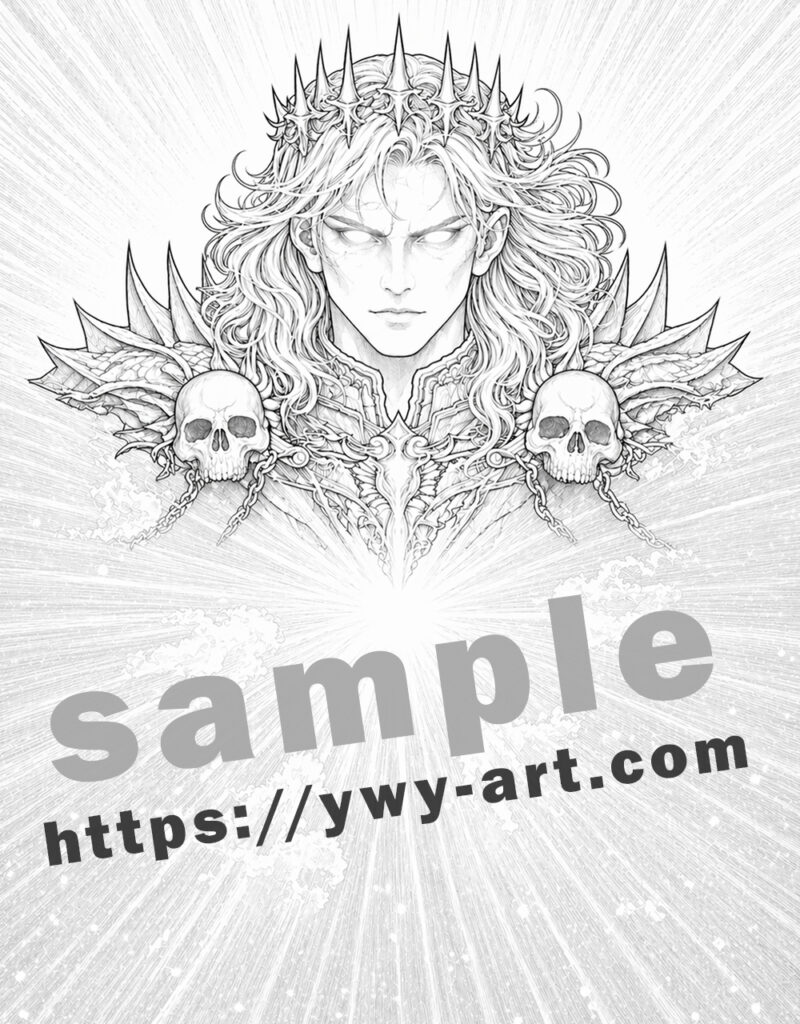
| Best For | Dark rulers, silent power, endgame presence |
|---|---|
| Visual Keywords | Skulls, dark crown, glowing core, energy convergence |
| Mood | Calm, inevitable, overwhelming |
| Useful Themes | Finality, control, aftermath of war |
Compare with Similar Deities
| Name | Mythology | Main Domains | Overall Image |
|---|---|---|---|
| Hel | Norse | Underworld, Death | Cold and dual-natured ruler of the dead |
| Anubis | Egyptian | Death, Judgment | Guide of souls, associated with passage and protection |
| Ereshkigal | Mesopotamian | Underworld | Isolated queen of the dead, emotionally heavy presence |
The Role of Hades in Titanomachy
During the Titanomachy, Hades does not lead armies or clash directly with the Titans. Instead, his role is more subtle yet crucial. He supports the Olympians from the shadows, ensuring that the balance of existence is maintained as the war escalates.
This scene reflects the moment where he prepares to absorb the consequences of the conflict. As gods fall and power fragments scatter, Hades gathers them, reinforcing his role as the ultimate destination of all outcomes.
The Energy of Convergence
The radiant burst from his chest represents a controlled convergence of energy. Unlike chaotic explosions, this force is deliberate, shaped by his will. It symbolizes his ability to command what others cannot control.
Each particle drifting outward is also being drawn inward, creating a paradox of expansion and collection. This duality reflects Hades himself, distant yet central to everything.
The Silence Before the End
While other gods act with visible intensity, Hades remains still. This stillness is not weakness, but confidence. He does not need to rush, because his role begins where others end.
This quiet dominance is what makes him one of the most formidable presences in the Titanomachy. He does not fight for victory. He defines what victory ultimately means.
Presence Beyond Battle
Hades represents a force that exists beyond the battlefield. He is not concerned with who wins or loses in the moment, but with the permanence of what follows.
In this sense, his presence extends beyond the war itself. He is the final authority that remains when all conflict has concluded.
Coloring Variations
- Underworld King: Use deep purples, blacks, and muted golds to emphasize his authority and darkness.
- Soul Collector: Apply cold blues and pale whites to highlight the energy and ghost-like elements.
- Final Light: Focus on high contrast with bright central light and darker outer tones for dramatic effect.
Coloring Tips
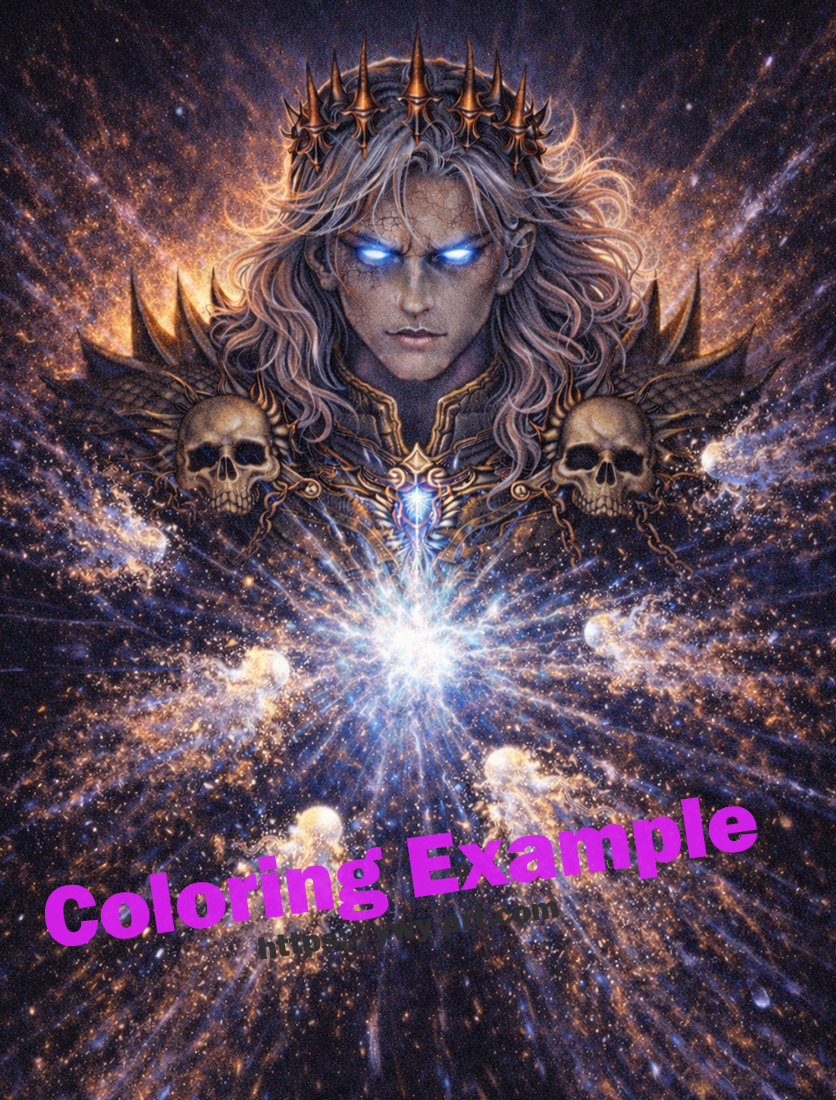
Start by defining the light source at the center of the chest. Gradually build outward with softer tones to create a glowing effect rather than a harsh contrast.
Use directional strokes for the hair to follow its natural flow, which will enhance the sense of movement without overwhelming the composition.
Keep the skulls slightly darker than the surrounding armor to create focal anchors, allowing the viewer’s eye to return to key elements naturally.
Japanese Summary
ハデスは死を司る神というよりも、「すべてが最終的に行き着く場所」を支配する存在です。彼は戦場の中心で戦うことはなく、その外側からすべてを見届ける役割を持っています。
このシーンはティタノマキア終盤において、戦いの結果を受け取る準備をしている状態を描いています。エネルギーの収束は、倒れた者たちの力や魂が彼のもとに集まることを象徴しています。
ティタノマキアにおける役割
ハデスは前線に立つ神ではありませんが、その存在は戦いの根幹に関わっています。彼は戦いの“後”を支配するため、結果そのものに影響を与える立場にあります。
このシーンでは、戦いが終わる前からすでにその結末を見据え、静かに力を集めている様子が表現されています。
表現としての意味
胸元から広がる光は破壊ではなく、収束と支配を表しています。散らばる粒子は戦いの残骸であり、それらが彼の意志によって集められていく流れになっています。
ハデスは怒りや激情ではなく、「確定した終わり」を象徴する存在として描かれています。
塗りのポイント
中心の光から外側に向かってグラデーションを作ることで、自然な発光表現ができます。白を活かしながら色を重ねていくのがポイントです。
髪や鎧は暗く塗りすぎず、コントラストで立体感を出すと全体のバランスが整います。
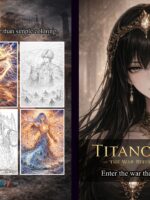
Explore Our Coloring Book Series
Discover more powerful gods and mythological figures in our coloring book series.
Each illustration is designed to bring myth, story, and creativity together.
Step into the world of mythology..
Available on Amazon Titanomachia: The War Before the Olympians Open in a new tab

コメント