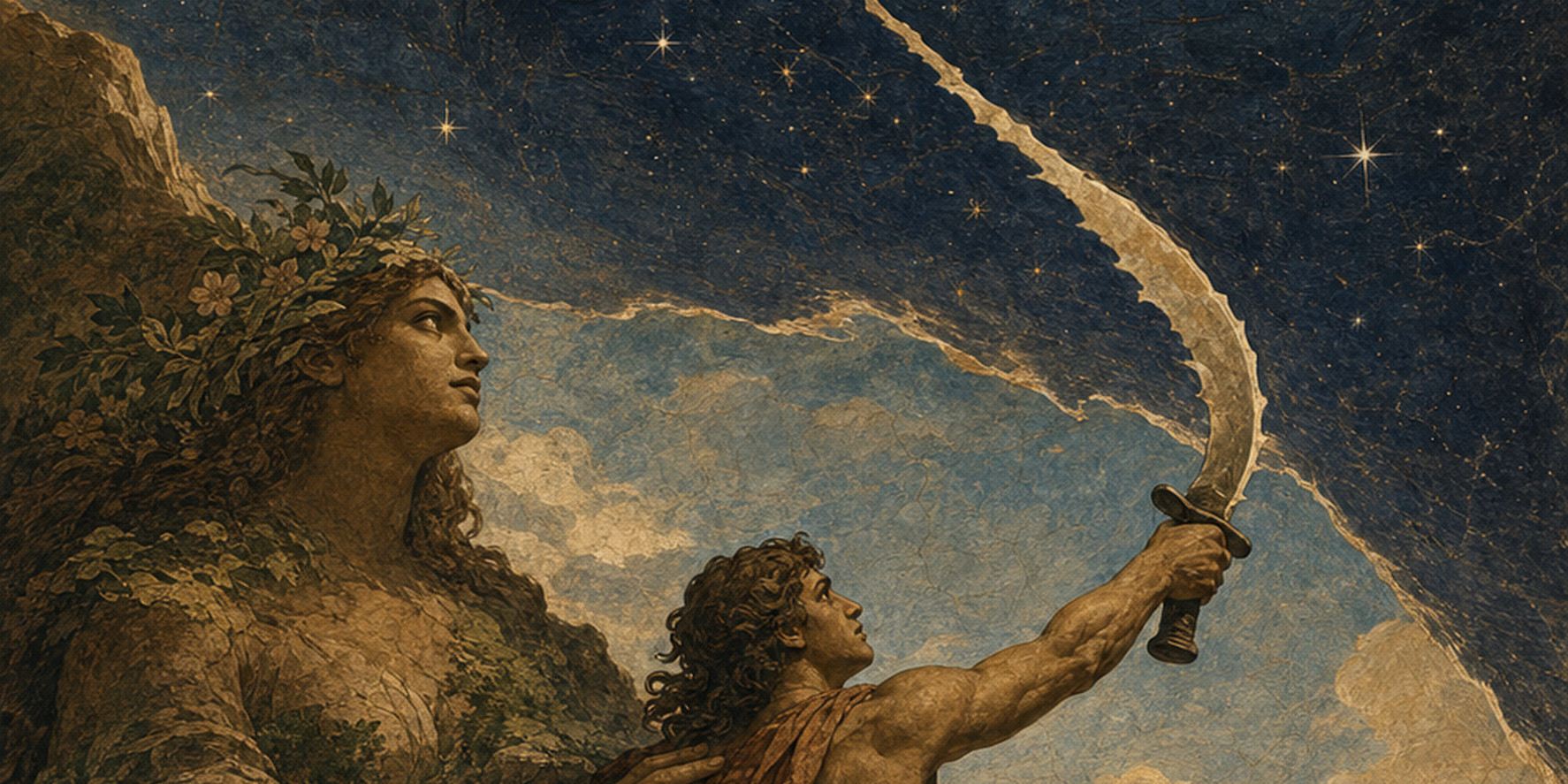
Gaia's plan and Cronus' sickle open space between Earth and Sky while transferring power to the Titans.
- Adamantine Sickle
- Aphrodite
- Cronus
- Cyclopes
- Erinyes
- Gaia
- Children ConfinedUranus hides the new generation within Gaia and refuses them light.
- Gaia Makes the SickleEarth creates the unyielding tool and calls her children to resist.
- Cronus AcceptsThe youngest Titan alone volunteers and waits in ambush.
- Sky Is SeparatedThe attack opens permanent space between Earth and Heaven.
- New Powers EmergeBlood and sea foam generate vengeance, Giants, nymphs, and Aphrodite in Hesiod.
Uranus confines his children within Gaia. Earth fashions a sickle, Cronus accepts her ambush, and Sky is separated from Earth. The first kingship ends, new beings arise from the violence, and the pattern of feared succession passes to Cronus.
Greek Mythology Timeline
Move through broad mythic ages and open the events that connect one story to the next. The sequence is a reading path, not an exact historical calendar.
The Overthrow of Uranus is the first divine succession crisis in Hesiod’s Theogony. Starry Sky confines his extraordinary children within Gaia, causing Earth pain and preventing a new generation from entering the light. Gaia fashions a jagged sickle and asks her children to resist. Only Cronus accepts. His ambush separates Sky from Earth, ends the first kingship, generates new beings from the violence, and establishes the pattern that will later threaten Cronus himself.
A World Held Closed
Uranus hates or fears the children born from his union with Gaia and hides them in a secret place within Earth. Hesiod emphasizes that they cannot come into the light. The injury is simultaneously familial, bodily, and cosmic: birth is blocked because Sky refuses space to the next generation.
The Titans, Cyclopes, and Hundred-Handers are not identical groups, and later sources vary the exact imprisonment. What remains stable is the political logic. The first ruler treats powerful descendants as threats and converts parenthood into confinement.
Gaia’s Pain and Counsel
Gaia groans under the pressure and devises resistance. She makes the material for a great sickle and explains the plan to her children. Earth is not merely rescued by a male avenger; she identifies the injustice, produces the technology, selects the location, and creates the opportunity for action.
Her role establishes counsel as a cosmic force. Across later succession stories, victory depends not only on strength but on information supplied by figures who understand hidden prisons, prophecies, births, and the weaknesses of rulers.
Cronus Volunteers
Fear silences the other children, but Cronus answers Gaia. Hesiod calls him wily, and his acceptance links courage to calculation. He does not challenge Uranus in an open contest; he waits in concealment with the weapon his mother provides.
The youngest son’s position anticipates later patterns in which the apparently least established child becomes the instrument of succession. Yet Cronus acts against tyranny without becoming a permanently just ruler. Liberation and ambition occupy the same deed.
The Adamantine Sickle
The sickle is often described through a material translated as adamant, an unyielding substance suitable for cutting a cosmic bond. Its curved agricultural form also evokes separation, harvest, and the controlled division of what has grown together.
Ancient art and later illustration frequently turn it into a sword or modern steel weapon. Keeping the hooked blade visible preserves the story’s distinctive technology and Gaia’s authorship of the revolt.
Separation of Earth and Sky
When Uranus descends to cover Gaia, Cronus reaches from ambush and attacks. The result permanently separates the first parents, creating room between earth and sky. A violent family act becomes an explanation for the inhabited world’s vertical space.
Responsible visual treatment can convey that rupture symbolically through the rising starry vault, Gaia’s released landscape, and the cutting arc of the sickle. Graphic anatomy adds little to the cosmological meaning and can overwhelm the event’s role in the larger sequence.
Blood, Sea Foam, and New Beings
Drops from Uranus fall upon Gaia and generate the Erinyes, Giants, and Melian nymphs in Hesiod. The severed part cast into the sea produces foam around which Aphrodite forms. Violence does not end generation; it redirects generation into vengeance, conflict, nature, and desire.
Aphrodite’s origin varies in Greek tradition. Homeric genealogy can make her a daughter of Zeus and Dione, while Hesiod connects her to the sea after Uranus’ overthrow. Both traditions should remain visible rather than forced into one family tree.
A Curse on Succession
Uranus names his sons Titans in a hostile etymological play and foretells punishment. Whether read as curse, consequence, or narrative pattern, the overthrow does not close the question of rule. It transfers the fear of replacement to Cronus.
Cronus later swallows the children of Rhea and imprisons primordial allies. He repeats the principle he resisted: power is protected by preventing descendants and rivals from emerging. The next succession must therefore reopen prisons and restore births.
Sources and Later Images
Hesiod gives the fullest surviving early narrative. Apollodorus summarizes related genealogy, while Orphic and later philosophical accounts rearrange primordial rulers. Roman Saturn inherits Cronus’ name and imagery but belongs to a reception history with different civic and agricultural meanings.
Modern images often show a duel between two human kings. The source instead describes primordial scale, maternal planning, concealment, and cosmic separation. Those features keep the episode distinct from the later Titanomachy, which is a prolonged war between coalitions.
How to Read the Event
The overthrow is both liberation and warning. It gives suppressed children a path into the world and ends Uranus’ control, yet it enthrones a son who will reproduce the same fear. Greek succession myth distrusts victory when institutions and habits remain unchanged.
Follow the event toward Gaia for the plan, Uranus for blocked generation, Cronus for inherited kingship, the Titans for the new dynasty, the Adamantine Sickle for crafted resistance, Aphrodite for sea-born aftermath, and the Titanomachy for the next transfer of power.
Trivia
- Gaia makes the sickle and designs the ambush in Hesiod.
- Cronus is the only child who immediately volunteers to act.
- The event generates the Erinyes, Giants, Melian nymphs, and Hesiod’s sea-born Aphrodite.