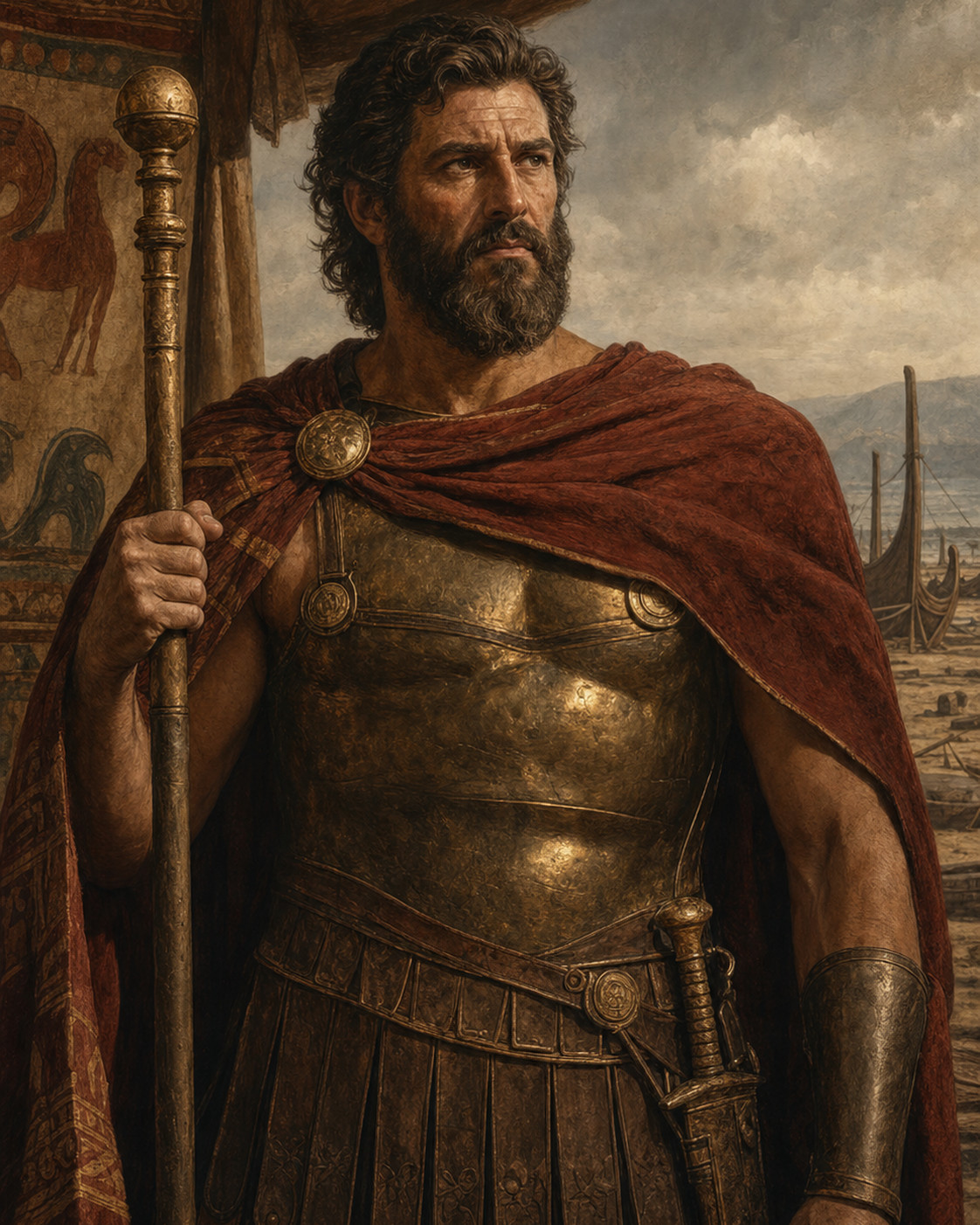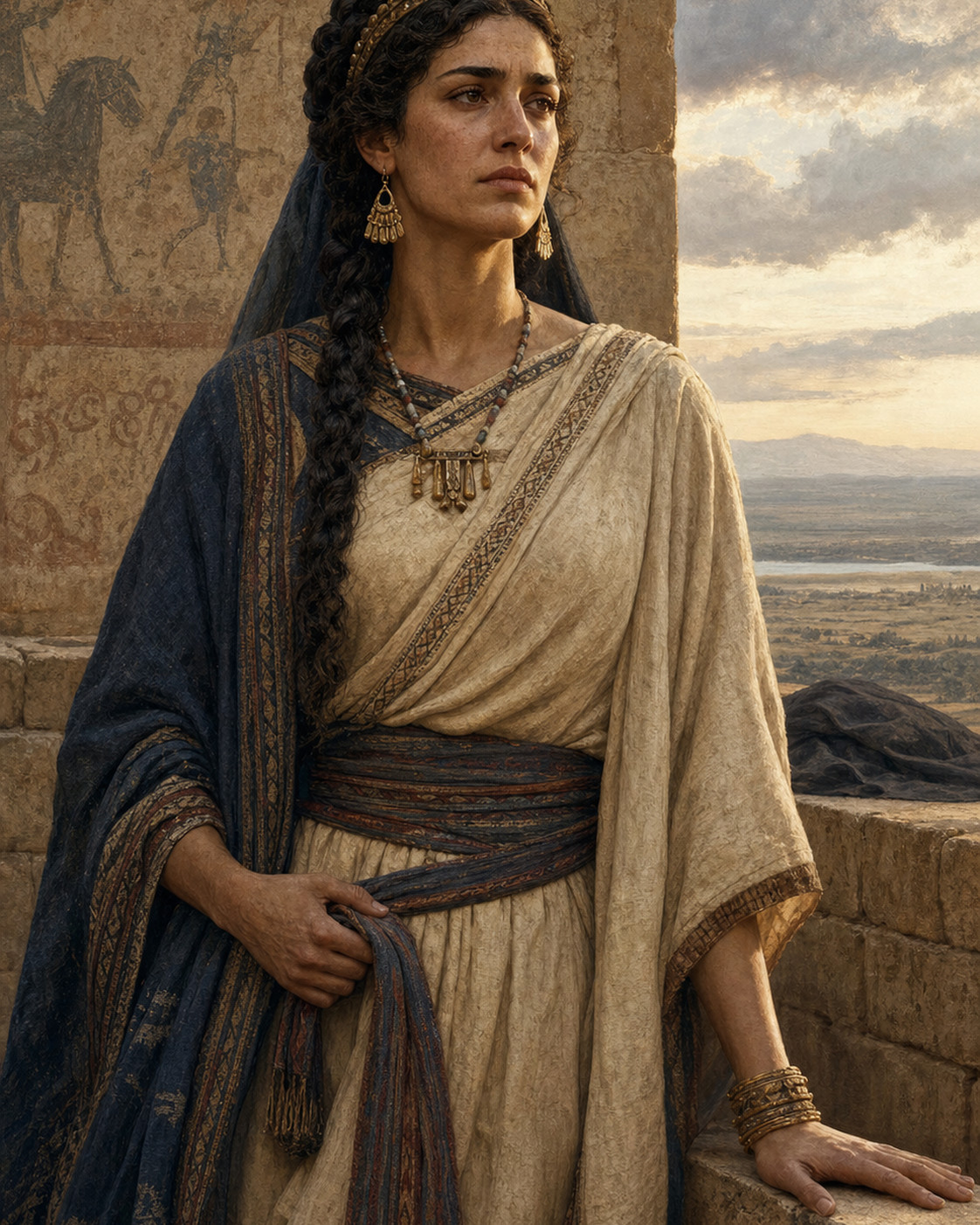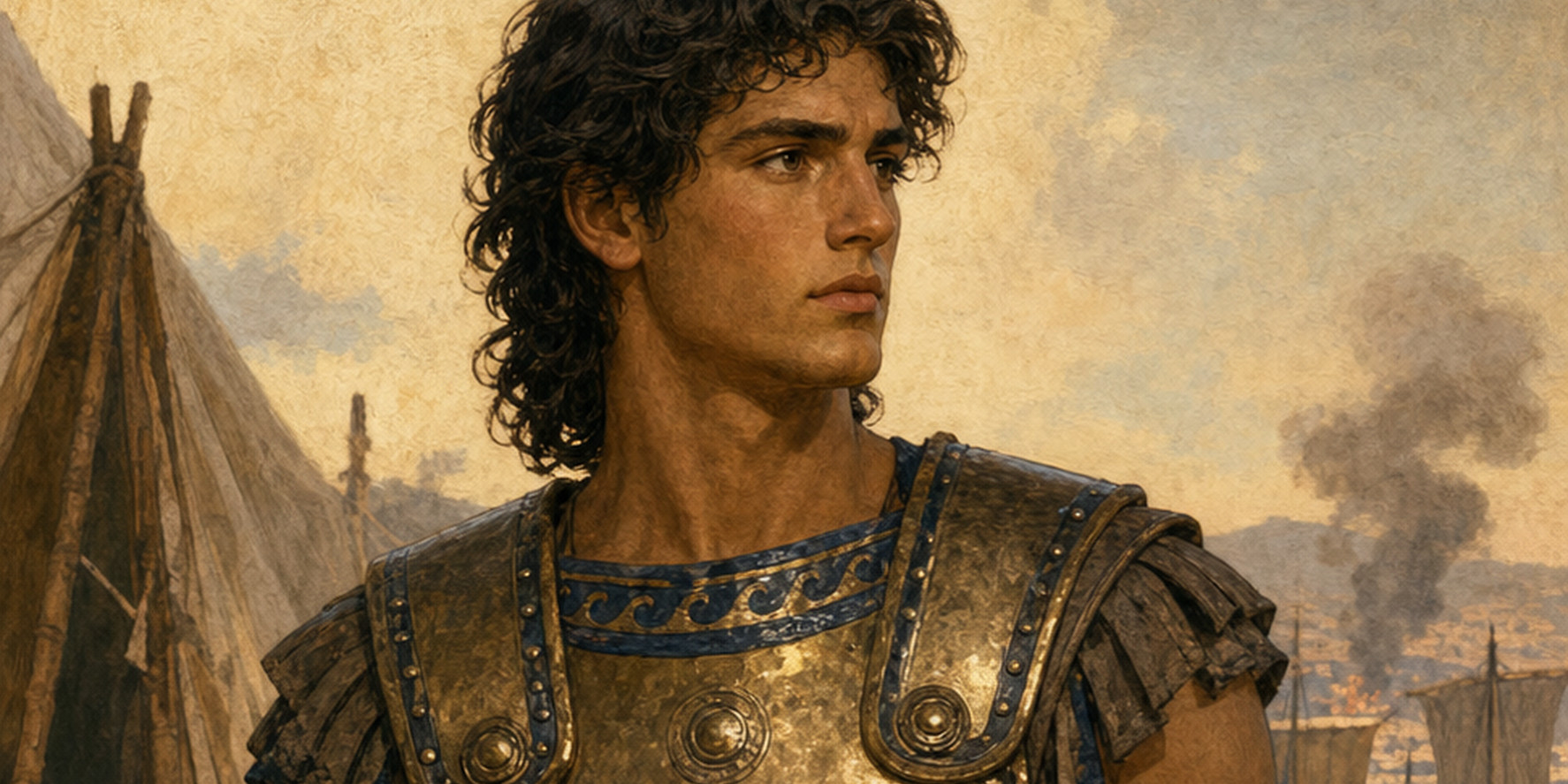
The compassionate substitute whose borrowed armor saves the ships and makes his death the turning point of Achilles' rage.
- Achilles
- Borrowed Armor
- Funeral Games
- Hector
- Myrmidons
- Sarpedon
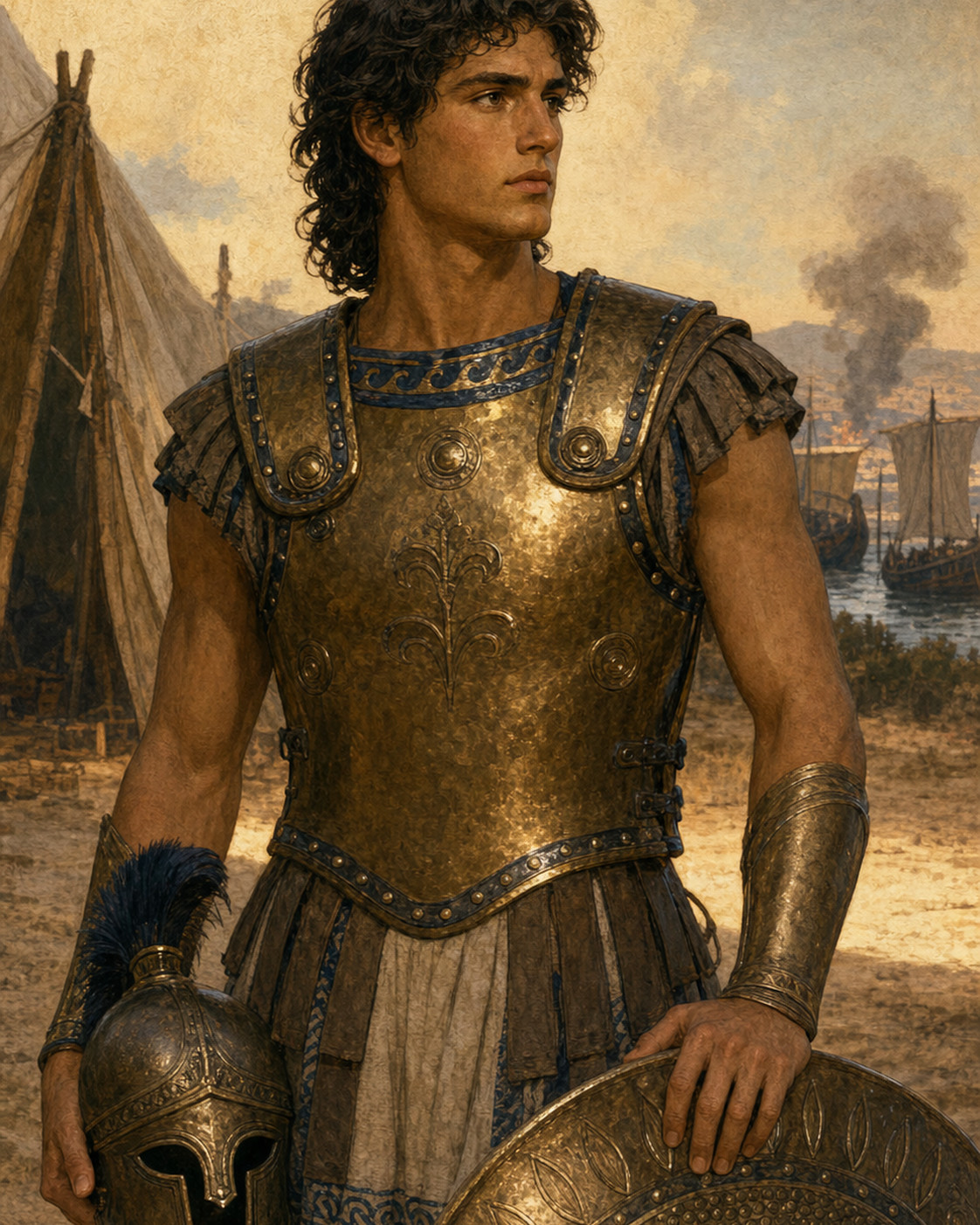
Patroclus enters battle in Achilles' armor to save the Achaean ships. He kills Sarpedon, is struck by Apollo and Euphorbus, and dies to Hector, turning Achilles' withdrawal into grief-driven return.
Greek Mythology Timeline
Move through broad mythic ages and open the events that connect one story to the next. The sequence is a reading path, not an exact historical calendar.
Patroclus is the companion whose death ends Achilles’ withdrawal from the Trojan War. Son of Menoetius and older than Achilles in the Iliad’s remembered genealogy, he tends wounded allies, weeps for the collapsing army, enters battle in borrowed armor, saves the ships, kills Sarpedon, and is finally brought down through the combined action of Apollo, Euphorbus, and Hector. His importance lies not only in dying, but in the care, persuasion, and dangerous substitution that precede it.
Exile and Companionship
Later in the Iliad, Nestor recalls how Patroclus’ father Menoetius advised him to guide Achilles, who was younger but stronger. Other traditions explain Patroclus’ arrival in Peleus’ household through exile after an accidental killing. These accounts place the friendship inside fosterage, correction, and shared displacement rather than a chance meeting at Troy.
The surviving sources do not define the relationship with one modern label. Homer gives intimacy through daily action, shared quarters, tears, memory, funeral wishes, and Achilles’ inability to imagine life after the loss. Later readers have understood them as comrades, foster-brothers, beloved companions, or lovers; responsible presentation preserves the evidence and the history of interpretation.
Care Inside the Camp
Patroclus is not introduced only as a substitute warrior. He receives Nestor, carries messages, and tends Eurypylus’ wound. These acts place healing and attention beside martial skill. The person who later crosses Achilles’ limit has already been shown responding to suffering beyond their own shelter.
That responsiveness distinguishes him from Achilles’ refusal. When Patroclus weeps over Achaean losses, Achilles compares him to a child. The image is dismissive, but the tears identify a moral difference: Patroclus cannot maintain distance from the army’s pain simply because its commanders behaved unjustly.
The Request for the Armor
As Hector’s assault reaches the ships, Patroclus asks to wear Achilles’ armor and lead the Myrmidons. He hopes the sight will make the Trojans believe Achilles has returned. Achilles agrees but orders him to drive the enemy away from the ships and then come back.
The plan treats identity as a battlefield instrument. Armor can transfer reputation before anyone tests the body inside it. Patroclus gains Achilles’ appearance and authority, but not his divine parentage, destiny, or exact judgment about when to stop.
Saving the Ships
The disguise works. Patroclus rallies the Myrmidons, kills many opponents, and pushes the Trojans away from the burning ships. His intervention prevents immediate Achaean disaster and proves that Achilles’ private equipment and followers remain a strategic force even without Achilles himself.
Success makes the boundary harder to obey. Rather than turn back, Patroclus pursues toward Troy. The poem does not reduce this to foolishness alone. Momentum, compassion, glory, divine planning, and the altered sense of self produced by victory all press him beyond the original mission.
Sarpedon and the Gods
Patroclus kills Sarpedon, a son of Zeus and Lycian ally of Troy. Zeus considers rescuing his child, but Hera warns that other gods would demand the same privilege for their mortal sons. Sarpedon dies, and Sleep and Death later carry his body home.
The episode prepares Patroclus’ own death by showing even divine affection constrained by a larger order. Zeus can preserve a body and arrange burial without cancelling fate. The battlefield joins families across opposing sides through the same impossible desire to exempt one loved person.
Three Agents of Death
Apollo strikes Patroclus from behind and knocks away his armor; Euphorbus wounds him; Hector delivers the final blow. Patroclus therefore does not fall in a simple equal duel. The sequence distributes causation across god, lesser warrior, and famous defender.
Dying, Patroclus tells Hector that Achilles will soon kill him. Hector takes the armor, while the Achaeans struggle to recover the body. The borrowed identity separates again: the equipment moves to Troy, the corpse returns to Achilles, and vengeance begins to reorganize the war.
Mourning and Funeral Games
Achilles receives the news with ash, torn hair, and cries that Thetis hears beneath the sea. Patroclus’ shade later asks for burial and for their bones to share one container. The request makes physical reunion part of the future Achilles now expects.
After the pyre, Achilles holds funeral games with chariot racing, boxing, wrestling, running, combat, discus, archery, and spear. Competition converts private grief into public distribution, memory, and renewed social order, though it cannot restore the person for whom the games are held.
Reading the Traditions
The Iliad supplies nearly all of Patroclus’ major action, while later texts expand childhood, family, and the interpretation of his bond with Achilles. Plato, Aeschylus, and other ancient readers already disagreed about age, role, and erotic structure. Modern certainty in either direction can obscure that long reception history.
Art and reception often identify Patroclus through borrowed armor, the recovery of his body, or Achilles mourning beside him. Those scenes should not collapse him into a passive cause of another hero’s action. The poem first establishes his judgment, medical care, persuasion, and battlefield achievement, so his death has force because a distinct agent is lost.
Follow Patroclus toward Achilles for attachment and rage, Hector for the final blow and captured armor, Zeus for Sarpedon’s death, the Underworld for the shade’s request, and the Trojan War for the substitution that restarts its central action.
Trivia
- Patroclus kills Sarpedon before his own death in Iliad Book 16.
- Apollo, Euphorbus, and Hector each participate in bringing him down.
- His funeral games occupy most of Iliad Book 23.