The solver who saves a city but cannot recognize the family hidden inside his own success.
- Eteocles
- Jocasta
- Polynices
- Seven against Thebes
- Sphinx
- Thebes
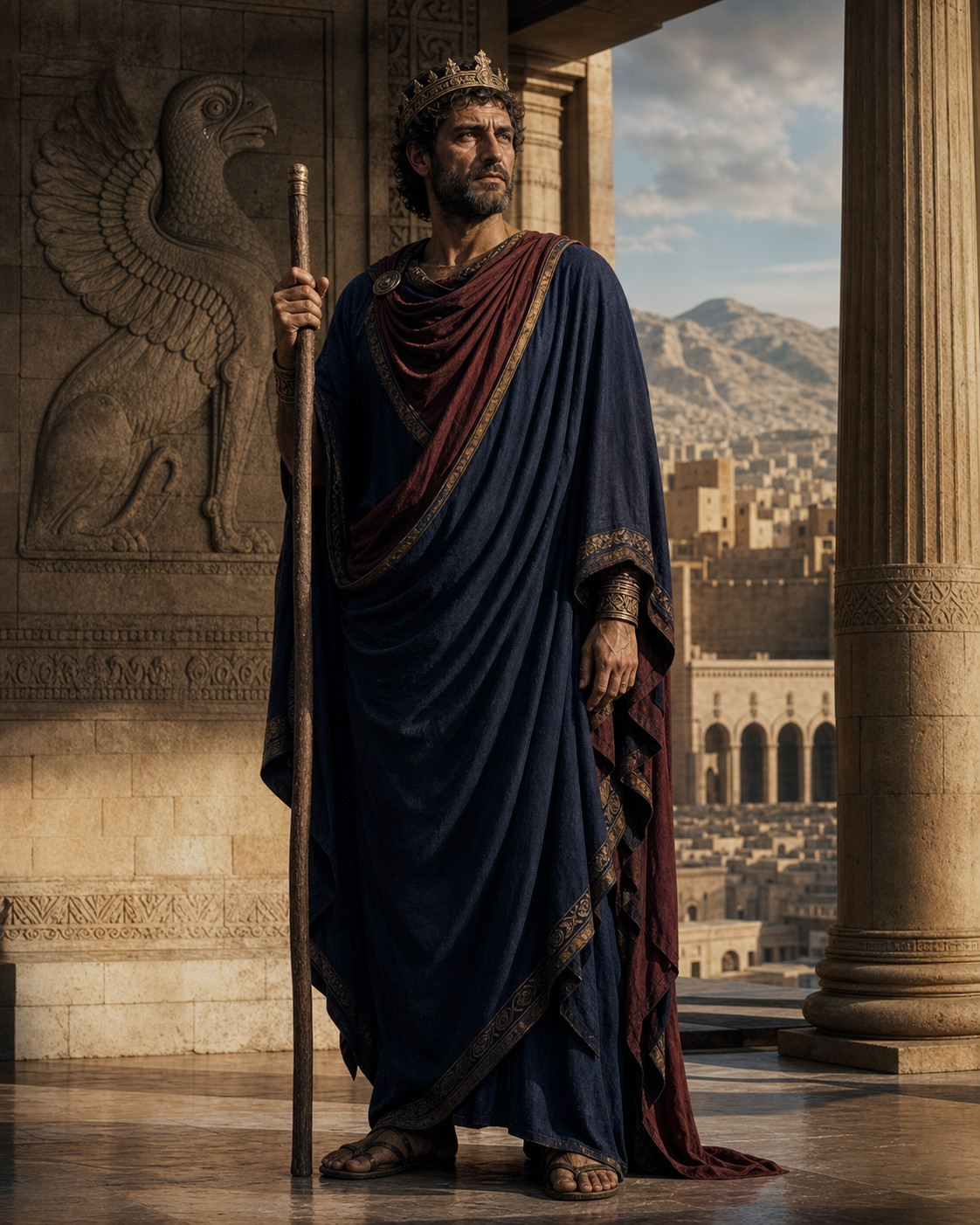
Oedipus is the exposed Theban prince who unknowingly kills Laius, solves the Sphinx's riddle, and marries Jocasta. His investigation of a plague reveals his identity, while his sons' dispute leads to the Seven against Thebes.
Greek Mythology Timeline
Move through broad mythic ages and open the events that connect one story to the next. The sequence is a reading path, not an exact historical calendar.
Oedipus is the Theban king who tries to escape a prophecy and fulfills it without recognizing the people involved. Exposed as an infant, raised in Corinth, and warned that he will kill his father and marry his mother, he leaves the parents he believes are his own. On the road he kills Laius, solves the Sphinx’s riddle, saves Thebes, and marries the widowed queen Jocasta. Years later, an investigation into plague reveals that the successful solver is himself the hidden cause. The surviving sources disagree about important details, including his children’s mother, his continuing rule, exile, blindness, and death, so his life is best read as a changing Theban tradition rather than one fixed script.
The Oracle to Laius
Before Oedipus is born, Laius receives a warning that a son will kill him. When Jocasta or Epicasta bears a boy, the child’s ankles are pierced or bound and he is given to a herdsman for exposure. The name Oedipus is traditionally connected with swollen feet, turning the attempted prevention into a mark carried through life.
Exposure is a human decision made in response to divine knowledge. The parents try to break the prophecy by removing the child, but the herdsmen and royal household of Corinth preserve him. The act intended to erase identity instead creates the ignorance that later makes recognition impossible.
Raised in Corinth
Oedipus grows up as the son of Polybus and Merope or Periboea, depending on the source. A taunt about his birth sends him searching for answers. At Delphi he is not given the names he wants; he hears instead that he will kill his father and marry his mother.
Believing the Corinthian rulers are his biological parents, he leaves them to protect them. The decision is morally serious and logically understandable. Tragedy arises because he acts on incomplete information. He cannot avoid a family he does not know, and the oracle does not explain the mistaken identity.
The Narrow Road
At a narrow crossroads or cleft way, Oedipus meets Laius and his attendants. A dispute over passage escalates, and Oedipus kills the older traveler without knowing he is the king of Thebes and his father. Accounts differ over how many attendants survive and who begins the violence.
The road scene reduces royal identity to behavior under pressure. Neither man recognizes kinship, and both assert movement through a space too narrow for competing claims. The first half of the oracle is fulfilled through anger, status, and ignorance rather than deliberate parricide.
The Riddle of the Sphinx
Thebes is being destroyed by the Sphinx, who poses a riddle and kills those who fail. Oedipus answers that the creature moving on four, two, and three supports across life is a human being. The Sphinx dies or destroys herself, and the city rewards its rescuer with kingship and marriage to Jocasta.
Solving the riddle makes Oedipus famous for knowledge, yet the answer concerns stages of human life while his own birth and family remain unknown. His intelligence is real. The tragedy does not depend on stupidity; it depends on the limits of even exceptional reasoning when evidence has been hidden.
King of Thebes
Oedipus rules Thebes and becomes father of Eteocles, Polynices, Antigone, and Ismene in the dominant tragic genealogy. Apollodorus notes a variant in which Eurygania, not Jocasta, bears the children. Early epic traditions also differ from later drama about how long he remains king after discovery.
As king, Oedipus is remembered as active and protective. In Sophocles he investigates the plague because the city suffers. Every step toward the murderer of Laius is also a step toward himself. The civic virtue that made him confront the Sphinx now makes concealment impossible.
Recognition and Blindness
Messengers, shepherds, old wounds, and testimony finally join into recognition. Jocasta dies by hanging in the familiar tragic version, and Oedipus blinds himself with pins from her clothing. Apollodorus then has him driven from Thebes after cursing sons who do not defend him.
Homer’s brief account is different: the gods reveal the marriage, Epicasta dies, and Oedipus continues to rule under suffering. Self-blinding and immediate exile belong especially to later influential traditions. Preserving that difference shows how tragedy expanded an older story.
The Curse on His Sons
Eteocles and Polynices inherit a damaged kingship. Traditions vary about the cause and wording of Oedipus’s curse, but the brothers’ dispute leads Polynices to Argos and brings the Seven against Thebes to the city’s gates. They eventually kill one another.
Oedipus therefore links personal recognition to intergenerational civil war. Discovering the truth does not close the story. It destabilizes succession, burial, and loyalty, creating the narrative space in which Antigone, the Seven, and the Epigoni act.
Colonus and the End
In Sophocles’ Oedipus at Colonus, the old exile reaches an Athenian sacred precinct with Antigone. Theseus receives him, rival cities seek control of his body and blessing, and his mysterious death gives protective power to the land that shelters him.
The ending transforms pollution into sacred value without declaring the past harmless. Follow Oedipus toward Thebes for kingship, the Seven against Thebes for his sons’ war, Cadmus for the dynasty’s beginning, and future routes toward Jocasta, the Sphinx, Eteocles, Polynices, Antigone, and Colonus.
Trivia
- The name Oedipus was anciently explained through his injured or swollen feet.
- Ancient sources disagree on whether Jocasta was the mother of all four famous children.
- Homer’s Oedipus continues to rule, unlike the immediate exile familiar from later tragedy.