The abducted princess whose crossing with the divine bull creates Cretan dynasties and sends Cadmus toward Thebes.
- Cadmus
- Crete
- Minos
- Rhadamanthys
- White Bull
- Zeus
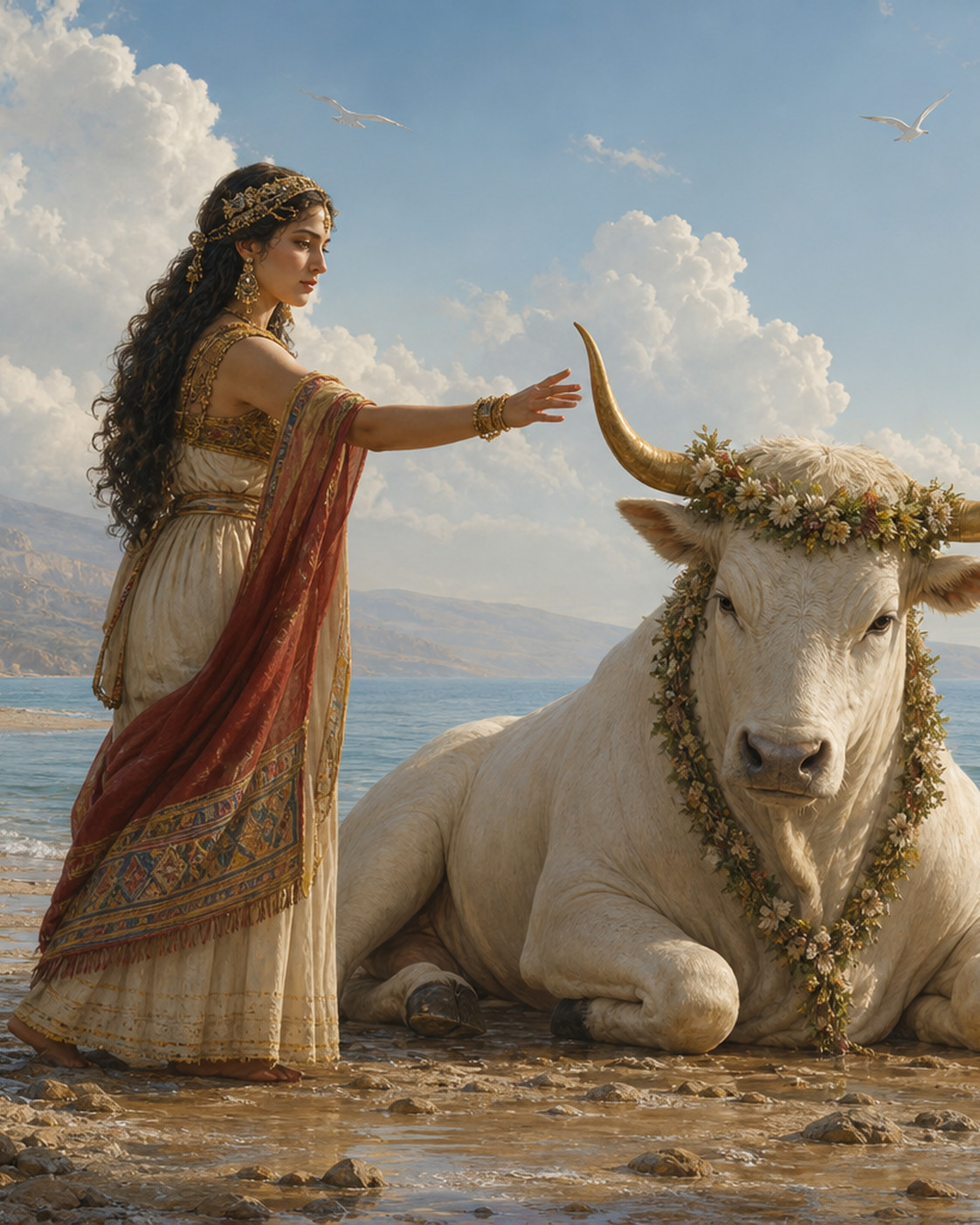
Europa is the Phoenician princess carried to Crete by Zeus in the form of a tame bull. She bears Cretan rulers, while her disappearance sends Cadmus and his brothers on foundation journeys across the Mediterranean.
Greek Mythology Timeline
Move through broad mythic ages and open the events that connect one story to the next. The sequence is a reading path, not an exact historical calendar.
Europa is the Phoenician princess whom Zeus carries across the sea in the form of a tame white bull. In Crete she becomes mother of Minos, Rhadamanthys, and, in many genealogies, Sarpedon. Her disappearance also sends her brothers into journeys that found or name new regions, most importantly Cadmus at Thebes. A short abduction story therefore becomes a map of dynasties connecting Phoenicia, Crete, Anatolia, and mainland Greece.
Daughter of Agenor—or Phoenix
Apollodorus names Europa as daughter of Agenor of Phoenicia and Telephassa, with Cadmus, Phoenix, and Cilix as brothers. He immediately notes an alternative in which Phoenix is her father. Genealogy varies because different communities use the family to explain their origins and relations. One neat modern family tree cannot contain every ancient claim.
Europa’s Phoenician identity places her on the eastern Mediterranean coast before Crete becomes the center of her story. Ancient myth does not treat the sea as an empty barrier between sealed cultures. It is the road along which gods, brides, names, technologies, and claims to ancestry move.
The Bull at the Shore
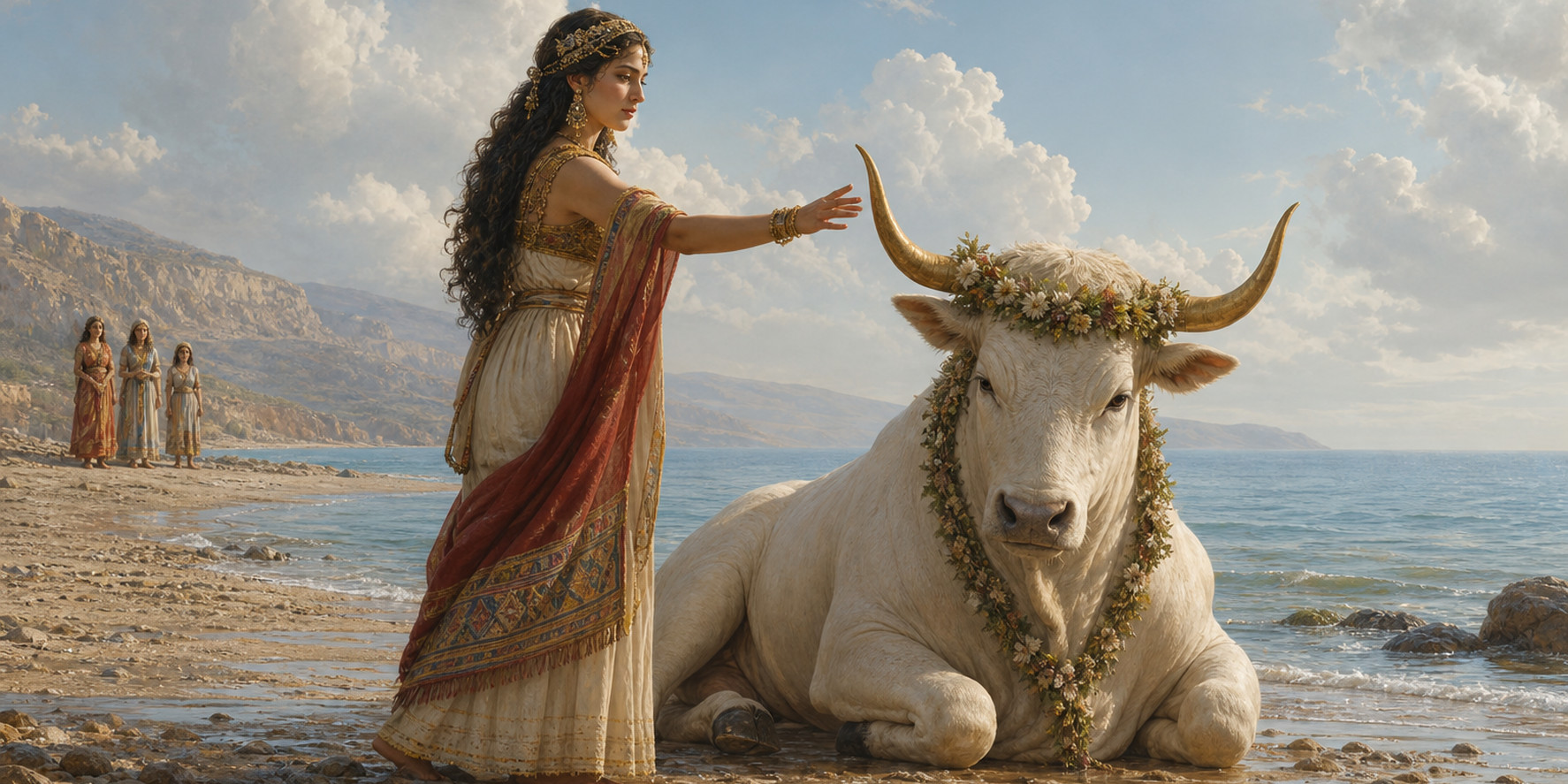
Zeus desires Europa and becomes a gentle bull. In later poetic and artistic elaboration, the animal is strikingly white, approaches a group of girls gathering flowers, and lowers itself so the princess loses fear. Europa touches, decorates, or climbs upon it. The disguise works through beauty and apparent harmlessness rather than force at first sight.
The moment is often romanticized, but the calm is deceptive. Once Europa is on its back, the bull enters the sea and carries her away from family and home. The story is an abduction shaped by divine transformation. Europa cannot consent to the destination or identity she has not been allowed to know.
Across the Sea to Crete
The bull swims to Crete, an image that made the myth exceptionally durable in ancient art. Europa clings to a horn or sits on the animal while sea creatures accompany the crossing. The sea route turns Zeus’s disguise into transportation and moves the heroine between royal worlds in a single continuous scene.
Ancient authors locate the union at different Cretan places, including Gortyn, and later traditions associate it with a plane tree that remains evergreen. Such local details attach a widely traveled myth to particular sanctuaries and landscapes. They should be presented as regional claims, not combined into one mandatory itinerary.
Mother of Cretan Rulers
Europa bears Minos and Rhadamanthys, and many sources add Sarpedon. Homer, however, gives the Trojan-war Sarpedon a different mother, Laodamia. Apollodorus preserves the conflict instead of hiding it. The disagreement shows how prestigious names can be pulled into multiple genealogical systems.
Asterius, ruler of Crete, marries Europa and raises her children. This often-overlooked step gives the sons a mortal royal household as well as divine paternity. Minos later claims rule and develops the Cretan line that leads to Pasiphae, Ariadne, the Minotaur, and the labyrinth story.
The Search That Must Not Return
When Europa disappears, Agenor orders his sons to search for her and not return without her. Phoenix and Cilix become connected with regions bearing their names. Cadmus travels through Delphi to Boeotia, follows a cow, kills Ares’ dragon, sows its teeth, and founds Thebes. The failed search creates new centers rather than restoring the lost princess.
This is one of Greek myth’s clearest examples of narrative branching. Europa’s page leads west to Crete, while Cadmus’ route turns north and inland toward Thebes. The siblings never need to reunite for the family to reshape the map. Absence is the engine of foundation.
Gifts and Guardians
Later myth gives Europa remarkable gifts from Zeus: Talos, the bronze guardian who circles Crete; Laelaps, the hound that always catches its quarry; and an unfailing javelin. Lists and ownership histories vary, and the objects later pass into other stories. They transform the aftermath from abandonment alone into the establishment of a protected royal household.
Talos becomes especially important in the Argonautic Voyage, where Medea or the Argonauts overcome him near Crete. A gift associated with Europa’s security thus becomes an obstacle for a later generation of travelers. Mythic objects retain history as they move between narrative cycles.
Name, Continent, and Later Memory
The relationship between Europa the mythic woman and Europe the geographic name developed over a long history. Ancient usage of Europe did not immediately mean the modern continent with fixed borders. The myth was repeatedly used to imagine movement between Asia and the lands to the west, and later political cultures made the bull ride into an emblem.
Modern currency, public sculpture, and institutional imagery often reuse Europa on the bull. That reception can make the scene look like a consensual journey or civilizational allegory. Returning to the myth restores the tensions of disguise, removal, motherhood, adaptation, and the family search left behind.
How to Read Europa
Europa is both acted upon and structurally powerful. Zeus controls the transformation and crossing, yet her descendants organize Cretan kingship, underworld judgment, heroic voyages, and the Minotaur cycle. Her absence organizes Cadmus’ foundation of Thebes. A story with little surviving dialogue for Europa creates one of mythology’s largest geographic networks.
Follow her toward Zeus for the disguise, Cadmus for the search, Ariadne for the Cretan dynasty, Talos and the Argonauts for the divine gift, and Alcmene for Rhadamanthys’ later marriage. These routes reveal that the bull crossing is an opening, not the whole of Europa’s significance.
Trivia
- Ancient sources disagree whether Europa is the daughter or sister of Phoenix.
- Asterius of Crete raises Europa’s divine sons and connects them to mortal kingship.
- The modern geographic meaning of Europe developed over centuries and should not be projected unchanged into the myth.