The Perseid princess whose deceived household becomes the beginning of Heracles' divine and mortal destiny.
- Amphitryon
- Eurystheus
- Hera
- Heracles
- Thebes
- Zeus
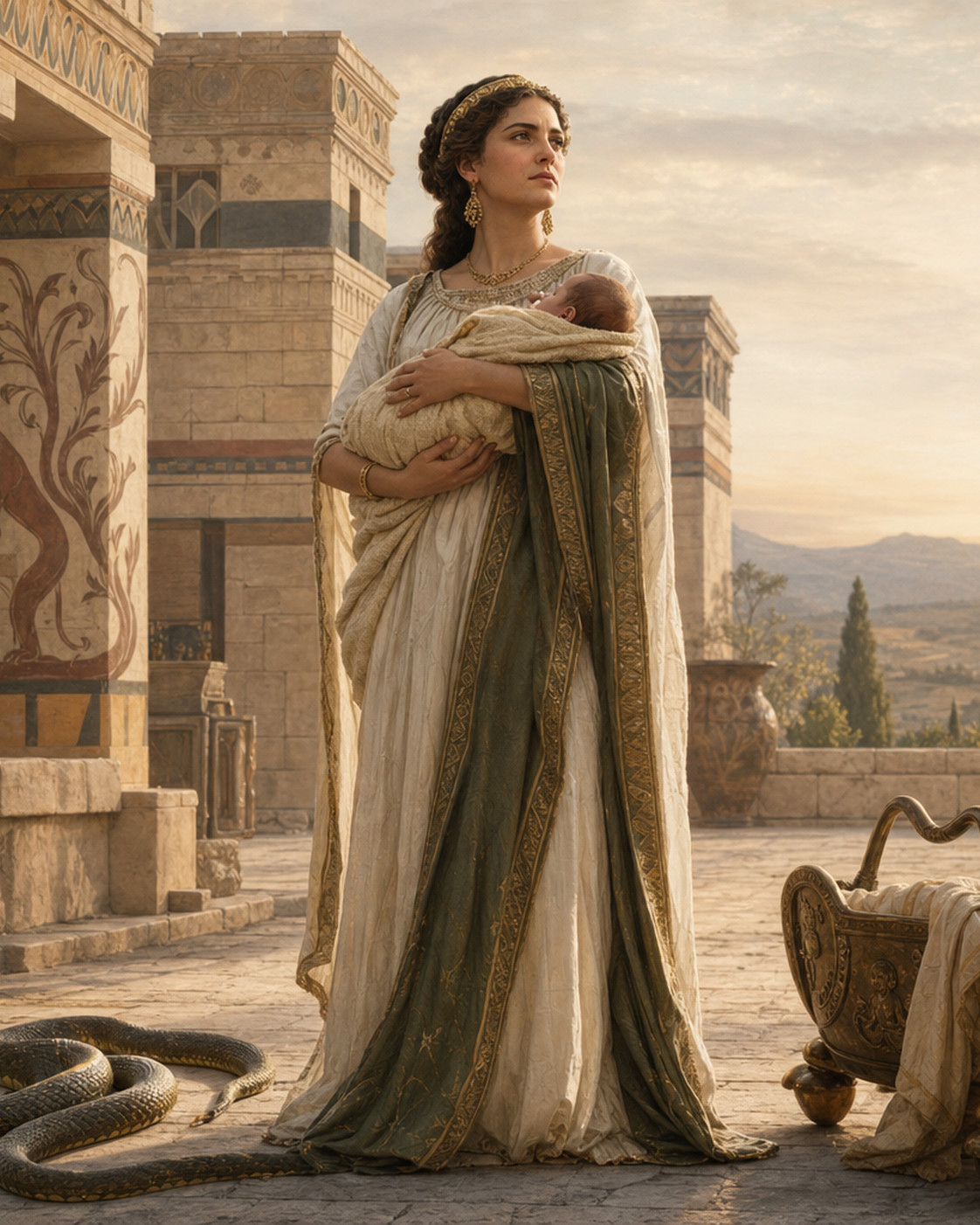
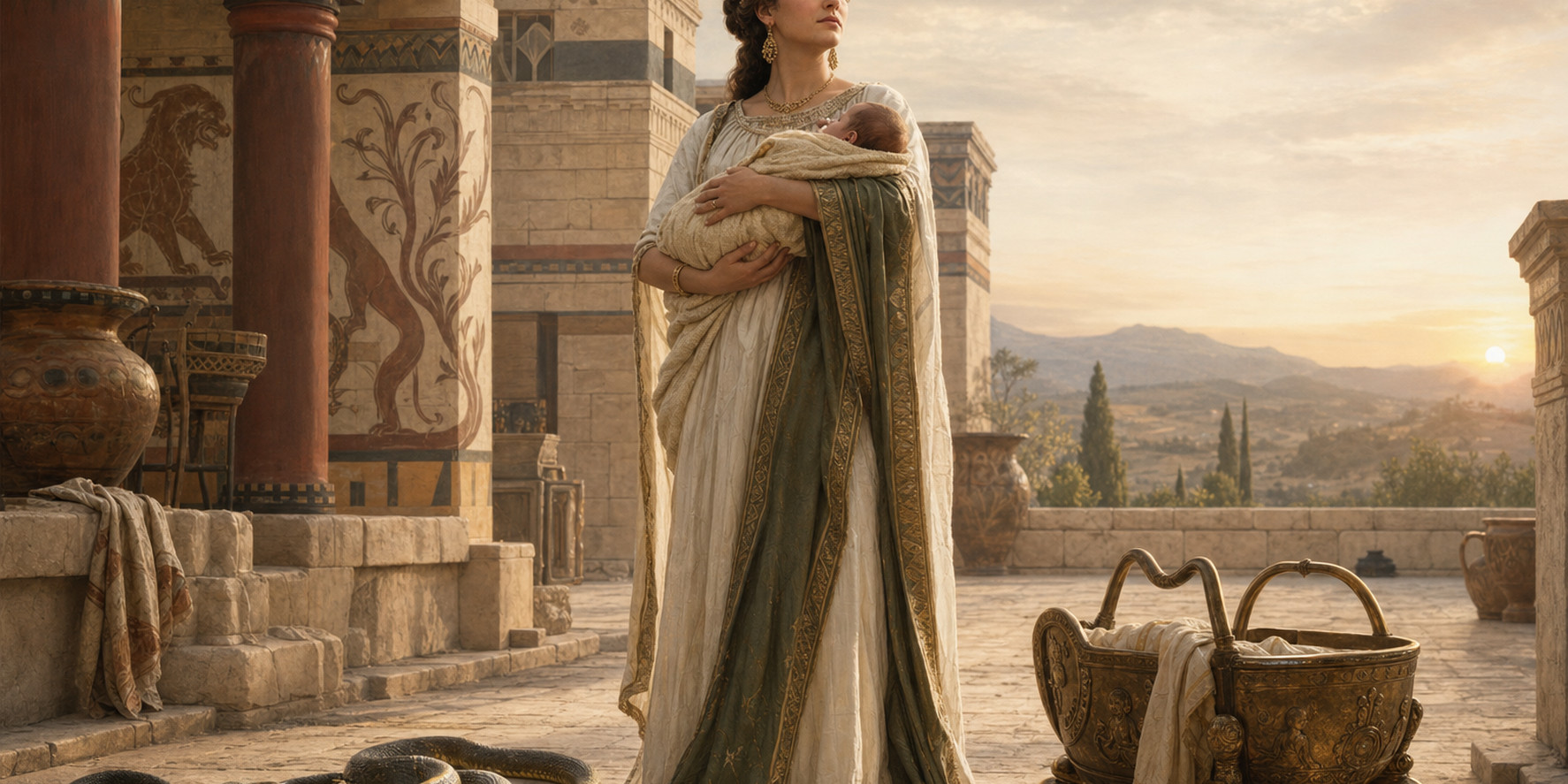
Alcmene is the Perseid wife of Amphitryon and mother of Heracles by Zeus and Iphicles by her husband. Zeus approaches in Amphitryon's form; Hera delays the birth, and the resulting succession places Heracles under Eurystheus.
Greek Mythology Timeline
Move through broad mythic ages and open the events that connect one story to the next. The sequence is a reading path, not an exact historical calendar.
Alcmene is the mortal mother of Heracles and one of the clearest examples of how a heroic genealogy can turn a woman’s endurance into the hinge of a divine plan. A descendant of Perseus and wife of Amphitryon, she becomes pregnant by Zeus when the god assumes her husband’s appearance. Ancient tellings repeatedly emphasize deception, delayed childbirth, threatened children, and survival. Her story is therefore not merely a prologue to a famous son’s strength: it is a study in contested identity, dynastic power, and the human cost of divine rivalry.
A Daughter of the Perseid House
Alcmene belongs to the royal family descended from Perseus. Most genealogies name her father as Electryon, king of Mycenae, and connect Amphitryon to the same extended Perseid line. This ancestry matters because Heracles is not inserted into an unrelated mortal household. Zeus chooses a woman whose family already carries the prestige, violence, exile, and succession struggles of Argive heroic memory.
The circumstances of her marriage differ in detail, but a recurring condition is that Amphitryon must avenge Alcmene’s slain brothers before the marriage is completed. Electryon’s accidental death then drives the couple into exile at Thebes. Her household thus begins with bereavement and displacement. Thebes, not Mycenae, becomes the setting for the extraordinary conception and birth that redirect the Perseid succession.
The Returned Husband Who Was Not Her Husband
While Amphitryon is away campaigning against the Taphians or Teleboans, Zeus approaches Alcmene in Amphitryon’s form. In influential versions he recounts the campaign as though returning victorious, making the disguise depend on intimate knowledge rather than appearance alone. Some later traditions lengthen the night so the god may remain with her. The episode is built around a deception Alcmene has little or no means to detect.
Amphitryon’s actual return exposes the impossible duplication. The seer Tiresias explains that Zeus has visited the house. Comedy, especially Plautus’s Roman Amphitryon, develops confusion between divine and mortal doubles, but the myth’s underlying imbalance remains serious: a god controls identity, time, and information, while Alcmene must live with consequences produced without informed choice.
Two Sons and Two Fathers
Alcmene bears Heracles by Zeus and Iphicles by Amphitryon. Ancient accounts describe the brothers as twins or as children conceived on adjacent nights, using their different fathers to contrast exceptional and ordinary heroic potential. Iphicles is not simply erased; he belongs to Heracles’ family and becomes the father of Iolaus in the dominant genealogy, extending the mortal branch into the hero’s closest partnership.
The double paternity also creates a test of recognition. One tradition says Amphitryon places serpents near the children to discover which is his: Iphicles recoils while Heracles stands firm. More familiar accounts make the serpents agents of Hera. The alternatives change Amphitryon’s responsibility, so they should not be blended into a single seamless nursery scene.
Hera Delays the Birth
Before Heracles is born, Zeus boasts that a descendant of Perseus born that day will rule. Hera binds him to his words, delays Alcmene’s labor, and brings Eurystheus prematurely into the world. The promised kingship therefore passes to the weaker cousin, establishing the political condition behind the Twelve Labors. A birth-room contest becomes the remote cause of years of heroic service.
Later authors picture Eileithyia, the Fates, or hostile women sitting with crossed legs and clasped hands to obstruct delivery. A clever attendant, called Galanthis in Ovid and Historis in a Theban account reported by Pausanias, falsely announces the birth. The startled blockers release their posture, allowing Alcmene to deliver. Names and transformations vary, but female intelligence breaks the divine restraint.
The Serpents in the Chamber
When Heracles is still an infant, two serpents enter the sleeping place shared with Iphicles. Theocritus gives Alcmene an active domestic presence: she hears the cry, calls Amphitryon, and gathers the terrified Iphicles while Heracles grips the creatures. The episode reveals supernatural strength, but it also places the first attack inside Alcmene’s home rather than on a distant battlefield.
The danger anticipates a lifetime in which Hera’s hostility reaches Heracles through family. Alcmene cannot shield him from every divine assault, yet she preserves a household in which the extraordinary child can grow. Reading the scene only as a feat of infant power misses the mother’s experience of discovering that heroic destiny has made ordinary safety impossible.
Mother of a Hero in Crisis
Alcmene remains connected to Heracles after childhood. Tragic and later traditions place her among the vulnerable relatives threatened by rulers hostile to the Heraclids. Euripides’ Children of Heracles makes the aged Alcmene a fierce survivor who has outlived her son and seeks security for his descendants. Her demand for vengeance against Eurystheus complicates any image of her as only passive or gentle.
Heracles’ madness, labors, and death create repeated consequences for his mortal kin. Alcmene’s long narrative life lets audiences view divine glory from below: Olympian parentage can produce protection and fame, but it also draws jealousy, war, exile, and bereavement into a family that cannot command the gods who use it.
Rhadamanthys and the End of Her Story
After Amphitryon’s death, Apollodorus says Alcmene marries Rhadamanthys, the just son of Zeus and Europa, and lives with him in Boeotia. Other accounts focus on her death and an extraordinary substitution in her coffin. A stone may be found where her body should lie, while Hermes carries her to the Isles of the Blessed to live with Rhadamanthys.
These endings connect Alcmene to another family shaped by Zeus and give her a destiny beyond motherhood. They also illustrate how local cult, heroic genealogy, and ideas about blessed afterlife could reshape the conclusion. The mortal woman who endured a god’s disguise is finally removed from ordinary burial and placed among exceptional dead.
How to Read Alcmene
Alcmene’s story should not be reduced to the phrase ‘mother of Heracles.’ It explains why Eurystheus rules, why the labors can be imposed, how Hera’s conflict begins before the hero can act, and why Thebes becomes central to his early identity. Her family history joins the Perseid dynasty to the Theban landscape and eventually to the return of the Heraclids.
Follow her toward Heracles for the labors, Zeus for the divine deception, Hera for the delayed birth, Thebes for the household setting, and Europa for the later Rhadamanthys connection. Each route reveals a different scale of the same problem: gods and dynasties make decisions, while a mortal household bears their lasting effects.
Trivia
- Heracles is frequently called Alcides, a name recalling the family line of Alcaeus rather than replacing Alcmene’s maternity.
- Ancient sources disagree about who sends or places the nursery serpents, so the scene does not have one fixed motive.
- The obstruction of Alcmene’s labor provides the legal-divine mechanism that puts Heracles under Eurystheus.