The ten-year siege whose divine causes, heroic anger, catastrophic sack, and broken returns reshape the entire Heroic Age.
- Achilles
- Agamemnon
- Hector
- Helen
- Odysseus
- Paris
- Divine ContestThe judgment of Paris connects Aphrodite's promise of Helen to a dispute among goddesses.
- Coalition at AulisThe oath around Helen's marriage becomes a fleet, while Iphigenia bears the cost of departure.
- Ten-Year SiegeRaids, alliances, plague, quarrels, and divine factions sustain a war the walls resist.
- Wrath and LossAchilles withdraws, Patroclus dies, Hector falls, and the Iliad ends before the city does.
- Horse, Sack, ReturnsConcealed warriors open Troy, but impiety and violence fracture the victors' journeys home.
The Trojan War begins when Paris takes Helen from Sparta and an Achaean coalition sails against Troy. The Iliad covers only a short span in the tenth year; other sources preserve the judgment of Paris, sacrifice at Aulis, wooden horse, sack, and dangerous returns.
Greek Mythology Timeline
Move through broad mythic ages and open the events that connect one story to the next. The sequence is a reading path, not an exact historical calendar.
The Trojan War is the great Greek mythic conflict in which an Achaean coalition besieges Troy after Paris takes Helen from Sparta. Its causes reach back to divine rivalry, dynastic oaths, and the judgment of Paris; its consequences extend through destroyed families, enslaved survivors, dangerous returns, and new foundations. The Iliad covers only a short period in the tenth year, so the familiar full war must be reconstructed from many poems, summaries, tragedies, artworks, and later retellings.
No Single Complete Ancient Book
Homer’s Iliad does not begin with Helen’s departure or end with the wooden horse. It focuses on the wrath of Achilles, from his quarrel with Agamemnon through the death and funeral of Hector. The Odyssey remembers the horse, sack, and returns, but centers Odysseus’ later homecoming. Other stages belonged to the lost Epic Cycle.
Proclus’ summaries, Apollodorus’ Epitome, surviving fragments, lyric poetry, tragedy, vase painting, and Roman epic preserve different parts. A modern continuous timeline is therefore a synthesis. It must identify variants instead of pretending that every famous incident appears in Homer or that all sources agree.
The Wedding and the Judgment
At the wedding of Peleus and Thetis, Eris introduces a golden apple associated with a contest in beauty. Hera, Athena, and Aphrodite claim it, and Paris of Troy is chosen as judge. Later accounts describe competing offers: kingship, military success, and the most beautiful woman. Paris awards victory to Aphrodite, who promises Helen.
This divine contest does not remove human agency. Paris travels to Sparta and departs with Helen and treasure, but sources differ sharply over persuasion, abduction, consent, and even whether the real Helen reaches Troy. Euripides’ Helen gives Egypt a phantom replacement. The war’s most famous cause is already a field of incompatible stories.
The Oath and the Gathering at Aulis
Helen’s former suitors had sworn to defend the chosen marriage, an oath associated with Tyndareus and often with Odysseus’ advice. Menelaus and Agamemnon use this network to gather rulers and ships. Odysseus’ attempted avoidance of service and Achilles’ concealment on Scyros belong to later prewar traditions.
At Aulis, the fleet is held by adverse conditions connected with Artemis. The cause and resolution vary, but Iphigenia is demanded as sacrifice in the most influential tragic tradition. Some versions kill her; others substitute a deer and carry her away. The expedition begins by placing a commander’s daughter under the pressure of collective war.
A Ten-Year Siege
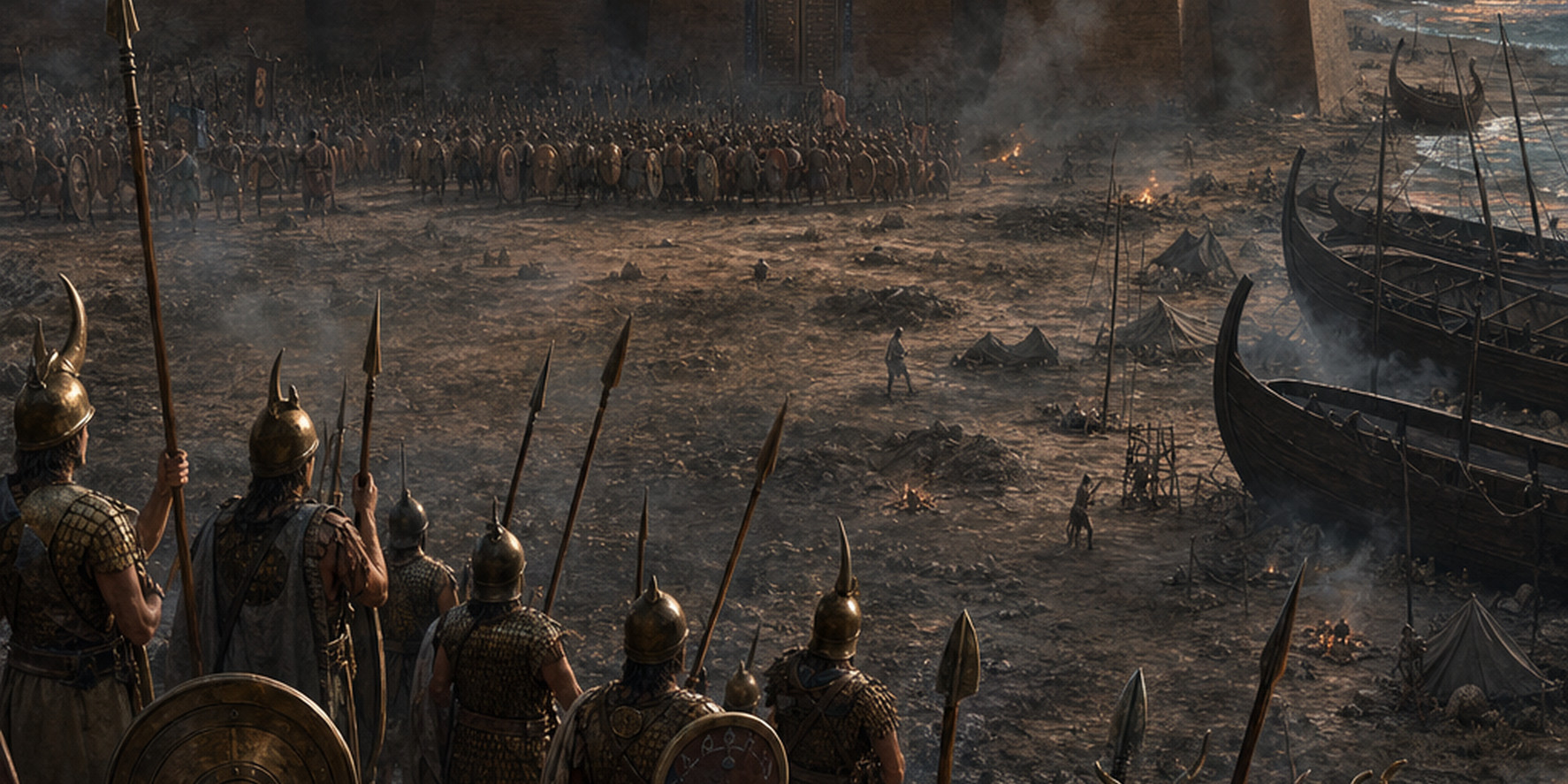
The Achaeans establish a camp by their ships and raid surrounding communities while Troy remains defended by walls and allies. The war is not ten years of continuous combat at one gate. Raids, duels, embassies, truces, disease, divine interventions, and struggles over honor shape the long stalemate.
Gods take sides without forming perfectly stable teams. Hera, Athena, and Poseidon often favor the Achaeans; Aphrodite, Apollo, and Ares aid Trojan figures; Zeus balances promises, fate, and his own authority. Divine action magnifies rather than replaces mortal conflict.
The Wrath of Achilles
The Iliad opens when Apollo sends plague after Agamemnon dishonors the priest Chryses. Agamemnon returns Chryseis but takes Briseis from Achilles, who withdraws from battle and asks Thetis to secure Trojan success until the Achaeans recognize his value. A quarrel within the coalition nearly destroys it.
Patroclus eventually wears Achilles’ armor to save the ships and is killed by Hector with divine and mortal participation. Grief returns Achilles to battle. He kills Hector, abuses the body, and finally releases it to Priam after the old king enters the enemy camp. The poem ends with Hector’s funeral, not Troy’s fall.
After Hector and Achilles
Post-Iliadic tradition brings new allies and losses: Penthesilea and the Amazons, Memnon from the east, the death of Achilles, and the contest between Ajax and Odysseus for his armor. Ajax’s madness and suicide expose another fracture within the victorious side.
Prophecies then require particular conditions for Troy’s capture, including Philoctetes and the bow of Heracles, Neoptolemus, and the Palladium in different accounts. Odysseus repeatedly appears as recruiter, infiltrator, and planner. Victory depends on gathering people and objects across earlier heroic stories.
The Wooden Horse
Odysseus proposes the wooden horse, which Epeius builds. Selected warriors hide inside while the fleet appears to depart. Sinon remains to persuade the Trojans that the object is a sacred offering. Cassandra and Laocoon warn against accepting it, but signs and arguments are interpreted in favor of bringing it within the walls.
At night the warriors emerge, the fleet returns, and the city is opened from within. The strategy ends the siege by turning a crafted object into concealed military space. It also repeats an Odyssean pattern: apparent identity and actual contents diverge until recognition comes too late.
The Sack and Its Victims
The fall of Troy is not a clean heroic victory. Priam is killed, Astyanax is thrown from the walls in major traditions, Polyxena may be sacrificed, Cassandra is violated at Athena’s image, and women including Andromache and Hecuba are assigned as captives. Temples and households fail as places of protection.
Greek tragedy gives these survivors extended voices, asking what victory means when the defeated lose city, children, freedom, and future. The violence also angers gods who supported the Achaeans. Impiety during the sack helps turn the return voyages into further punishment.
The Returns
Nostos, return, becomes a new cycle. Nestor reaches home, Menelaus wanders, Agamemnon is murdered, Ajax the Lesser dies, and Odysseus spends ten more years at sea. The coalition that crossed together does not return together. Each household receives a different aftermath.
The Odyssey is therefore not an unrelated sequel but one branch of the war’s consequences. Penelope’s suitors, Telemachus’ uncertainty, Poseidon’s anger, and the stories told at Pylos and Sparta all exist because departure for Troy destabilized families for a generation.
History, Archaeology, and Myth
Hisarlik in modern Türkiye preserves the remains of a major ancient settlement identified with historical Ilios or Troy, and several destruction layers belong to the Late Bronze Age. This evidence shows that the location was real and contested over time. It does not prove that one ten-year war occurred exactly as later epic tells it.
The poems combine memories of material culture, performance traditions, divine narrative, and centuries of reinterpretation. Responsible reading can compare archaeology and epic without forcing either to certify the other. Mythic truth operates through cultural memory and story structure as well as possible historical conflict.
How to Read the Trojan War
The Trojan War is less a single event page than a central interchange. Divine beauty contests lead into family oaths; personal anger reshapes armies; crafted objects defeat walls; survivors carry violence into return and exile. Every apparent ending opens another story.
Follow the war toward Odysseus for the horse and return, Aphrodite and Athena for the judgment, Ares and Apollo for divine participation, and Penelope and Telemachus for the home left behind. Future pages for Helen, Paris, Achilles, Hector, Agamemnon, Troy, and the Trojan Horse will allow readers to move through the conflict by cause, combatant, place, artifact, and aftermath.
Trivia
- The Iliad covers only part of the final year and ends with Hector’s funeral.
- The wooden horse is recalled in the Odyssey but described more fully in later surviving sources and summaries of lost epics.
- Archaeological Troy and the literary war can be compared, but neither provides a simple proof of the other.